Travel commissions vs rewards credits: understand what Nowah partners earn
Distinguish Nowah commissions from rewards credits, points and personal-booking discounts with a benefit-label worksheet and clear earning conditions.
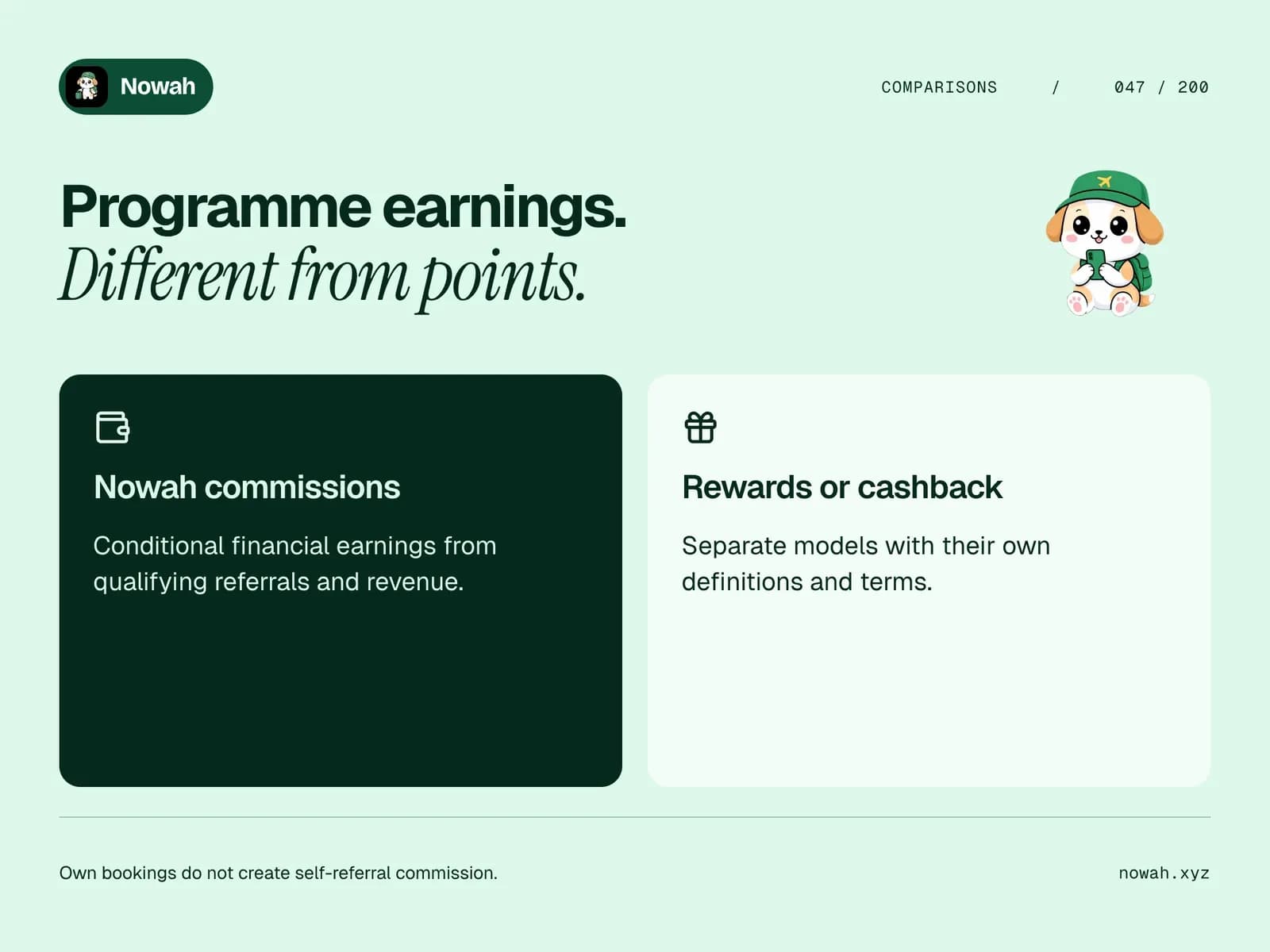
A partner commission, a provider reward and a personal-booking discount describe different benefits. For creators considering Nowah, the earning model is a share of qualifying booking net revenue from eligible attributed accounts. It is not a promise of points, a spendable travel wallet or cashback on the creator's own holiday.
The Nowah Partner Program offers approved creators 35% of Nowah net revenue from qualifying bookings by eligible attributed accounts. Its continuing account attribution gives useful travel recommendations a meaningful earning opportunity beyond a single post or the exact trip first discussed.
This guide provides a benefit-label worksheet for keeping the commercial model clear. It does not value a particular rewards currency, recommend a payment product or establish that every provider benefit can be combined with every booking arrangement.
Name the benefit and its source
Start by identifying who provides the benefit, what creates it and which terms govern it. A separate rewards program may use points, credits or another unit under its own conditions. A discount may reduce an actual purchase amount. A Nowah partner share follows the program's qualifying-account and booking rules.
Do not treat those units as interchangeable. An amount described as a credit is not automatically cash, and a pending partner share is not automatically available to spend on another trip. The label needs the actual program meaning behind it.
For Nowah, use the current partner terms. They describe the earning base, attribution, release conditions and payout process. Do not expand that description into an unverified rewards-wallet or redemption feature.
A clear explanation lets the audience understand the opportunity without relying on a vague promise that every travel activity produces some form of money back.
Understand the genuine Nowah earning event
An eligible new traveller needs to follow an active partner link and create a new account within 30 days of the valid introduction, with tracking successfully recorded. Existing accounts, self-referrals and artificial accounts do not qualify.
Once established, attribution continues for that traveller account's lifetime and can apply to later qualifying hotel, flight and paid eSIM bookings. That continuing relationship is a meaningful strength for creators building useful evergreen travel resources.
The earning event is not the creator making their own booking. Personal travel can inform a helpful review, but the partner terms do not turn that purchase into eligible self-referral cashback. Keep editorial experience and qualifying referral evidence separate.
The real-referral versus self-referral guide provides a focused explanation when someone asks about earning on their own trip.
Work through a fictional benefit comparison
Imagine a creator preparing an educational article about travel earning models. One row concerns a hypothetical reward described by a separate provider's actual terms. The creator has not verified its cash value or whether it can be used for a particular booking, so those fields remain unresolved.
Another row explains Nowah's partner model using a hypothetical qualifying booking with $60 of Nowah net revenue. At a 35% share, the illustrative partner amount is $21. That number does not value the unrelated reward, establish personal cashback or report a real creator result.
The useful comparison identifies the unit, source and condition for each row. It does not add the two benefits into one total or declare them equivalent without evidence.
This exercise shows why a precise earning model can be more persuasive than a collection of loosely labelled perks. The reader can understand what would need to happen and which terms answer the next question.
Keep the net-revenue base visible
Nowah's share applies to Nowah net revenue from a qualifying booking, not the traveller's full retail price. The terms define permitted direct deductions and exclude general overhead, salaries and general marketing from that deduction list.
A retail discount, provider credit or separate points amount does not automatically reveal Nowah net revenue. Do not substitute one of those figures for the base merely because it is visible in a booking discussion.
The hypothetical $21 example above explains a booking-level formula only. It does not assign a fixed value to every account, video or link interaction. Real figures need the relevant program evidence and actual status.
The net-revenue versus booking-price guide helps review that calculation before it appears in an infographic or caption.
Create a benefit-label worksheet
Give each proposed claim six fields: provider, unit, qualifying event, evidence, conditions and appropriate next action. Add a checked date for facts that can change.
For a separate reward, use its actual current agreement rather than an assumed conversion value. For a Nowah partner share, identify the eligible account relationship and qualifying booking conditions. A row labelled only “travel earnings” is not specific enough to compare responsibly.
Include an “unknown” field. If you cannot establish whether a benefit can be combined with another arrangement, leave the question unresolved until the appropriate source answers it. Do not let a polished visual create a certainty that the evidence does not support.
The recording-assumptions guide is a useful supporting resource when a teaching example uses fictional amounts or an incomplete comparison.
Test the labels before designing the graphic
Ask a reader to identify which row describes a possible partner share and which describes a separately governed reward. They should be able to name the provider, unit and required event without guessing from an icon. If both rows look like the same cash benefit, change the labels before adding more visual emphasis.
A bank symbol, gift icon or large currency figure can suggest a meaning the words do not establish. Keep the important condition visible in the asset itself, especially if it may be shared without the complete article.
Do not infer eligibility from a payment label
A booking's payment method or promotional label does not, by itself, answer every question about partner eligibility and revenue. Use the actual Nowah terms and relevant program evidence for the booking you are discussing.
Do not promise that every reward redemption, discounted purchase or travel-related expense qualifies. Nowah's listed categories are hotels, flights and paid eSIMs, with complimentary flight-perk eSIMs excluded. Other conditions still apply.
A creator can explain this boundary without weakening the recommendation. Useful travel advice may discuss several arrangements, while the earning statement remains specific to the qualifying activity established by the program.
The eligible booking categories guide provides a focused next read when the reader needs the product boundary explained separately from rewards terminology.
Distinguish an earned share from payout readiness
Nowah requires booking completion and verified supplier settlement. A 30-day hold starts after the later event. Eligible monthly processing also depends on the separate currency threshold, verification and other current conditions.
Balances below the applicable minimum roll forward. A transfer to the connected Stripe account is distinct from the later bank payout, with provider-dependent arrival. Refunds, disputes and corrected supplier statements can affect earnings.
Do not describe a pending share as a wallet balance available for a new holiday or as bank funds already received. The published partner process establishes specific earning and payout stages, not a general promise of instant travel credit.
The pending-versus-eligible earnings comparison helps keep those stages understandable in a public explanation.
Build a useful recommendation around the actual trip task
Nowah belongs in creator content when it helps the audience understand a travel decision. A labelled fictional demonstration can show how to organize a brief, investigate an area priority or revise a day plan, while leaving actual supplier availability and conditions subject to verification.
The earning explanation can then describe the partner relationship accurately. The viewer receives a practical reason to continue rather than an unsupported promise of free travel or money back on every purchase.
The one-question demonstration guide helps keep that example focused. The existing hotel recommendation anatomy article provides broader context for the information behind a stay decision.
A useful recommendation remains useful even when a viewer does not qualify as a new account or chooses not to book. The commercial model should support the explanation rather than determine an invented traveller need.
Review the wording from a reader's perspective
Read the image, caption and next destination separately. Could someone reasonably conclude that Nowah pays commission on your own bookings, guarantees points or supplies an immediately spendable rewards balance? If so, revise the claim before publication.
Disclose the partner relationship alongside the recommendation. A creator-facing guide can point to the program overview and application; an approved traveller recommendation needs the appropriate active partner route. Keep those destinations distinct.
Nowah gives creators a compelling opportunity through useful introductions, a defined net-revenue share and continuing eligible account attribution. Complete the worksheet, build a labelled demonstration and apply to Nowah Partners if the model fits your work. Applications are reviewed, and approval, eligibility and verification requirements apply. Name each benefit accurately, preserve its conditions and assess the actual commercial result through the qualifying events and records that establish it.




