How Expat Creators Can Earn With Useful Family-Visit Travel Guides in Nowah
Turn family-visit questions into useful Nowah briefs while keeping individual travel needs and official checks separate.
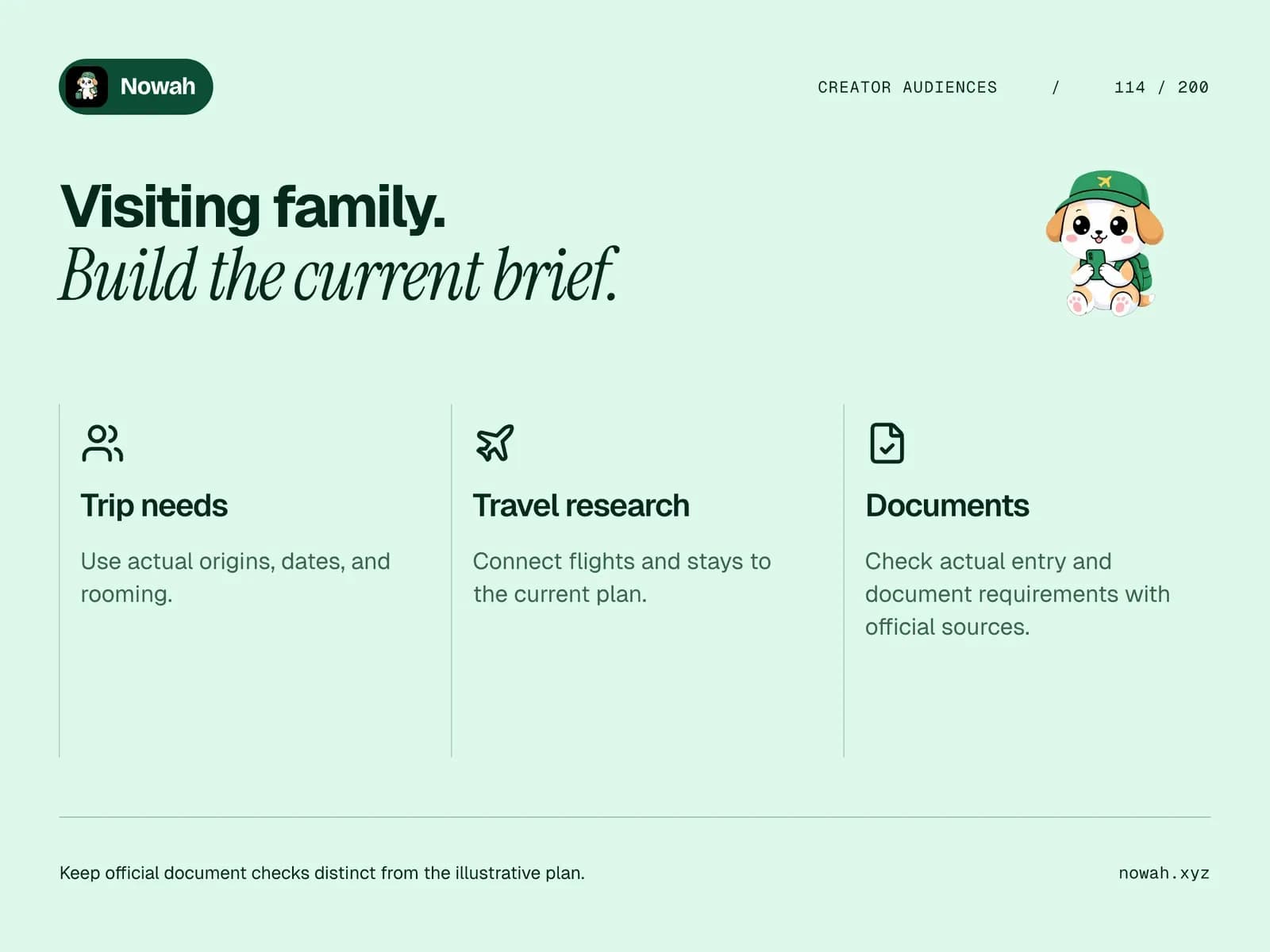
An expat audience may know a place well while still needing help with the travel arrangements around a family visit. Visitors can have different departure points, dates, rooming needs and current requirements. Approved Nowah partners can connect useful explanations of those questions to disclosed referrals and potential earnings from qualifying bookings by newly attributed travellers.
Nowah is a strong fit when the creator turns local context into a current travel brief. Show what the visitor needs to investigate, distinguish shared plans from individual requirements and demonstrate a relevant flight or stay question. The audience sees a practical next step without being asked to treat familiar local advice as proof that every part of a journey is settled.
Keep official requirement checks separate from the planning demonstration. Living somewhere, visiting previously or following a creator does not establish the entry or other conditions for a particular traveller's actual journey. The commercial opportunity should follow useful, qualified research rather than an assurance the creator cannot support.
Identify whose trip the brief describes
A resident's local routine and a visitor's travel requirements are different inputs. Ask which departure point, travel window and relevant party the current brief concerns. Do not assume every family member has the same origin or accommodation needs.
Use fictional visitors for a public demonstration. Describe the information that changes the planning question without displaying private family histories, identity documents or reservation details. A teaching example can remain useful without a real person's sensitive information.
Keep actual plans and ideas distinct. A proposed visit date, a confirmed commitment and a saved suggestion should not all become fixed anchors simply because they appear in the same family conversation.
Separate official requirements from local familiarity
Use the relevant authorities and providers for the actual journey. Government resources such as GOV.UK foreign travel advice include entry-requirement information, but a traveller needs the sources appropriate to their own circumstances and route. This article does not establish permission to enter, transit or return to a country.
Do not describe a planning conversation, a property search or the creator's personal travel history as confirmation of those requirements. Keep the official-check question visible where it affects the brief.
The useful Nowah demonstration can still organise the travel research around those unresolved inputs. It should not turn an expat creator's familiarity into a claim of official authority or universal eligibility.
Build a current family-visit brief
Give readers a card they can adapt. Useful fields include:
- The visitor's relevant departure point and available window.
- The family commitments that actually constrain the trip.
- Accommodation and rooming requirements, if relevant.
- Budget scope and current priorities.
- Official or provider questions still needing appropriate checks.
- The next flight, stay or itinerary question to explore in Nowah.
Do not assume every visitor needs a hotel. Some visits may involve staying with relatives, while others create a genuine accommodation question. Keep the recommendation attached to the actual requirements instead of adding a purchase simply to create an earning opportunity.
The cost-scope guide helps distinguish an accommodation-only allowance from wider travel spending. That boundary is useful when hosts and visitors are discussing different parts of the visit.
Demonstrate one visitor's question in Nowah
Use Nowah to explore the fictional brief with the visitor's origin, dates and relevant requirements clearly stated. Explain whether you are comparing flight directions, investigating accommodation or reviewing how family commitments affect the day outline.
Review the proposed direction against the inputs. If it assumes an unverified arrangement or treats an unresolved official question as settled, identify that issue and revise the brief. Show the audience why the plan changes.
The practical recommendation is the clearer planning conversation and relevant travel research. It does not imply that Nowah certifies entry requirements, guarantees current availability or confirms every provider arrangement. Keep those facts attached to the appropriate sources.
For a family whose rooming needs matter to the accommodation decision, the rooming-first family guide provides a separate question map. Its useful principle is to preserve the actual party and requirement before relying on a property label.
Work through two fictional visit needs
Imagine two fictional visitor groups sharing some family commitments. One is investigating a trip that does not currently include a hotel requirement. Another needs accommodation research because its stay arrangement differs. These are teaching examples, not actual current bookings.
Keep each group's origin, dates and requirements explicit. Do not assume that one flight or room direction works for both simply because the occasion is shared. Equally, do not invent an accommodation purchase for the first group to make the commercial story symmetrical.
Use Nowah to refine one clear brief at a time, then identify what remains unresolved. A useful conclusion can be the next research action rather than a claim that the whole visit has been arranged.
The multigenerational planning guide addresses the daily rhythm when relatives have different interests around shared moments. That is a separate task from the visitor's origin, dates and accommodation questions.
Use local insight honestly
A creator can explain observed local context without pretending it establishes every current supplier fact. Identify what comes from your own experience, what comes from current information and what remains a fictional planning assumption.
Do not manufacture local expertise for a place you do not know. A generated illustration can explain the brief, but it does not prove a real visit, route condition or property experience. If a specific local fact matters to the recommendation, use an appropriate current source.
If the visit involves several places, the older Nowah article on multi-city trip intelligence provides background for connected travel questions. Keep the actual accommodation nights and movements visible rather than turning a familiar family route into a universal itinerary.
Give visitors and creators distinct next steps
A traveller continuing the relevant research needs the appropriate disclosed referral route through an approved partner's active link. Another creator interested in participating needs the program explanation and application. Do not merge those actions into an unclear invitation.
When recommending the active link, explain that you may receive commission from qualifying referred bookings. Put the relationship beside the useful action so the audience understands the destination and your commercial connection.
Keep sharing appropriate to the audience. A useful resource for relatives or viewers who want travel information is different from treating personal contacts as permission for bulk unsolicited promotion. The Nowah terms prohibit spam and misleading claims.
A useful refresh starts with the visitor’s current question rather than the creator’s familiar local routine. If the travelling party changes its origin or dates, revisit the relevant travel and official-check questions. If only an accommodation preference changes, keep that revision separate so the audience can see what caused the new direction.
For the fictional demonstration, preserve a clear distinction between host knowledge and visitor evidence. A resident can explain local context without establishing the visitor’s entry status, flight conditions or room arrangement. The Nowah brief can organise those travel questions while the appropriate authorities and providers establish the relevant facts.
Keep that boundary in the companion graphic as well as the article. A map or family-visit montage should not imply that official requirements have been settled merely because the trip looks familiar. A useful research resource can remain positive and practical while showing which questions still need an appropriate answer.
Explain attribution without assuming the whole family qualifies
The terms require an eligible traveller to follow an active partner link and create a new account within 30 days of the introduction. Existing accounts, self-referrals and artificial accounts do not qualify. Tracking must reach Nowah successfully; a family message or link click is not proof of attribution.
Once valid attribution is established, it can remain for that traveller account's lifetime, including qualifying later bookings. It does not automatically attribute every relative or guarantee future travel and income.
Nowah's listed qualifying categories are hotels, flights and paid eSIMs. Family visits do not make every meal, gift or other purchase commissionable. The partner receives 35% of Nowah net revenue after the direct deductions defined in the terms, not a share of the whole visit budget.
A labelled hypothetical $60 of Nowah net revenue produces $21 in partner earnings. That does not forecast a return from either fictional visitor group. Completion, supplier settlement, the applicable hold and payout conditions also matter before earnings become eligible.
To participate, apply to Nowah Partners. Applying is free, applications are reviewed and there is no minimum follower count. Begin with a current family-visit question, demonstrate the useful Nowah research and keep official checks and individual requirements visible as followers investigate their own journey.




