How Multigenerational Travel Creators Can Earn With Better Premium Trip Briefs
Create better multigenerational travel briefs with Nowah, optional-day planning and transparent partner recommendations.
A multigenerational trip can bring several different ideas of a good holiday into one group. A creator who shows how to accommodate those differences provides more value than a polished itinerary that assumes everyone will follow the same schedule. Nowah Partners gives approved creators a way to connect useful planning demonstrations with disclosed referrals and potential earnings from qualifying bookings by newly attributed travellers.
Nowah is useful here because the recommendation begins with a brief: who is travelling, what commitments the group shares, and which preferences need room to differ. You can demonstrate how a premium trip develops around those constraints, then explain what still requires provider evidence. That is a stronger earning workflow than presenting luxury as a substitute for suitability.
A higher trip budget does not establish greater partner earnings. The partner share is 35% of Nowah net revenue from qualifying bookings, not a percentage of the family's total spend. Keep that distinction separate from the content's promise to help a group make a better decision.
Plan around individual preferences, not age labels
Begin with what travellers actually say they need. Someone may want a slower morning, a particular meal time, an optional outing or a room arrangement that deserves direct verification. Do not assign those preferences according to age or a family role.
A multigenerational group is not necessarily a group in which everyone wants the same activity at different speeds. People may want genuinely different experiences. Your content can show how to protect shared moments while leaving useful space for those differences.
For a public example, use a fictional travelling party and explain the assumptions. You might describe six adults who want to share some meals, keep one day flexible and investigate different daytime interests. There is no need to invent medical needs, family tensions or personal histories to make the planning problem credible.
If access requirements are part of a real brief, treat them as specific questions with appropriate provider evidence. The source-led accessibility guide addresses that task without suggesting that a map or a broad hotel label certifies suitability.
Give the trip a shared backbone
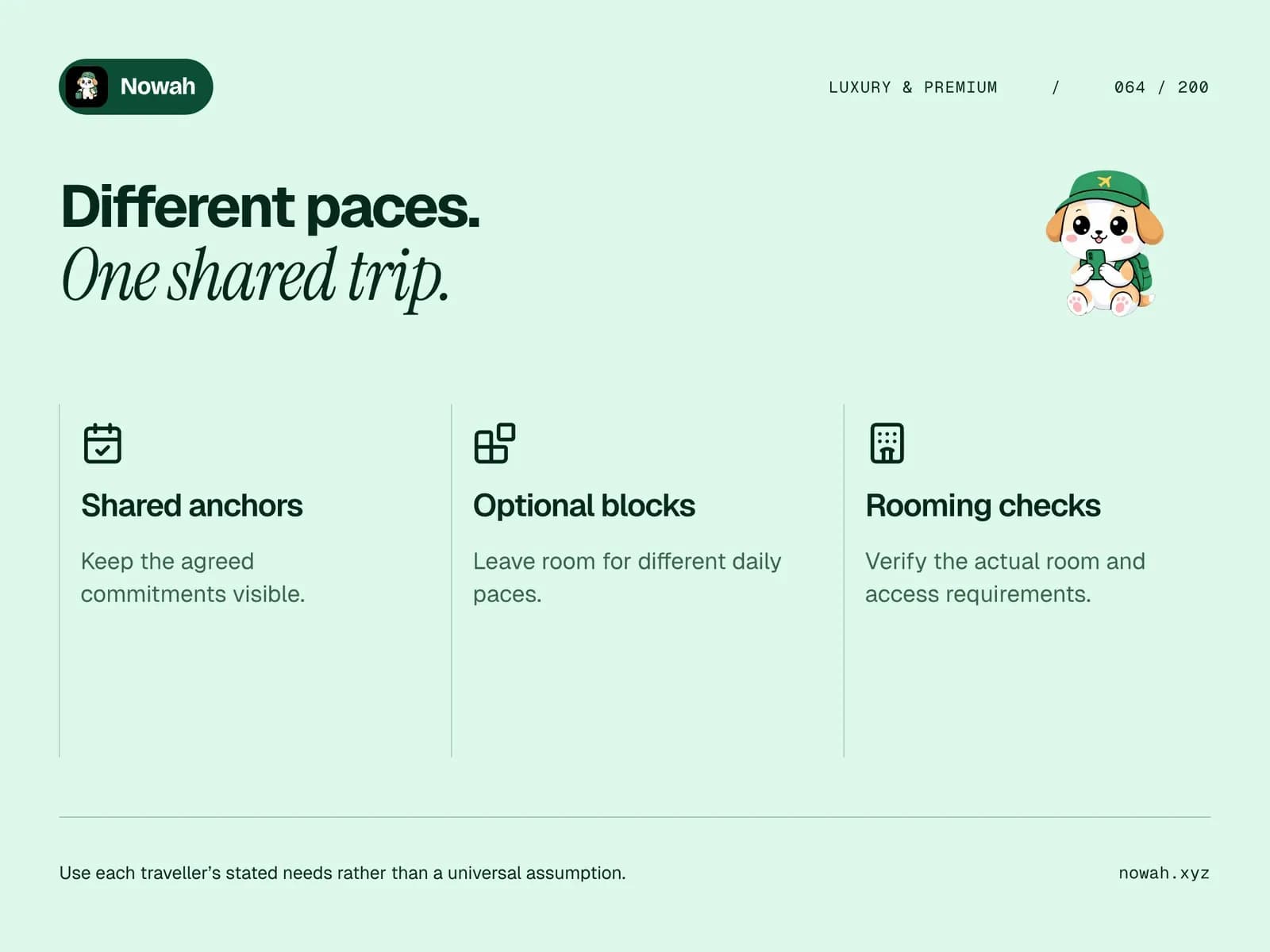
Choose a small number of common anchors before filling the days. These could include actual arrival and departure boundaries, a shared celebration or a decision to stay in one area. Then separate what the group wants to do together from what can remain optional.
Demonstrate the distinction in Nowah. Ask a focused planning question such as how a single accommodation base might support a shared evening and two different daytime directions. Review the response against the stated priorities and revise the plan when an activity creates unnecessary movement or conflicts with a fixed commitment.
Explain that an itinerary draft is a planning aid. Actual services, timings, occupancy and provider arrangements need current evidence before anyone relies on them. Showing a revision makes the demonstration more useful: the audience learns how to check whether a suggestion respects the brief instead of treating the first output as a finished answer.
The older article on multi-city trip intelligence provides background when the group's question involves several destinations. Your multigenerational guide should still focus on which shared anchors justify the movement.
Build an optional-day matrix
An optional-day matrix gives the group a simple way to compare plans without forcing everyone into one timetable. Use rows for day blocks and columns for the information that changes the decision:
- The shared commitment, if there is one.
- The different activity directions being considered.
- The accommodation base and movement questions.
- A sensible place to pause or leave the block open.
- Facts still needing confirmation.
- The next decision the group must make together.
Do not populate the matrix with invented journey times or claim that every combination is convenient. A blank marked “route to verify” is more helpful than a precise-looking assumption. The point is to show where the plan depends on information, not to fill every box for visual completeness.
Readers can use the matrix beside a Nowah demonstration. It makes your recommendation tangible and gives followers a reason to return to the resource when their party or dates change.
A fictional premium-trip example
Imagine six adults considering four nights in one base. They want two shared dinners, one relaxed day and space for different interests. In one direction, the group investigates a centrally located accommodation base. In another, they investigate a property where they would expect to spend more of their time on site.
Explain which questions separate those directions. A central base may be relevant when the actual interests involve several places nearby, but the route and property information still need checking. An accommodation-focused direction may fit a group that wants fewer separate outings, but facilities and inclusions cannot be assumed from its premium positioning.
Use Nowah to explore how the group's shared commitments fit each structure. Keep the same four-night boundary in both examples. If a suggestion introduces a second hotel, make the added move visible and ask whether it advances the group's priorities.
For a deeper accommodation discussion, direct readers to luxury family rooming. Even when every traveller is an adult, the method of separating room requirements from attractive property imagery remains useful.
Preserve rooming and rate questions
A premium multigenerational trip can require several rooms or accommodation units with different needs. Do not assume availability, connecting rooms, preferred locations within a property or shared access between units. Explain which arrangements are important enough to need confirmation from the provider.
Compare actual offers on matched assumptions. If the party size or included services differ between options, state that difference instead of treating the totals as equivalent. A rooming preference and a rate inclusion are separate facts, even when both influence the final choice.
The guide to premium rate inclusions can take readers further into meals, fees and cancellation conditions. Keeping that detail in a relevant supporting guide lets this article concentrate on how the group structures its decisions.
Connect useful planning with a disclosed referral
Tell viewers that you are a Nowah partner and may earn commission when you recommend the service through your active link. Put that explanation alongside the recommendation rather than leaving the relationship to a separate profile page.
The program terms require an eligible traveller to follow an active partner link and create a new account within 30 days of the introduction. Existing accounts, self-referrals and artificial accounts do not qualify. Tracking must successfully reach Nowah, so a shared link is not evidence that every group member has become attributed.
Once a valid account attribution is established, it can remain for that account's lifetime, including qualifying later bookings. This concerns the traveller account, not a general claim that you own the group's future travel. Do not describe one introduction as automatically attributing every relative or every purchase associated with a family trip.
Keep creator recruitment separate from traveller referrals. A viewer who wants to join the program should receive the program explanation and application. A traveller considering the trip should receive the relevant disclosed referral next step.
Explain the economics without using group size as a forecast
Nowah's listed qualifying categories are hotels, flights and paid eSIMs. Activities or other services discussed in the itinerary are not automatically commissionable. The partner share is 35% of Nowah net revenue after the direct deductions defined in the terms; it is not 35% of the group's booking expenditure.
For illustration, $60 of qualifying Nowah net revenue produces $21 of partner earnings. That calculation says nothing about the expected value of a six-person premium trip. The number of travellers, room category and booking spend do not establish a particular net revenue amount.
Completion, supplier settlement, the hold and payout requirements also matter. If your content discusses earning outcomes, distinguish a planning conversation, an attributed account, a booking and eligible earnings rather than presenting them as the same event.
Keep different versions consistent
If you publish a short video and a companion article, use the same shared anchors in both. A viewer should not discover that the longer example quietly adds a night or drops a traveller to make the itinerary work. Mark any revision explicitly and explain which preference caused it. That consistency makes the Nowah demonstration easier to follow and keeps the optional-day matrix useful across formats.
Give the group a useful next conversation
Close the example with one decision the fictional party can make next: choose the accommodation direction, confirm a shared anchor or resolve an important rooming question. A clear next conversation is more practical than a long itinerary that leaves everyone unsure what has actually been agreed.
For creators, applying to Nowah Partners is the route to participating. Applying is free, applications are reviewed and there is no minimum follower count. Start with a truthful demonstration of how Nowah helps organise different preferences. Your strongest recommendation is the one that gives a real group a clearer basis for deciding how to travel together.




