How Fashion Creators Can Earn With Event-Trip Content Through Nowah
Connect fashion event content to relevant flight and stay questions with a practical, disclosed Nowah partner workflow.
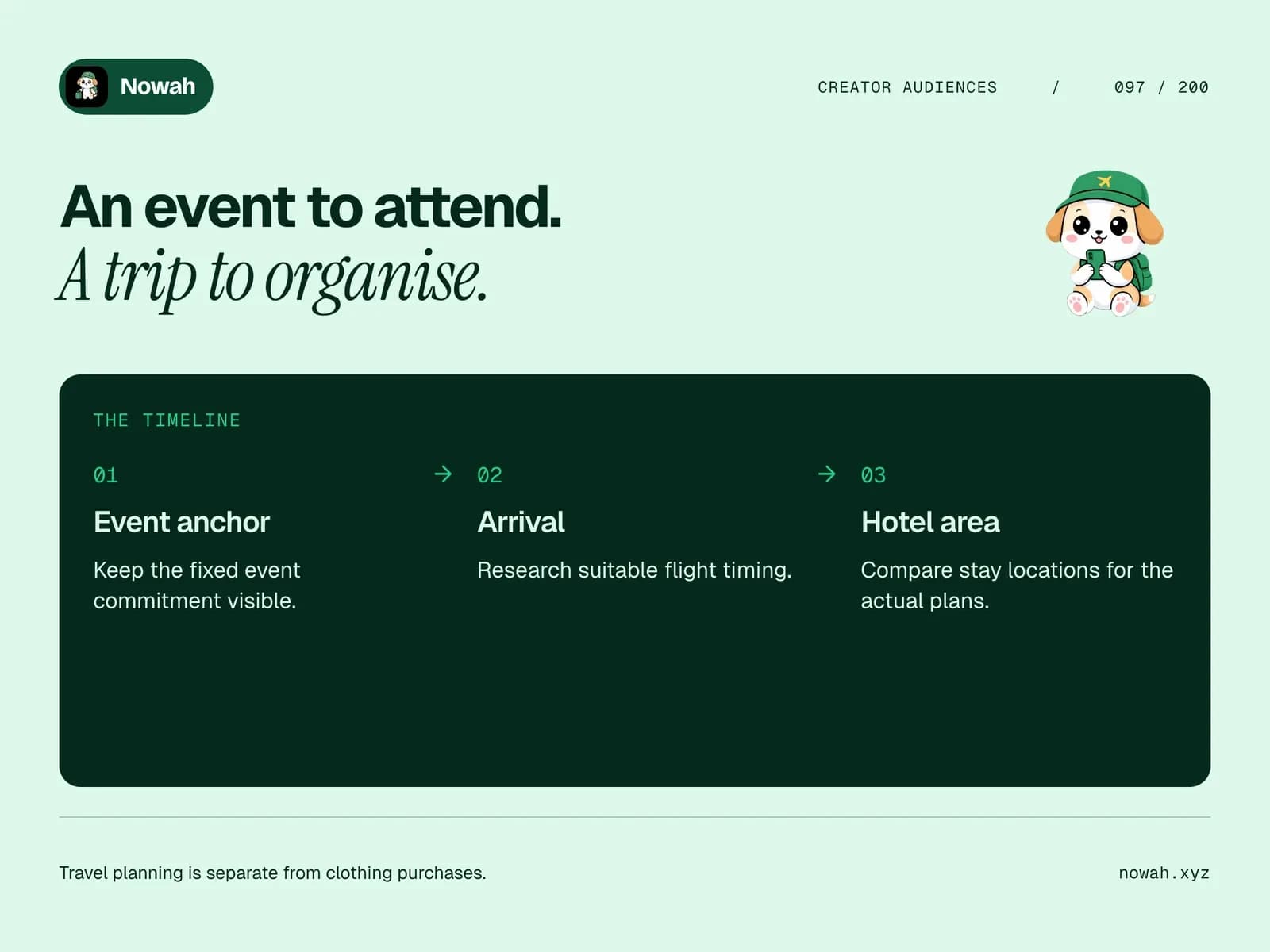
Fashion content often includes travel even when the audience does not think of the account as a travel channel. A trip around an event can raise useful questions about flights, accommodation location and the time available between commitments. Approved Nowah partners can connect that practical guidance to disclosed referrals and potential earnings from qualifying bookings by newly attributed travellers.
Nowah fits when the creator demonstrates the travel problem that actually exists. Show the event boundary, the current requirements and the research question a follower could bring to the service. The recommendation then follows the content's real context rather than becoming an unrelated invitation to book a generic holiday.
Keep the earning scope explicit. Qualifying hotels, flights and paid eSIMs are the listed Nowah partner categories. Clothing purchases, fashion products and event access are not automatically commissionable because they appear in the trip story.
Identify the travel question inside the fashion content
Start with a question the audience needs answered. It might concern how to investigate a hotel area around a fixed commitment, compare arrival directions or keep the final day's plan inside a departure boundary.
Do not assume that every viewer wants to attend the same event or has the same access. An invitation, a saved idea and an actual commitment are different inputs. Keep the status visible before building a travel demonstration around it.
Use a fictional example for general teaching. State that the event boundary and traveller inputs are assumptions for the demonstration, not a claim about a real current event schedule or an audience member's booking. The useful output is a method for organising travel questions.
Build an event-to-travel handoff sheet
A handoff sheet turns the content context into a usable brief. Useful fields include:
- The event or commitment and its actual status.
- Relevant current date and location information.
- The travel window the person can investigate.
- Rooming, accommodation and budget-scope requirements.
- The arrival, departure or movement question.
- The next fact to verify before relying on the direction.
Do not fill the sheet with assumed access, precise journey times or provider benefits. A premium-looking trip image does not establish those details. Keep missing information as a question so the audience can see what determines the recommendation.
The sheet can support a companion article while a short video explains one travel decision. Preserve the important event boundary and evidence status in the shorter format rather than relying on a qualification the viewer may never encounter.
Demonstrate the current brief in Nowah
Use Nowah to explore the fictional travel window with the relevant commitment and current priorities stated clearly. Explain which question you are testing: how an arrival boundary affects the trip, which hotel-area direction deserves research or what changes when several commitments are involved.
Review the proposed direction against the brief. If it assumes an arrangement that has not been confirmed or adds movement that conflicts with the event boundary, identify the issue and revise the question. Show the revision so the audience can understand the reasoning.
The practical case for Nowah is the clearer planning conversation and relevant flight and accommodation research. It does not imply that a planning output confirms event access, supplier conditions or current availability. Keep those facts attached to appropriate evidence.
Work through a fictional event-trip comparison
Imagine a fictional traveller investigating a short trip around one fixed commitment. They are comparing an accommodation direction shaped mainly by that commitment with a direction shaped by wider interests during the stay.
Keep the dates, party and relevant requirements consistent. Explain which location and route evidence each direction needs. Do not declare one convenient, cheaper or suitable simply because the map or property imagery looks persuasive.
Use Nowah to refine the preferred direction after the traveller identifies the priority. If the event boundary changes, revisit the travel assumptions rather than keeping a polished itinerary that no longer reflects the brief.
The culture-creator planning guide offers a transferable way to distinguish fixed anchors from optional interests. Its relevant principle is to keep the status of each commitment visible, not to turn a fashion trip into a generic list of attractions.
Separate the wardrobe story from the booking requirements
Fashion imagery can communicate the trip's style without establishing practical offer conditions. A room photograph does not confirm space, occupancy or a particular arrangement for a future traveller. A travel outfit post does not establish an airline's actual baggage conditions.
If a detail matters to the recommendation, identify the current offer evidence or the provider question still needing an answer. Do not infer a benefit from the creator's own arrangement or imply that a follower receives the same access by using a partner link.
The rate-inclusions guide helps followers compare actual rooming, inclusions and conditions. Link where the fashion-led story creates a specific accommodation question rather than appending unrelated travel resources at the end.
Give fixed dates their own research boundary
An event-driven trip may have less room for changing dates than a general inspiration piece. Make the actual boundary visible without claiming that the remaining travel arrangements are guaranteed.
Do not invent an arrival buffer, a transfer duration or an event-entry condition. Use current evidence for a specific claim, or preserve the question. If the trip depends on several commitments, show how the sequence changes when one is optional or unresolved.
The festival fixed-date guide provides a deeper method for the wider travel window. It addresses a different task from choosing which image or outfit to feature in the content.
A useful creator conclusion can identify the next research direction without pretending the whole trip is confirmed. That honesty makes the Nowah recommendation more understandable, because the viewer knows what the service helps them investigate.
Explain the partner relationship beside the action
When recommending an active Nowah partner link, say that you may receive commission from qualifying referred bookings. Put the relationship beside the travel-research step so the viewer understands both its purpose and your commercial connection.
Under the Nowah terms, an eligible traveller must follow an active partner link and create a new account within 30 days of the introduction. Existing accounts, self-referrals and artificial accounts do not qualify. Tracking must reach Nowah successfully; a fashion post's reach or a link click is not proof of attribution.
Once valid attribution is established, it can remain for the lifetime of that traveller account, including qualifying later bookings. That offers a potential continuing relationship, while future travel and income remain unguaranteed. A creator interested in joining the program needs the application destination, while a traveller needs the relevant disclosed referral route.
The handoff sheet can also guide what the creator chooses to film. A travel-location question may need an explanation of the current brief, while a wardrobe-focused clip may simply supply context. Do not use the latter as proof of a room inclusion, an airline condition or an event arrangement. Each visual should do the job its evidence supports.
For a companion article, show how one changed commitment alters the next travel question. If the fictional event boundary moves, the arrival direction and accommodation research may need reassessment. Preserve that change across formats rather than updating the attractive itinerary image alone. This gives a fashion audience a genuinely useful planning method without implying that a particular outfit, invitation or creator status establishes travel privileges or Nowah earnings. The recommendation remains grounded in relevant flight and stay research.
Explain what can generate an earning
The partner receives 35% of Nowah net revenue from qualifying attributed bookings after the direct deductions defined in the terms. The traveller's full booking price is not the base. Fashion-product expenditure and other purchases shown in the trip cannot be substituted for qualifying Nowah revenue.
A labelled hypothetical $60 of Nowah net revenue produces $21 in partner earnings. That arithmetic does not forecast a return from an event trip, a wardrobe series or a particular follower. Completion, supplier settlement, the applicable hold and payout conditions also matter before earnings become eligible.
Keep content interest, useful research, valid attribution, qualifying travel and completed payouts distinct when discussing results. A creator can explain the opportunity positively without inventing a fashion-campaign success story.
The older Nowah article on the trust question around AI travel bookings provides context for making travel commitments understandable. Your event-to-travel sheet gives that concern a practical application for fashion audiences.
To participate, apply to Nowah Partners. Applying is free, applications are reviewed and there is no minimum follower count. Begin with a real travel question inside the content, demonstrate the relevant Nowah brief and give followers a transparent route to investigate the trip around their interests.




