Turn Saved TikTok Travel Ideas into a Useful Nowah Planning Brief
Turn saved TikTok travel ideas into a checked planning brief for Nowah, with place verification, realistic sequencing and a disclosed partner action.
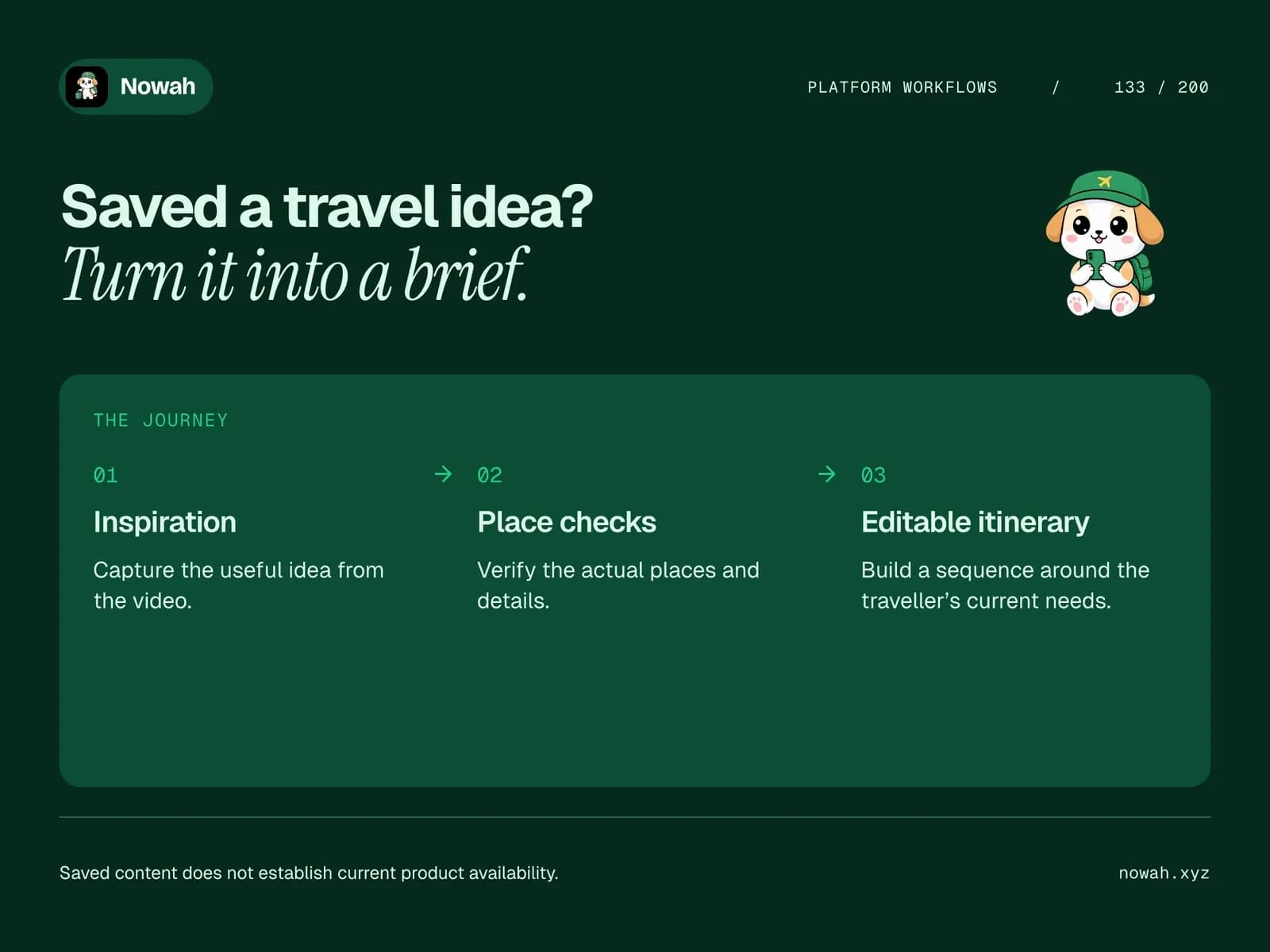
A folder of saved travel videos is full of possibilities, but it is not yet a trip. The places may be far apart, the details may be outdated and the activities may not fit the time the traveller actually has.
A creator can add value by showing how to turn that inspiration into a clear research brief. Nowah is useful when the content moves from “this looks appealing” to “how would these priorities fit together?” Through Nowah Partners, approved creators can earn 35% of Nowah net revenue from qualifying bookings by eligible newly attributed accounts.
The recommendation should follow a useful planning explanation. Do not imply that saving a video establishes availability, that Nowah automatically imports a viewer's saved collection or that every featured activity generates partner commission.
Treat saved videos as leads to investigate
A saved clip can suggest a neighbourhood, a meal, a view or a kind of stay. Its first role is inspiration, rather than confirmation of current facts.
Identify what appealed to the viewer. Was it the atmosphere of an area, a particular design detail or the idea of spending more time outdoors? Sometimes the underlying preference matters more than reproducing every stop shown in the original video.
Keep the creator and source context with the idea. Do not lift another person's footage, wording or claimed experience into your own recommendation without the appropriate rights and evidence.
Separate a place name you can verify from a vague visual impression. If you cannot identify the location reliably, record the question instead of guessing. An appealing clip should not become a confident itinerary instruction on the strength of an uncertain caption.
This approach gives the audience a useful habit: ask what an idea represents before trying to fit it into a schedule.
Create a saved-idea triage board
Use an ordinary notes document or spreadsheet to organise the ideas. The board should help you decide what to research, not create the illusion that every saved item belongs in the final trip.
For each idea, record:
- The preference or experience it represents.
- The identifiable place, if known.
- The original source and what it actually establishes.
- The current facts still needing verification.
- The fixed commitment or timing issue it might introduce.
- Its priority compared with the rest of the brief.
- The reason to keep, replace or drop it.
An idea can remain valuable even if the exact place is unsuitable. A traveller interested in a relaxed food-focused afternoon may not need the specific venue from a video to express that priority.
Do not claim that this board is a Nowah saved-video integration. It is a manual research tool that helps you create a clearer brief before demonstrating the product.
Verify places before sequencing them
Check the identity and relevant location details of each place you intend to discuss. Use current, appropriate sources for facts such as opening information, access arrangements or booking requirements when those facts affect the plan.
Do not turn an old clip into proof that an offer, menu, event or room category remains available. A planning demonstration should name any important unanswered question rather than quietly assuming it away.
Consider the source of your own statement as well. You may be able to say that a video inspired an idea while lacking evidence to recommend a particular property. That is a reason to frame the material as research, not to invent a first-hand review.
Nowah's article about what travel AI gets wrong provides background for keeping generated suggestions separate from verified facts. The same distinction applies to attractive social content.
The output of this stage is a set of ideas with known evidence limits. It is not a promise that all of them can be booked or visited.
Convert preferences into a bounded brief
Write the trip requirements in your own words. Include the available time, travelling party, arrival and departure boundaries, any fixed anchor and the priorities that emerged from the saved ideas.
Avoid handing the audience a long undifferentiated list. A brief that says “food-focused, slower mornings and one fixed evening event” gives the planning task more direction than a list of twenty unrelated venues.
Choose which question the Nowah demonstration will investigate. You might examine how much activity fits into a day or whether one accommodation base makes sense for the priorities. Keep the question small enough to explain.
Label a fictional brief as an example. Do not reproduce a viewer's private travel details or claim that the resulting plan describes a real follower's holiday.
The one-question demonstration guide helps narrow the scope when the collection contains several different planning problems.
A fictional food-and-culture collection
Imagine a creator explaining how to organise several saved ideas for a short city break. The example is hypothetical and does not describe a real traveller, confirmed venue or campaign result.
The collection includes inspiration for a food neighbourhood, a cultural visit and a slower afternoon. The creator first identifies the underlying preferences and separates any uncertain place information into a verification list.
The fictional brief specifies the trip length, a fixed evening anchor and a preference for avoiding an overfilled arrival day. It does not include invented opening times or assumed transfer durations.
A Nowah demonstration investigates how those priorities could shape the day plan. The creator explains why one optional idea might be moved or dropped when the available time becomes clearer.
The useful output is not a claim that the exact saved trip can be replicated. It is a more coherent brief, a sequence to investigate and a visible list of facts still requiring current evidence.
The partner recommendation then invites viewers to explore their own requirements. The creator makes clear that restaurant spending is not a qualifying Nowah partner booking category.
Show the revision, not just the finished plan
The most instructive moment may be the decision to remove an idea. Explain why it no longer fits the brief or why the evidence is insufficient.
A viewer can learn from seeing that a fixed commitment changes the surrounding day structure. They can also learn that a saved venue may represent a preference that can be explored in another way.
In the Nowah demonstration, show only actions and product behaviour you can verify. Do not claim automatic extraction of locations, direct saved-video importing or confirmed booking availability unless the current product evidence actually establishes those features.
Keep the explanation clear enough that the audience does not need to read a dense itinerary on screen. A diagram can show which decision changed, while your commentary supplies the reason.
The TikTok planning-demonstration workflow covers the production steps for recording that reasoning.
Connect the relevant travel products honestly
A food or culture post can lead naturally into hotel-area research, flights and paid connectivity. It does not make every place in the itinerary a partner-eligible purchase.
Nowah's program terms identify qualifying hotel, flight and paid eSIM bookings. Do not imply that a restaurant meal, museum ticket, rail journey or every activity featured in your collection earns commission through the program.
The commercial strength is the connection between useful inspiration and the traveller's broader trip requirements. A clear accommodation-area question or arrival brief can be more relevant than adding a booking link to every saved idea.
Tell viewers that you are a Nowah partner and may earn commission from qualifying referrals. Check applicable current TikTok disclosure tools and the actual link surface available on your account.
The destination should match the viewer's task. Someone researching a trip needs a different explanation from another creator applying to join the program.
Keep earnings separate from saved-content engagement
A saved video, a comment or a click does not establish partner income. Under Nowah's terms, an eligible traveller must follow an active partner link and create a new account within 30 days of introduction, with successful tracking.
Existing accounts and self-referrals do not qualify. Once valid attribution exists, later qualifying bookings can produce earnings for the account's lifetime, but no future bookings or income are guaranteed.
The share is 35% of Nowah net revenue, rather than 35% of the traveller's booking spend. Completion, supplier settlement and the applicable hold and payout conditions still matter.
For creators evaluating the later stages, why new accounts are not bookings explains another distinction in the earning journey. Your content can be useful before any of those outcomes has occurred.
Publish a method your audience can reuse
Before publishing, compare the video with the triage board. Check that inspiration has not become an unsupported fact and that the demonstration has not become a fictional testimonial.
Make the practical lesson explicit: identify the preference, verify the place, state the constraints and investigate a manageable sequence. Keep source-dependent details current when you reuse the material.
Choose a different question for the next piece. A saved-idea triage board, a room-evidence ledger and a fixed-event plan provide different kinds of value even when they all involve travel content.
If turning inspiration into useful research fits your audience, apply to Nowah Partners. Describe the planning questions you can help people answer. A clear, evidence-led method gives your Nowah recommendations a stronger reason to exist than an unexplained collection of attractive clips.




