Calculated commission vs settled payout: reconcile a Nowah earning example
Reconcile a Nowah partner calculation with corrections and payout stages using a fictional example and an evidence-led worksheet.
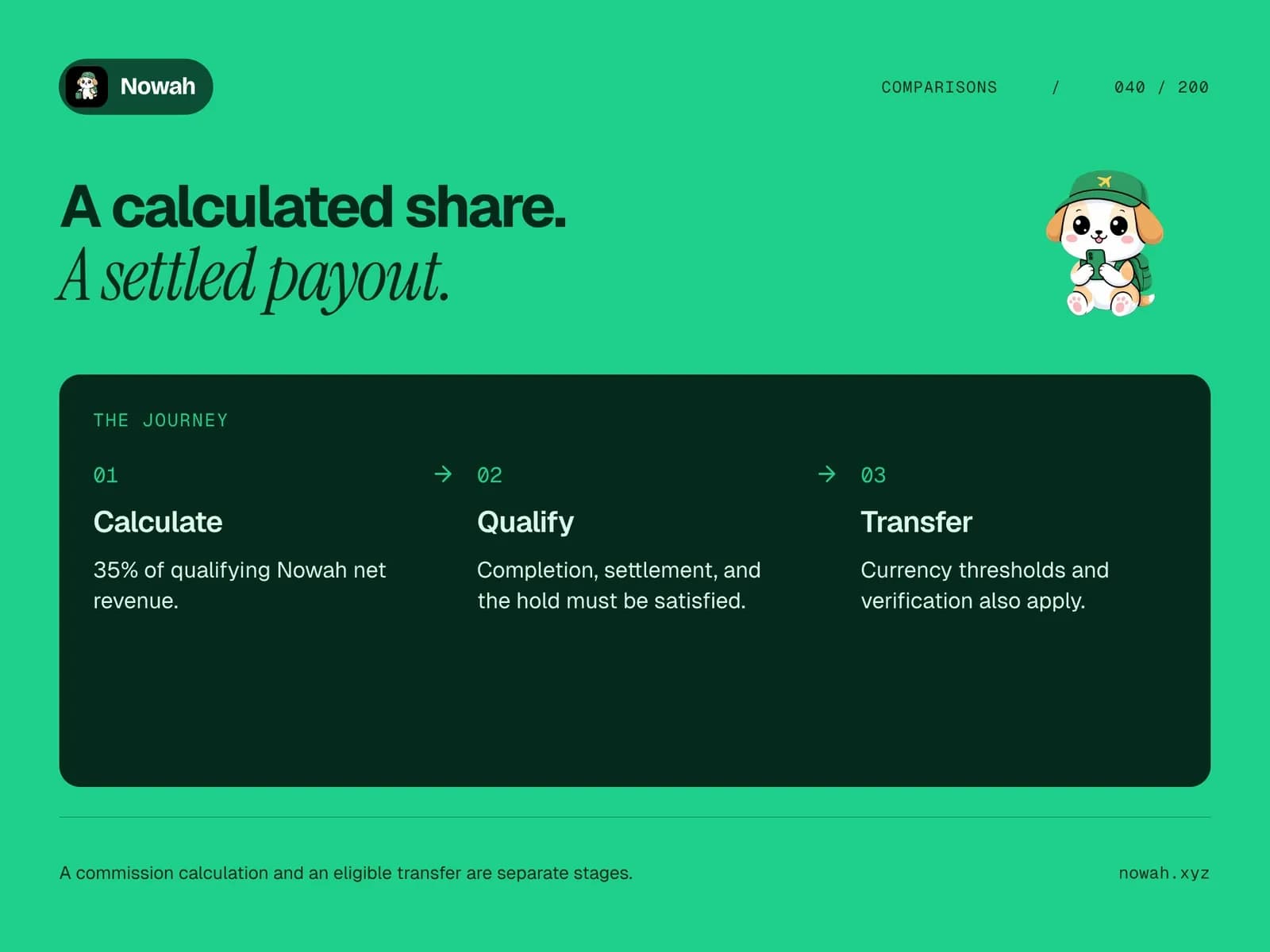
A calculated partner share is not the same as a settled payment reaching a bank. For creators using Nowah, a useful earnings explanation needs to distinguish the booking-level calculation, any corrections, payout eligibility and the later provider stages. A headline amount should not silently stand in for all of them.
The Nowah Partner Program offers approved partners 35% of Nowah net revenue from qualifying bookings by eligible attributed accounts. Its defined share and continuing account attribution give creators substantial reasons to consider the opportunity, with documented conditions for earning release and payment.
This guide uses “calculated commission” as an explanatory phrase, not as a claim about a particular portal field. It gives you a reconciliation worksheet for comparing amounts and evidence without assuming every pending figure is guaranteed cash.
Name the amount before comparing it
The traveller's retail booking value, Nowah's net revenue, a partner share and a bank receipt describe different quantities. A general term such as gross commission can be ambiguous if the base and stage are not named.
For Nowah, begin with the current partner terms. The share applies to net revenue actually received for a qualifying booking, less the permitted direct deductions. General overhead, salaries and general marketing are excluded from that deduction list.
Do not substitute the traveller's total purchase price for the base or treat a recorded share as proof that every release condition has been satisfied. A clean calculation can still be at an earlier stage than a payment.
The net-revenue versus booking-price guide provides a focused explanation of the quantity behind the percentage.
Work through a fictional correction example
For teaching only, suppose a hypothetical qualifying booking initially produces US$200 of Nowah net revenue. At a 35% partner share, the calculated amount is US$70. These are invented educational inputs, not a real creator statement or typical booking margin.
Now suppose the relevant record is corrected and the verified net-revenue amount becomes US$160. Applying the same 35% share produces US$56. The difference between the two calculated shares is US$14.
The example does not establish why a real record would change or predict how a specific refund would affect every component. It simply demonstrates that a corrected base can change the resulting share. The actual statement and correction evidence determine a real case.
The US$56 is also not automatically a bank receipt. Completion, supplier settlement, the hold, threshold, verification and other payout conditions still need their own evidence. Keep those stages visible rather than drawing a direct arrow from the original US$70 figure to a bank icon.
Check completion and supplier settlement separately
Nowah requires completed bookings and verified supplier settlement. These are two conditions, not different labels for the booking date. A traveller's initial payment or confirmation does not by itself establish both events.
A 30-day hold begins after whichever event occurs later. If completion happens before settlement, the later settlement event starts the hold. Do not count from the earlier date just because it would make a payment appear due sooner.
Mark an event unresolved if the appropriate evidence is not available to you. A creator worksheet should not invent a date to make the sequence look complete or support an immediate-income claim.
The completion-and-settlement guide is useful when your question concerns those two prerequisites rather than the arithmetic itself.
Review the actual payout eligibility conditions
Eligible Nowah balances are processed monthly, subject to a minimum equivalent to US$50 separately for each settlement currency. Below-threshold balances roll forward. A current exchange rate is used to assess the threshold; it does not merge different currency records into a single balance.
Stripe identity and bank verification, supported-country eligibility, available settlement funds and unresolved payout exceptions also matter. A calculated amount above the nominal minimum does not prove that every other condition is satisfied.
In the fictional correction example, the US$56 figure is above a US$50 amount, but that comparison alone does not establish an actual transfer or arrival date. The example remains a calculation with explicit limits.
The per-currency thresholds guide provides a focused supporting resource. A useful reconciliation preserves the actual currency unit and status alongside each amount.
Build a reconciliation worksheet
Use one row for the relevant booking or statement record. Separate columns for the earning base, calculated share, correction evidence, current recorded amount, completion status, settlement status, hold status and remaining payout conditions.
Then add distinct fields for a transfer reference, bank-payout evidence and actual receipt where those events are established. Do not copy one reference into every field as if it proves the complete journey.
Keep an open-question column. It may identify a changed net-revenue amount, an unverified settlement event or a provider-stage inquiry. A specific question is more actionable than a vague statement that two numbers do not match.
For public teaching material, label every invented row hypothetical. For actual work, use appropriate program evidence and keep unnecessary private traveller or banking information out of your content documents.
Keep program and provider charges distinct
The current Nowah terms state that the program does not deduct a separate payout fee from the earned share. A transfer to the connected Stripe account is nevertheless distinct from the later bank payout, and provider-dependent currency-conversion or bank charges may matter to that stage.
Do not turn the absence of a separate program payout fee into a promise that every external service is free. Likewise, do not assume every difference between an earning record and another amount is a provider charge. The actual evidence determines the question.
The Stripe-transfer versus bank-payout comparison helps distinguish those events. A reconciliation worksheet should show the sequence instead of treating Stripe and the bank as interchangeable payment choices.
Avoid publishing a universal arrival schedule that the actual terms or provider record do not establish.
Preserve the history of corrections
Refunds, chargebacks and corrected supplier statements can affect earnings, including after an earlier payout. Nowah's terms describe corrections being recorded in statement history and offset against unpaid earnings. A negative adjustment does not authorize an automatic debit from the partner's bank account.
Keep the earlier context when reviewing a change. Identify the statement reference, the event affected and the clarification you need. Do not invent a cause before the record has been reviewed.
The refund-corrections guide provides a useful next read for that particular issue. A correction is a reason to examine evidence, not a reason to replace the original earning definition with a guessed deduction rule.
Use precise amounts in public creator content
A public case study should say what a figure represents, which period and currency it concerns and what evidence supports it. A hypothetical example must remain labelled, even if its graphic looks like a real statement.
Do not describe a pending or calculated share as money already received. Do not add unrelated currencies or multiply an illustrative booking share across invented future travel. A creator can make a strong Nowah recommendation without presenting an unverified earnings total.
The recording-assumptions guide helps review teaching material before publication. The existing trust and AI booking article provides wider context for clear evidence-led explanations.
Connect the earning model with useful travel work
Nowah's opportunity begins with eligible new-traveller introductions. The traveller needs to follow the active partner route and create a new account within 30 days of the valid introduction, with successful tracking. Existing accounts, self-referrals and artificial accounts do not qualify.
Once established, attribution continues for the traveller account's lifetime and can apply to later qualifying hotel, flight and paid eSIM bookings. That continuity can suit creators building useful evergreen travel explanations, without guaranteeing repeat income.
Show the practical value in a labelled demonstration. A fictional brief can explain a location or arrival tradeoff while leaving current supplier conditions subject to verification. The recommendation then has a purpose beyond a headline earning number.
The one-question demonstration guide helps keep the travel task focused enough for a useful article or video segment.
Reconcile the evidence before claiming the result
Nowah gives creators a compelling model through its defined net-revenue share and continuing eligible account relationship. Understanding the stages from a calculation to a payout makes that model easier to explain, rather than reducing it to an unsupported promise of immediate cash.
Prepare the worksheet, review a clearly labelled hypothetical example and identify the actual evidence for any real result. If Nowah fits the recommendations you want to publish, apply to Nowah Partners. Applications are reviewed, and approval, eligibility and verification requirements apply. Help travellers understand their next decision, keep each amount attached to its base and status, and assess earnings through the qualifying events and records that establish them.




