Turn Instagram Audience Questions into Useful Nowah Content
Turn Instagram follower questions into useful Nowah planning content with minimal inputs, fictional demonstrations and a clear partner recommendation.
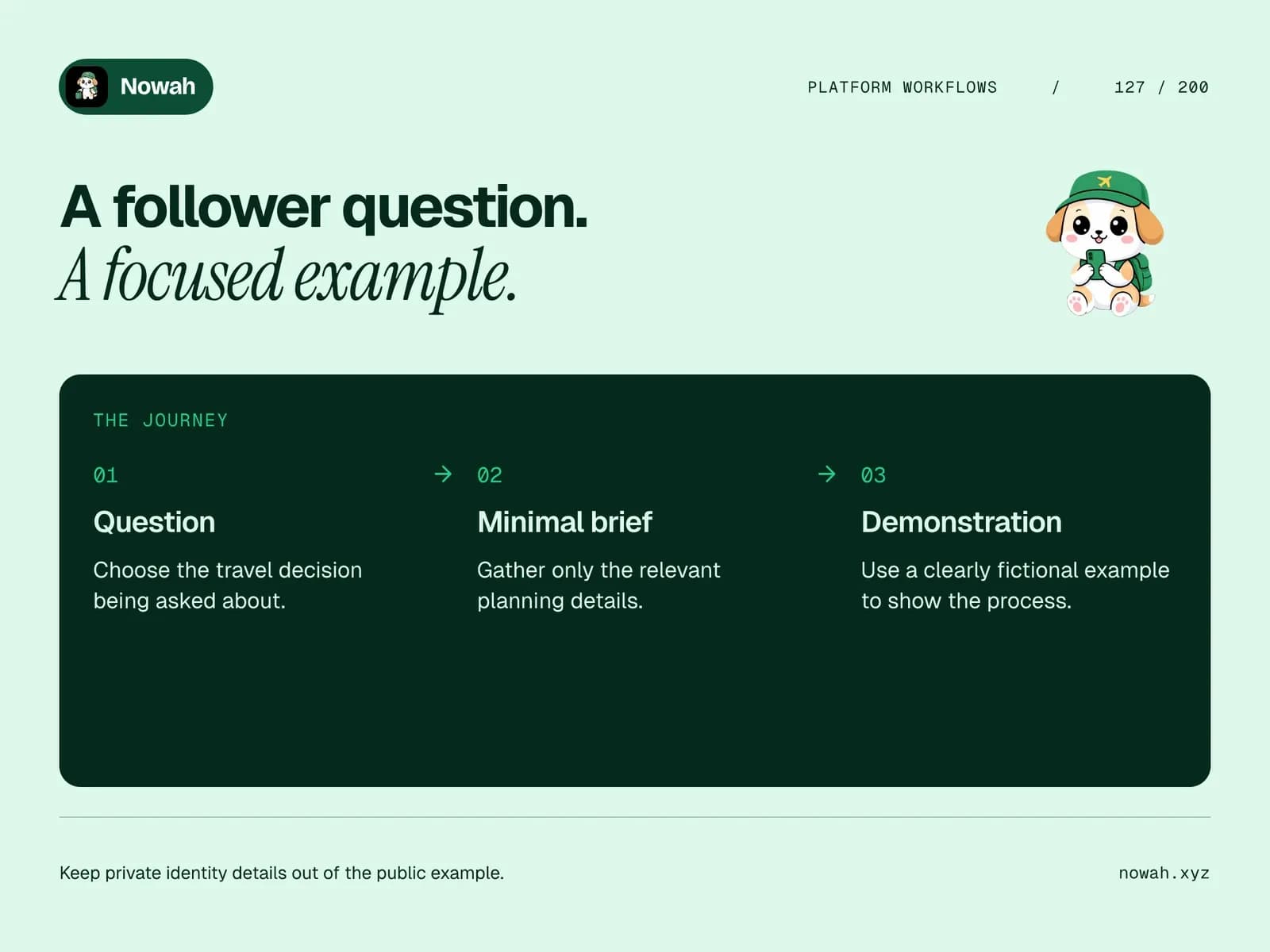
The most useful idea for your next travel post may be a question someone has already asked. A follower wondering about rooming, arrival timing or a hotel move is revealing a decision they have not resolved. A creator can help by explaining the decision clearly, rather than replying with a generic booking link.
Nowah can give that explanation a practical demonstration. You can turn a carefully bounded question into a fictional travel brief, investigate the relevant planning task and show the audience what they should check for their own trip. Approved Nowah partners can earn 35% of Nowah net revenue from qualifying bookings by eligible new accounts they introduce.
The commercial opportunity begins with useful content and an appropriate introduction. A follower asking a question has not necessarily become an attributed account, made a booking or generated earnings.
Listen for a decision, rather than a content slogan
A broad message such as “any recommendations?” needs interpretation before it becomes a helpful post. Ask what choice the person is actually facing.
Are they choosing a hotel area, deciding whether to change bases or trying to fit a fixed commitment into a short trip? A narrow decision gives the explanation a clear end point. You can show what information matters and what would change the answer.
Avoid treating every question as a request for a complete itinerary. The follower may need help understanding one tradeoff before they can describe the rest of the trip.
Keep a private editorial list of recurring topics in your own notes. Record the question in general terms, the planning decision behind it and whether it would help a wider audience. Do not invent feedback to fill the list or imply that an illustrative question came from a real person.
The follow-up questions guide develops the distinction between genuine audience evidence and a hypothetical content idea.
Ask only for the inputs that change the answer
A planning explanation usually requires a small set of relevant inputs. Dates or approximate trip length, travelling party, fixed commitments, budget scope and current priorities can reveal the decision's shape.
Ask what an ambiguous word means. A follower asking for a “comfortable” trip may mean fewer hotel moves, more space or a slower day structure. Someone asking for a “central” hotel may be thinking about one event rather than the city as a whole.
Do not collect identity documents, payment information or private booking references to create a public demonstration. Those details are unnecessary for explaining how a brief works. If a question concerns an actual booking issue, do not turn a public comment thread into a place to exchange private account information.
A creator can also decline to answer a question beyond the evidence they have. “Here is what I would investigate” is useful when it is accurate. Pretending to confirm a room arrangement or supplier condition is not.
Translate the question into a fictional brief
For public teaching content, create an illustrative scenario that preserves the planning problem without reproducing a follower's private situation.
Label the brief as fictional. Change or omit unnecessary identifying details, and do not suggest that the resulting plan was the follower's actual trip or a real booking outcome.
A brief can contain the party, length of stay, a fixed anchor and the priority being tested. Add the question that the Nowah demonstration will investigate. Leave unrelated background out.
For example, a general question about travelling with relatives could become a fictional brief involving adults with different preferred daily paces. The demonstration might examine optional day blocks and hotel-move choices. It need not use a real family's names, exact travel dates or personal circumstances.
This transformation produces a reusable lesson. The audience can understand which inputs matter without being invited to inspect someone else's private travel conversation.
Give Nowah a specific job in the explanation
Show how Nowah helps investigate the brief. A useful demonstration could explore a day structure, revise a plan around a fixed commitment or examine how a hotel-area choice affects the rest of the trip.
Explain the reasoning behind the revision. If different members of a fictional party prefer different activity levels, show why optional blocks may be worth investigating. Do not present a single plan as universally suitable.
Verify the product behaviour you intend to show. Avoid inventing features for processing follower messages, collecting leads or reporting commissions. An ordinary editorial worksheet is something you can maintain yourself; it should not be presented as a Nowah dashboard.
Keep supplier questions visible. A suggested day plan does not establish room occupancy, access suitability, current opening information or transport availability. Name the checks that remain before a traveller relies on the example.
The multigenerational premium-travel guide can support the particular questions that arise when several adults have different priorities.
A fictional question-to-content example
Imagine a creator who wants to explain a recurring planning problem: how to structure a trip when some adults prefer a full sightseeing day and others want more rest. The following is a hypothetical editorial scenario, not a reported follower conversation or campaign result.
The creator writes the general question in an editorial note, then builds a fictional brief with a short stay and one fixed shared activity. They leave out names, exact personal details and unsupported assumptions about age or ability.
The Nowah demonstration explores a shared morning anchor with optional afternoon choices. The creator explains why everyone does not need the same day plan, then identifies the accommodation and transport questions that would still need current evidence.
The resulting post offers a small decision worksheet: what must happen together, what can be optional, what requires provider confirmation and what would make the plan too rushed.
The partner recommendation follows naturally. Viewers who want to investigate their own brief are offered an appropriate active partner route, with a clear explanation of the commercial relationship. The creator does not claim that the fictional group booked or generated commission.
Use a question-to-content worksheet
A repeatable worksheet helps keep audience-driven content focused:
- General question: the planning problem, recorded without unnecessary personal detail.
- Reader decision: the choice the explanation should help someone make.
- Relevant inputs: the facts that change that choice.
- Illustrative brief: the fictional scenario used for public teaching.
- Nowah task: the investigation or revision being demonstrated.
- Evidence gap: the supplier or source checks still required.
- Useful output: the checklist, comparison or planning rule the audience can use.
- Next action: the relevant, disclosed destination.
Write the useful output before designing the post. If you cannot identify what the viewer will learn, the material may need more thought before it becomes a recommendation.
Keep the worksheet with your editorial notes and update it when you revise the content. It does not need to contain the follower's original message.
Answer follow-up questions without inventing certainty
A useful post often produces another question. Treat that as an opportunity to clarify the decision, not a reason to promise a complete answer immediately.
Separate general planning questions from requests for a current supplier fact. You may be able to explain why occupancy matters while still directing the person to verify the actual room conditions. You may demonstrate how an arrival constraint changes the plan without guaranteeing a journey duration.
When you do not know, identify the missing evidence. This is more helpful than filling the gap with a confident guess. Do not turn a generated planning response into proof that a real arrangement is available.
Nowah's article on what travel AI gets wrong offers useful background for explaining those limits. Apply the same standard to your own commentary around a demonstration.
Make the partner journey clear
If you are recommending Nowah to travellers, tell them that you are a partner and may earn commission from qualifying referrals. Check the actual linking tools available on your Instagram account, and make the destination match the task you described.
The Nowah program terms require a traveller to follow an active partner link and create an eligible new account within 30 days of introduction. Tracking has to reach Nowah successfully. Existing accounts and self-referrals are excluded.
An attributed account may generate earnings from future qualifying hotel, flight and paid eSIM bookings, but there is no guaranteed repeat income. The 35% share is calculated from Nowah net revenue, not the traveller's booking spend. Completion, settlement and payout conditions still apply.
A creator interested in joining the program needs a separate application explanation. The creator-versus-traveller journey guide helps keep those two audiences from receiving confusing instructions.
Choose the next question deliberately
Review whether the published explanation helped readers understand the decision. Genuine follow-up questions can reveal a missing assumption, a different audience need or a useful next topic.
Do not turn a handful of replies into a claim about conversion or earnings. Those are different events requiring different evidence. A good editorial decision can be valuable before any commercial outcome is known.
For the next piece, choose a question that requires a different tool or explanation. A room-evidence ledger, a day-structure worksheet and a hotel-move comparison solve different problems. That is a stronger series than repeating the same Nowah introduction under several audience labels.
If you want to build useful travel recommendations this way, apply to Nowah Partners. Describe the audience you help and the questions you intend to answer. Start with a truthful demonstration that gives someone a clearer next decision, then connect that value to an appropriately disclosed partner route.




