How Lifestyle Creators Can Turn Weekend Content Into Nowah Referrals
Turn lifestyle weekend stories into compact travel briefs, useful Nowah demonstrations and transparent partner recommendations.
A weekend story can combine food, accommodation and personal interests into an appealing short sequence. The viewer still needs to understand how the travel actually fits between arrival and departure. Approved Nowah partners can turn that practical explanation into a useful demonstration, a disclosed referral and potential earnings from qualifying bookings by newly attributed travellers.
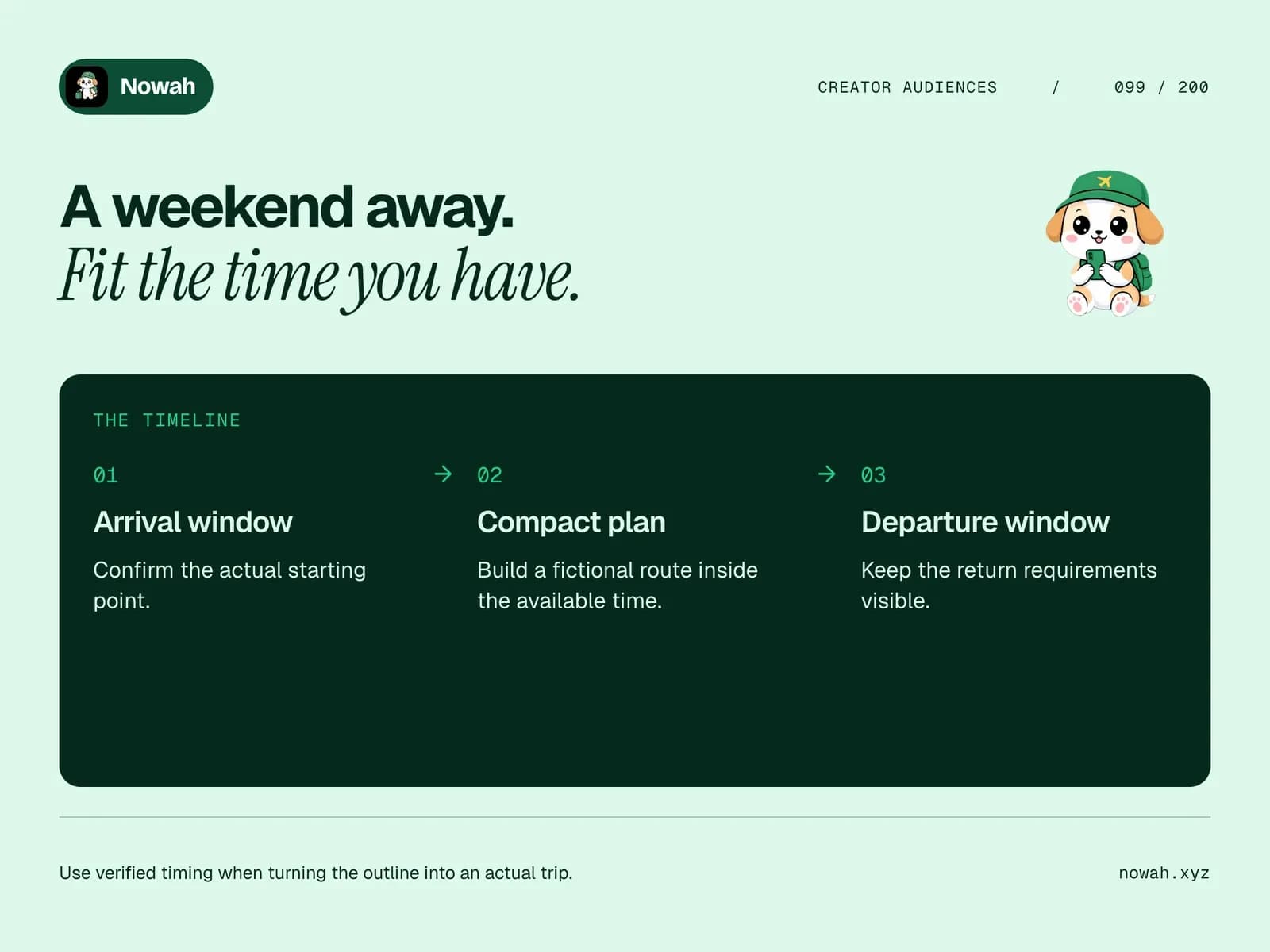
Nowah fits when the creator translates the story into a current brief. Show the limited arrival window, the return boundary and the priority that should shape the day plan. The audience then sees why continuing the travel research through the service is relevant to the content it enjoyed.
Keep the commercial claim clear. The partner receives 35% of Nowah net revenue from qualifying bookings under the program terms, not a percentage of the traveller's entire weekend budget. A busy montage, attractive accommodation or popular lifestyle account does not establish a particular earning result.
Find the travel decision in the weekend story
Choose the question the content can genuinely help answer. A viewer might need to investigate whether a short trip has enough time for one main interest, how to choose an accommodation direction or what changes when the arrival occurs late in the available window.
Do not assume that every follower wants to copy the creator's weekend. Their origin, dates, travelling party and priorities may differ. A useful recommendation explains a method for their current brief rather than presenting a personal story as a universally suitable package.
Use fictional inputs for the public demonstration when appropriate. State which details are assumptions and distinguish them from your own actual experience or current supplier information. A teaching case does not need an invented booking confirmation to be useful.
Translate the edit into an arrival-to-departure outline
A finished video can compress several moments into a few seconds. Before turning it into planning advice, identify the actual boundaries the example would need. Distinguish nights away from the periods genuinely available for destination activities.
Do not assign exact transport or arrival allowances from memory. Use current evidence for specific claims, or keep the timing as a question to investigate. A compact plan should expose dependencies rather than hide them behind precise-looking labels.
The premium short-break guide offers a usable-time ledger that can be adapted across budgets. Its relevant principle is the travel window, not a requirement that a lifestyle audience choose a premium style of stay.
Choose one priority for the demonstration
A useful weekend example does not need to include every interest shown in the creator's account. Ask what the traveller wants the brief to protect. That might be one shared commitment, time at the accommodation or a particular food interest.
Keep optional ideas genuinely optional. If removing one activity changes every later movement, explain that dependence. An open block can remain deliberately open instead of being filled with another recommendation to make the graphic look complete.
Use the priority to shape the Nowah question. The audience should understand why this input matters and how a changed preference would lead to a different direction. That is a stronger product demonstration than asking for a generic weekend itinerary and accepting the first outline without review.
Demonstrate the compact brief in Nowah
Use Nowah to explore the fictional travel window with the priority and relevant accommodation requirements visible. Explain whether you are comparing directions, revising the day outline or identifying a supplier question that affects the trip.
Review the proposed plan. If it uses the arrival period as a full destination day or adds an activity that conflicts with the return boundary, identify the assumption and revise the question. Show the change so the audience can follow the reasoning.
Nowah's practical value is the clearer planning conversation and relevant travel research. It does not independently confirm current availability, actual route conditions or supplier arrangements. Keep those facts attached to appropriate evidence rather than letting an attractive outline imply a confirmed weekend.
Build a story-to-brief card
Give readers a small card connecting the lifestyle content to the travel task. Useful fields include:
- The story detail that attracted the audience.
- The current traveller's origin and available window.
- The priority the compact plan should protect.
- The accommodation or movement question.
- The fact still needing current evidence.
- The relevant next action demonstrated in Nowah.
The card prevents a loosely related travel link from becoming the whole commercial strategy. It also helps followers adapt the idea instead of treating the creator's edited sequence as a complete itinerary.
For a shorter video, keep the fictional label and the main unresolved question visible. A companion article can hold the full card, but the short version should not communicate greater certainty than the longer explanation supports.
Work through two fictional weekend structures
Imagine the fictional traveller has an evening arrival boundary and a fixed return requirement, with one main interest during the stay. Structure A keeps the day plan compact around one accommodation base. Structure B adds several ideas that introduce more movement questions.
Keep the dates, party and requirements consistent. Do not give Structure B an extra morning or assume convenient transfers to make the fuller plan look equally workable. Explain which new dependency each added idea creates.
Use Nowah to revise the chosen structure after the traveller identifies the priority. The useful output may be a clearer research direction rather than a final schedule. If the main question becomes the scope of the travel budget, the cost-scope guide provides a relevant next resource.
Do not present the fictional comparison as a live package, guaranteed saving or proof that every service shown can be booked through one destination. The teaching value lies in the brief and the revision.
Make the next click continue the useful work
The review-to-next-click guide explains how a clear destination and a useful message card support the transition from content to action. Adapt the task to the lifestyle audience rather than assuming it wants the creator's exact trip.
A traveller needs the appropriate disclosed referral route through an approved partner's active link. Another creator who wants to participate needs the Nowah program explanation and application. Do not merge both journeys into a vague instruction that leaves the viewer unsure what happens next.
When recommending the active link, say that you may receive commission from qualifying referred bookings. Put that relationship beside the relevant action so the audience understands the travel purpose and the commercial connection.
Explain attribution and earnings accurately
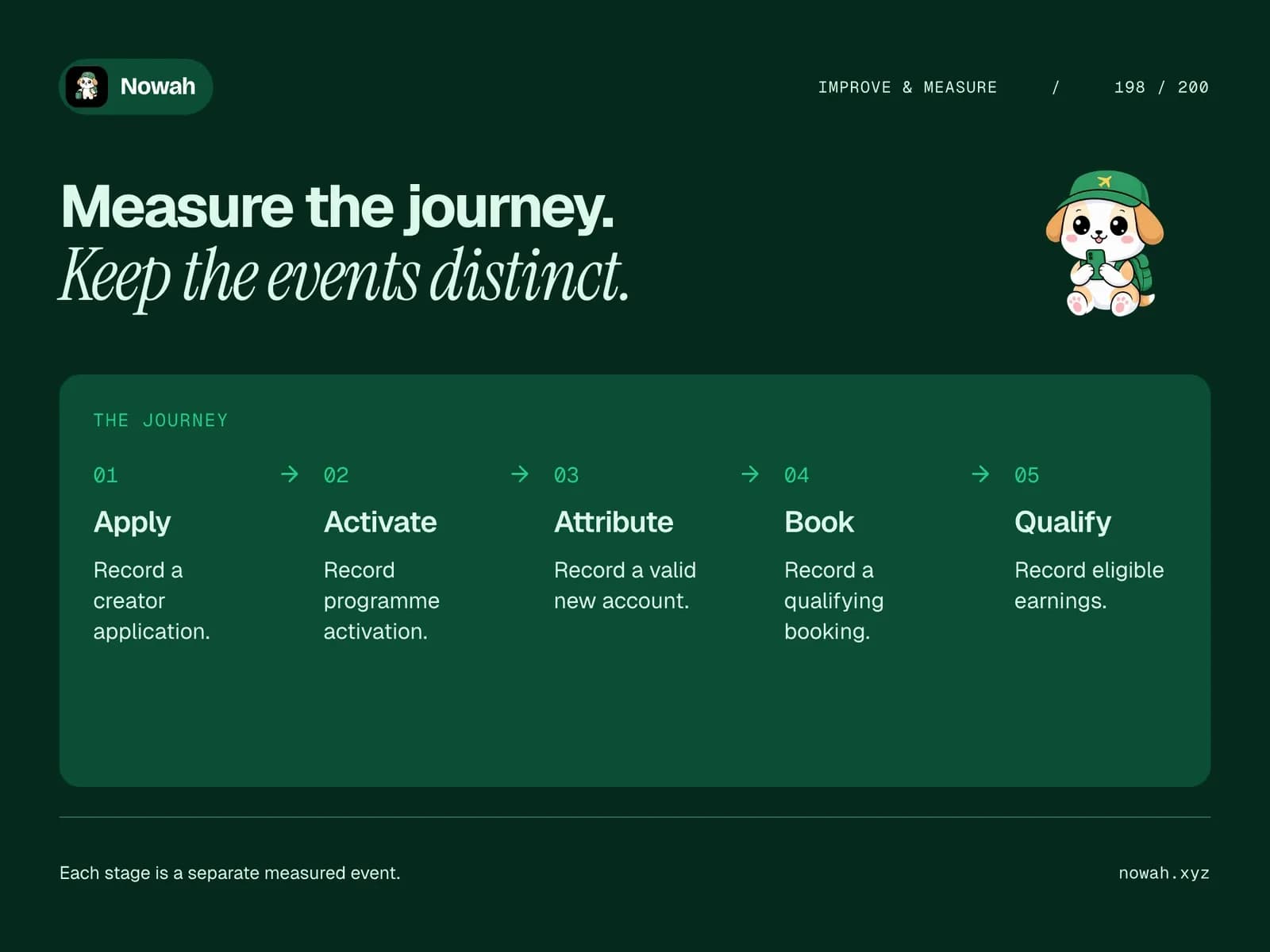
Under the Nowah terms, an eligible traveller must follow an active partner link and create a new account within 30 days of the introduction. Existing accounts, self-referrals and artificial accounts do not qualify. Tracking must reach Nowah successfully; a saved weekend post or a link click is not proof of attribution.
Valid account attribution can remain for that account's lifetime, including qualifying later bookings. That offers a potential continuing relationship, while future travel and income remain unguaranteed. Nowah's listed qualifying categories include hotels, flights and paid eSIMs, not every meal, purchase or activity in the weekend story.
The partner share uses Nowah net revenue after the direct deductions defined in the terms, rather than the traveller's booking expenditure. A labelled hypothetical $60 of Nowah net revenue produces $21 in partner earnings. That does not forecast the return from either fictional weekend structure.
Completion, supplier settlement, the applicable hold and payout conditions matter before earnings become eligible. Keep audience attention, a useful action, valid attribution, qualifying travel and a completed payout distinct when discussing results.
If you use footage from your own weekend, keep the actual experience distinct from the fictional planning case. A sequence assembled for storytelling should not imply that every shown moment belongs to the same available travel window for a follower. Explain what the footage illustrates and what the Nowah demonstration is testing.
This is particularly important when one attractive scene creates a new accommodation or location inference. If the evidence does not establish that relationship, identify the question rather than letting the edit answer it by implication. The viewer can still enjoy the lifestyle story while understanding which parts of the travel decision remain to investigate.
Keep the resource current and coherent
If the fictional brief changes, update the card and the shared visual together. A new arrival boundary should not be attached to an older day outline as if the whole example had been checked again. Keep personal experience, current supplier facts and teaching assumptions recognisable.
The older Nowah article on moving beyond a traditional search form provides background for expressing travel as a current question. Your story-to-brief card gives that idea a practical lifestyle-content application.
To participate, apply to Nowah Partners. Applying is free, applications are reviewed and there is no minimum follower count. Begin with one relevant weekend decision, demonstrate the useful Nowah revision and give followers a transparent way to investigate their own trip.