Maintain useful internal links in your Nowah creator guides
Maintain contextual links in Nowah creator guides with a ledger that checks reader questions, destination relevance and published link behaviour.
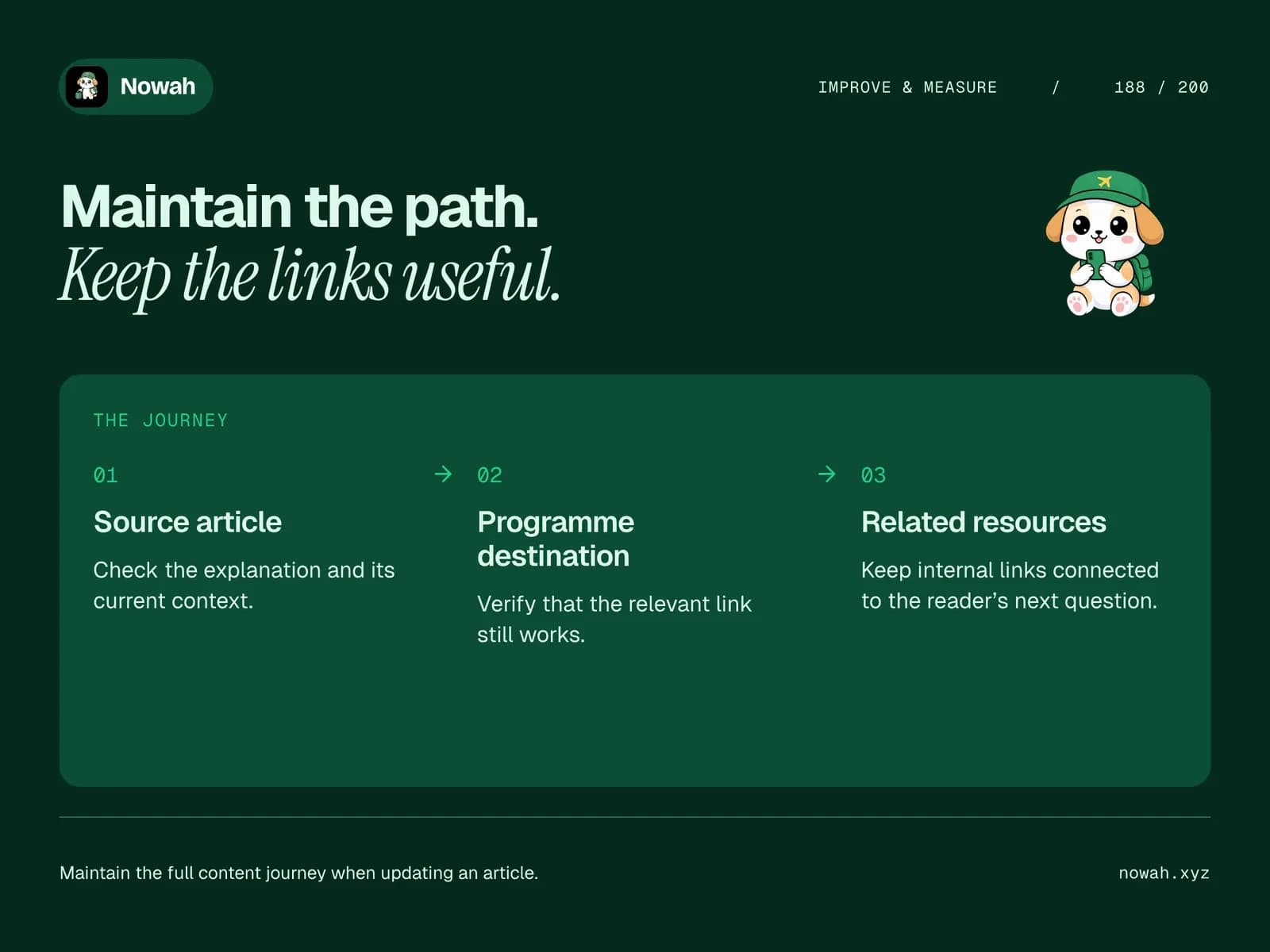
A useful link continues the question a reader is trying to answer. In a Nowah creator guide, that might mean moving from an earning explanation to attribution rules, from a hotel-review example to a planning demonstration, or from program information to an application. Maintenance means checking that the link still serves that task, as well as checking that the destination opens.
For creators building a business through Nowah Partners, this matters because the recommendation has a defined purpose. You want to explain a useful travel workflow and give an interested reader an appropriate next step. A collection of unrelated links can distract from that explanation, even when every URL technically works.
This guide provides a link-maintenance ledger for resources you have already published. It focuses on reviewing existing connections, rather than choosing the structure of an entirely new content library.
Start with the reader question around the link
Read the paragraph containing the link before opening its destination. Identify the question the reader should be able to answer next. A paragraph about separate payout currencies needs a different resource from a paragraph about the net-revenue calculation base.
Write that question in your maintenance notes. If you cannot explain why the link appears at that point, inspect whether it belongs there. A relevant resource should add something useful to the surrounding explanation, rather than serve as a generic promotional interruption.
Check the link label too. Descriptive wording helps the reader decide whether the destination matches their need. Keep the description accurate to the resource's actual scope, especially when a title or article has changed since you first linked to it.
Separate editorial links from commercial routes
Your guide may contain several link types. An internal editorial link takes the reader to another explanation. An official source supports a claim. A creator application link starts a program application. An approved active partner link serves the appropriate traveller referral journey.
Record those types separately. They have different maintenance questions. An editorial link needs a relevant resource; a source link needs current evidence; an application invitation needs the correct audience and destination. A partner link also needs to remain consistent with the route provided through the program.
Avoid treating all of them as interchangeable buttons. The promise-to-destination guide provides a separate card for choosing the right destination when the reader task itself is unclear.
Build a link-maintenance ledger
Create one row per material link. You can keep the ledger in your ordinary editorial document or content-management notes. It does not require a special Nowah integration.
Field | What to record |
|---|---|
Source resource | The article, caption or maintained guide containing the link |
Reader question | The next task the surrounding paragraph introduces |
Label | The words the reader can select |
Destination | The actual resource and link type |
Checked date | When you opened and reviewed it |
Action | Keep, clarify, replace, repair or remove |
Add a short reason for the action. “Works” is incomplete if the destination answers the wrong question. “Explains the currency threshold discussed in this paragraph” records the relationship that makes the link useful.
Check both availability and meaning
Open the destination through the published link. Check whether it loads, redirects unexpectedly or asks the reader to undertake a different task. Then read enough of the destination to confirm that it supports the promise made by your label.
A working page can still be the wrong resource. It may describe a different program, have changed its purpose or no longer contain the worksheet your guide promises. Repairing the connection can require a wording change as well as a new URL.
If no suitable resource exists, narrow the claim or remove the unsupported promise. Sending a reader to a generic homepage does not necessarily resolve the question you introduced. Keep the useful content that remains supported and make the next action clear.
A hypothetical link correction
Imagine a fictional creator maintains an article about understanding Nowah earnings. One paragraph discusses separate currency balances, but its linked resource explains the commission calculation base. Both topics are relevant to the program; they are different questions.
The creator records the mismatch in the ledger. They revise the link label and destination so the paragraph leads to the per-currency threshold explanation. The separate calculation section can still use the net-revenue definition guide where that resource answers the question in context.
This is an illustrative maintenance example, not a report of an actual site's error or a measured conversion improvement. Its value is the clearer reader path. The correction gives each explanation an appropriate place instead of making one link stand in for every program question.
Keep the Nowah demonstration connected to the article
Review the practical product example around your links. If the article explains a travel decision, the Nowah demonstration should address the same constraints and open questions. A link to another guide can then support the part that needs deeper treatment.
A hotel-area article might demonstrate how arrival timing and preferred pace affect a fictional brief. It can link to a focused guide for the demonstration method, while keeping the current article's own explanation complete enough to be useful. The one-question demonstration guide is a relevant resource for that separate production task.
This approach lets Nowah appear as part of the work the reader understands. The link strengthens the workflow rather than compensating for an unrelated product mention at the end.
Preserve current evidence for earning claims
When maintaining a source link, check the statement it supports. The Nowah Partner Program terms define the partner share as 35% of Nowah net revenue from qualifying referred bookings. The traveller's booking total is not the calculation base.
The same terms define the eligible new-account introduction and later earning conditions. A reader following a link about attribution should find the relevant rule, rather than have to infer it from a rate graphic or an application invitation.
Keep official source links alongside material claims where appropriate. Your own explanation can make those conditions easier to understand, but it should not replace the source with an unsupported summary when the details matter.
Review the actual rendered article
Inspect the published version after changing a link. Confirm that the label appears as a usable link in the intended paragraph. Check that emphasis, punctuation or another formatting change has not left a visible URL or broken Markdown text in its place.
Read the article on the publishing surfaces that matter to your audience. A link should remain understandable when a reader encounters the page on a small screen or follows a maintained resource from a newsletter. The explanation should not depend on a sidebar or caption that is absent in that version.
Keep the commercial disclosure appropriate to the recommendation. Correcting an editorial URL does not replace the explanation of a partner relationship where you recommend using Nowah.
Maintain the next action without confusing the journey
A creator ready to apply should reach the official Nowah Partners application portal. A traveller responding to an approved partner recommendation needs the appropriate disclosed traveller route. Preserve active partner links as provided instead of inventing URL changes to make them resemble your editorial links.
A click alone does not establish eligible attribution. The program requires a new eligible account within 30 days of the valid introduction, with tracking successfully reaching Nowah. Existing accounts and self-referrals do not create eligible new attributions.
After valid attribution, possible later qualifying bookings can generate earnings for the account's lifetime. Keep that commercial opportunity distinct from a claim that a repaired link has already produced income. The complete-journey measurement guide helps identify the later events.
Choose a manageable maintenance priority
Start with resources you are actively recommending, content you are refreshing and links attached to material claims. New reader questions or a changed destination can also identify a connection worth reviewing.
Record what you changed and why, then update other maintained versions that repeat the same link and promise. A short ledger can make that work more focused than repeatedly checking a list of URLs without reading their context.
Where a guide links to several useful resources, give each a distinct job. One can explain attribution, another can support a planning demonstration and another can answer a payout question. The reader should be able to see those differences from the surrounding prose.
Keep the reader path useful
Good link maintenance helps your Nowah recommendation remain a coherent resource. Check the reader question, destination, label and actual published behaviour together. Keep the useful product explanation in the article and use related guides to deepen the next task.
If you want to build this kind of creator content, apply to Nowah Partners. Prepare one helpful recommendation, connect it to relevant explanations and maintain the path as the resources evolve. Qualifying earnings come through the program's actual introduction and booking conditions; your editorial work makes that journey easier for interested readers to understand.




