Nowah vs Airalo: keep currencies and commission percentages separate
Compare Nowah and Airalo earning bases while keeping settlement currencies, separate thresholds and payment stages clear in a creator ledger.
International travel content can produce earnings records in different currencies and under different calculation rules. For creators comparing Nowah with Airalo, that creates two separate questions: what amount the commission percentage applies to, and which currency the resulting amount belongs to. Mixing them makes a comparison harder to understand and can produce misleading totals.
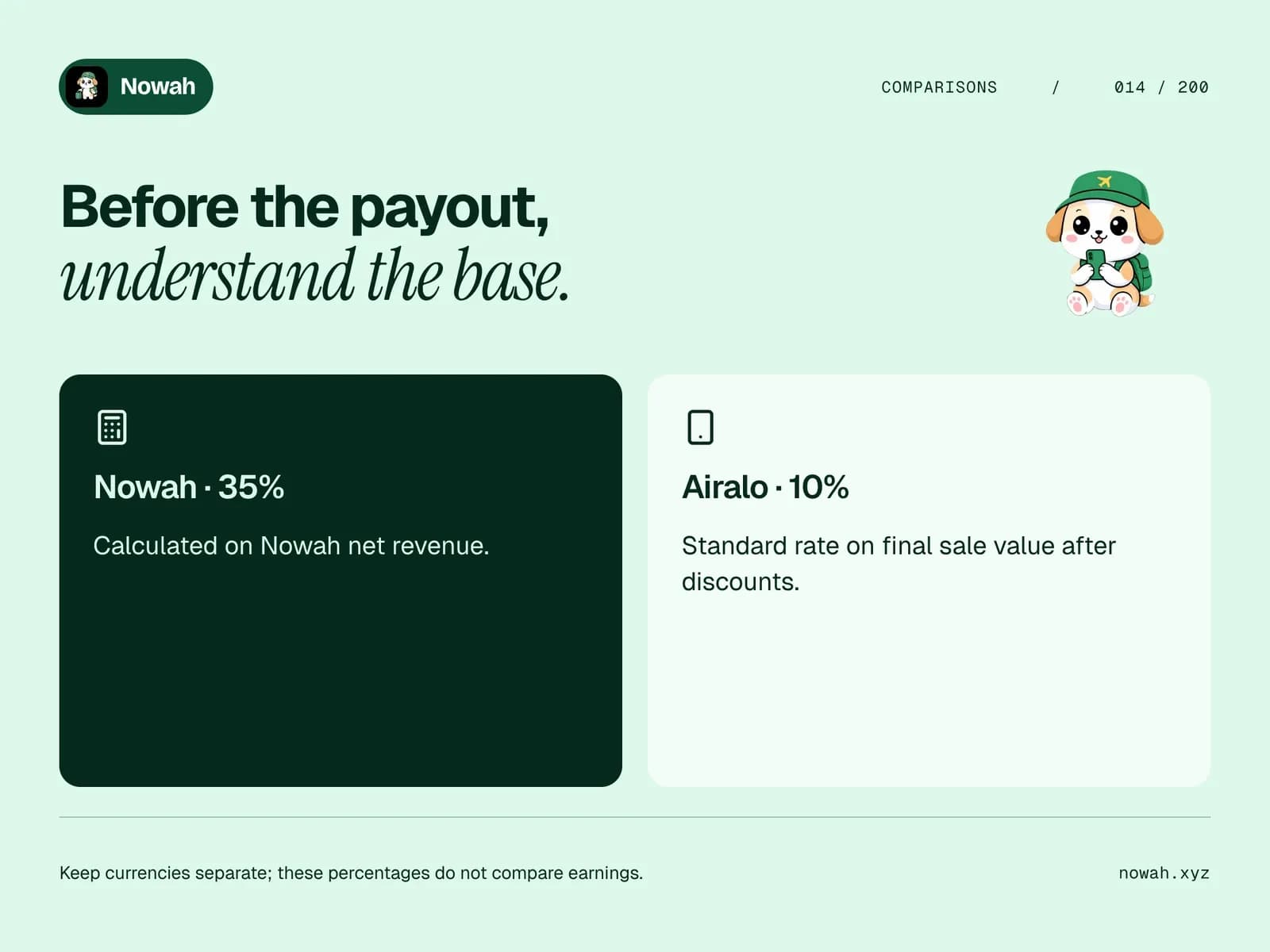
The Nowah Partner Program offers approved partners 35% of Nowah net revenue from qualifying bookings by eligible attributed accounts. Airalo's official affiliate page describes a standard 10% of final sale value after discounts, with possible variation by method. Those bases differ before any currency question is considered.
Nowah also assesses its payout minimum separately for each settlement currency. This guide provides a creator ledger you can use to keep the earning base, currency and payment stage understandable. It is an organizational example, not a recommendation about exchange rates, tax treatment or currency speculation.
Identify the base before the currency
A currency symbol does not explain what an amount represents. A traveller's retail purchase price, a platform's net revenue and an earned partner share can all be denominated in dollars while describing different things.
For Nowah, start with the definition in the current program terms. Net revenue means booking revenue actually received by Nowah, less the specified direct deductions. General overhead, salaries and general marketing are not included among those deductions.
For Airalo, use the applicable final-sale and discount conditions in your actual affiliate arrangement. The public standard rate does not establish every product-specific term or the currency arrangements available to your account.
Write the base in a separate ledger field from the currency. This makes it harder to accidentally apply Nowah's 35% share to a retail price or to treat another program's post-discount amount as if it were Nowah net revenue.
The more general Nowah versus Airalo earning-base guide includes a calculation worksheet. Here, the additional task is keeping international records and comparisons coherent.
Use independent currency examples
As hypothetical arithmetic, a qualifying booking generating US$60 of Nowah net revenue would produce a US$21 partner share at 35%. A separate hypothetical qualifying booking generating €60 of Nowah net revenue would produce a €21 share under the same formula, if that settlement situation applies.
These examples illustrate arithmetic in separate currencies. They do not establish which currencies are supported for every partner or booking. They also do not say that US$21 and €21 have equal value, can be added as one currency amount or will reach the bank at the same time.
Keep the currency unit attached to both the input and the output. A spreadsheet column labelled simply “earnings” invites confusion once the records contain more than one unit. Use the actual settlement currency and program record instead.
If you create an Airalo example, verify the applicable rate, eligible final-sale amount and currency information first. Do not invent the missing input just to make a side-by-side comparison look balanced.
Understand Nowah's separate threshold rule
Nowah's eligible payout minimum is the equivalent of US$50 for each settlement currency. The terms state that a current exchange rate is used to assess the threshold. This assessment does not merge balances or convert the booking statement into a single currency.
A creator should therefore keep different currency balances distinct. Do not combine a below-threshold balance in one currency with another balance and assume the total satisfies a shared minimum. Balances below the applicable minimum roll forward under the terms.
This is one reason an attractive percentage and a pending amount do not establish a bank-arrival date. Hold completion, verification, available settlement funds and other payout conditions also matter. The currency threshold is one stage of eligibility, not the whole payment process.
The per-currency thresholds guide explains that rule in detail. Link to it when your content needs a focused answer rather than adding an exchange-rate discussion to every travel recommendation.
Build a ledger with four separate sections
Use one section for the commercial model: program, eligible product, calculation base and applicable rate. Use a second for the statement evidence: booking or statement reference, settlement currency and the relevant recorded amounts.
The third section should describe status. Keep pending, eligible, transferred and bank-received information distinct where those stages apply and are supported by evidence. Do not count the same earning again every time it moves to a later stage.
The fourth section contains review notes: source checked, date, unresolved question and any correction or refund reference. This preserves the context behind a number without requiring you to reconstruct the agreement from an old social caption.
For a real record, use the actual program information available to you and avoid collecting unnecessary private traveller details. For a teaching ledger, label all entries fictional. Do not present a neatly formatted sample as a screenshot of genuine creator income.
Work through a fictional record review
Imagine a creator preparing an educational post about international affiliate earnings. Their sample ledger contains two separate Nowah currency examples and a blank row for a proposed Airalo comparison. The post has no measured campaign result.
The creator first checks that each Nowah row uses net revenue as the base. They retain the settlement currency, show the 35% share and label the calculated result illustrative. They do not convert the two outputs into a total because no conversion assumptions or actual payment evidence have been established.
Next, they review the Airalo row against the applicable agreement. If the current eligible final-sale amount or payment details are unknown, the row stays marked “requires verification” in the working document. The published post can explain the different model without filling that gap with an invented number.
The exercise produces a useful lesson: a transparent comparison may need fewer totals and more clearly named inputs. That is stronger commercial communication than an impressive aggregate that nobody can reproduce.
Distinguish a Stripe transfer from bank receipt
For Nowah, a transfer to the connected Stripe account is separate from a bank payout. Provider-dependent arrival times and any Stripe or bank currency-conversion charges can affect the later bank stage. The terms state that Nowah does not deduct a separate program payout fee from the earned share.
Do not turn that statement into a promise that every provider or currency conversion is free. Read the actual provider information relevant to your situation, and preserve the distinction between a program charge and an external conversion or bank charge.
Nowah also requires booking completion and verified supplier settlement, followed by a 30-day hold after the later event. Refunds, disputes and revised supplier statements can affect earnings, including after an earlier payout.
The transfer-versus-bank-arrival guide is a useful supporting resource when you need to explain why a transfer record and a bank statement may describe different stages.
Keep the creator recommendation focused on usefulness
Your audience does not need a complicated ledger to understand why Nowah may fit a travel-tech or connectivity workflow. Show a useful, labelled trip-planning example and explain how the commercial relationship works at the appropriate level.
An eligible new traveller must follow your active partner link and create a new Nowah account within 30 days of the valid introduction, with successful tracking. Existing accounts and self-referrals do not qualify. Once established, attribution continues for that account's lifetime and can apply to later qualifying bookings.
That continuing relationship is a meaningful strength for creators publishing evergreen travel advice. It is not guaranteed repeat income or a reason to forecast currency balances from follower counts. The earning model becomes relevant when the qualifying events actually occur.
The existing 20-tab planning article provides context for building a recommendation around a real planning task. A clear workflow is a better reason to introduce Nowah than a speculative earnings total.
Review a public earnings comparison before posting
Check every displayed number for its base, currency, status and source. Read the visual without its caption to see whether a viewer could mistake an illustrative amount for an actual payout. Remove any combined total that lacks a justified unit and clearly stated assumptions.
Keep program comparisons separate from personal reporting obligations. This guide does not establish what tax or accounting treatment applies to you. Use appropriate qualified guidance for those questions and rely on actual records rather than a generic creator template.
If you discuss results publicly, describe the period and evidence accurately. Pending amounts, transferred balances and bank receipts should not be presented as interchangeable proof of performance.
Make a clear earning model part of your Nowah content
Nowah offers creators a defined share of net revenue and continuing eligible account attribution. Airalo's final-sale model uses a different base and should be evaluated under its own applicable conditions. Keeping currencies separate makes both explanations more credible.
Prepare the ledger, check a hypothetical example and connect the recommendation with a useful travel task. If Nowah fits your audience, apply to Nowah Partners. Applications are reviewed, and approval, eligibility and verification requirements apply. Explain the opportunity confidently, maintain the relevant units and stages, and assess real earnings from the records when they exist.




