Nowah vs Booking.com for luxury creators: recommend the stay that fits the trip
Compare Nowah and Booking.com for luxury travel content, with a suitability card covering evidence, rooming, location and partner earnings.
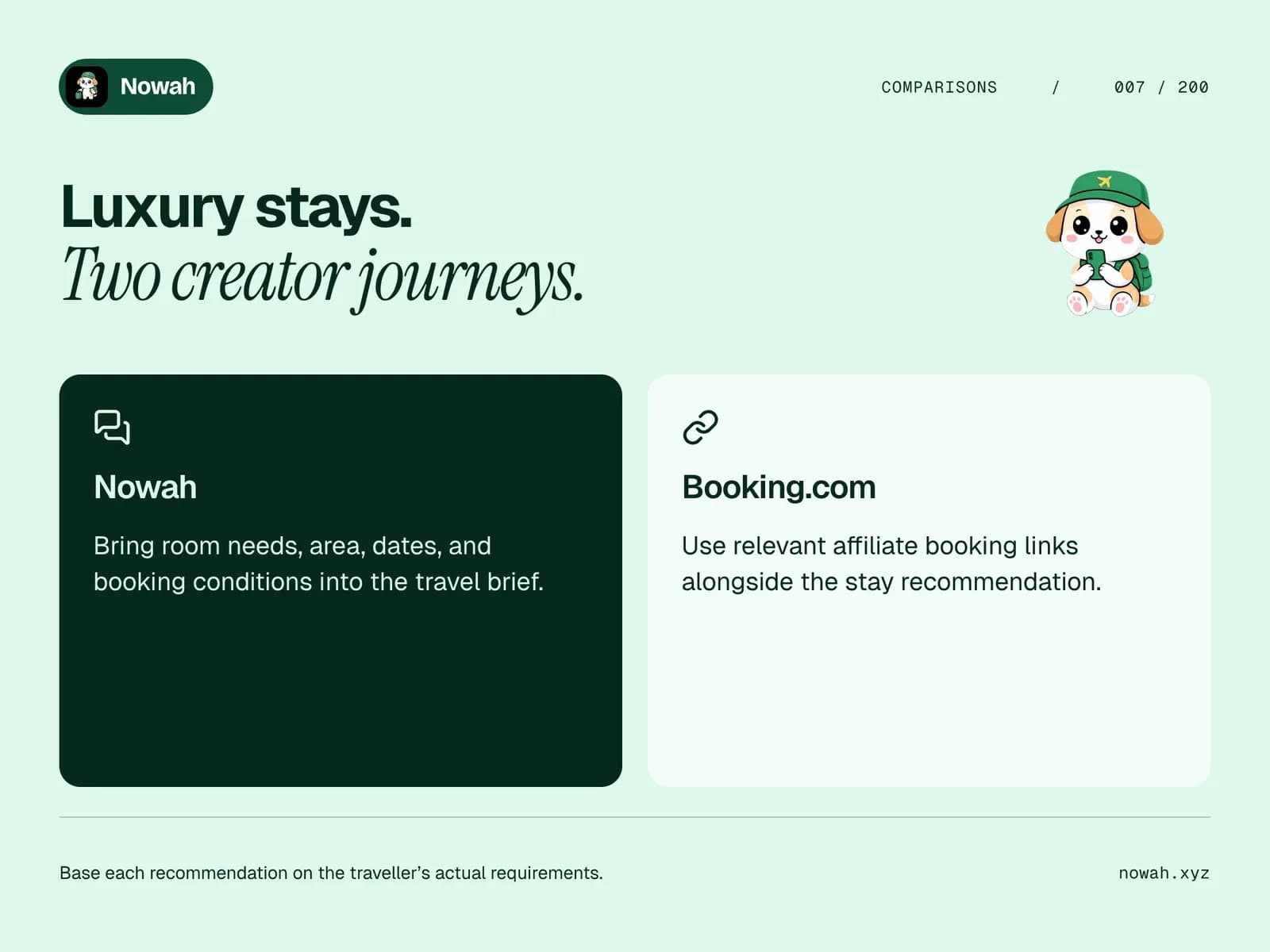
Luxury travel content becomes more useful when it explains why a stay fits a particular trip. A striking suite, a design detail or a polished resort film can attract attention, but viewers still need to decide whether the room, location and conditions suit their own plans. That is the practical starting point for comparing Nowah with Booking.com's affiliate offering.
The Nowah Partner Program gives approved creators a share of Nowah net revenue from qualifying bookings by eligible attributed accounts, including later qualifying bookings. A luxury creator can build a persuasive Nowah recommendation around a thoughtful planning demonstration, rather than suggesting expensive imagery automatically produces expensive commissions.
Booking.com's affiliate page describes links, banners and commissions on qualified bookings through its affiliate partners. Its public overview used here does not establish a numeric rate for your particular arrangement. This guide focuses on the luxury traveller's decision and the creator workflow, not an unsupported payout ranking.
Translate luxury into concrete requirements
“Luxury” is too broad to function as a complete travel brief. One couple prioritises space and a quieter pace. Another wants a particular neighbourhood and a flexible cancellation condition. A family may care more about verified occupancy and rooming arrangements than the pool shown in a film.
Ask what the traveller is trying to achieve. Identify dates, party composition, rooming needs, budget scope and the experience priorities they actually state. Avoid inferring preferences from clothing, social profiles or the price of a previous trip.
These inputs give a Nowah demonstration useful substance. You can show how a planning conversation becomes more specific as the brief improves, while keeping supplier facts subject to verification. The value lies in making the decision understandable, rather than promising privileged access or a universally best hotel.
For the underlying editorial distinction, read luxury traveller questions before search. A clear brief is a better starting asset than a list of impressive property names.
Keep your evidence in three categories
Separate what you personally observed, what a current supplier source states and what your content uses as a hypothetical example. All three can contribute to a useful luxury guide, but they carry different evidential weight.
If you filmed a suite during a hosted stay, describe that relationship clearly and limit your observations to the stay you experienced. Do not imply that every reader can book the same room with the same inclusions. An invitation, upgrade or special arrangement is not a standard benefit unless current evidence establishes that it is included for the reader's actual offer.
Supplier facts need a date and an applicable scope. Room occupancy, included meals, fees and cancellation conditions can vary by offer. Your Nowah planning example should not turn those conditional facts into universal promises.
The dedicated hosted-stay disclosure guide helps distinguish a property relationship from a separate affiliate recommendation. A reader should understand both connections when both are relevant.
Compare two possible recommendation journeys
A property-led recommendation can help someone investigate the exact hotel they have just seen. If you use a Booking.com affiliate destination for that purpose, follow your applicable agreement and describe the destination truthfully. Do not assume every program or property carries the same commercial conditions.
A Nowah-led recommendation can start with a broader question: how to structure the stay within a trip, which location priorities matter or what to investigate before comparing rooms. That journey is particularly useful when followers like your review but need a different solution for their own dates and party.
Neither approach excuses vague links. Write one sentence explaining what the traveller can reasonably do next. “Explore a current trip brief with these priorities” and “investigate this property's current offer” are different promises. The link and the surrounding content should fulfil the promise you choose.
For a wider workflow comparison, see Nowah versus Booking.com for creators. This luxury-focused article adds the evidence and suitability questions that premium content often raises.
Build a fictional premium-stay example
Imagine a clearly labelled example involving two adults celebrating an anniversary over four nights. They want a manageable pace, one main base and enough room for their stated needs. They have not requested an upgrade, a specific brand or an invented VIP benefit.
In Nowah, demonstrate how you would explain those priorities and organize the trip question. Discuss two different directions rather than declaring one hotel automatically best: a location-led stay that reduces movement and a facilities-led stay that supports more time on site.
Explain the tradeoff in plain language. Then identify what needs current verification, such as the actual room configuration, inclusions, supplier conditions and arrival arrangements. A planning output does not replace those checks.
You can make the earning connection naturally: you are a Nowah partner recommending a useful planning route, and eligible new traveller accounts may establish attribution for qualifying bookings. The explanation belongs beside the demonstration because it describes why the recommendation is commercial, not in a disconnected disclaimer paragraph at the end.
Understand why booking price does not predict your share
Nowah's partner share is 35% of Nowah net revenue from qualifying bookings. It is not 35% of the retail price of a luxury suite. The program terms define which direct deductions apply and exclude general overhead, salaries and general marketing from that deduction list.
A hypothetical booking producing $60 of Nowah net revenue would yield a $21 partner share. A more expensive room does not automatically establish a higher net-revenue amount, and the example is not a promise about the anniversary itinerary.
For Booking.com, use your actual accepted affiliate terms to establish the relevant calculation. Do not fill a comparison table with a remembered percentage or rank payouts from incomparable bases.
The luxury-versus-budget earning definition guide explains why the same Nowah definition applies across audiences. Your recommendation should favour suitability rather than the appearance of a larger commission opportunity.
Consider the ongoing account relationship
An eligible new traveller must follow your active Nowah partner link and create a new account within 30 days of the valid introduction. Tracking must reach Nowah successfully. Existing accounts and self-referrals do not qualify.
After that attribution is established, it continues for the traveller account's lifetime and can apply to later qualifying hotel, flight and paid eSIM bookings. That continuity can suit a creator publishing a body of useful travel work rather than a single campaign.
It remains conditional. A traveller may never complete a qualifying booking, and repeat income is not guaranteed. Completion, supplier settlement, the hold and payout conditions also determine when qualifying earnings can become payable. Keep these stages distinct in any public explanation of results.
Nowah's lifetime attribution guide gives readers a focused explanation without making your luxury review carry every administrative detail.
Use a luxury suitability card
Before publishing a recommendation, complete a one-page card containing the following prompts:
- What did the traveller actually ask for?
- Which rooming, location and pace requirements are known?
- Which statement comes from first-hand observation?
- Which facts depend on the actual supplier offer?
- What tradeoff does each proposed direction involve?
- What specific task will the Nowah recommendation help the traveller continue?
- Where are the relevant commercial relationships disclosed?
Include a short “not confirmed” section. It might record a connecting-room request or arrival arrangement that requires a supplier response. Showing the status accurately is more useful than replacing uncertainty with VIP language.
The existing hotel recommendation anatomy article offers useful background for thinking about the information behind a recommendation. Your suitability card should make that information accessible to the reader.
Use the card to review an example before filming. If the fictional couple prefers fewer moves, make that priority visible when you compare a central base with a property chosen for on-site facilities. Do not introduce a third option only because it looks more exclusive. Explain which unanswered supplier question would change the choice. This gives the viewer a reusable decision process and shows why their own brief may produce a different recommendation from yours. It also creates a natural reason to continue the investigation in Nowah.
Publish luxury advice with a clear commercial purpose
Review the finished piece from the traveller's perspective. They should understand the trip priorities, the evidence, the important tradeoff and the next action. If the only reason offered for choosing an option is that it looks expensive, the content needs more practical reasoning.
Nowah gives luxury creators a compelling partner model when useful planning content leads to eligible new accounts and qualifying travel. Its continuing attribution and defined net-revenue share deserve a confident explanation, with the conditions visible. You do not need invented perks or unsupported competitor claims to make that case.
Choose one premium-stay question, build the suitability card and prepare a labelled demonstration. If the workflow fits your audience, apply to Nowah Partners. Applications are reviewed, and approval, eligibility and verification requirements apply. Build your recommendation around the traveller's actual decision; the earning story can then support a relationship worth maintaining.




