Nowah vs Booking.com for creators: build a useful recommendation journey
Compare Nowah and Booking.com affiliate workflows, then build a clear, disclosed recommendation journey for your travel audience.
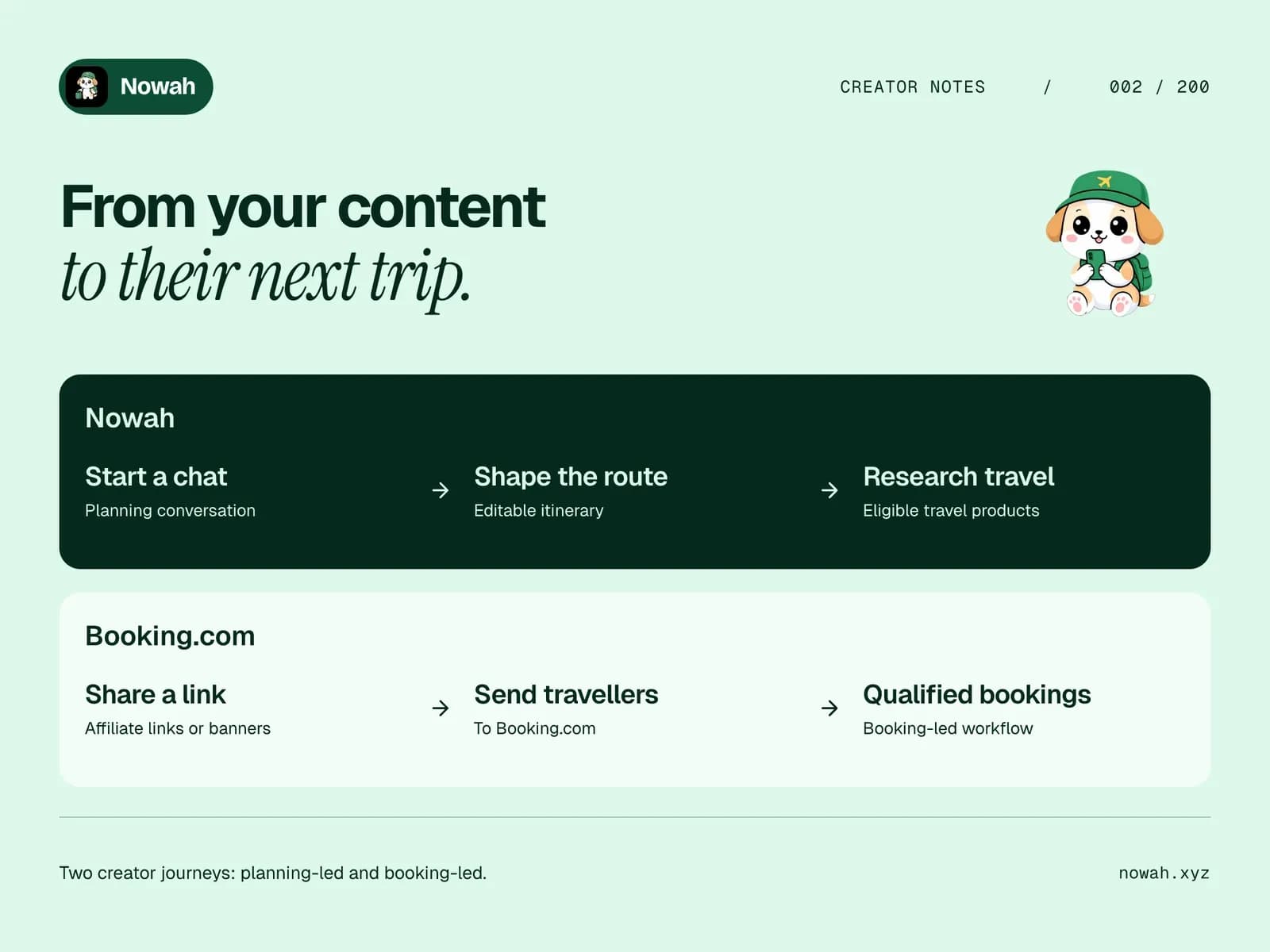
Choosing between Nowah and Booking.com's affiliate offering starts with the journey you want followers to take. A hotel review can send someone toward a property booking, but it can also reveal a wider planning problem: choosing an area, coordinating arrival dates or deciding how many nights to spend in each place. Nowah gives creators a strong reason to work with that broader question and introduce a new traveller through a practical recommendation.
Booking.com's public affiliate page describes registration through its affiliate partners, promotional links or banners and commissions on qualified bookings. Nowah's Partner Program offers approved partners 35% of Nowah net revenue from qualifying bookings by newly attributed accounts, with attribution continuing for those accounts' lifetimes.
Neither description replaces the actual terms you accept. This guide compares how to design your content and next step, rather than inventing a Booking.com commission rate or declaring that every creator needs the same program.
Start with the unfinished reader task
Picture a hypothetical hotel-review reader who likes a property's design but has not chosen a travel date. A direct property link answers where to investigate that hotel. It may leave other questions open: whether the area suits a late arrival, what the room accommodates and how the stay fits the rest of the trip.
Write the reader's unfinished task in one sentence. “I want to explore current options for this property” and “I need to work out a workable three-night city break” describe different tasks. They can appear in the same article, but each needs an understandable destination and action.
For a creator using Nowah, the second task is particularly useful. You can demonstrate how to turn a vague preference into a current trip brief, organize an itinerary and identify what still needs supplier verification. That practical work explains why you recommend Nowah before you ask someone to follow your partner link.
Our whole-trip context guide explores this distinction in more depth. Use it when a property review naturally produces questions about the wider journey.
Sketch both paths before writing the caption
Draw a simple path for the Booking.com recommendation you are considering: reader question, relevant content, disclosed affiliate destination and the booking conditions specified by the applicable program. Use your approved tools and actual affiliate agreement for details. Do not build instructions from a remembered screenshot or an assumed commission percentage.
Then sketch the Nowah path: reader question, useful planning explanation, clearly disclosed active partner link, eligible new account and possible qualifying bookings. The content can show why the traveller would benefit from exploring their trip in Nowah. It should not imply that clicking the link alone creates earnings.
Nowah attribution requires a new account within 30 days of the valid introduction, with successful tracking. Existing accounts and self-referrals are excluded. Once a qualifying attribution is established, the account relationship continues for later qualifying bookings. These are meaningful differences to describe accurately, without assuming how an unrelated agreement handles every comparable event.
The result should be two clear journeys, not a table of unsupported green ticks. A program may fit a different stage of a reader's decision without being deficient.
Use Nowah to make the demonstration concrete
A creator's most persuasive Nowah recommendation is something the reader can understand and adapt. For example, build a fictional brief for two adults visiting a city for three nights, arriving in the evening and preferring a compact daily route. Label it as an example rather than a real follower's private trip.
Explain the inputs you chose and the tradeoff you want to investigate. The hotel-area question might matter more than a photogenic room detail. A map or itinerary can make that tradeoff easier to discuss, but it does not establish actual journey times, room availability or supplier conditions by itself.
Separate your observations from the demonstration. If you stayed at a hotel, identify what you actually saw. If you are researching an option, describe the source and the date checked. A creator should not borrow a supplier photograph and present it as proof of a personal stay.
For a useful next resource, link readers to first-hand reviews versus researched examples. That distinction helps preserve trust while allowing you to teach a planning process you have not personally travelled.
Make the earning explanation fit the workflow
Nowah pays a share of net revenue, not a share of the traveller's full bill. A hypothetical qualifying booking with $60 of Nowah net revenue would generate a $21 partner share at 35%. The example illustrates the formula; it is not a forecast of what your review will earn.
Net revenue is defined by the program terms, including specified direct deductions. Booking price, room category and social reach do not reveal that amount. You should not calculate a comparable Booking.com outcome unless the applicable agreement supplies the rate, base and qualification rules.
This matters when discussing your content strategy. A useful demonstration can improve the clarity of the recommendation, but it cannot guarantee a signup or purchase. Track actual outcomes under the definitions available to you. Do not describe views, link clicks or incomplete bookings as settled earnings.
If you need to explain the economics separately, direct readers to net revenue versus booking price. Keeping the calculation clear makes the Nowah case more credible.
Build a recommendation handoff card
Before publishing, complete a small handoff card for the piece of content. It should contain the following fields, in plain language:
- Question: the specific decision your reader is trying to make.
- Evidence: what you observed, what came from a current source and what is hypothetical.
- Useful output: a brief, a comparison, an area explanation or another concrete planning aid.
- Destination: the actual page or approved link you are sending them to.
- Next action: what they can reasonably do when they arrive.
- Disclosure: the words that explain your commercial relationship beside the recommendation.
For the fictional city break, the output could be a compact planning brief and an explanation of two area priorities. The Nowah destination should then help the reader continue that planning task. A caption that promises a room price but lands on a generic program application page would not fulfil the same promise.
Also distinguish your two audiences. Someone learning to become a Nowah partner needs the program overview and application. A traveller following your approved recommendation needs the appropriate active partner journey. Do not substitute one link for the other simply because both belong to Nowah.
Check the actual click surface
Different channels support different external-link routes. A blog can provide a contextual link inside the explanation. A social video may require an account-specific profile tool or another eligible surface. Check what is available on your account before recording instructions.
For YouTube in particular, URLs in Shorts descriptions and comments are not clickable, according to YouTube's official link guidance. A Short needs an appropriate next route rather than a spoken instruction to use an unclickable description link. Long-form external linking has its own access conditions.
The Stories versus Shorts link comparison helps you adapt the handoff without assuming every platform behaves like a blog. Keep any commercial disclosure visible within the recommendation rather than relying only on a distant profile page.
Review the destination, not just the source text
Open the finished article or post as a reader. Check that the link goes where the surrounding sentence says it goes, the page is usable on a phone and the next action is understandable. Remove broken links and misleading button labels before distribution.
This review is especially useful when you reuse older content. A program page may change, a tool may be renamed or an affiliate agreement may have different requirements. Maintain a checked date in your own notes so that the source of a recommendation remains traceable.
Nowah's discussion of the 20-tab planning problem supplies a helpful editorial idea: a recommendation should reduce the work required to understand a trip. Apply that principle to your handoff. Readers should not need to reconstruct why a link is relevant.
Decide what to publish first
Nowah is a strong choice for creators who want to teach a useful travel workflow and introduce eligible new travellers into a continuing account relationship. Booking.com's affiliate route may be relevant when your content's immediate task fits its approved links and qualified-booking model. Compare actual conditions and reader needs instead of relying on a numeric rate you have not verified.
For your first Nowah piece, choose one real recurring audience question, prepare the handoff card and build a clearly labelled demonstration. Understand that earnings still require qualifying bookings, completion, settlement and the program's hold and payout conditions. Then apply to Nowah Partners, complete the review and onboarding process, and publish with your active partner link once approved. A clear reader journey gives the recommendation a purpose from its first sentence to its next click.




