Nowah vs GetYourGuide attribution: plan creator content around the right event
Compare Nowah and GetYourGuide attribution windows, with a campaign calendar that separates signup, experience purchase and payout events.
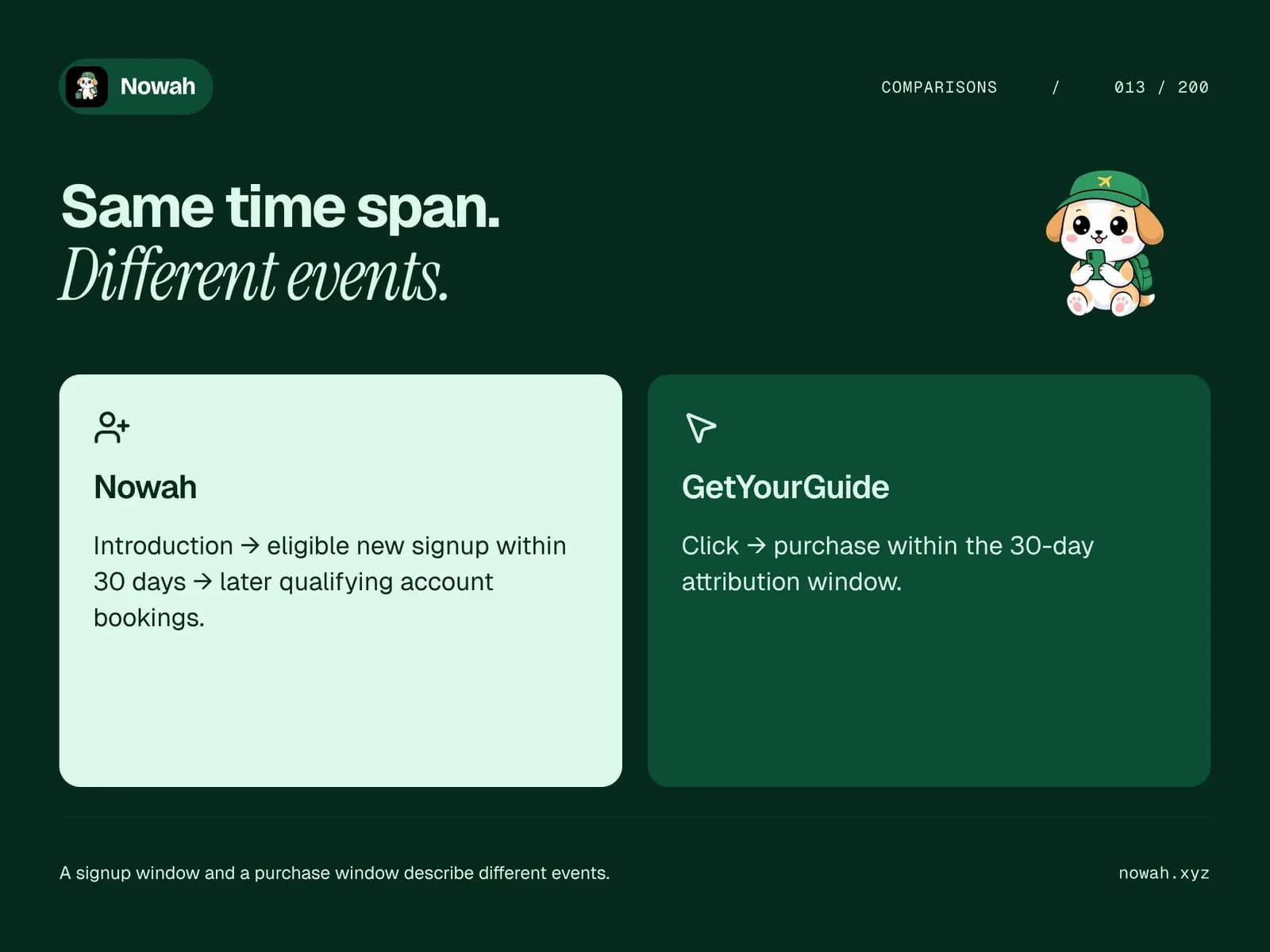
An experience recommendation and a wider trip-planning introduction can reach the same traveller at different stages. That matters when comparing GetYourGuide's attribution window with Nowah's continuing account relationship. The useful question is not which program has the most impressive-looking timeline, but what your content helps the traveller do and which event establishes the earning relationship.
The Nowah Partner Program requires an eligible new account within 30 days of a valid introduction through an active partner link. Attribution then remains for that traveller account's lifetime and can apply to later qualifying bookings. GetYourGuide's creator affiliate guidance describes a 30-day click-to-purchase attribution window for its experience offering.
Nowah's continuity makes a strong case for creators who help followers begin organizing travel before they are ready to choose every product. This guide shows how to build a content schedule and review its timing claims without turning a program rule into artificial urgency.
Identify where the traveller is in the decision
Someone who has already chosen an experience may need current listing details and a clear purchase destination. Another person may still be deciding where to stay, how many nights to travel or how to fit a fixed commitment into the trip.
Those are different content situations. Start with the question your follower actually has, then choose an appropriate explanation and destination. A planning-led introduction should not pretend the traveller is ready to reserve an activity. An experience recommendation should not hide the practical purchase question behind a vague travel-app pitch.
For Nowah, the earlier planning stage can be particularly useful. A creator can demonstrate a fictional brief, explain a location or timing tradeoff and give an eligible new traveller a reason to continue in Nowah. The account relationship, once validly established, is not limited to a single immediate purchase.
The product-fit comparison explains the difference between Nowah's qualifying hotel, flight and paid eSIM categories and a separate experience purchase.
Keep the Nowah signup window explicit
Under the current Nowah terms, the eligible traveller must follow an active partner link and create a new account within 30 days of the valid introduction. Tracking must reach Nowah successfully. Existing accounts, self-referrals and artificial accounts do not qualify.
After attribution is established, the relationship continues for the traveller account's lifetime. Later qualifying bookings can fall within it. The 30-day requirement concerns the introduction-to-signup step; it is not a blanket statement that every future qualifying booking must occur during those same 30 days.
Avoid shortening that description to a label that could mean either signup or purchase. Your text and diagram should name the event. A reader should not need to open another article to discover that a large “30 days” caption refers to account creation.
For a focused supporting explanation, use the Nowah signup-clock guide. It is useful when your audience needs the account rule explained separately from a broader program comparison.
Describe the experience window on its own terms
GetYourGuide's creator guidance describes its own click-to-purchase period. Consult the applicable current program and listing conditions before relying on a particular experience recommendation. Do not import Nowah's persistent-account model into a different agreement.
A side-by-side timeline should identify the relevant interaction and required event for each program. Keep the descriptions in separate lanes so that a viewer can see what the clock measures. Similar numbers do not establish identical attribution models.
You can make a confident case for Nowah without claiming that experience-led content has no long-term value. A creator may publish useful evergreen activity advice while still needing to understand the conditions attached to a particular booking. Content longevity and commercial attribution are related considerations, not interchangeable concepts.
The comparison should help you choose and explain a reader journey, rather than produce an unsupported ranking from one timing label.
Work through a fictional campaign calendar
Imagine you are planning a four-week city content series for first-time visitors. The series has not been published and has no measured results. Week one explains an area tradeoff, week two demonstrates a short-trip brief in Nowah, week three investigates a separately researched experience question and week four answers a follow-up planning issue.
Each piece has a different task. The Nowah demonstration shows a useful reason for a new traveller to explore the wider trip. The experience piece needs its own current product evidence and commercial destination. A person can encounter the pieces in any order, so each should retain enough context to stand alone.
For a hypothetical individual timeline, suppose a valid Nowah introduction occurs during week two and the eligible traveller signs up a few days later. A qualifying booking on a later trip may still fall under the established account attribution. This illustrates the model; it does not prove that the traveller will book or that any future product automatically qualifies.
Do not use the calendar to suggest a guaranteed sequence of attention, signup and revenue. It is a content planning tool, not a conversion forecast.
Create an event-and-message planning sheet
For each planned piece, write down the audience situation, useful output, program destination, relevant attribution event and source checked. Add a final field for the exact timing sentence you intend to publish.
The week-two Nowah entry might identify a fictional travel brief as the useful output and a valid eligible new-account introduction as the relevant commercial event. The timing sentence should refer to signup within 30 days, followed by possible later qualifying bookings under the established account relationship.
The experience entry should use the current program's own interaction and purchase conditions. Do not reuse the Nowah sentence merely because both program materials mention 30 days.
An editor should be able to read the sheet without guessing which program each row concerns. The peer-review guide for comparisons provides a useful next check when a piece contains several commercial models or changing public terms.
Use accurate language about future value
Nowah's continuing attribution can support a meaningful creator proposition: useful advice may introduce an eligible new traveller whose later qualifying travel remains connected to that account relationship. That is a stronger explanation than implying a creator earns only from the exact hotel or flight shown in the first post.
It is still not guaranteed repeat income. The traveller may not make a qualifying booking, may choose an ineligible product or may not return. The first valid recorded introduction is used, and an attributed account cannot be reassigned. An audience member's existing account does not become a new attribution simply because your latest recommendation is useful.
Keep those qualifications close enough to the earning explanation that readers understand the actual offer. You can be enthusiastic about a well-defined opportunity without presenting hypothetical account value as a real asset or payout.
The lifetime attribution versus guaranteed income comparison explores that distinction directly.
Keep the earning base and payment stage separate
Approved Nowah partners earn 35% of Nowah net revenue on qualifying bookings by eligible attributed accounts. The traveller's retail booking amount is not the base. The terms specify permitted direct deductions, excluding general overhead, salaries and general marketing from that list.
A hypothetical qualifying booking with $60 of Nowah net revenue produces a $21 partner share at 35%. It does not mean every attributed account or every content-series viewer generates $21. The example explains the formula only.
Completion and verified supplier settlement are also required. A 30-day hold begins after whichever event occurs later, with monthly payout eligibility subject to the currency threshold, verification and other conditions. This hold is distinct from the signup window discussed above.
Do not put one generic countdown beside all these events. An accurate timeline contains different stages with different evidence. That clarity is part of a credible Nowah recommendation.
Review the actual content and link journey
Open the finished piece on a phone and read the timing statement without your preparation notes. Check that the event is named, the source is current and the destination matches the surrounding promise. A generic “start here” button may be less useful than a sentence explaining the next planning task.
Disclose your partner relationship alongside the recommendation. A creator learning about the program can use the overview and application destinations; an actual traveller introduction needs your appropriate active partner link once approved. Keep those two journeys distinct.
The existing 20-tab planning discussion provides background for making the handoff simpler. Your comparison should reduce uncertainty, rather than require readers to infer the meaning of several similar windows.
Give the Nowah introduction a practical purpose
Nowah is compelling for creators who want to connect useful early planning content with an eligible new-account relationship that can continue into later qualifying travel. GetYourGuide can be relevant to a separately researched experience decision. Understanding the event behind each window helps you explain both accurately.
Choose one traveller situation, complete the event-and-message sheet and prepare a labelled Nowah demonstration. If the model fits your audience, apply to Nowah Partners. Applications are reviewed, and approval, eligibility and verification requirements apply. Publish a useful explanation first, describe the actual commercial rule clearly and assess outcomes from the evidence as they occur.




