Understand Nowah's 30-Day Signup Window
Understand Nowah's 30-day introduction-to-signup window, separating eligible account creation from future bookings, the earning hold and payout timing.
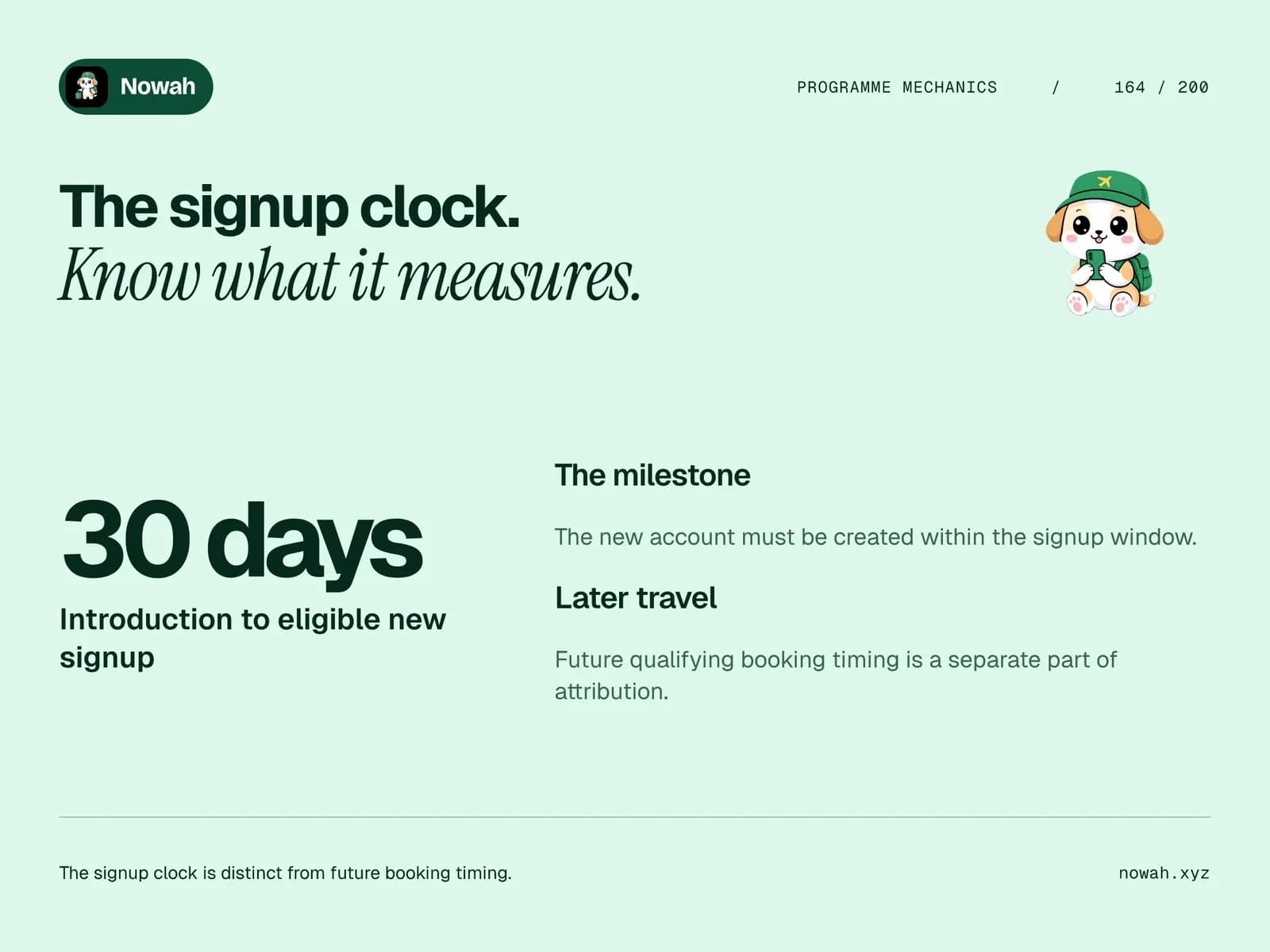
The Nowah Partner Program includes a 30-day requirement, but it applies to a particular event: an eligible new traveller account being created after introduction through an active partner link.
It is not a blanket instruction that every future booking must happen within 30 days. Keeping that distinction clear helps creators explain the continuing account-attribution opportunity accurately.
Approved Nowah partners can earn 35% of Nowah net revenue from qualifying bookings by eligible accounts they introduce. Once valid account attribution is established, later qualifying travel may generate earnings for the account's lifetime. The opportunity still depends on the program conditions and does not guarantee future bookings or income.
Identify the event that starts the signup question
The Nowah terms require a traveller to follow an active partner link and create a new account within 30 days of introduction. Tracking must successfully reach Nowah.
Do not substitute the date a video was uploaded, an article was published or a link was first added to your profile. Those dates describe your content, not necessarily the relevant recorded traveller introduction.
Likewise, a general product page visit or a creator application is not automatically the active-link introduction described by the program.
For a real eligibility question, use the actual program evidence. A public comment saying that someone saw your post does not establish the recorded event or the account timing.
The first-valid-introduction guide develops the priority and recording rule in more detail.
Keep account creation separate from booking
The account-creation window establishes one part of eligible attribution. A later qualifying booking is a separate event.
Once an account is validly attributed, later qualifying bookings may generate partner earnings throughout its lifetime. Do not tell travellers that they must complete every future purchase inside the initial signup window.
This is a useful strength of the model for creators. A relevant introduction can remain associated with the account beyond one immediate trip, while actual future travel remains uncertain.
The program does not guarantee a booking simply because the account was created in time. The traveller might investigate a plan and choose not to book.
The lifetime-attribution guide explains that continuing relationship separately from the initial timing requirement.
Do not confuse three different clocks
A clear explanation distinguishes the signup window, the earning hold and the payout process.
The signup question concerns introduction and creation of an eligible new account. The hold begins after the later of booking completion and supplier settlement. Monthly payout eligibility involves the remaining conditions, including separate currency thresholds and relevant verification.
These are different timing concepts. Calling all of them a “30-day payment window” would obscure the events the terms actually describe.
A content view, an eligible account and a completed booking should have separate places in your notes. Do not collapse them into one referral date.
The 30-day hold guide develops that later clock, including why completion and settlement both matter.
Use a three-clock worksheet
Create an explanatory worksheet with a row for each timing question. Record:
- The event or condition involved.
- What starts the relevant timing question.
- What later event needs to occur.
- The evidence establishing those events.
- The status that remains unresolved.
- The statement you can accurately make.
This worksheet is a creator-maintained teaching tool, not a claim that Nowah provides a particular timing dashboard.
For the signup row, do not invent a boundary-minute, timezone or extension rule that your source does not establish. Use the actual program record and official clarification for an individual uncertainty.
For the later rows, preserve completion, settlement, hold and processing as separate conditions. A date on one event does not prove the next stage has occurred.
The worksheet's value is clarity about which question you are answering.
A fictional account created within the window
Imagine an approved creator publishing a useful arrival-day explanation. This is a hypothetical example, not a real account or earning result.
Assume an eligible traveller follows the active partner route, tracking successfully reaches Nowah and the new account is created within the required introduction-to-signup period.
Under those stated assumptions and the other terms, valid attribution can be established. A later qualifying booking may produce earnings under the continuing account relationship.
The example does not promise that a booking occurs, infer an earning amount or claim that a payment is immediately due.
If you label an illustrative sequence with relative days, make clear that the labels are a teaching device. They should not be treated as a substitute for the actual recorded dates or a determination of a boundary case.
A fictional incomplete timing record
Now imagine that a creator knows when their article was published but has no evidence of when a particular traveller followed the active partner route or created an account.
The article's publication date cannot fill those missing fields. The correct conclusion is that the known information does not establish the individual's timing status.
Do not label the case eligible or ineligible based only on a public interaction. Do not invent an extension or advise the person to create an artificial duplicate account.
For a real question, identify the relevant event and use the official support route with appropriate context. A general guide can explain the rule but cannot decide a specific account from incomplete evidence.
This approach preserves the difference between a useful explanation and an unsupported attribution claim.
Avoid false urgency in promotional content
A clear next action should reflect the rule accurately. Do not create pressure by claiming that a traveller must book an entire holiday within the signup window if the terms do not say that.
Likewise, do not suggest that an existing account becomes newly eligible by clicking again before a deadline. Existing accounts and self-referrals are excluded, and an attributed account cannot be reassigned.
The legitimate message is that an eligible new account must meet the introduction and signup conditions. After valid attribution, later qualifying bookings remain a separate question.
A useful travel recommendation can explain why Nowah helps a reader investigate their brief without inventing urgency, savings or guaranteed earnings.
The clear partner-disclosure guide helps keep the commercial relationship understandable alongside that recommendation.
Keep the rest of the earning conditions visible
The 35% share applies to Nowah net revenue, not the traveller's full booking spend. Qualifying categories include hotels, flights and paid eSIMs under the terms, with complimentary flight-perk eSIMs excluded.
Booking completion and verified supplier settlement are both necessary before the hold and payout conditions can be satisfied. A signup inside the window does not establish paid commission.
Monthly eligibility also depends on separate per-currency thresholds and other requirements. A transfer to the connected Stripe account is different from a bank payout and its arrival timing.
These conditions should not crowd out the useful travel lesson, but the lesson must not contradict them. If you use an earning example, label the assumptions and name the correct base.
No particular booking volume, repeat travel or income is guaranteed.
A useful wording test is to ask which action the sentence appears to require. If it tells the reader that every booking must happen within the initial period, it has changed the rule. If it says that a valid new account must be created within the introduction-to-signup window and that later qualifying bookings are separate, it preserves the distinction. Read the sentence without the surrounding article as well. That helps catch a shortened graphic or caption that accidentally creates a different promise from the fuller explanation.
Make the original recommendation useful
The timing rule is not a reason to publish a vague link pitch. Give the audience a practical reason to consider Nowah.
A fictional brief might demonstrate how an early departure changes a day plan or how a fixed event affects a hotel-move choice. Verify the product behaviour before describing it.
Keep supplier-dependent facts separate from the planning example. A suggested sequence does not confirm a room, transport arrangement or rate condition.
Nowah's article about the trust involved in AI-assisted travel booking provides background for clear explanations. Your own content should still show why the product fits the decision at hand.
Tell the audience that you are a Nowah partner and may earn commission from qualifying referrals, and check the actual destination before publishing instructions.
Review the timing words before publication
Search the draft, graphic and spoken script for every mention of days, signup, booking, hold and payment. Check that each refers to the right event.
A short caption or graphic can lose the distinction even when the longer article explains it correctly. Preserve the relevant qualification in the format where the claim appears.
For real account questions, use actual records and the official clarification process rather than a hypothetical calendar from an article.
If useful travel recommendations fit your work, apply to Nowah Partners. Understand the signup clock before promoting the continuing-attribution opportunity. A precise explanation gives travellers a clear next step without turning an account-creation rule into a false booking deadline.




