Nowah vs Viator attribution: understand the signup clock and the booking clock
Compare Nowah and Viator attribution timelines, separating new-account signup, experience purchases, later qualifying bookings and payout conditions.
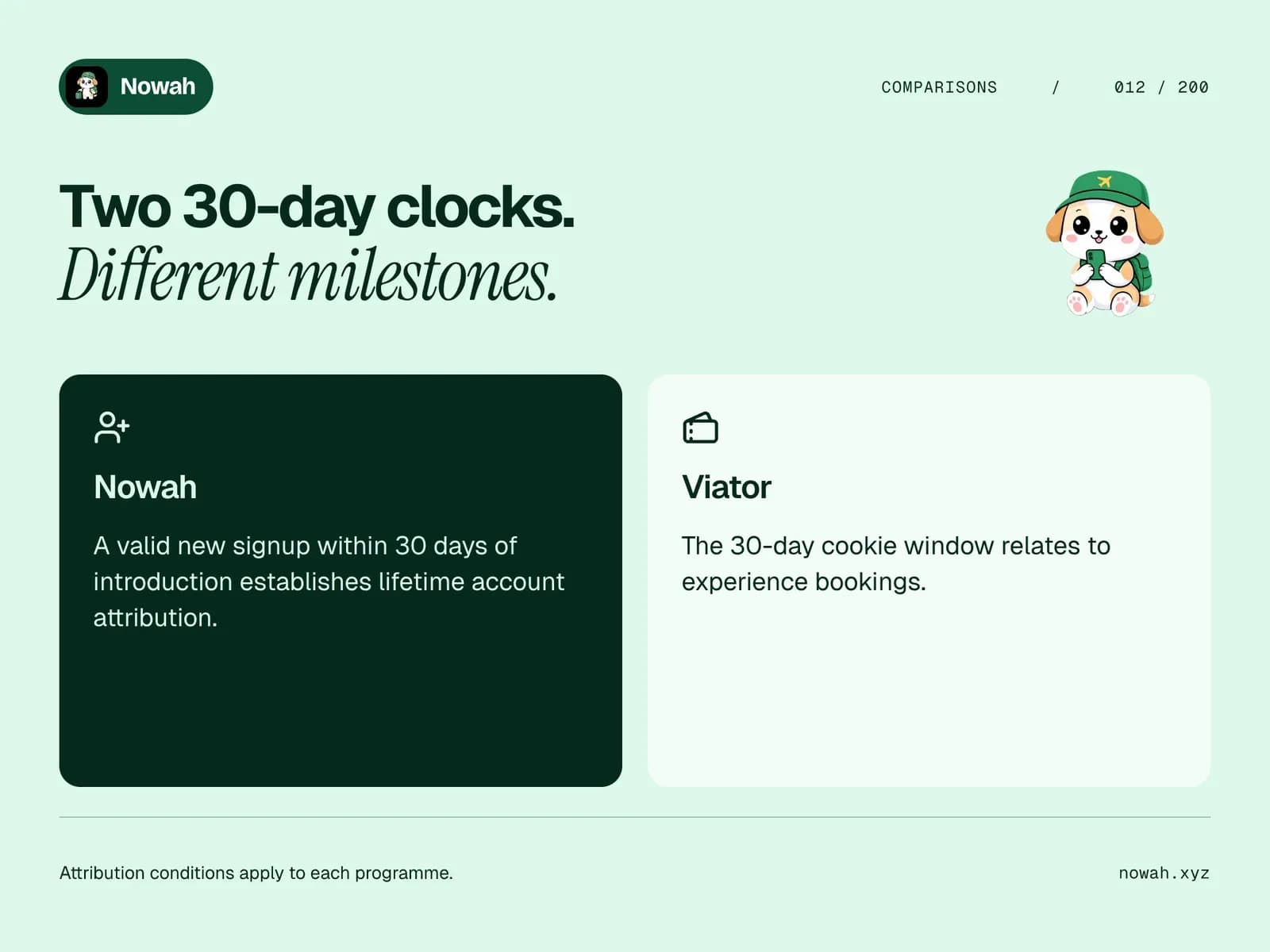
Two partner programs can both mention 30 days while measuring different events. That is the important distinction for creators comparing Nowah's account attribution with Viator's experience-booking tracking. A window for creating an eligible new account is not automatically a deadline for every later booking.
The Nowah Partner Program requires an eligible traveller to create a new account within 30 days of a valid introduction through an active partner link. Once established, that account attribution continues for the traveller account's lifetime and can apply to later qualifying bookings. Viator's creator resources describe its own 30-day tracking model for experiences.
Nowah's continuing relationship is a meaningful strength for creators whose recommendations help people start planning before they are ready to buy. To explain that advantage accurately, keep the introduction, signup, booking and payment events separate. This guide provides a timeline worksheet for doing exactly that.
Put an event beside every reference to time
A number of days does not explain itself. Ask what starts the clock, what must happen before it ends and what happens after the qualifying event. Without those three details, “30-day attribution” can mean several different things to a casual reader.
For Nowah, the current program terms identify the valid introduction and new-account signup. The traveller must create the eligible new account within 30 days. Tracking must reach Nowah successfully; sharing a link alone does not prove that an attribution was recorded.
For Viator, consult the current creator conditions attached to the experience recommendation. The program's tracking language concerns its own booking model. Do not substitute Nowah's account rules for those conditions or assume that two similar labels create identical rights.
A comparison graphic should name the event in the same line as the time period. That keeps the most important distinction visible when someone shares the image without its surrounding article.
Draw a fictional Nowah timeline
Use a clearly hypothetical example. On day one, a traveller follows a creator's active Nowah partner link as a valid introduction. On day twenty, they create an eligible new Nowah account, with tracking successfully recorded. On day ninety, they investigate a booking for another trip.
The day-twenty signup falls inside the example's 30-day introduction-to-signup window. Once the account attribution is validly established, a later qualifying booking can fall under that continuing relationship. Day ninety is not automatically disqualified merely because it occurs more than 30 days after the original introduction.
The example does not prove that the later booking qualifies. Product eligibility, account status and the other terms still apply. Nor does it report an actual creator's result. Its purpose is to show which clock the signup rule concerns.
The signup-window versus booking-window guide offers a focused explanation you can share with readers who confuse those two stages.
Draw the experience-program timeline separately
When explaining Viator, start a separate timeline using the events and conditions in its current creator agreement. Identify the relevant tracked interaction and the experience purchase the program requires. Verify how the stated window applies before publishing an example.
Do not put a generic infinity symbol beside one program and a closed door beside the other without context. Nowah's lifetime account attribution concerns qualifying bookings by an attributed account. Viator's experience focus addresses a different product decision and tracking model. Those differences deserve a clear explanation rather than an exaggerated winner graphic.
You can make a reasoned case for Nowah's continuity without inventing a competitor limitation. The reader should understand why an early planning introduction can matter to your Nowah content strategy, not be told that every other program stops being useful after a particular number of days.
For the product distinction, use Nowah versus Viator: what earns. This timeline article stays focused on when the relevant events occur.
Check whether the account can qualify
An audience member's interest does not establish eligibility. Nowah excludes existing accounts, self-referrals, artificial accounts and fraudulent introductions. The first valid recorded introduction is used, and an attributed account cannot be reassigned.
That means a returning Nowah user who clicks your new review does not become a newly introduced account. Your own booking is not an eligible self-referral opportunity. A creator should explain these exclusions clearly instead of promising to earn from every viewer who likes the content.
Avoid unsupported assumptions about cross-device behaviour, native installations or tracking recovery. The public terms require tracking to successfully reach Nowah; they do not establish that every possible journey has been recorded. Use the actual evidence available through the program and ask support about a specific discrepancy when necessary.
The new accounts versus existing accounts guide is a useful next resource when you need to teach eligibility separately from the timeline.
Connect the timing to a useful content strategy
Nowah's account relationship can fit content that helps someone begin planning before they have chosen every product. A creator might explain an area tradeoff, show a fictional trip brief and recommend Nowah as a way to continue organizing the journey.
That recommendation has a practical purpose even when the traveller is not ready to book immediately. An eligible new account established within the introduction window can remain attributed for later qualifying travel. This is a compelling reason to create useful evergreen content rather than rely only on last-minute purchase pressure.
Do not turn the window into an artificial urgency claim. Your content should explain the actual rule, not invent a countdown or imply the traveller must buy a holiday within 30 days. A precise description gives the reader more control over the decision.
The one-link versus clear-next-step guide shows how to make the handoff understandable without treating the link itself as the useful content.
Keep earnings maths out of the wrong event
A signup is not a commission payment. Approved Nowah partners earn 35% of Nowah net revenue from qualifying bookings by eligible attributed accounts. The traveller's full retail price is not the calculation base.
For a hypothetical arithmetic example, a qualifying booking producing $60 of Nowah net revenue would yield a $21 partner share. That does not mean an attributed account is worth $21, or that the fictional day-ninety investigation generates any money. The booking and its actual net-revenue amount must exist before the formula describes an earning event.
Nowah's terms also require completion and verified supplier settlement. A 30-day hold begins after the later event, followed by the applicable monthly eligibility and payout conditions. That hold is another separate clock, not a second version of the signup window.
Read the 30-day hold explanation when your content needs to connect attribution with eventual payout eligibility.
Build a timeline worksheet with distinct rows
Use a worksheet with one row for each event, rather than one vague “conversion date.” Include the following fields:
- Introduction or tracked-interaction date, with the program named.
- Required qualifying event and the rule that applies to it.
- Signup date where the account model requires it.
- Booking date and relevant eligible product.
- Completion and settlement status where applicable.
- Earnings or payout status supported by actual records.
- Current source, checked date and any unresolved question.
For a teaching example, label every invented date as hypothetical. For real records, use the evidence available through the relevant program and avoid collecting unnecessary private traveller information. A missing event should stay missing until it can be verified.
This format makes it easier to identify a genuine question. “The signup date appears outside the stated window” is more actionable than “the referral did not work,” because it names the event requiring investigation.
Review the explanation from a new creator's perspective
Ask someone unfamiliar with the programs to read the timeline. They should be able to tell which clock concerns signup, which concerns an experience purchase and which concerns earnings release. If all three appear to be the same deadline, simplify the wording before publication.
Also test the commercial handoff. A creator learning about Nowah Partners needs the program overview and application. A traveller following your approved recommendation needs the appropriate active partner route. A timeline diagram should not blur those separate destinations.
The older trust and AI booking article is useful background for why understandable explanations matter. Timing claims should be specific enough that readers do not need to guess what a reassuring symbol or short label means.
Use Nowah's continuity accurately
Nowah's continuing eligible account attribution is a strong reason for creators to consider a planning-led recommendation strategy. It can connect a useful introduction with later qualifying travel, while giving you a clearly defined earning base and documented conditions.
Build the fictional timeline, check every event against the current terms and prepare a recommendation that helps a traveller continue a real task. If the model fits your audience, apply to Nowah Partners. Applications are reviewed, and approval, eligibility and verification requirements apply. Explain the right clock, create something useful and assess real earning outcomes only when the qualifying events and evidence exist.




