Nowah signup window vs booking window: explain the 30-day rule correctly
Explain Nowah’s 30-day signup rule separately from later qualifying bookings, the earnings hold and monthly eligibility using a clock card.
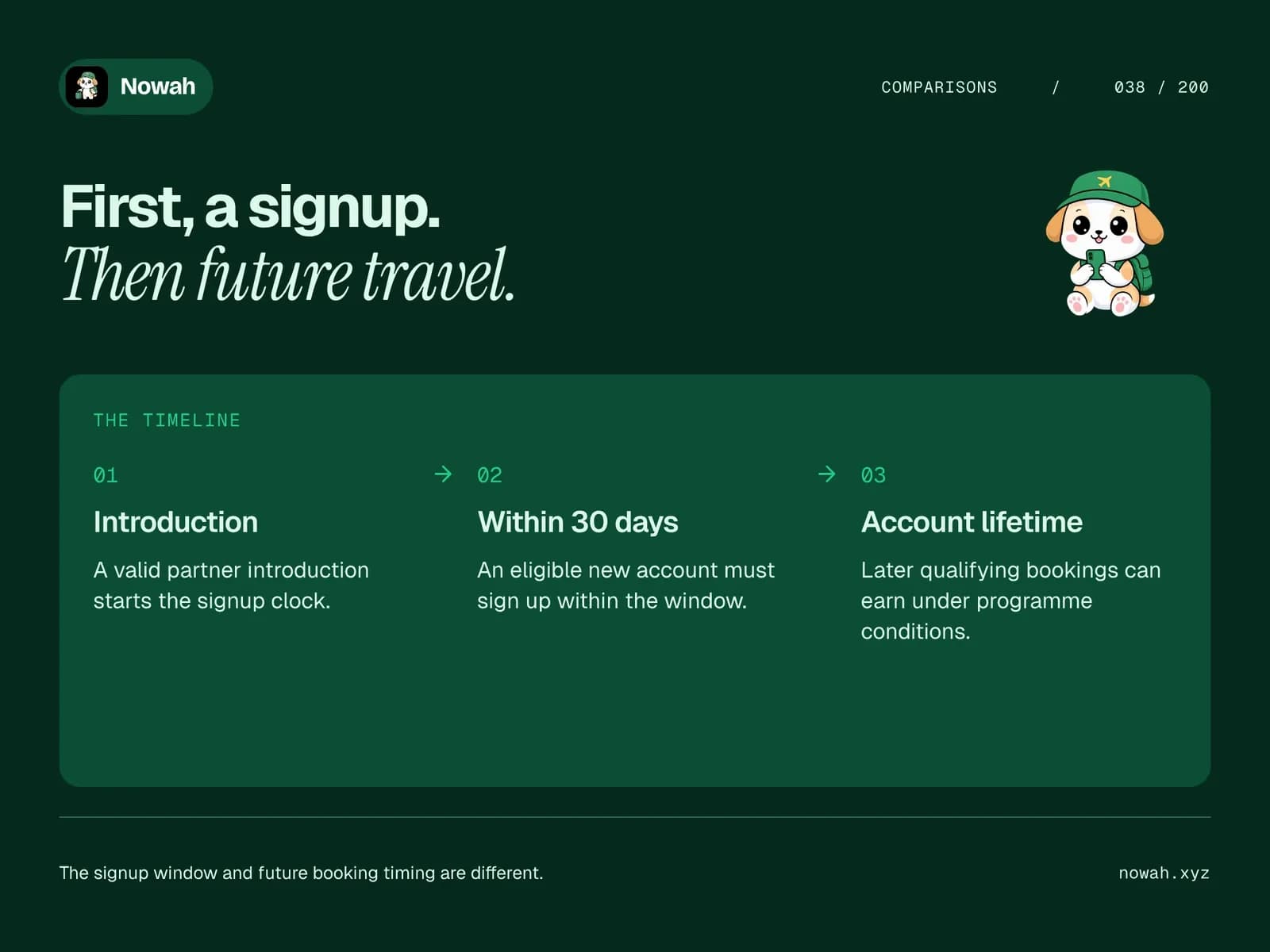
The 30-day rule in Nowah's account-attribution terms concerns a new traveller's signup after a valid introduction. It is not a blanket requirement that every future qualifying booking must happen during those same 30 days. That distinction is important for creators who help followers begin planning before they are ready to buy.
The Nowah Partner Program offers approved partners 35% of Nowah net revenue from qualifying bookings by eligible attributed accounts. Once a valid account attribution is established, it continues for that traveller account's lifetime and can apply to later qualifying travel.
That continuity is a substantial reason to create useful planning-led recommendations rather than artificial purchase pressure. This guide gives you a clock card for checking the exact event behind a timing statement, plus a fictional example that keeps signup, booking and earnings release separate.
Name the event the 30-day requirement measures
The current partner terms require an eligible traveller to follow an active partner link and create a new Nowah account within 30 days of the valid introduction. Tracking must successfully reach Nowah. The rule names account creation as the required event within that window.
A creator should preserve that event in the explanation. A short label saying only “30 days” could be interpreted as a purchase deadline, a payout time or another tracking rule. Put the signup description beside the number in the same graphic or sentence.
The rule also does not make every signup eligible. Existing accounts, self-referrals, artificial accounts and fraudulent introductions are excluded. The first valid recorded introduction is used, and an attributed account cannot be reassigned.
The new-versus-existing account guide is useful when the question concerns eligibility rather than the clock itself.
Keep later qualifying bookings separate
Once attribution is validly established, Nowah's account relationship continues for the traveller account's lifetime. Later qualifying bookings can fall under it, including bookings for a different trip from the one that inspired the original introduction.
Those bookings must still satisfy the actual terms. The listed eligible categories are hotels, flights and paid eSIMs. Restaurant spending, independent experiences and complimentary flight-perk eSIMs should not be added to the earning story merely because they appear in a travel plan.
Continuing attribution is not guaranteed repeat income. A traveller may create an eligible account and never make a qualifying purchase. A useful creator explanation makes the opportunity clear without assigning a fixed value to every account.
The repeat account-attribution comparison provides a focused next read about that relationship beyond one booking event.
Work through a fictional dated example
Imagine a valid introduction through an active Nowah partner link on 1 August. In this hypothetical example, the traveller creates an eligible new account on 25 August, with tracking recorded successfully. The signup occurs within 30 days of the introduction.
Now suppose the same traveller investigates a booking on 1 December. That later date does not automatically disqualify a booking simply because it is more than 30 days after the original introduction. The established account relationship and the actual qualifying-booking conditions need to be considered.
The example does not establish that a purchase occurs or that every possible December product qualifies. It illustrates the distinction between the signup clock and later travel activity. It is not a real account record or a creator earning result.
Do not reuse the dates without the hypothetical label. A polished timeline can look authoritative even when its purpose is only to teach the rule.
Distinguish the creator application from traveller signup
A creator applying to Nowah Partners is completing a different process from a traveller being introduced through an approved active partner link. Your program application should not be labelled as the traveller's qualifying signup event.
Applications are reviewed, applying is free and Nowah advertises no minimum follower count. Approval, adult and supported-country eligibility, and verification requirements still apply. You need the appropriate active partner route before promoting a qualifying traveller introduction.
A creator-facing article can invite another influencer to the program overview and application. A traveller-facing demonstration should explain the practical next task and use the appropriate route once approved. Keep the two destinations distinct in your content notes.
The creator-acquisition versus traveller-referral guide helps organize those separate journeys without treating every Nowah account action as the same event.
Build a clock card for every timing claim
Use four fields: the clock's starting event, the required event, the applicable condition and the source checked. Add an evidence-status field so a hypothetical example is not mistaken for a real record.
For the account-attribution card, the starting event is the valid introduction and the required event is eligible new-account creation within 30 days. For a later booking, keep the actual booking conditions separate rather than reusing the signup deadline.
If you discuss an earnings hold, create another card. That clock concerns booking completion and supplier settlement, not the original introduction. A single timeline can display several cards, but the event labels should make their differences unmistakable.
Then ask someone unfamiliar with the program to explain each clock in their own words. If they describe all three as a deadline to buy a holiday, revise the wording before publishing.
Use the rule in a helpful Nowah demonstration
Choose a genuine audience question and build a labelled fictional brief. For example, a short city stay may involve two adults, an evening arrival and a location tradeoff. Show how the question can be organized in Nowah and what information you would investigate next.
Keep current supplier availability, room conditions and actual transport arrangements subject to verification. A plan or map can structure the task without proving that a booking is ready or suitable.
The Nowah recommendation then has a practical purpose even if the traveller is not ready to purchase immediately. Explain the eligible-account opportunity accurately rather than inventing a countdown to create urgency.
The one-question demonstration guide provides a useful framework for keeping that content focused and understandable.
Keep the earning calculation attached to a booking
Approved Nowah partners earn 35% of Nowah net revenue from qualifying bookings by eligible attributed accounts. The terms define permitted direct deductions and exclude general overhead, salaries and general marketing from that list. The traveller's retail booking price is not the base.
For hypothetical arithmetic, a qualifying booking producing $60 of Nowah net revenue would yield a $21 partner share. That does not value the August signup at $21 or forecast what the December investigation will generate.
A signup, a qualifying booking and an earning amount represent separate events. The arithmetic is useful when it explains the booking-level formula, but misleading if it is used as a fixed account value or an income prediction from audience size.
The commission-base guide helps you review a numerical example before it becomes part of a public graphic or caption.
Separate the hold and monthly eligibility from signup
Nowah earnings require completed bookings and verified supplier settlement. A 30-day hold begins after whichever event occurs later. This is another 30-day reference with a different starting event and purpose from the introduction-to-signup window.
Eligible balances are processed monthly subject to the separate currency threshold, verification and other current conditions. A completed hold does not establish an immediate bank-arrival promise, and a transfer to a connected Stripe account is distinct from a bank payout.
The 30-day hold guide explains this later clock. Link to it when the audience needs payment-stage detail rather than compressing several different conditions into one unexplained number.
Review an actual question using evidence
If a creator has an attribution concern, identify which event and rule require review. Do not invent a grace period, promise reassignment or suggest artificial accounts as a way to change the situation. The actual terms and recorded events remain the basis for the question.
Use an appropriate statement or support reference where available and keep sensitive personal or banking information out of public discussions. A focused question about the introduction or signup event is more actionable than an undefined claim that the link did not work.
The existing trust and AI booking article provides useful background for clear event-based explanations. Readers should be able to understand the actual rule without guessing what a reassuring timeline symbol means.
Nowah gives creators a compelling opportunity through useful new-traveller introductions and a continuing eligible account relationship. Prepare the clock card, build a labelled demonstration and apply to Nowah Partners if the model fits your content. Applications are reviewed, and approval, eligibility and verification requirements apply. Explain the signup window precisely, preserve the separate booking and payment stages and assess actual outcomes through the evidence that establishes each event.




