One currency vs mixed balances: keep Nowah creator earnings understandable
Keep Nowah settlement currencies and payment stages separate with a unit-preserving report card and a clearly hypothetical mixed-balance example.
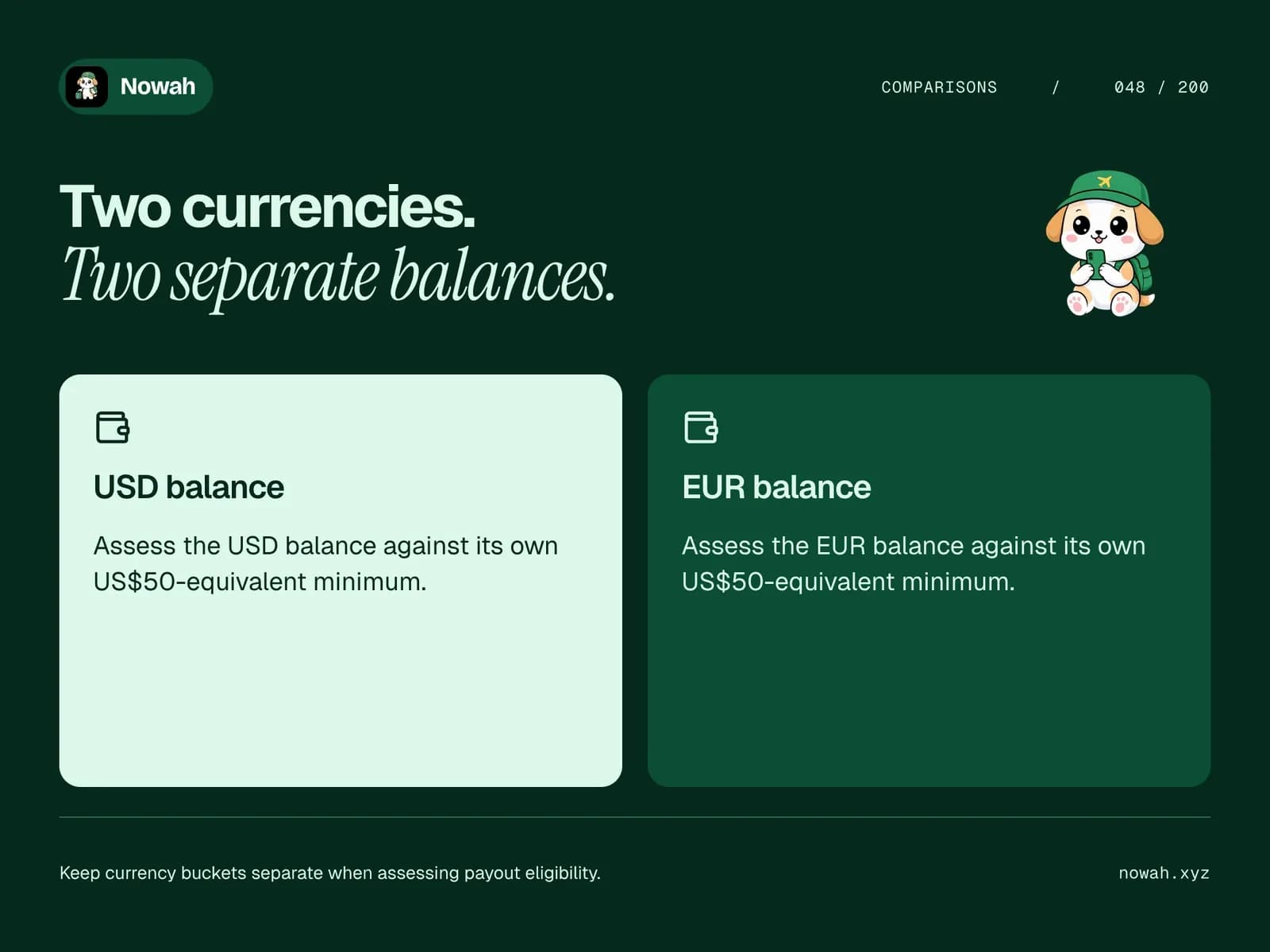
A single-currency amount is easier to read than a collection of different currency balances, but simplicity should not come from adding incompatible units. For Nowah creators, the settlement currency belongs beside the amount and status whenever you discuss earnings or payout eligibility.
The Nowah Partner Program offers approved partners 35% of Nowah net revenue from qualifying bookings by eligible attributed accounts. Its terms assess the payout minimum separately for each settlement currency. That is different from treating every recorded amount as one combined cash balance.
This guide gives you a unit-preserving report card for educational examples or your own evidence review. It does not establish which currencies are available to every account, supply an exchange-rate forecast or replace the actual program records for a specific payment question.
Preserve the settlement unit
A currency label is part of the amount's meaning. US$30 and €30 are separate quantities; the shared number does not make them interchangeable or establish a single total in either currency.
Use the settlement currency shown in the relevant evidence. Do not remove the unit to simplify a chart or apply a conversion assumption that has not been stated. A public earning graphic should make the currencies understandable without requiring the reader to infer them from a country flag or colour.
The current Nowah terms state that amounts are calculated in the settlement currency. The program's threshold assessment uses a current exchange rate, but that assessment does not merge balances or convert the booking statement into one shared currency.
The separate-currency reporting guide provides a focused follow-up for maintaining those distinctions in a creator record.
Keep a single-currency report explicit too
If the relevant records all use one currency, the report can remain simple. Keep the unit in the heading and beside any figure that may be shared independently. Do not assume a future reader will know which dollar or period an unlabeled total refers to.
The same principle applies when the report later gains another currency: add a clearly separated section rather than silently changing the meaning of the original column. Simplicity comes from consistent labels and evidence, not from removing distinctions that matter.
Work through a fictional mixed-balance example
Imagine a teaching worksheet containing US$30 in one example balance and €30 in another. These are hypothetical figures, not a real partner statement or a claim about supported currencies for every account.
Do not present the two entries as US$60, €60 or a unitless total of 60. The worksheet should retain separate currency rows. If a conversion is relevant to a different reporting purpose, it needs its own explicit source, date and assumptions rather than a silent replacement of the original units.
For Nowah's payout minimum, the US-dollar example alone is below US$50. The euro example needs the program's actual current threshold assessment; this guide does not invent an exchange rate to decide the result. Other eligibility conditions would also need their own evidence.
The useful lesson is not a numerical forecast. It is that a clear report sometimes needs several separate amounts instead of one attractive but unsupported total.
Keep threshold assessment distinct from conversion
Nowah's eligible monthly processing uses a minimum equivalent to US$50 for each settlement currency. Balances below the applicable minimum roll forward. Different currency balances are not combined to reach a shared threshold.
The terms describe a current exchange rate being used for the assessment. That does not mean every statement is converted to US dollars or that the creator can merge separate balances. The rule concerns eligibility for processing under the program.
Do not assume the same conversion treatment applies at a later provider or bank stage. A transfer to a connected Stripe account and a separate bank payout have their own provider-dependent circumstances.
The per-currency thresholds guide explains the minimum in more detail. Link to it when your audience needs a focused answer rather than adding an invented currency table to a general travel recommendation.
Give the earning amount its correct base
Approved Nowah partners earn 35% of Nowah net revenue from qualifying bookings by eligible attributed accounts. The traveller's full retail booking price is not the base, regardless of which currency appears on the price.
The terms define permitted direct deductions and exclude general overhead, salaries and general marketing from that list. Use actual relevant evidence for a real booking and keep unknown net revenue unknown rather than deriving it from retail spending.
For hypothetical arithmetic, a qualifying booking generating US$60 of Nowah net revenue would create a US$21 partner share. This is not a conversion rate, a fixed signup value or a claim about what a euro-denominated booking would produce in dollars.
The net-revenue versus booking-price guide is useful when the earning base needs to be explained before the currency units are reviewed.
Build a unit-preserving report card
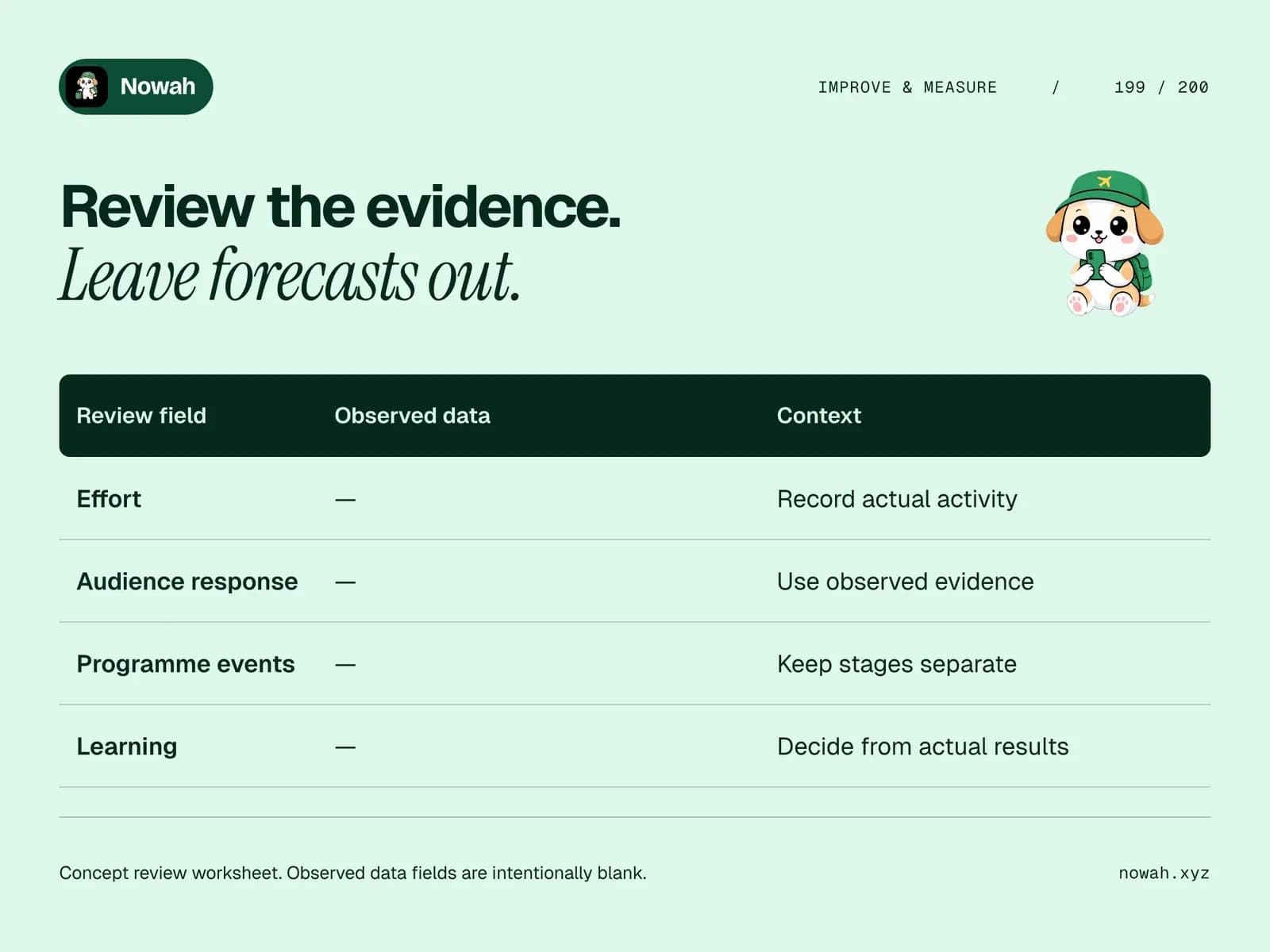
Use fields for the booking or statement reference, settlement currency, evidence period, earning base, recorded share, correction status and payment stage. Give each currency its own section when more than one unit appears.
Separate the hypothetical example from real evidence. A teaching card should identify invented figures clearly. An actual record should use appropriate program evidence and avoid unnecessary private traveller details.
Add a final question field. It might concern a threshold assessment, a changed amount or a later provider stage. A precise question is more actionable than an unexplained claim that several numbers do not add up.
The program questions and evidence guide helps turn the report card into a focused support inquiry where necessary. Do not send banking credentials, identity documents or card numbers through an ordinary email or public comment.
Avoid double-counting payment stages
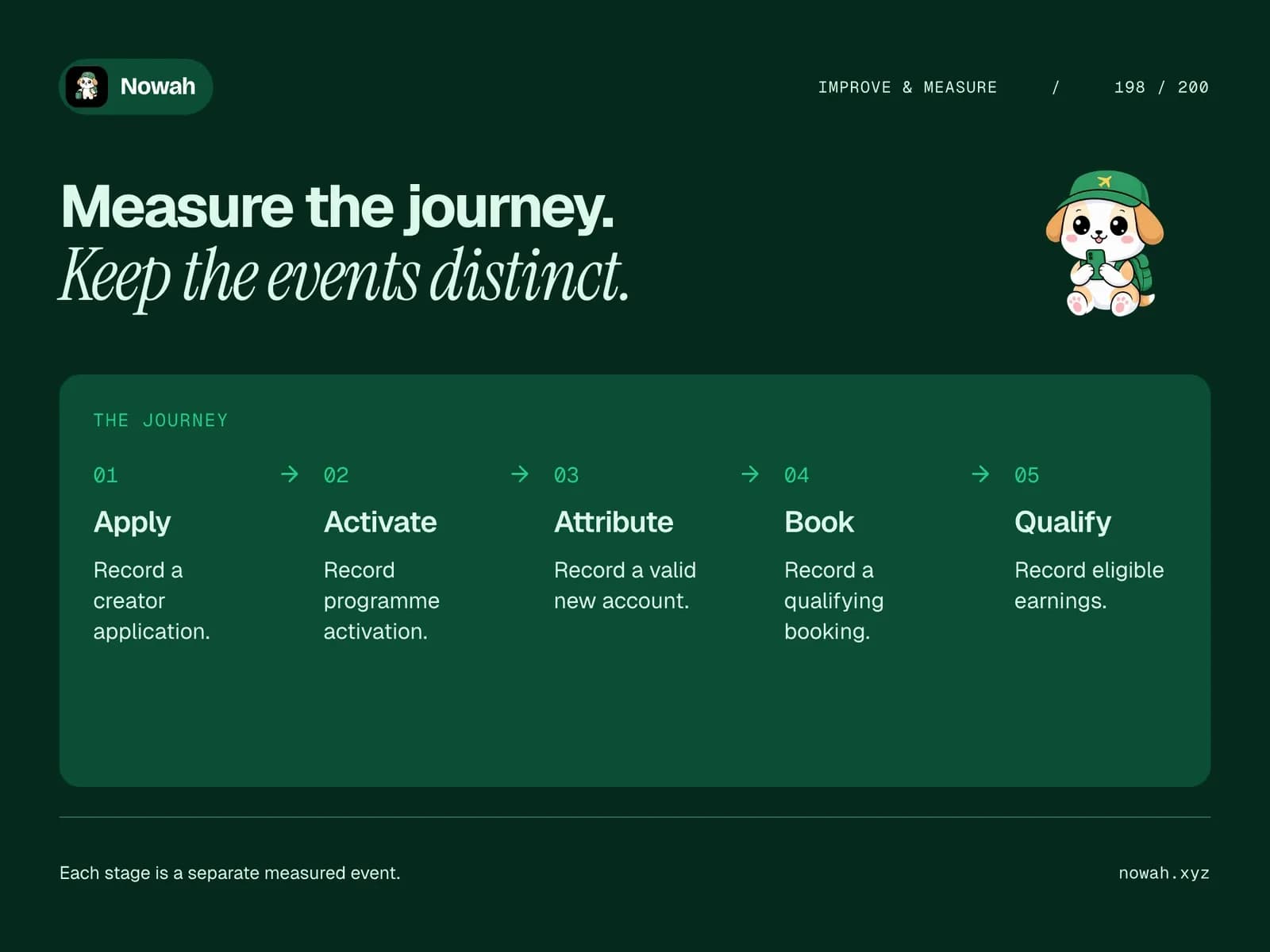
A calculated share, an eligible amount, a transfer and a bank receipt can concern different stages of the same underlying earning. Do not add them together as if each were separate new income.
Nowah requires booking completion and verified supplier settlement. A 30-day hold starts after the later event, followed by the relevant monthly eligibility and payout conditions. Refunds, disputes and corrected supplier statements can affect earnings.
Keep the status attached to the amount and currency. A pending figure in one section should not silently reappear as paid income in another. If a record changes, preserve the relevant history and identify what the new evidence establishes.
The pending-versus-eligible earnings comparison provides a useful explanation of those stage boundaries.
Keep provider conversion questions separate
The current terms state that Nowah does not deduct a separate program payout fee from the earned share. That does not establish that every external currency conversion or bank service is free. Relevant provider conditions and evidence matter at the later payment stage.
Do not assume every difference between a program amount and a bank record is an exchange-rate movement. It may require a more specific review of the actual events. This guide does not supply a universal bank-arrival time or conversion result.
The transfer-versus-bank-payout guide helps keep the sequence clear. A report card should preserve the original settlement unit and distinguish it from whatever evidence supports a later bank event.
Explain the opportunity without an inflated aggregate
Nowah's continuing eligible account attribution is a meaningful reason for creators to build useful travel recommendations. A new traveller needs to follow the active partner route and create an eligible account within 30 days of the valid introduction, with successful tracking. Existing accounts, self-referrals and artificial accounts do not qualify.
Once established, attribution continues for the account's lifetime and can apply to later qualifying hotel, flight and paid eSIM bookings. It is a possible ongoing earning relationship, not guaranteed repeat income or a reason to combine unrelated balances into a forecast.
A useful planning demonstration can explain why Nowah helps the traveller's task. Use labelled fictional inputs and leave actual supplier availability and conditions subject to verification. The commercial model should support the practical explanation rather than replace it.
The existing unit-economics discussion provides broader business-model context, while the current partner terms remain the source for this specific earning and payout definition.
Review the visual before sharing
Read the graphic without its caption. Can the viewer identify the currency, the status and whether the amount is hypothetical? If a combined total appears, ask what evidence and unit support it before publishing.
Check that a cropped or resized version retains the qualifiers. A simple chart can become misleading if a currency label or illustrative note disappears. A meaningful alternative-text description should preserve the same key distinction for readers who do not rely on the image.
Nowah gives creators a compelling opportunity through useful introductions, a defined net-revenue share and continuing eligible account attribution. Prepare the report card, keep currencies and stages distinct and apply to Nowah Partners if the model fits your content. Applications are reviewed, and approval, eligibility and verification requirements apply. Make each amount understandable before using it to describe a commercial outcome.