Give Podcast Listeners a Clear Next Step with Nowah
Create a truthful spoken next action for a Nowah podcast recommendation, with useful travel context, a clear partner explanation and a relevant destination.
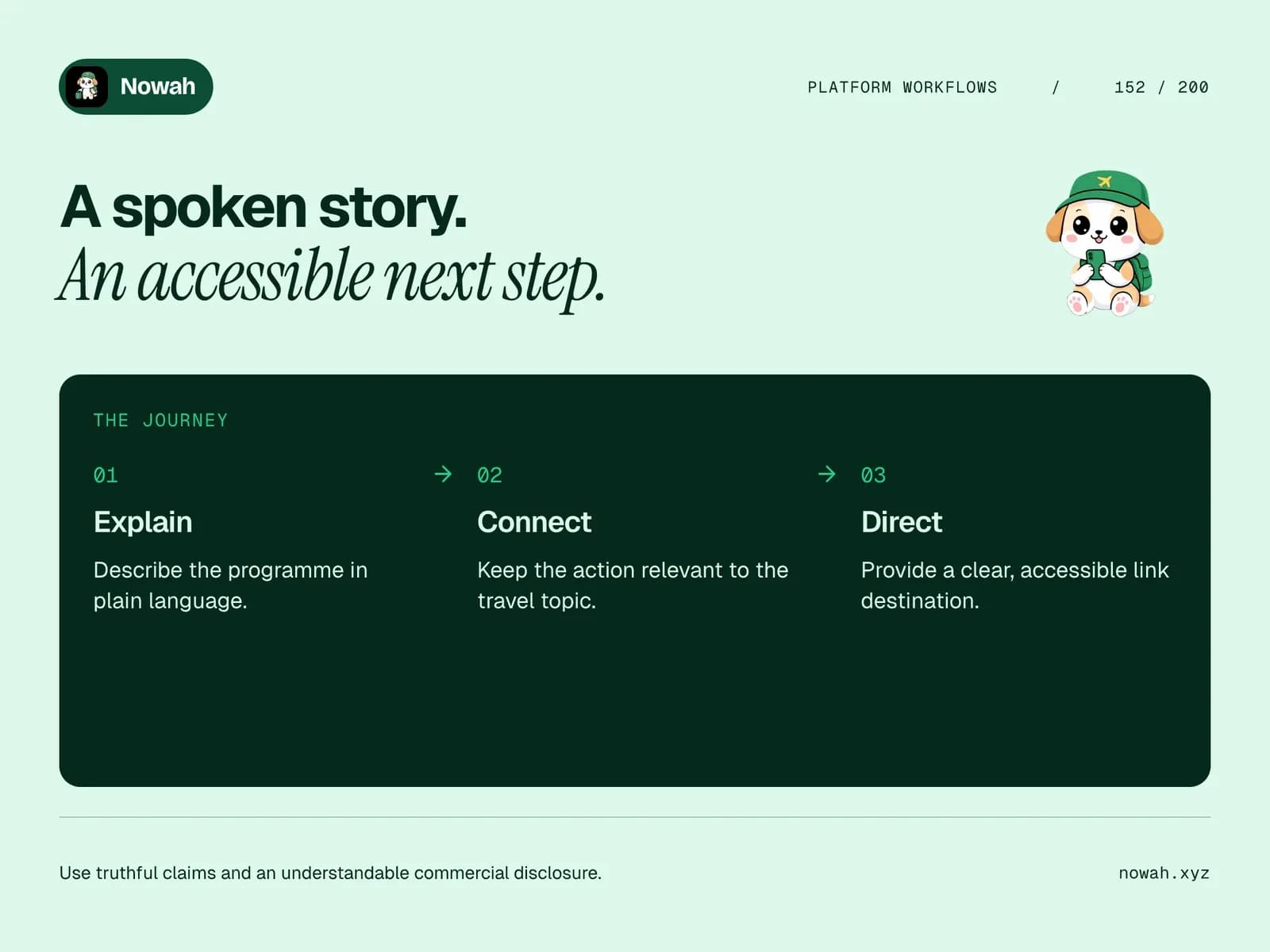
A podcast listener cannot inspect a graphic while deciding whether your recommendation is relevant. The spoken explanation needs to make the travel question, the product's role and the next action understandable without relying on a screen.
Nowah can fit an episode that helps people think through a practical trip decision. You might explain how arrival constraints change a day plan or how a hotel move affects a short break. Approved Nowah partners can earn 35% of Nowah net revenue from qualifying bookings by eligible new accounts they introduce.
The commercial opportunity should follow a useful explanation. Do not invent listener bookings, a special podcast code or an attribution shortcut to make the segment sound complete.
Choose a travel problem that works in audio
Start with a decision listeners can picture. A late arrival competing with an ambitious first evening is easier to follow than a detailed screen walkthrough that depends on reading several itinerary panels.
State the important inputs in plain language. Party, time available, fixed commitments and current priorities can explain the decision without a long list of place names.
Keep the scope bounded. An episode segment can teach why a particular constraint matters without pretending to solve every question about the whole holiday.
Use a fictional brief when demonstrating a method. Label it clearly, and do not present the scenario as a real listener conversation or travel outcome.
The one-question demonstration guide can help narrow the lesson before you write the spoken segment.
Explain what Nowah contributes
Give the product a specific role in the reasoning. A useful explanation might describe how you would investigate a lighter arrival day, revise the plan after adding a fixed event or organise a clearer trip brief.
If you have tested a product workflow, explain the relevant behaviour accurately. Do not imply that an imagined screen or output exists because it would fit the audio story.
A spoken demonstration can describe the decision without narrating every product interaction. The listener needs to understand what you are investigating and why the revision matters.
Keep supplier facts separate. A planning example does not confirm a room, a transport arrangement or current availability. Identify the questions the listener would still need to verify for their own trip.
Nowah's article about the twenty-tab planning problem offers background for explaining why a coherent brief helps. The podcast segment should still answer its own particular question.
Separate the teaching segment from the destination
The useful lesson and the next action have different jobs. The lesson helps the listener think more clearly. The destination gives them somewhere appropriate to continue.
Decide whether the segment addresses travellers or other creators. A traveller needs a relevant planning route; a creator considering the program needs official information and an application explanation.
For travellers, an approved partner should use the active route supplied through approval and onboarding. Do not invent a podcast referral code or assume that a generic page attributes traveller accounts.
For creators, the official partner portal is the appropriate application or sign-in destination. Explain what the listener can do there rather than implying automatic acceptance.
Make any supporting episode notes match the spoken instruction. A listener should not encounter a different task or an unexplained promotion after following the direction you gave.
Build an audio next-action card
Write a small production card with these fields:
- The travel question and intended audience.
- The useful finding the listener should remember.
- The verified role of Nowah in that finding.
- The plain-language partner relationship statement.
- The destination and the task available there.
- The instruction a listener can follow without seeing a screen.
- The claims requiring evidence or qualification.
This card is a creator-maintained tool. It is not a promised Nowah podcast publisher or attribution feature.
Read the destination field before writing the spoken instruction. If you cannot describe what the listener will find, the call to action is probably too vague.
Avoid adding urgency or a result promise merely to make the closing line sound persuasive. A clear task can be compelling without claiming guaranteed savings, bookings or income.
A fictional arrival-day episode
Imagine a creator preparing an episode about why a short break can feel rushed before it has properly begun. The following is a hypothetical production example, not a real listener story or a campaign result.
The segment introduces a fictional party with a late arrival and a fixed commitment the next morning. The host explains why filling the first evening with activities may conflict with the party's preference for a slower start.
A verified Nowah planning example helps investigate a lighter day structure. The host describes the reasoning rather than asking the listener to imagine an unreadable screen. Actual check-in and transport arrangements remain questions for current provider evidence.
The useful takeaway is a short brief: identify the arrival boundary, the next fixed commitment and the pace the party wants. The recommendation then offers an appropriate next step for listeners investigating their own trip.
The host explains the partner relationship with the recommendation and ensures that any episode-note destination continues the same task. No fictional booking confirmation or listener commission is added.
Use an audio-only listening test
Listen to the segment without reading the script or looking at the notes. Can you understand the traveller's question, the important constraint and the reason Nowah is being mentioned?
Then test the next action. Does the instruction tell the listener what to find and why it is relevant? Does it rely on a visual element that audio alone does not supply?
Read the destination explanation separately. A person arriving without remembering the entire episode should still understand the task and the commercial context.
If another person helps review the segment, ask them to repeat the intended next action in their own words. Treat any confusion as an editorial question to resolve, not as evidence about future conversion.
The relevant landing-destination guide supports that promise-to-page check.
Describe the commercial relationship accurately
Tell listeners that you are a Nowah partner and may earn commission from qualifying referrals. Make the explanation understandable with the recommendation rather than assuming that everyone has read an earlier episode's notes.
If another arrangement affects the segment, describe it separately. A fixed sponsorship fee, hosted stay or content-licensing agreement is not the same thing as a Nowah referral commission.
Do not describe approval you have not received or benefits the program does not establish. An ordinary application is not an active partner account, and a separate hotel arrangement is not proof that Nowah provides complimentary stays.
The partner-disclosure guide offers a broader framework for examining the wording.
Disclosure and factual accuracy remain separate checks. A clear commercial statement does not make an unsupported earning or travel promise true.
Explain the earnings model without a fictional result
The Nowah terms describe a 35% share of Nowah net revenue from qualifying bookings. It is not 35% of the listener's total holiday cost.
For an audio recommendation to lead to valid attribution, the traveller still needs the supplied active-link route, successful tracking and an eligible new account within 30 days of introduction. Neither an existing account nor the host's own self-referral meets those conditions.
After valid attribution, later qualifying hotel, flight and paid eSIM bookings may generate earnings throughout the account's lifetime. No repeat booking or particular income is guaranteed.
Completion, supplier settlement and the applicable hold and payout conditions remain part of the process. A listener's interest, a destination visit or a pending plan is not evidence that paid commission has been earned.
If you use arithmetic to explain the model, label the inputs as illustrative. Do not turn a hypothetical calculation into a reported podcast campaign result.
Keep episode notes useful and current
Supporting notes can supply the sources, resource and destination that the audio introduces. Give each link a clear purpose instead of presenting an unexplained collection of promotions.
Check changeable program and product statements before reusing the segment. If a destination or route changes, review the instruction and update the supporting material where possible.
Do not assume that changing a web page automatically changes every previously downloaded or delivered recording. Keep the current explanation clear in the places you control and record the reason for the revision.
The evergreen newsletter review guide offers a related reuse framework for material that may already have reached an audience.
Finish with a task the listener can understand
Before publication, compare the script with the audio next-action card. Remove any claim that exceeds the evidence, and make sure the recommendation follows naturally from the lesson.
For the next episode, choose another genuine travel decision rather than repeating the same product pitch. A rooming question, an arrival constraint and a hotel-move tradeoff require different explanations.
If useful travel teaching fits your podcast, apply to Nowah Partners. Explain the audience you help and the questions your episodes can clarify. A specific lesson, an accurate relationship statement and an understandable destination give the recommendation a practical purpose listeners can follow.




