Travel commissions vs selling guides: build a useful creator offer with Nowah
Compare selling travel guides with Nowah commissions, including distinct reader promises, product boundaries, attribution and earning evidence.
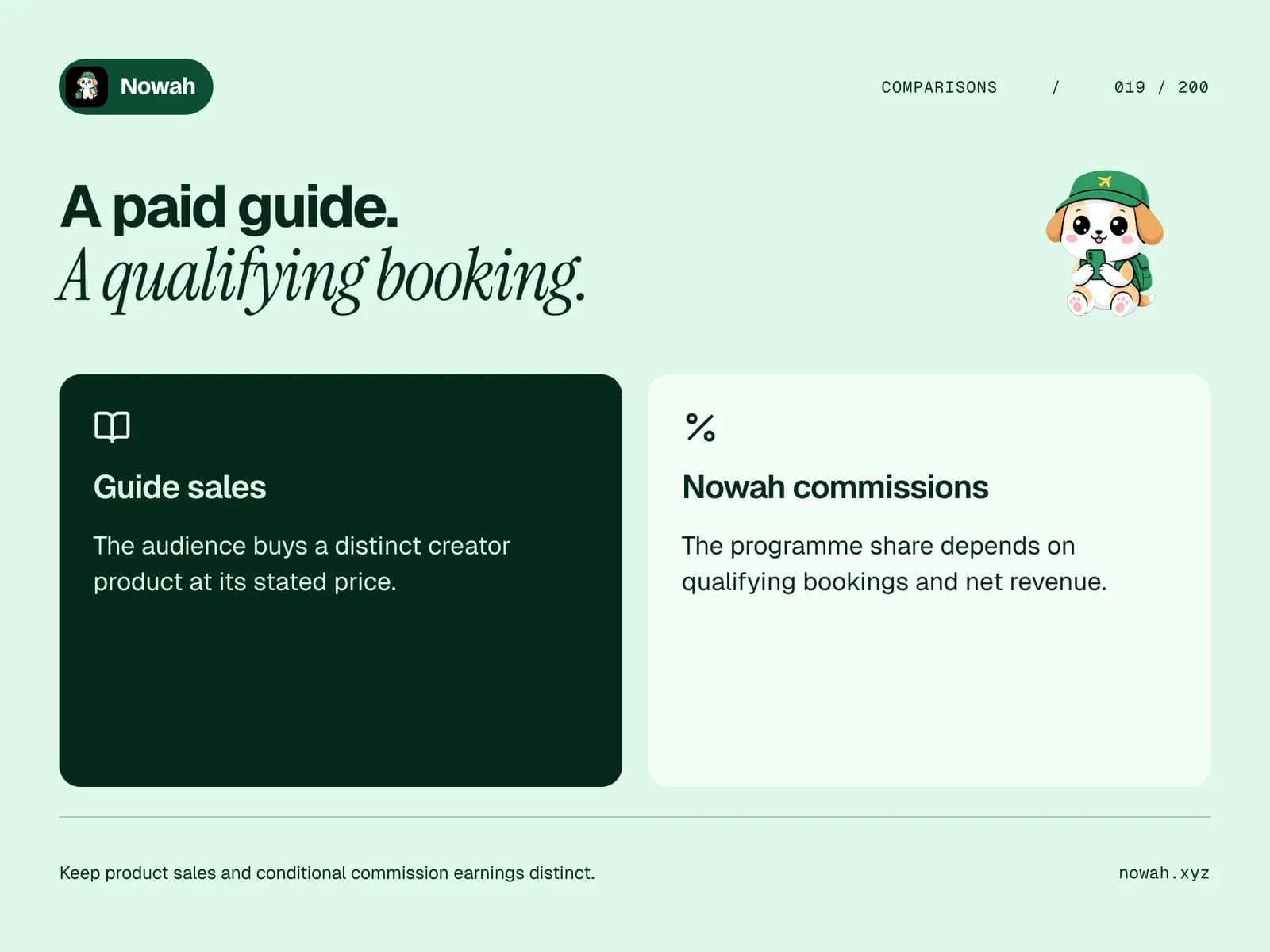
A travel creator can sell a separately produced guide, recommend a planning workflow or do both under clearly described arrangements. The important distinction is what the reader receives and what creates the earning event. A guide purchase and a qualifying Nowah booking are different transactions.
The Nowah Partner Program offers approved creators 35% of Nowah net revenue from qualifying bookings by eligible attributed accounts. Its continuing account attribution can suit creators who publish useful travel knowledge and introduce new travellers through a practical recommendation.
Nowah's partner terms do not establish a guide-selling marketplace or a checkout for your own digital products. This guide compares the business models without inventing that feature. It helps you decide what a guide should teach, where a Nowah demonstration adds value and how to keep the commercial explanation clear.
Define the reader's purchase decision
A paid guide needs a specific useful outcome. It might organize original research, explain a decision process or provide a carefully maintained resource. A collection of attractive images and generic recommendations does not automatically establish what a buyer will gain.
Write the outcome in one sentence. For example, a proposed city resource might help first-time visitors compare different base priorities and prepare questions for current hotel research. That is a clearer promise than claiming it contains the perfect itinerary for every traveller.
A Nowah recommendation answers a different question: how can this reader continue organizing their actual trip and investigate relevant travel arrangements? It can sit beside useful editorial material without being the same product as the guide.
This distinction gives you a strong way to promote Nowah naturally. The recommendation helps the reader move from an explanation into a practical next task, rather than appearing as an unrelated commission link.
Decide what belongs in your own guide
Use your own legitimate knowledge, research and materials you are entitled to publish. Identify what you observed personally, what comes from a current source and what is hypothetical. Do not assume that using a planning tool automatically grants every possible right to resell outputs or third-party content.
A durable guide should also explain its limits. Hotel offers, opening arrangements, transport conditions and prices can change. A fixed document should not promise live availability or conditions you have not verified for the buyer's actual trip.
Consider including a research method and a list of questions rather than presenting every recommendation as timeless. The value can lie in helping a traveller understand the decision, including how to update the information that matters.
The first-hand review versus researched example guide is useful when planning a resource that mixes your own experience with researched material and fictional teaching examples.
Give Nowah a distinct practical role
A guide can explain a tradeoff; the reader still needs to apply it to dates, party composition and current priorities. A labelled Nowah demonstration can show how to turn that understanding into a useful trip brief.
For a hypothetical example, imagine two adults planning a three-night city break with a late arrival. Your guide explains the difference between choosing a base for location and choosing one for on-site facilities. The Nowah segment shows how you would organize that question and identify information still requiring verification.
Do not claim that a demonstration guarantees a particular room, price or supplier arrangement. A planning output helps structure investigation. Actual bookings and conditions still need the appropriate current checks.
The one-question demonstration guide can help you keep the segment focused. The reader should understand why Nowah is relevant to the task, not simply that you would like them to click.
Keep the two earning models separate
A guide sale depends on the actual terms and payment arrangements for your own product. This article does not set a market price or promise that a particular number of followers will buy it. You would need to define the product, selling route and responsibilities independently.
Nowah commissions depend on qualifying bookings by eligible attributed accounts. Publishing a guide, receiving a download or collecting an email address does not by itself establish an eligible Nowah introduction or earning.
The distinction also matters when a guide is free. A useful free resource can support a partner recommendation, but it should not be described as guaranteed income or a shortcut around the account and booking conditions.
For the broader choice between audience attention and a relevant recommendation, read follower count versus travel intent. A focused reader question is more useful than an invented sales forecast.
Explain Nowah's calculation with the right base
Approved partners receive 35% of Nowah net revenue from qualifying hotel, flight and paid eSIM bookings. Under the current terms, the base is revenue actually received for the booking, less the permitted direct deductions. General overhead, salaries and general marketing are excluded from that deduction list.
As hypothetical arithmetic, a qualifying booking producing $60 of Nowah net revenue would generate a $21 partner share. That figure does not price your guide or predict the earning value of a reader who downloads it. The traveller's full retail booking price is not the commission base.
If you compare possible income streams in a business plan, keep the assumptions and units visible. A guide price, a net-revenue amount and a pending partner share describe different quantities. Do not add them into an impressive total without actual evidence and a consistent interpretation.
The recording assumptions guide provides a focused review for teaching examples and hypothetical arithmetic.
Understand who can become an attributed traveller
An eligible new traveller must follow your active Nowah partner link and create a new account within 30 days of the valid introduction. Tracking must successfully reach Nowah. Existing accounts, self-referrals, artificial accounts and fraudulent introductions do not qualify.
A guide buyer who already uses Nowah does not become a new eligible introduction merely because your resource is useful. Do not encourage an existing user to create another account to appear new. The first valid recorded introduction determines the attribution, and an attributed account cannot be reassigned.
Once validly established, the account relationship continues for that traveller account's lifetime and can apply to later qualifying bookings. That continuity is a meaningful strength for creators building a body of useful travel resources. It is a possible ongoing earning relationship, not guaranteed repeat income.
Your recommendation should explain the actual opportunity while leaving the travel decision with the reader.
Create a guide-and-referral boundary sheet
Before publishing, complete two columns. The first describes the guide: its promise, evidence, materials, maintenance plan, selling route and actual product conditions. The second describes the Nowah recommendation: reader task, labelled demonstration, active partner destination, disclosure and relevant earning rules.
Add a shared section identifying what neither column guarantees. For the fictional city break, that would include actual room availability, supplier conditions and whether the reader will make a qualifying booking. A clear boundary prevents one product's promise from silently expanding into the other model.
Test the sheet with someone who has not seen your preparation notes. They should be able to identify what a guide buyer receives and what a traveller following the Nowah recommendation can do next. If both routes look like the same purchase, rewrite the handoff.
This is useful even when the guide is a small resource. Clarity matters more than the number of pages or the polish of the cover.
Maintain links and changing information
A resource that contains recommendations needs maintenance. Keep a checked date for material supplier and program facts, review link destinations and revise claims that no longer have current support. Do not leave an old rate or product condition in place simply because the guide still looks attractive.
The content-link maintenance guide explains how to keep the reader's next step relevant. Your internal links can connect the guide's topic with a useful platform walkthrough or program explanation instead of sending every reader to the same generic page.
The existing hotel recommendation anatomy article provides useful background when your resource discusses stay choices. Link to it where the reader needs that context, without implying that a general article confirms a particular supplier offer.
Keep payment evidence distinct from content activity
A guide sale, an attributed account and a settled qualifying booking are separate events. Use the actual records for each. Do not invent a case study that treats downloads or link clicks as proof of earnings.
Nowah requires completion and verified supplier settlement, followed by a 30-day hold after the later event. Monthly payout eligibility also depends on the separate currency threshold, verification and other conditions. A pending share is not a bank receipt.
Nowah gives creators a compelling way to connect useful travel knowledge with an eligible account relationship and qualifying future travel. A separately sold guide can have its own purpose without becoming a feature of the partner program. Define the two offers, build one labelled demonstration and apply to Nowah Partners if the model fits your audience. Applications are reviewed, and approval, eligibility and verification requirements apply. Make the reader outcome clear before asking either model to support your business.




