How Wedding Creators Can Earn With Useful Guest-Travel Content Through Nowah
Help wedding guests organise different origins, travel dates and rooming questions with useful Nowah research.
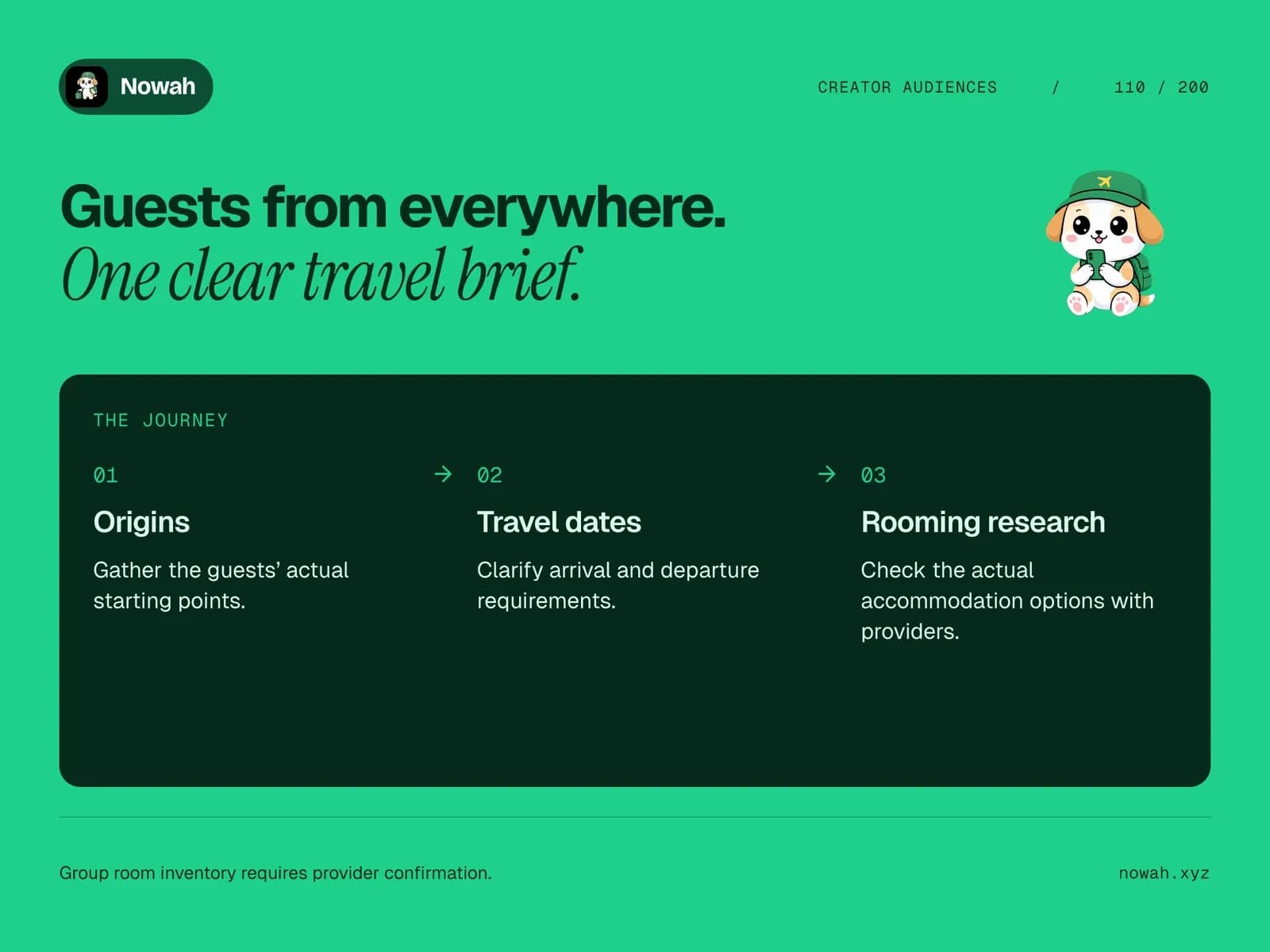
A wedding can bring travellers from several origins into one place, while leaving each household with different flight, stay and rooming questions. A useful creator explains those differences rather than presenting one generic travel link as a complete answer for every guest. Approved Nowah partners can connect practical guidance to disclosed referrals and potential earnings from qualifying bookings by newly attributed travellers.
Nowah is a strong fit when guest travel becomes a current brief. Show the actual event boundary, identify the requirements that differ between travellers and demonstrate one relevant flight-and-stay question. The audience sees why continuing research through the service relates to the occasion without being promised a group arrangement that has not been established.
Keep the earning scope clear. Qualifying hotels, flights and paid eSIMs are the listed Nowah partner categories. Wedding services, venue spending and other celebration purchases are not automatically commissionable because they appear in the travel story.
Separate the shared occasion from individual travel needs
The event may be a common anchor, but guests can have different departure points, available dates and accommodation requirements. Do not assume that the same arrival direction or room arrangement works for every household.
Use fictional guest groups in a public demonstration. Describe the relevant travel inputs without sharing actual guest lists, personal contacts or private event details. A useful teaching example does not need real identities or reservation references.
Keep an actual event commitment distinct from an idea still being discussed. The travel brief should reflect the information guests can rely on, while unresolved questions remain visible. Do not invent a confirmed date or location to make the example appear more complete.
Build a guest-origin research matrix
Give each fictional travel group its own row. Useful fields include:
- The relevant departure point and available travel window.
- The actual event boundary that affects the trip.
- Rooming and accommodation requirements.
- Budget scope and priorities where they change the research.
- The flight, stay or provider question still unresolved.
- The next research action the group needs.
Do not fill the matrix with assumed fares, transfer times or guaranteed rooms. Its purpose is to show why the travel questions differ, not to imply that a group package has been arranged.
The matrix also helps the creator choose useful content. One resource can explain the general method, while a demonstration follows one clearly labelled fictional row. That is easier to understand than combining several incompatible guest requirements into one itinerary.
Demonstrate one guest brief in Nowah
Use Nowah to explore the selected fictional group's requirements with the occasion's actual planning boundary visible. Explain which question you are asking and why this group's departure point, dates or rooming requirement matters.
Review the proposed direction. If it changes an essential input or assumes a provider arrangement without evidence, identify the issue and revise the question. Show the audience how the brief develops rather than presenting the first outline as a confirmed trip.
The practical recommendation is the clearer flight-and-stay research. It does not imply that Nowah guarantees group inventory, a block rate, event access or every arrangement mentioned in the content. Keep actual availability and supplier conditions attached to appropriate current evidence.
The family rooming guide offers a useful verification sheet when household accommodation needs are central. Adapt the method to the actual party rather than assume that a wedding guest group has one standard arrangement.
Keep group-inventory questions separate
A group discussing the same property does not establish that every required room is available or that the property has confirmed a particular group arrangement. Do not promise a shared floor, connecting rooms, a discount or other benefit from a general description.
If an arrangement matters, identify the appropriate provider question and preserve its actual status. A request and an acknowledgement are different from a confirmed commitment. A creator's own hosted or personal stay does not establish what every guest receives.
For a fictional comparison, keep each group's input explicit. If one household changes its dates, revisit that row instead of treating the matrix's earlier accommodation direction as automatically valid for the new window.
Compare two different guest research needs
Imagine two fictional groups share the same occasion but depart from different origins and have different accommodation requirements. The creator can demonstrate why each needs its own research question without inventing live offers.
For one group, the main unresolved point might concern arrival information. For another, it might concern rooming or the scope of the stay. Explain which source or provider needs to answer each question before the direction can be relied on.
Use Nowah to refine one brief at a time. Do not give both groups the same assumed flight schedule or room conditions to make the graphic look consistent. Consistency means using the same method, not pretending the inputs are identical.
The multigenerational planning guide provides a separate optional-day matrix when relatives also want different plans around shared moments. It addresses the daily rhythm, while the guest-origin matrix keeps the travel and stay questions organised.
Explain budget scope without inventing a group total
A guest's stated allowance might concern accommodation alone or a wider set of travel costs. Identify that boundary before comparing directions. Do not combine different household scopes into one apparent group budget.
The cost-scope guide gives a worksheet for keeping flights, stays, paid connectivity and exclusions visible. It can be adapted across budgets without implying current availability or a guaranteed saving.
If you use fictional numbers, label them and keep them separate from actual evidence. A polished total should not make a teaching example look like a live wedding-travel package or a supplier quote.
Give the audience a useful disclosed route
When recommending an active Nowah partner link, say that you may receive commission from qualifying referred bookings. Put the relationship beside the relevant research action so guests understand the destination and your commercial connection.
A traveller needs the appropriate disclosed referral route. A creator interested in participating needs the program explanation and application. Do not merge those journeys or imply that visiting a traveller link enrols someone as a partner.
Keep sharing relevant and appropriate to the audience. The Nowah terms prohibit spam and misleading promotion. A useful resource for people seeking guest-travel information is different from treating a private guest list as permission for bulk unsolicited messages.
A useful matrix review keeps common occasion information separate from each group’s own requirements. If the shared event boundary changes, revisit every affected row. If one fictional household changes its available dates or rooming need, update that row without pretending all other guests have changed their brief as well.
This lets the creator demonstrate a consistent method while preserving genuinely different travel questions. It also prevents an apparently complete group outline from implying confirmed inventory or an arrangement no provider has established. A traveller should be able to identify which part applies to their own research and which part merely explains the wider occasion. Keep those boundaries in the shared visual, especially if it may circulate outside the original context. The resource’s value is a clearer next question for each relevant traveller, not a promise that one recommendation has already organised everyone’s journey.
Explain attribution account by account
Under the terms, an eligible traveller must follow an active partner link and create a new account within 30 days of the introduction. Existing accounts, self-referrals and artificial accounts do not qualify. Tracking must reach Nowah successfully; sharing the resource with a wedding party does not prove every guest is attributed.
Once valid attribution is established, it can remain for that traveller account's lifetime, including qualifying later bookings. That offers a potential continuing relationship while future purchases and income remain unguaranteed. It does not automatically attach every household member or every purchase associated with the occasion.
The partner receives 35% of Nowah net revenue after the direct deductions defined in the terms, not the group's entire travel or wedding expenditure. A labelled hypothetical $60 of Nowah net revenue produces $21 in partner earnings, not a forecast for either fictional guest group.
Completion, supplier settlement, the applicable hold and payout conditions matter before earnings become eligible. Keep useful research, valid attribution, qualifying bookings and completed payouts distinct when discussing results.
The older Nowah article on the anatomy of a hotel recommendation provides background for putting requirements before a shortlist. Your guest-origin matrix makes that principle useful for an occasion with different travelling parties.
To participate commercially, apply to Nowah Partners. Applying is free, applications are reviewed and there is no minimum follower count. Begin with accurate occasion inputs, demonstrate one useful Nowah guest brief and give the audience a transparent way to investigate its own travel arrangements.




