Organise YouTube Description Links for Clear Nowah Recommendations
Organise YouTube description links for Nowah content with clear audience labels, current channel eligibility and a useful disclosed next action.
A long-form travel video may need several supporting destinations: a planning resource, a source behind an important claim and a relevant Nowah next step. The description becomes more useful when those links have clear purposes instead of appearing as an unexplained list.
For an approved Nowah creator, that organisation connects the video to a practical recommendation. A traveller can understand what they are being invited to investigate, while another creator can find the program explanation without confusing it with a traveller referral. Nowah Partners offers 35% of Nowah net revenue from qualifying bookings by eligible new accounts you introduce.
A well-organised description does not guarantee a click, attribution or earnings. It does give the viewer a more understandable route from the question answered in the video to the task they want to perform next.
Verify the channel's linking tools
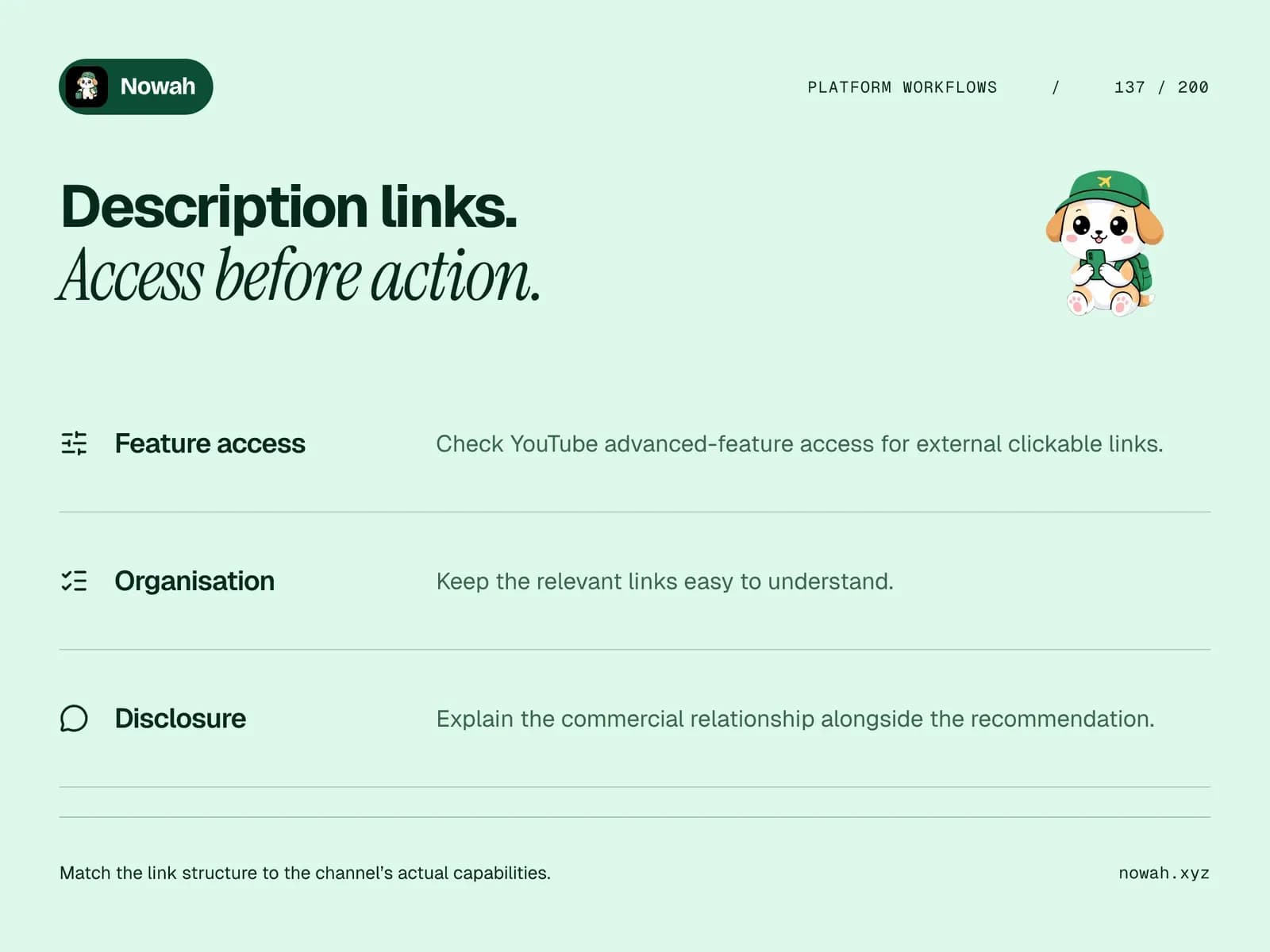
YouTube's official link guidance says that clickable external links in long-form descriptions require advanced-feature access. Check the current channel tools before publishing instructions that depend on that behaviour.
Do not copy a link-placement tutorial without confirming the actual surface involved. Long-form descriptions and Shorts descriptions are different contexts. The Shorts external-link guide covers the separate route needed for that format.
Record what you checked and what the destination opened. This is a navigation review, not evidence that a traveller introduction has been recorded.
If the channel setup or destination changes, revisit the spoken instruction as well as the description. A video can continue telling viewers to look for a resource that has been renamed, removed or replaced with a different task.
Inventory every link before ordering them
Make a list of the destinations you intend to include. For each, state the audience, the task it supports, why it is relevant to this video and whether the link has a commercial role.
A source link answers “what supports this claim?” A planning worksheet answers “how can I apply the lesson?” A traveller partner route answers “how can I investigate my own trip through this recommendation?” A creator application answers a different question about joining the program.
If a link has no clear role, reconsider including it. A large collection of destinations can obscure the useful next step rather than making the description more valuable.
Keep the inventory with your editorial notes. Do not claim that Nowah automatically creates or audits a description for you unless you have verified such functionality. This is a process you can manage in an ordinary document.
The inventory also makes later maintenance easier because you know why each destination was originally included.
Order links around the video's actual decision
The description should continue the lesson, rather than introduce an unrelated set of promotions. Start by identifying what the viewer still needs after watching.
A hotel-area comparison may leave a research question about the viewer's own dates and priorities. A creator-program explanation may leave an application question. A planning demonstration may point to a worksheet that helps organise the next brief.
Use the order that serves that reader task. There is no universal number of links or arrangement that this guide claims will produce more earnings. The aim is clarity, not a fabricated conversion formula.
Write labels that describe the destination. An unexplained “best deal here” claim can be misleading if the page does not establish that promise. A label explaining the relevant planning or application task gives the reader a fairer choice.
The destination-relevance guide provides a broader framework for matching the promise to the page reached.
Keep traveller and creator destinations distinct
Many travel channels attract both holiday researchers and other creators. These audiences can watch the same video while needing different next steps.
For travellers, use the active partner route supplied after approval and onboarding, and explain the task it supports. Do not invent a referral URL or imply that a general program application address establishes traveller attribution.
For prospective partners, the official program overview and application portal are appropriate destinations. Describe the reviewed application and the actual offer rather than suggesting that clicking enrols someone automatically.
You can include both purposes when the video genuinely addresses both, but label them so readers can tell the difference. Do not leave the audience to infer whether a destination is for planning a holiday or starting a creator application.
This separation is especially important when the spoken instruction is brief. A clear description can supply context, but it should not contradict what you said in the video.
A fictional hotel-review description
Imagine a creator publishing a long-form video about how a hotel location affects a short city break. The following is a hypothetical editorial example, not a real traveller result or commission report.
The video separates observed property material from a fictional planning brief. It explains a tradeoff between a particular location priority and the surrounding day structure, using a verified Nowah demonstration where relevant.
The creator's description inventory contains a supporting planning article, the source for a changeable property fact and an appropriate Nowah traveller route. Each destination receives a label describing its job.
A separate section for creators explains where to read about Nowah Partners and apply, if that topic is relevant to the channel's audience. It is not presented as the same action as researching a holiday.
The creator checks the actual channel linking behaviour and opens each destination. They confirm that the pages match the labels and that the commercial explanation is clear. The check does not claim that a viewer has signed up, booked or generated income.
Write the disclosure with the recommendation
Tell viewers that you are a Nowah partner and may earn commission from qualifying referrals. Make that relationship understandable where the recommendation occurs, including in the video as appropriate to the content and applicable requirements.
Do not rely on an unrelated profile statement to explain every later commercial destination. A person evaluating a link in this video should receive relevant context here.
Check the description's claims independently from its disclosure. A visible commercial explanation does not make an unsupported “lowest price” statement accurate. It does not turn a hypothetical planning example into evidence of real savings or a completed booking.
If the video includes other commercial arrangements, distinguish them rather than implying that every linked brand supplied the same benefit. A separate hotel stay arrangement is different from a Nowah referral commission relationship.
The partner-disclosure guide can help you examine the relationship wording more closely.
Keep the Nowah earning explanation accurate
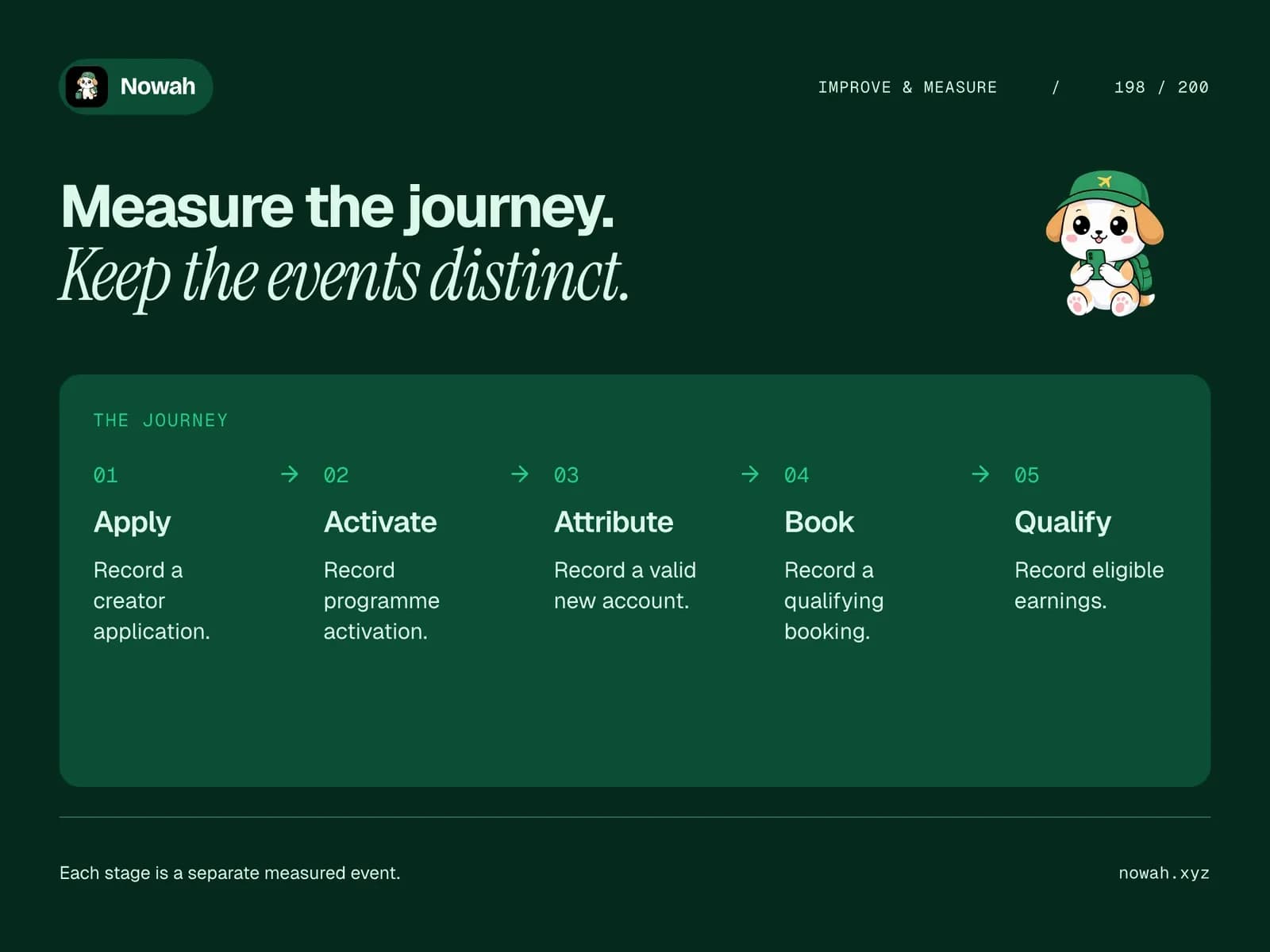
The Nowah program terms require an eligible traveller to follow an active partner link and create a new account within 30 days of introduction. Tracking must successfully reach Nowah. Existing accounts and self-referrals do not qualify.
Validly attributed accounts can generate earnings from later qualifying hotel, flight and paid eSIM bookings throughout the account's lifetime. That does not promise future travel or a fixed creator income.
The share is 35% of Nowah net revenue, rather than the traveller's total booking spend. Booking completion, supplier settlement, the applicable hold and payout conditions remain part of the process.
Your description does not need to repeat an entire terms page under every link. It does need to avoid claims that contradict those conditions and provide an appropriate route to the detailed explanation.
For example, do not label a destination as instant commission or suggest that a view is an earning event. Accurate labels can be concise without becoming misleading.
Test the complete instruction
Listen to the closing instruction in the video, then follow it using the actual publishing context. Look for the label you named and inspect the page reached.
Ask whether a first-time viewer can understand why the destination is relevant. If the link opens an application when the video promised travel research, revise the route or the instruction.
Check the source destinations as well. A dead or changed source can undermine an important claim even when the commercial link still opens. Keep a record of when changeable statements and destinations were reviewed.
Nowah's article about trust in AI-assisted travel booking is useful background for examining how these small instructions contribute to a coherent traveller journey.
The test should record observed behaviour, not a claim that tracking, eligibility or payment has been proven.
Maintain a description that keeps its purpose
Descriptions can become outdated when a content series changes, a destination is replaced or a program updates its wording. Review the inventory when those events occur.
Remove destinations that no longer help the video answer its question. Update labels that no longer describe the page reached. Where an old spoken instruction cannot easily be changed, make the current explanation as clear as the available publishing tools allow.
For the next video, build a new inventory from its own reader task rather than copying the entire list without review. Relevance is what makes the description useful.
If this approach fits your channel, apply to Nowah Partners. Explain the travel decisions your content helps people investigate. After approval, connect those useful explanations to a clearly labelled, disclosed and checked partner route.