The Data Moat: Why Travel AI Gets Better With More Users
More users generate more data. More data improves recommendations. Better recommendations attract more users. The flywheel effect that makes AI travel durable.

Every trip booked on Nowah makes the next traveler's experience better. That sentence sounds like marketing, but it describes an engineering reality. Each booking generates data — preference signals, satisfaction feedback, pricing observations, route intelligence — that feeds back into the recommendation engine. More data produces better recommendations. Better recommendations produce more bookings. More bookings produce more data.
This is a flywheel, and it creates a structural advantage that compounds over time. The question is not whether AI travel platforms will be better a year from now. It is how much better, and what that means for platforms that start building data later.
The flywheel mechanics
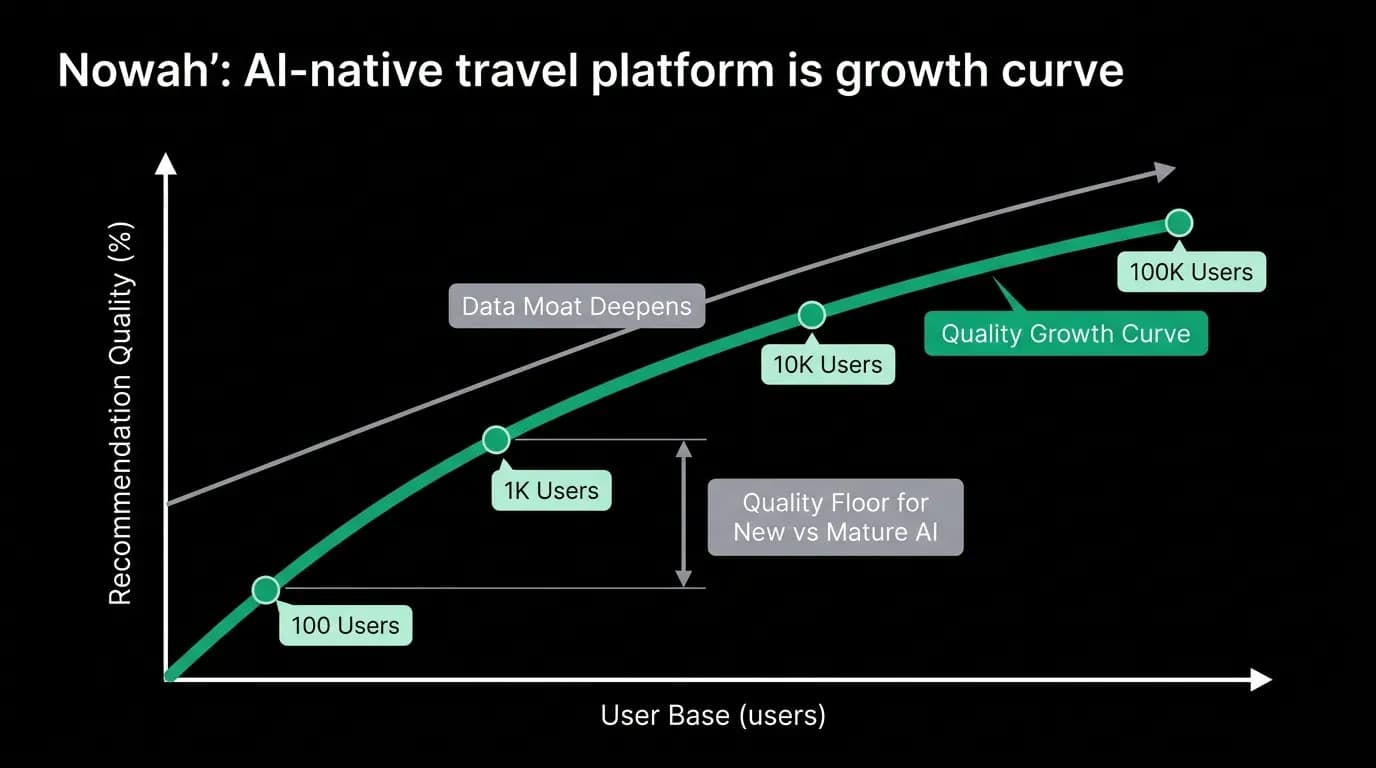
The flywheel has four stages that reinforce each other.
Users generate data. Every search, every booking, every piece of post-trip feedback, every stated preference, and every behavioral pattern becomes a data point. The data is both individual (this specific traveler prefers aisle seats and boutique hotels) and aggregate (this route's pricing tends to drop on Tuesdays, this hotel's reviews mention noise problems).
Data improves the AI. Individual data makes recommendations more personalized for each traveler. Aggregate data makes recommendations more accurate for everyone. Route pricing models get better calibrated. Hotel quality assessments become more nuanced. Airline reliability scores reflect more recent performance. The AI's understanding of travel — routes, destinations, pricing patterns, traveler behavior — deepens with every data point.
Better AI attracts more users. The recommendation quality difference between an AI trained on thousands of trips and one trained on millions is meaningful. The more-trained AI surfaces better options, provides more accurate pricing context, and makes fewer mistakes. Travelers notice the difference and choose the platform that feels smarter.
More users generate more data. The cycle repeats, each revolution making the flywheel spin faster.
The individual data moat
At the individual level, every interaction teaches the AI more about how you specifically travel. After your first trip, the AI has a rough sketch of your preferences. After your fifth trip, it has a detailed portrait. After your twentieth trip, it anticipates your needs before you articulate them.
This individual learning creates a switching cost. If you move to a different platform, you start over. The new platform does not know that you hate connections through a specific airport. It does not know your partner is vegetarian. It does not remember that you rated the hotel in Lisbon highly and want something similar for your next trip. All of that context — accumulated over months or years of interactions — stays with the platform that earned it.
The switching cost is not punitive. You can export your data and your preferences are yours. But the accumulated learning is more than a list of preferences. It is a model of your travel behavior that takes time and trips to rebuild on any platform.
The aggregate data moat
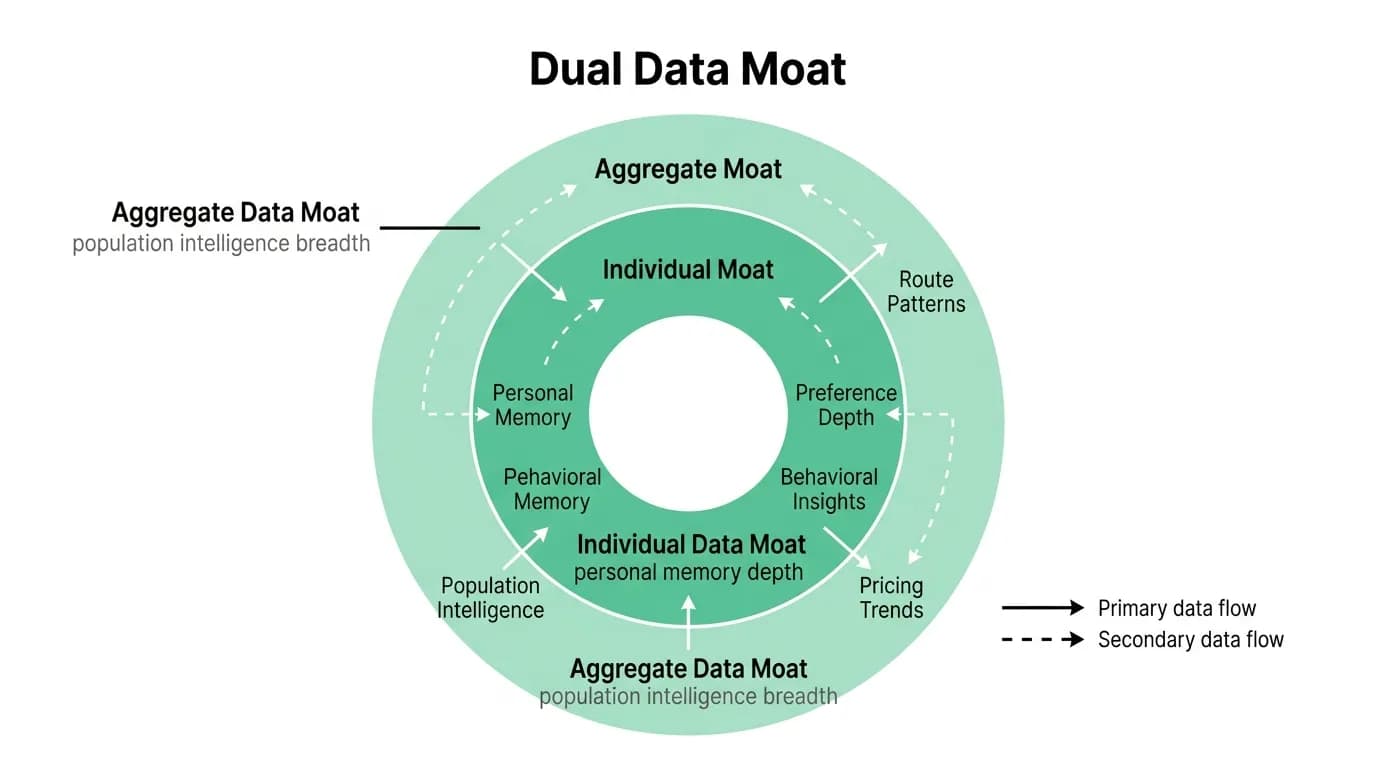
The aggregate data moat is even more powerful. Population-level intelligence — route pricing patterns, destination quality signals, airline reliability trends, seasonal demand curves — improves for every user simultaneously. When one traveler's booking data confirms that a specific route's pricing drops on Tuesdays, every future traveler on that route benefits from the insight.
This aggregate intelligence compounds. Early data points establish baseline patterns. Subsequent data points refine them with increasing precision. The difference between a model trained on 10,000 route observations and one trained on 10 million is not linear — it is the difference between knowing broad trends and knowing granular, route-specific, time-specific, fare-class-specific patterns.
Aggregate data also enables capabilities that simply do not work with small datasets. Destination similarity computation requires broad coverage across destinations and traveler types. Emerging destination detection requires enough search volume to distinguish signal from noise. Price trajectory prediction requires dense historical observations. These features are not just better with more data — they are only possible above certain data thresholds.
Why this is a durable advantage
Data moats are not the same as traditional competitive advantages like brand recognition or capital investment. They are harder to replicate because the data is generated by the product itself, not purchased or built through spending.
A competitor can match features, copy UX patterns, and even use the same underlying AI models. What they cannot copy is the accumulated learning from millions of trips. They would need the same volume of user interactions to build comparable intelligence, which requires the same scale of user base, which requires comparable recommendation quality — which they do not have because they lack the data.
This creates a virtuous cycle for early movers and a cold-start problem for late entrants. The platform that reaches critical data scale first has a structural advantage that widens with every additional user and every additional trip.
The AI travel market is projected to exceed $5 billion by 2027, and the global online travel market is approximately $800 billion. The platforms that build the deepest data moats will capture a disproportionate share of this market because their recommendation quality will be measurably and perceptibly better than competitors with less data.
The compounding effect
The data moat is not static. It compounds. A 10% improvement in recommendation quality from a year of data accumulation does not just add value — it attracts more users, who generate more data, which produces another improvement. The gap between the data leader and followers widens each year, not narrows.
Personalized recommendations already drive two to three times higher booking completion rates compared to generic results. As the AI's individual and aggregate intelligence deepens, that conversion advantage grows. The platform that knows you best converts you most reliably. The platform with the most aggregate intelligence serves the most accurate recommendations to new users.
Join Nowah now. Every trip makes the AI smarter — for you and for every traveler who follows. The earlier you start building your personal data moat, the more the AI can do for you.
Nowah is an AI travel agent that searches and books real flights and hotels through conversation — no filters, no thirty open tabs. Plan your next trip.