Gen Z Travel Trends 2026: AI, Experiences, and the End of Package Tours
Gen Z wants TikTok-worthy destinations, personalized itineraries, and instant booking. Package tours and search boxes are not part of their vocabulary.
A 22-year-old sees a 15-second video of someone cliff-jumping into turquoise water in the Philippines. Within the next 60 seconds, she wants to know how much it would cost to go, when the best time is, and whether she can book it right now. If the answer involves opening a search engine, entering dates into a form, and scrolling through 200 hotel results, she has already swiped to the next video.
This is not a caricature. This is the dominant travel discovery and booking pattern for the generation that will spend more on travel by 2030 than any other demographic alive. Gen Z travel spending is growing at twice the rate of older cohorts. They average 4.5 trips per year compared to 3.2 for Boomers. And the tools they expect bear zero resemblance to the booking infrastructure the industry built for their parents.
The travel industry is about to learn that the generation raised on TikTok, instant messaging, and personalized feeds has no patience for search boxes, filter panels, and 47-page booking flows.
Experience over itinerary
Gen Z does not plan trips around flights and hotels. They plan trips around experiences. The destination is chosen because of something they want to do or see or feel — not because they found a good fare.
This is a fundamental inversion of the traditional booking funnel. The old model: choose dates, find cheap flights, pick a hotel near the airport, then figure out what to do. The Gen Z model: find something incredible to do, then figure out how to get there.
Sixty percent of Gen Z travelers discover destinations on TikTok or Instagram before performing any search. The discovery is visual, emotional, and spontaneous. A food market in Oaxaca. A sunrise hike in Bali. A night market in Bangkok. The decision to travel is made in seconds. The planning should match that speed.
Traditional OTAs cannot handle this. Their entire architecture assumes you already know where you want to go and when. The search form starts with destination and dates. But Gen Z starts with a vibe, a visual, an experience. "I want to do that cliff jump thing in the Philippines" is not a query that any search form can process.
AI agents handle it natively. Describe the experience. The agent identifies the location, suggests the best season, finds flights and accommodation, and builds an itinerary around the experience you actually want. The planning matches the speed and style of the discovery.
The death of the package tour
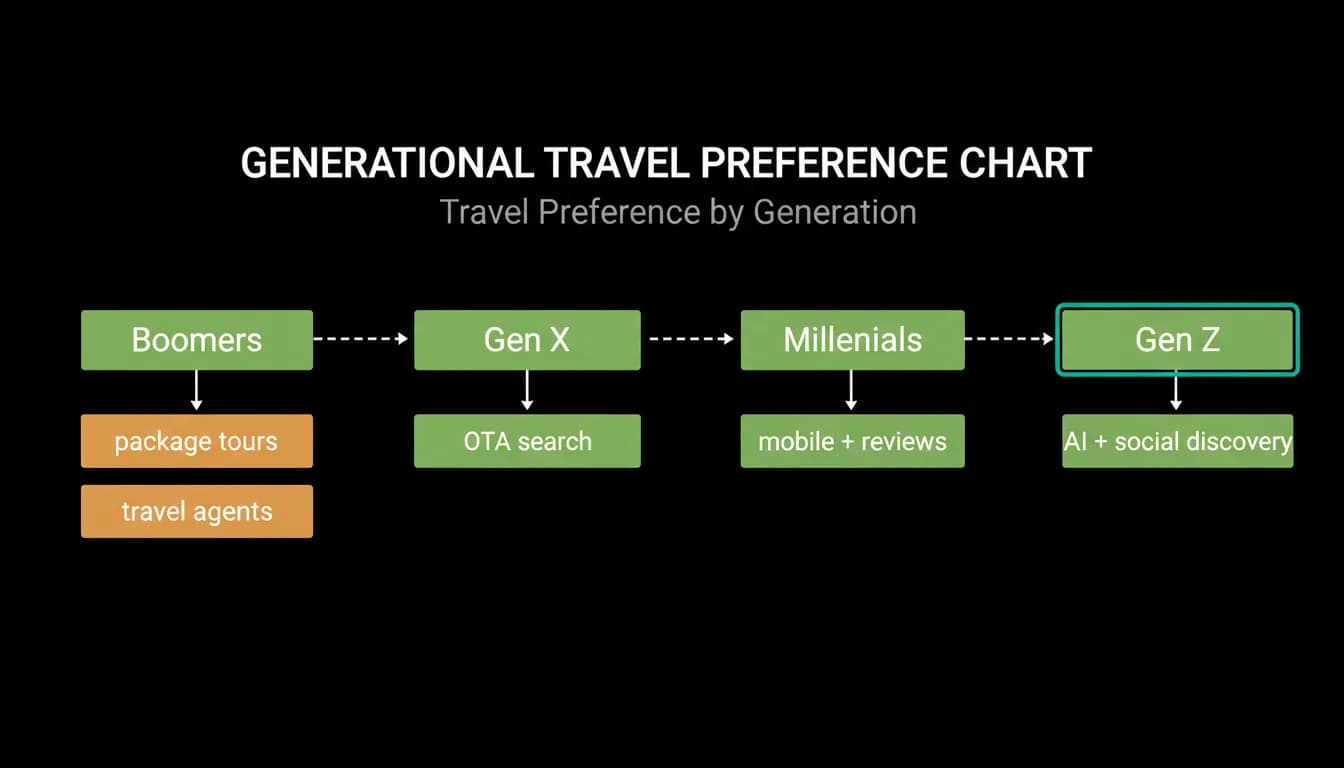
The package tour market is declining 5 to 8 percent annually among travelers under 30. This is not a temporary dip. It is a generational rejection of the entire concept.
Package tours optimize for logistics and cost efficiency. They standardize the experience: same hotel for everyone, same bus, same restaurants, same timeline. This is exactly what Gen Z does not want.
Gen Z wants authenticity. They want to feel like they discovered something, not like they were herded through it. They want to eat where locals eat, not where the tour bus stops. They want flexibility — the ability to stay an extra day somewhere that surprised them, or skip the museum that looked boring.
This demand for personalization and spontaneity is structurally incompatible with package tours. But it is perfectly compatible with AI-driven trip planning. An AI agent builds a trip that is entirely personal — your interests, your pace, your budget, your style. No two trips are alike because no two travelers are alike.
The package tour was a solution to a logistics problem: coordinating flights, hotels, transfers, and activities was too complex for most individuals. AI eliminates that complexity without eliminating the individuality. You get the coordination benefits of a package tour with the personalization of a bespoke itinerary.
Social-media-driven discovery
TikTok and Instagram have replaced guidebooks, travel magazines, and even Google search as the primary discovery channel for Gen Z travel. This is not a minor shift in marketing channels. It is a fundamental change in how travel decisions are made.
The old discovery model was research-heavy: read articles, compare destinations, check reviews, study maps. It took days or weeks. The new discovery model is inspiration-driven: see a video, feel something, decide to go. It takes seconds.
This creates a massive gap between discovery speed and booking speed. You can discover a destination in 3 seconds on TikTok. Booking it through traditional channels takes 3 hours. That friction kills conversion. Gen Z does not tolerate friction — they have been trained by apps that deliver what they want in one or two taps.
AI agents close this gap. "I saw this video of kayaking through bioluminescent water — where is that and can I go next month?" That is a complete booking initiation. The agent identifies the location (multiple possibilities — Mosquito Bay in Puerto Rico, Halong Bay in Vietnam, Jervis Bay in Australia), suggests the best option based on your departure city and budget, and presents a bookable plan.
From TikTok to booked in under five minutes. That is the experience Gen Z expects. That is the experience only AI can deliver.
AI as the perfect Gen Z travel tool
The alignment between Gen Z communication preferences and AI agent interfaces is not coincidental. It is structural.
Messaging is the native interface. Eighty-three percent of Gen Z prefer mobile for travel research and booking. But more specifically, they prefer messaging-style interfaces. They grew up on iMessage, WhatsApp, and Instagram DMs. A chat interface is not a new paradigm for them — it is the only paradigm. Search forms and dropdown menus feel alien.
Speed is non-negotiable. Gen Z expects responses in seconds, not minutes. An AI agent that returns flight options in 10 seconds matches their expectations. A search results page that takes 30 seconds to load and then requires 10 minutes of scrolling does not.
Personalization is assumed. Gen Z has never known a world without algorithmic feeds. Their TikTok, Instagram, YouTube, and Spotify are all personalized. They assume every digital experience knows their preferences. A booking platform that treats every search as a fresh session with no memory feels broken to them.
Voice is natural. Forty-five percent of Gen Z prefers voice input for search queries. An AI agent that accepts "find me a cool hostel in Lisbon for under 40 bucks a night" as voice input matches their behavior. No OTA search form can process that sentence.
Spontaneity culture
Gen Z travels more spontaneously than any previous generation. This is partly cultural — they value experiences over planning — and partly economic. Many do not have the financial runway to book months in advance. They book when they have the money and the moment aligns.
This spontaneity creates specific requirements that traditional booking tools handle poorly.
Flexible dates. "I have a long weekend in two weeks — where can I go for under $300 round trip?" This requires searching across dozens of destinations simultaneously, something OTAs handle through clunky "flexible dates" or "explore" features that still require significant manual exploration.
Last-minute everything. Hotels booked the same day. Flights booked two days out. Activities booked on arrival. The tools need to handle urgency without creating anxiety. AI agents thrive here because last-minute complexity is a search problem, and AI agents are built to search.
Group coordination. Gen Z travels in groups coordinated through group chats. "Can we all get on the same flight? What if two of us fly from New York and three from Boston?" This multi-origin, multi-constraint problem is painful on traditional platforms and natural for an AI agent.
Budget flexibility. "I can spend $500 total. What is the best trip I can get?" This is a constrained optimization problem. OTAs make you solve it manually by checking individual flights and hotels against your budget. AI agents solve it computationally and present the optimal answer.
From vibe to itinerary
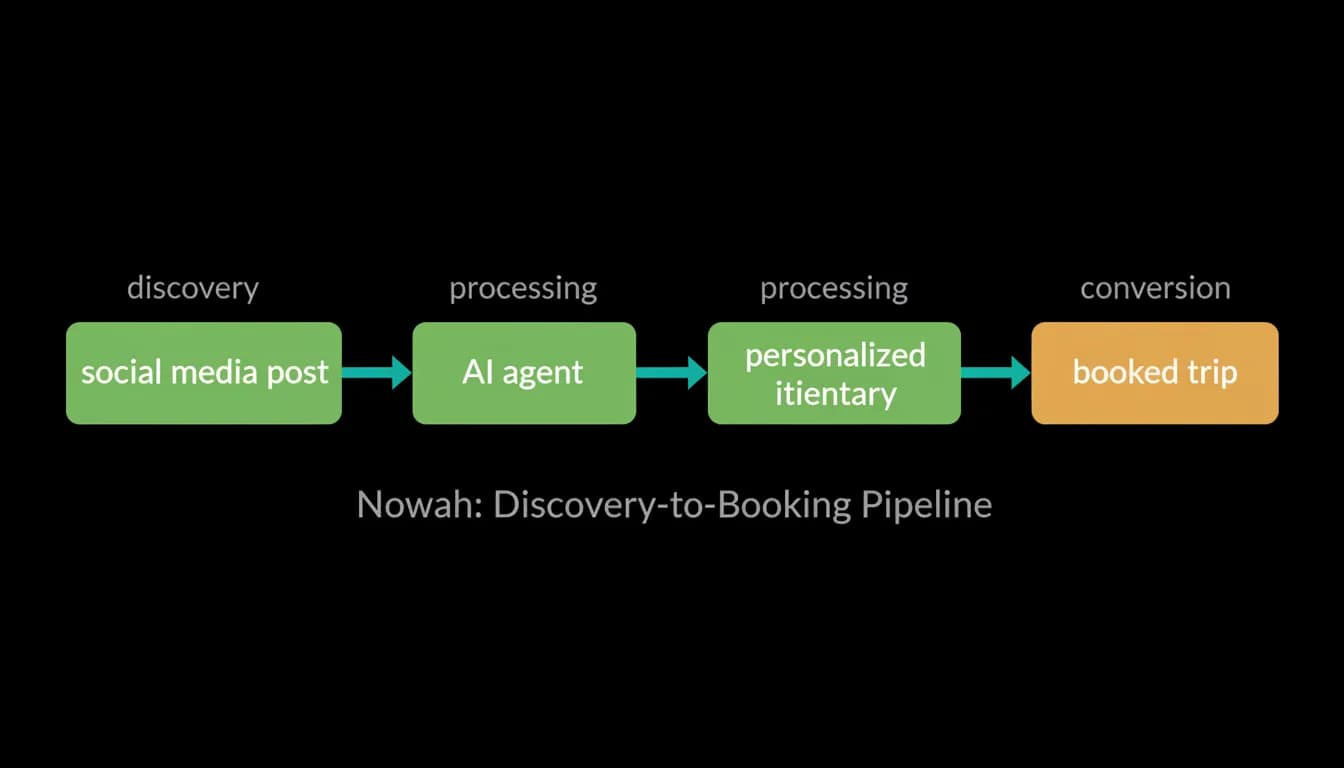
The most powerful shift AI enables for Gen Z travel is the ability to start from a feeling and end with a booked trip.
"I want somewhere warm with good street food and nightlife, under $800 all-in for a long weekend from LA."
That sentence contains six constraints: climate, food scene, nightlife quality, total budget, trip duration, and departure city. A traditional search form cannot even accept this query. An AI agent can process it, search across dozens of destinations, evaluate hundreds of flight and hotel combinations, and present three or four optimized options in under a minute.
This is how Gen Z thinks about travel. Not "I want to go to Bangkok." But "I want a vibe." The AI translates the vibe into logistics. The human picks the one that feels right. The AI books it.
The generation that plans trips from TikTok comments expects to book in 60 seconds. The travel industry has two options: build tools that match that expectation, or watch Gen Z build their own. The AI-native platforms that speak Gen Z's language — literally and figuratively — will capture the fastest-growing travel demographic in the world.
Nowah is an AI travel agent that searches and books real flights and hotels through conversation — no filters, no thirty open tabs. Plan your next trip.