Handling Negative Reviews: A Playbook Ready Before Launch Day
A review-response playbook ready before launch day — severity tiers, response SLAs, and how we convert harsh feedback into product work.
Harsh reviews will arrive. The mistake is inventing a process after the one-star rating lands. This is the response ladder we will use: severity, SLA, product routing, and when to reply in public versus fix in silence.
Triage framework
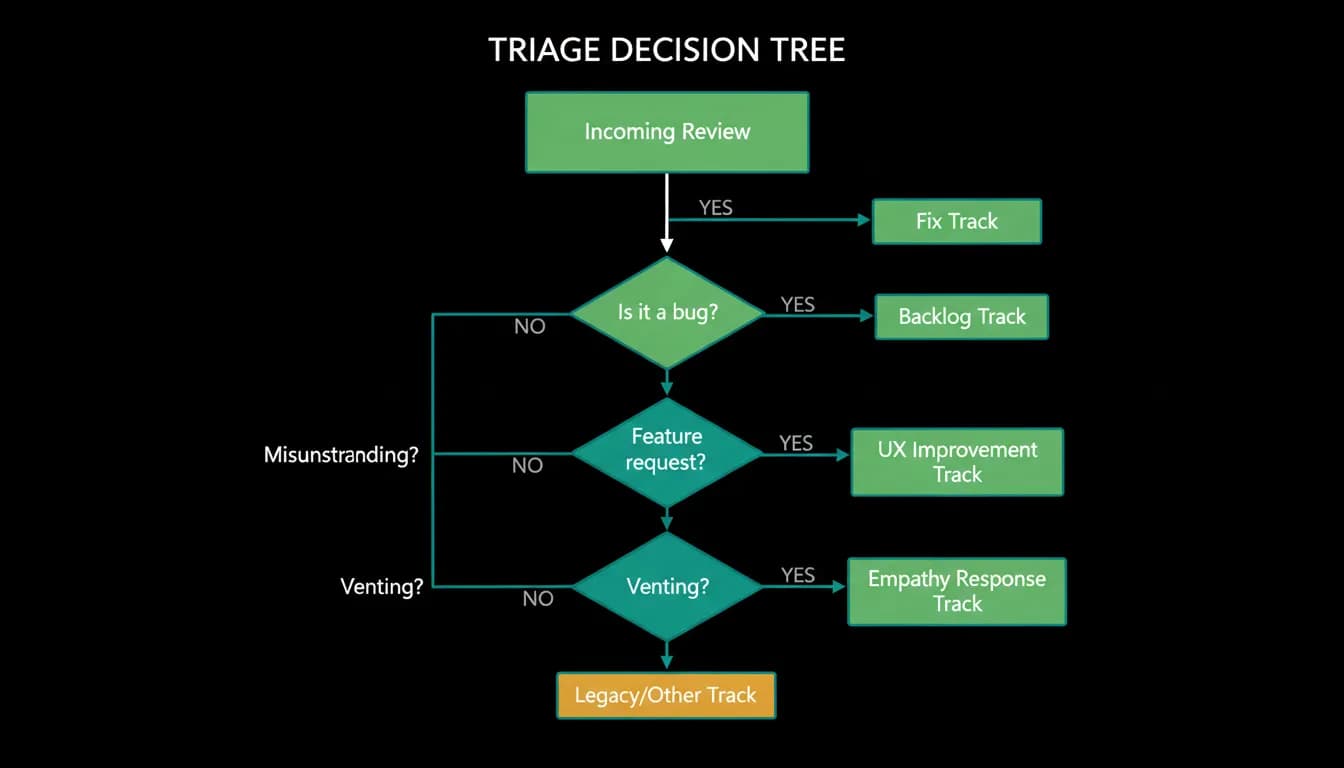
Not all negative reviews are the same, and they should not all receive the same response. We triage every negative review into one of four categories, and the category determines the response.
Bug reports are reviews that describe a specific malfunction. The app crashed. The agent gave wrong information. A booking failed. These are the most valuable negative reviews because they identify real problems that affect all users, not just the reviewer. Response: acknowledge the issue, explain that we are investigating, provide a timeline for the fix, and follow up when it ships. Roughly 40 percent of negative reviews fall into this category.
Feature requests are reviews that express disappointment about missing capabilities. The app does not support group booking. There is no way to filter by specific airlines. The agent cannot handle requests in a particular language. These reviews are not complaints about what exists. They are requests for what should exist. Response: acknowledge the gap, explain whether it is on the roadmap, and invite the reviewer to the beta program for early access. About 25 percent of negative reviews are feature requests.
Misunderstandings are reviews where the traveler tried to do something the app supports but could not figure out how. The capability exists. The user experience did not guide them to it. Response: explain how to accomplish what they wanted, and internally flag the UX gap for improvement. These reviews are direct evidence that the interface is confusing, which is actionable. Around 20 percent fall here.
Venting reviews express general frustration without specific actionable information. "This is the worst app ever." "AI is not ready for travel." "Waste of time." Response: empathize, offer to help if they want to try again, and move on. These reviews contain signal about sentiment but not about specific improvements. About 15 percent are venting.
Response templates
We use response templates as starting points, not as copy-paste answers. Every response is personalized to reference the specific issue the reviewer described. A templated response that does not acknowledge the reviewer's specific complaint is worse than no response at all because it signals that we did not actually read the review.
The bug acknowledgment template includes three elements: a statement that we have identified the issue, a specific description of what went wrong in plain language, and a commitment to a resolution timeline. No marketing language. No deflection. Just honest acknowledgment and a timeline.
The feature request template acknowledges the desire, explains our current prioritization, and invites the reviewer to join the private test community for early access to new features. This template converts a frustrated reviewer into a potential beta tester, which is the ideal outcome.
The response time target is twenty-four hours for acknowledgment. Not resolution. Acknowledgment. The reviewer needs to know that a human read their review and is taking it seriously. Resolution follows on its own timeline, but the initial response cannot wait.
The feedback-to-product pipeline
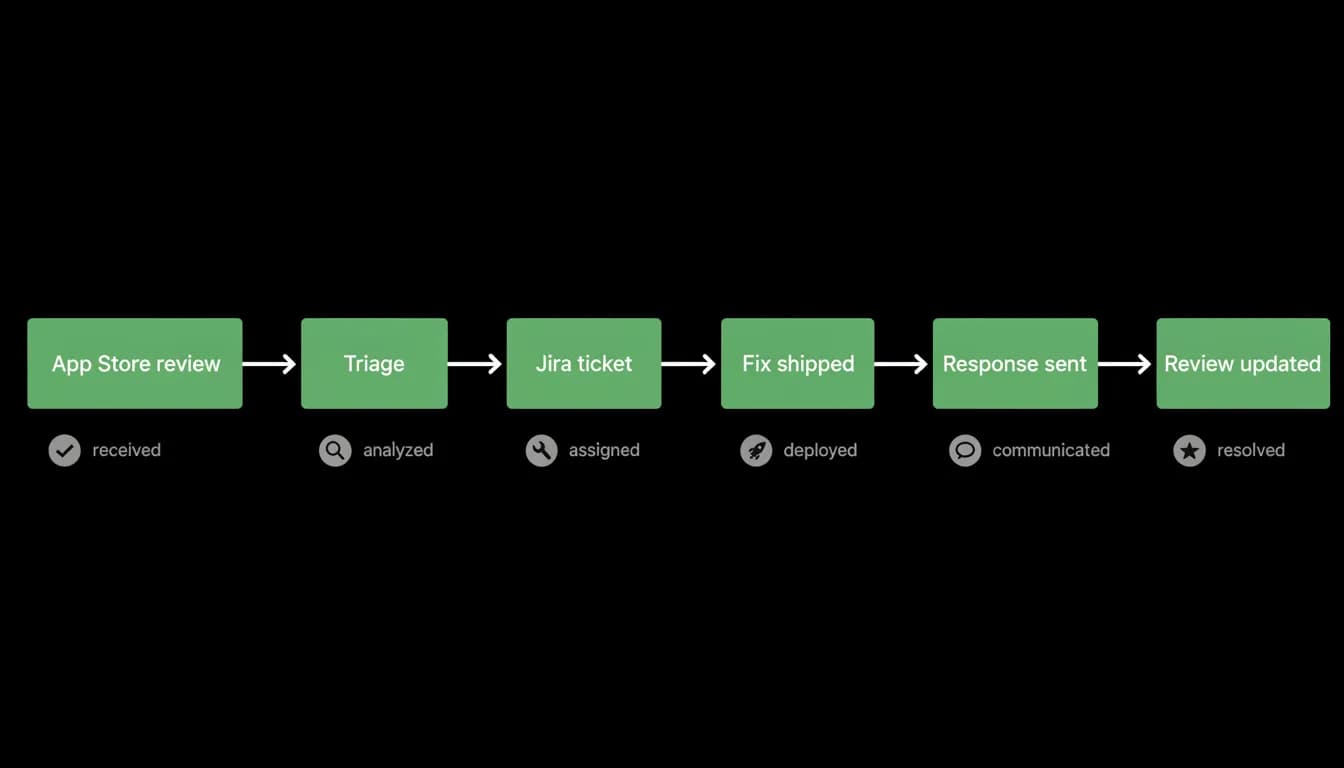
A negative review is only valuable if it reaches the team that can act on it. We built a pipeline that routes review insights from the App Store to our product development process.
The pipeline works in stages. Reviews are ingested and categorized daily. Bug reports are converted into issue tickets with the reviewer's description, our triage assessment, and severity classification. Feature requests are added to the backlog with the reviewer's use case as context. UX misunderstandings are flagged for the design team with the specific confusion point documented.
When a fix ships that addresses a reviewer's complaint, the support team follows up on the review with an update: what we fixed, when it goes live, and an invitation to try again. Travelers who receive this follow-up are significantly more likely to update their review because the update demonstrates that their feedback was not just heard but acted upon.
The complete loop, from review to ticket to fix to response to updated review, typically takes one to two weeks for bug reports. This timeline is fast enough to preserve the reviewer's engagement and slow enough to ship a proper fix rather than a hasty patch.
Public versus private resolution
Not every interaction should happen in the public review thread. We decide based on the issue's complexity and sensitivity.
Simple bugs and feature requests are addressed publicly. The response validates the reviewer's experience, which signals to other potential users that we are responsive. Public responses also serve as informal documentation: other users who encounter the same issue can see that it has been acknowledged and is being addressed.
Complex issues that require detailed troubleshooting or account-specific investigation are moved to private channels. The public response says "we want to help resolve this. Please reach out to our support team at [contact] so we can look into your specific situation." This maintains the public responsiveness signal while handling the complexity privately.
Some reviews, particularly venting reviews that do not contain actionable information, receive a brief empathetic response but do not require extended engagement. Engaging too deeply with non-specific criticism can be counterproductive because it opens a public dialogue without a clear resolution path.
Reviews as product research
Individual reviews tell anecdotes. Hundreds of reviews tell a story. We analyze review sentiment across our entire review corpus to identify patterns that individual reviews cannot reveal.
Sentiment analysis across hundreds of reviews surfaces recurring themes. If fifteen different reviewers mention difficulty with the onboarding flow, that is a pattern, not an outlier. If a specific feature generates disproportionate negative sentiment, that feature needs attention regardless of its internal metrics.
We track review sentiment over time to measure the impact of product changes. After shipping a major update, we monitor whether the negative review themes shift. If they shift from "the app crashes" to "I wish it had more features," that is progress: the baseline quality issues are resolved and travelers are now expressing aspirational feedback.
Power user complaints deserve special attention. A reviewer who describes hitting rate limits during heavy usage is not a casual user. They are deeply engaged with the product and bumping against its boundaries. These reviewers helped us identify the need for burst allowances in our rate limiting system, a feature that improved the experience for all power users.
Turning critics into advocates
The most powerful transformation in review management is turning a one-star reviewer into a five-star advocate. It happens more often than you might expect, and it follows a consistent pattern.
The reviewer leaves a negative review describing a specific problem. We respond promptly and honestly. We fix the problem. We follow up to tell the reviewer about the fix. The reviewer tries the app again, finds that the issue is resolved, and updates their review. The updated review often includes a note about the responsive support, which is more credible social proof than any marketing we could produce.
Not every negative reviewer will convert. Some issues are fundamental mismatches between what the traveler wants and what the product does. That is fine. The goal is not to convince every critic. It is to resolve every legitimate issue and demonstrate responsiveness to everyone watching. The silent audience, the potential users reading reviews before deciding to download, is larger than the active reviewers. They see how we respond. They draw their own conclusions.
Nowah is an AI travel agent that searches and books real flights and hotels through conversation — no filters, no thirty open tabs. Plan your next trip.