Building Group Travel: The Hardest Problem in AI Trip Planning
The group travel challenge — coordinating multiple travelers, conflicting preferences, shared budgets, consensus-building AI, and multi-party booking flows.

Six friends wanted to go on vacation together. One wanted a beach resort. One wanted a city with nightlife. One had a strict budget. One refused to fly economy. One could only travel on specific dates. And one wanted to bring a dog.
Each individual preference was reasonable. Together, they formed a constraint space so complex that the optimal solution required navigating hundreds of possible combinations. This is group travel: the coordination problem that makes single-traveler booking look trivial.
The coordination problem
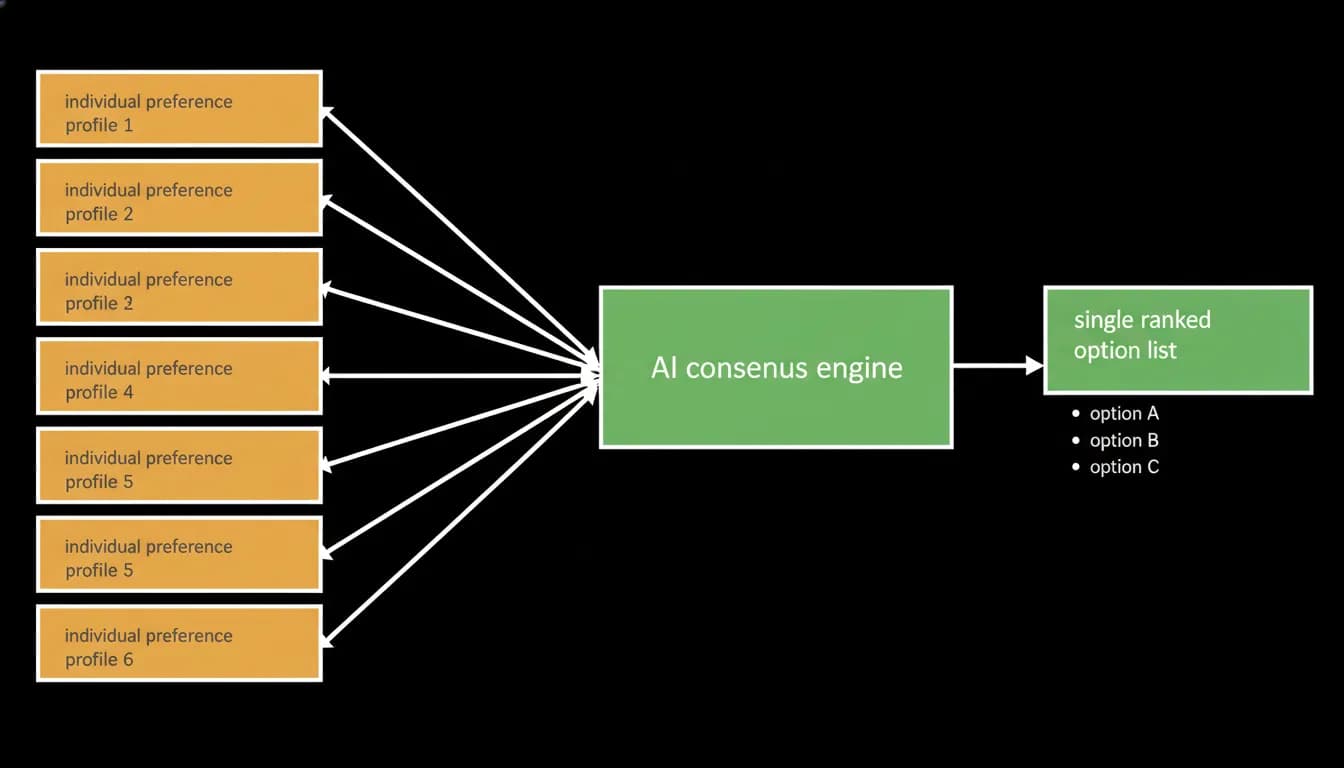
Single-traveler booking is an optimization problem with one objective function: find the best option for this person. Group travel is a multi-objective optimization problem where "best" means something different to each member of the group, and the objectives frequently conflict.
A budget-conscious traveler and a comfort-first traveler have fundamentally different definitions of a good hotel. A traveler with rigid dates and a traveler with flexibility have different search spaces. A family with young children and a couple looking for nightlife have different destination criteria. The agent cannot optimize for all preferences simultaneously because the preferences are contradictory.
The traditional solution is compromise, and compromise in travel usually means nobody gets exactly what they want and somebody is disappointed. The AI approach is different: instead of averaging preferences into a mediocre middle ground, the agent identifies the specific overlaps where multiple travelers' interests genuinely align and builds the trip around those intersection points.
Preference aggregation
Preference aggregation for group travel is not averaging. Averaging produces results that are nobody's first choice. Instead, the agent uses a weighted overlap approach that identifies options satisfying the most important preferences of the most members.
The process works in layers. First, the agent collects individual preferences from each group member. Not a simple form. A conversation where the agent probes for priorities, flexibility, and non-negotiables. The distinction between "I prefer morning flights" (flexible) and "I cannot fly after 3 PM because of my medication schedule" (rigid) matters enormously for how the preference is weighted.
Second, the agent identifies constraint dimensions: dates, budget, destination type, accommodation style, flight preferences. For each dimension, it maps where group members agree and where they conflict.
Third, the ranking system balances preferences across members rather than optimizing for one. A flight option that is the first choice for three members and acceptable to the other three ranks higher than an option that is the first choice for one member and unacceptable to two. The algorithm maximizes minimum satisfaction across the group rather than maximum satisfaction for any individual.
This approach requires extending the trip data model to support multiple traveler profiles linked to a single trip. Each member's preferences are stored individually, and the agent's reasoning considers all profiles simultaneously when making tool calls.
Shared budgets and split payments
Money is where group travel gets personally complicated. Who pays for the shared hotel room? How are flight costs divided when one person booked a more expensive seat class? What happens when the group dinner bill arrives and three people had cocktails while two had water?
The payment architecture for group travel handles several scenarios. Equal splits divide the total cost evenly across all members. Proportional splits assign costs based on individual consumption. Hybrid splits combine shared costs (hotel, transport) with individual costs (flights, personal expenses).
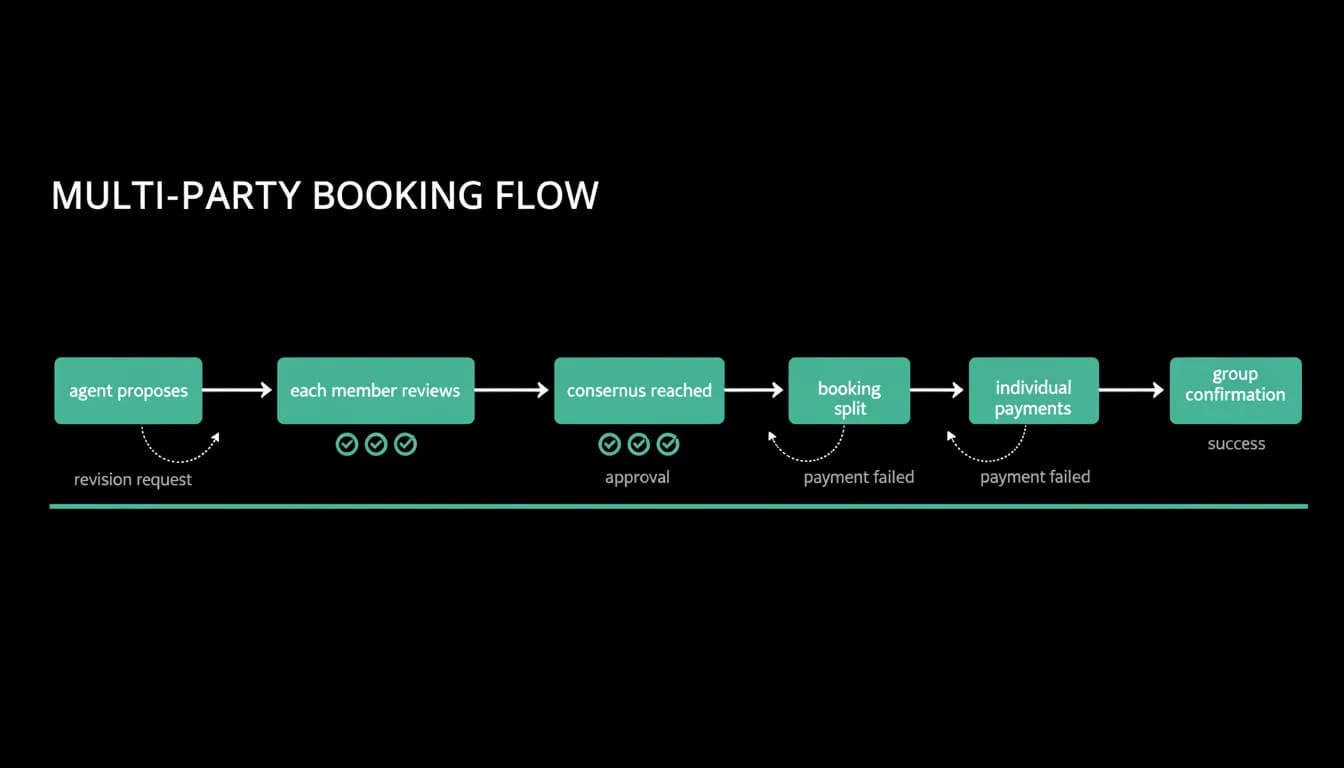
The payment processor supports per-member payment collection through a single booking flow. The agent presents the total cost and the proposed split. Each member receives a payment request for their share. The booking proceeds when all members have confirmed and paid. If a member does not pay within the confirmation window, the agent notifies the group and offers options: someone else covers the share, the group adjusts the booking, or the unpaid member is removed.
Handling the straggler, the group member who does not respond to the payment request, is one of the trickiest UX challenges. The agent cannot nag too aggressively because it is a social situation. But it cannot wait indefinitely because travel inventory is time-sensitive. We settled on a escalating notification cadence with a clear deadline, after which the group organizer can make a decision on behalf of the group.
Consensus-building AI
The agent's role in group travel goes beyond search and booking. It actively facilitates consensus. This is a fundamentally different agent behavior than individual booking, where the agent serves a single user's interests.
The consensus flow works through proposal and voting. The agent analyzes the group's preferences, generates a set of options that represent different tradeoff points, and presents them to the group. Each member can express support, concerns, or alternatives. The agent aggregates the responses, addresses concerns by finding variations that resolve conflicts, and iterates until the group converges on a choice.
This process requires the agent to be diplomatically intelligent. When one member strongly dislikes an option that everyone else loves, the agent needs to acknowledge that member's concern, explain why the option works well for the rest of the group, and offer a specific accommodation that addresses the concern without derailing the consensus. "I understand you prefer a city hotel. This resort has a shuttle to the nearby town center that runs every 30 minutes. Would that address your concern?"
The consensus-building behavior is new to the agent's capability set. It requires a different reasoning pattern than individual booking: instead of optimizing for one person's satisfaction, the agent optimizes for group harmony while respecting individual needs.
Multi-party booking flow
The booking confirmation flow for group travel requires multiple approvals. Unlike individual booking where one person reviews and confirms, group booking needs each member to verify their details and authorize their payment.
The flow is sequential but parallel. Each member receives a booking review with their individual details: their flight seat, their hotel room allocation, and their payment amount. Members can review and confirm independently and in parallel. The booking only executes when all members have confirmed.
If a member wants to change something, the change may affect the entire group. A request to switch to a different flight time might not work for other members' connecting flights. The agent evaluates the impact of individual changes on the group booking and communicates the implications before proceeding.
Timeout handling is critical. Group confirmations cannot remain open indefinitely because flight and hotel availability changes. The booking flow has a defined confirmation window. If all members have not confirmed within the window, the agent notifies the group, offers to extend the window, or suggests rebooking with updated availability.
Group travel metrics
Measuring success for group travel requires metrics that account for multiple perspectives. A booking that satisfies five out of six members is not a five-out-of-six success. The dissatisfied member's experience matters, and if they had a bad time, the social dynamics mean the whole group's experience is diminished.
We measure satisfaction across all group members, not just the organizer. Each member receives a post-trip feedback prompt. The group satisfaction score is the minimum individual satisfaction, not the average. This metric holds us to a high standard: the group trip is only as successful as the least satisfied member.
Booking completion rate with multiple approvals is significantly harder than individual completion. Each additional member who must confirm is a potential dropout point. We track the completion rate by group size and identify the group sizes where the approval flow creates too much friction.
Coordination efficiency measures how many conversation turns it takes to reach consensus. Fewer turns means the agent is better at identifying overlapping preferences and proposing options that work for everyone. More turns means the agent is struggling to find common ground, which suggests that the preference aggregation algorithm needs improvement or that the group's preferences are genuinely irreconcilable.
Group travel is the hardest problem in AI trip planning because it is not just a technology problem. It is a social coordination problem mediated by technology. The agent is not just a booking tool. It is a facilitator, a mediator, and sometimes a diplomat. Getting this right means understanding not just what each traveler wants, but how a group of travelers can find joy in a shared experience.
Nowah is an AI travel agent that searches and books real flights and hotels through conversation — no filters, no thirty open tabs. Plan your next trip.