Why Points Programs Are Broken and AI Can Fix Them
Loyalty programs are designed to confuse, not reward. AI agents analyze point valuations in real-time and optimize across all your memberships automatically.

I have 147,000 Delta SkyMiles, 52,000 Marriott Bonvoy points, and about 80,000 Chase Ultimate Rewards points sitting across three different accounts. I have no idea what any of them are actually worth. And that is entirely by design.
Loyalty programs are one of the great consumer deceptions of modern travel. They market themselves as rewards for your patronage, but they function as elaborate systems engineered to keep you confused enough to leave value on the table. The math is deliberately opaque. Redemption options are labyrinthine. Dynamic pricing means your points are worth a different amount on Tuesday than they were on Monday. And the programs change their terms constantly, always in the direction of less value for you.
This is a problem that AI agents are built to solve. Not with blog posts about "maximizing your rewards" that require a spreadsheet and three hours of free time, but with real-time analysis that runs in the background and tells you exactly what to do with your points at the moment you need to make a decision.
Loyalty programs are designed for the company, not you
Let me be direct about something the loyalty industry prefers to obscure: the primary purpose of airline and hotel loyalty programs is not to reward you. It is to create switching costs that keep you booking with one brand even when a competitor has a better price.
American Airlines AAdvantage launched in 1981. The idea was straightforward: fly with us and accumulate miles you can redeem for free flights. Simple. Transparent. A mile was a mile.
Forty-five years later, the same program has dynamic award pricing where a domestic round trip might cost you 12,500 miles or 75,000 miles depending on the day, the route, and how full the flight is. Marriott Bonvoy has eight tiers of properties with peak and off-peak pricing, and they shuffle hotels between tiers annually. United MileagePlus eliminated its award chart entirely in 2023, moving to fully dynamic pricing where the only way to know what a redemption costs is to search for it.
This complexity is profitable. Airlines and hotels earn billions from selling points to credit card companies. In 2023, Delta reported that its SkyMiles program generated more revenue from point sales to American Express than it did from actually flying people. The points become a currency that the issuer controls completely, including its exchange rate, and they consistently adjust that rate downward.
The average consumer has no chance of navigating this optimally. And the programs know it. They are betting that you will either hoard points indefinitely (free liability that never gets redeemed) or redeem them at poor valuations because you cannot be bothered to compare across dates, routes, and programs.
AI as your loyalty advocate
Here is where AI travel booking changes the game. An AI agent does not get tired of comparing valuations. It does not find dynamic pricing confusing. It can evaluate the cash value of your Delta miles against your Marriott points against your Chase points against just paying cash, across every route and hotel for your trip, in seconds.
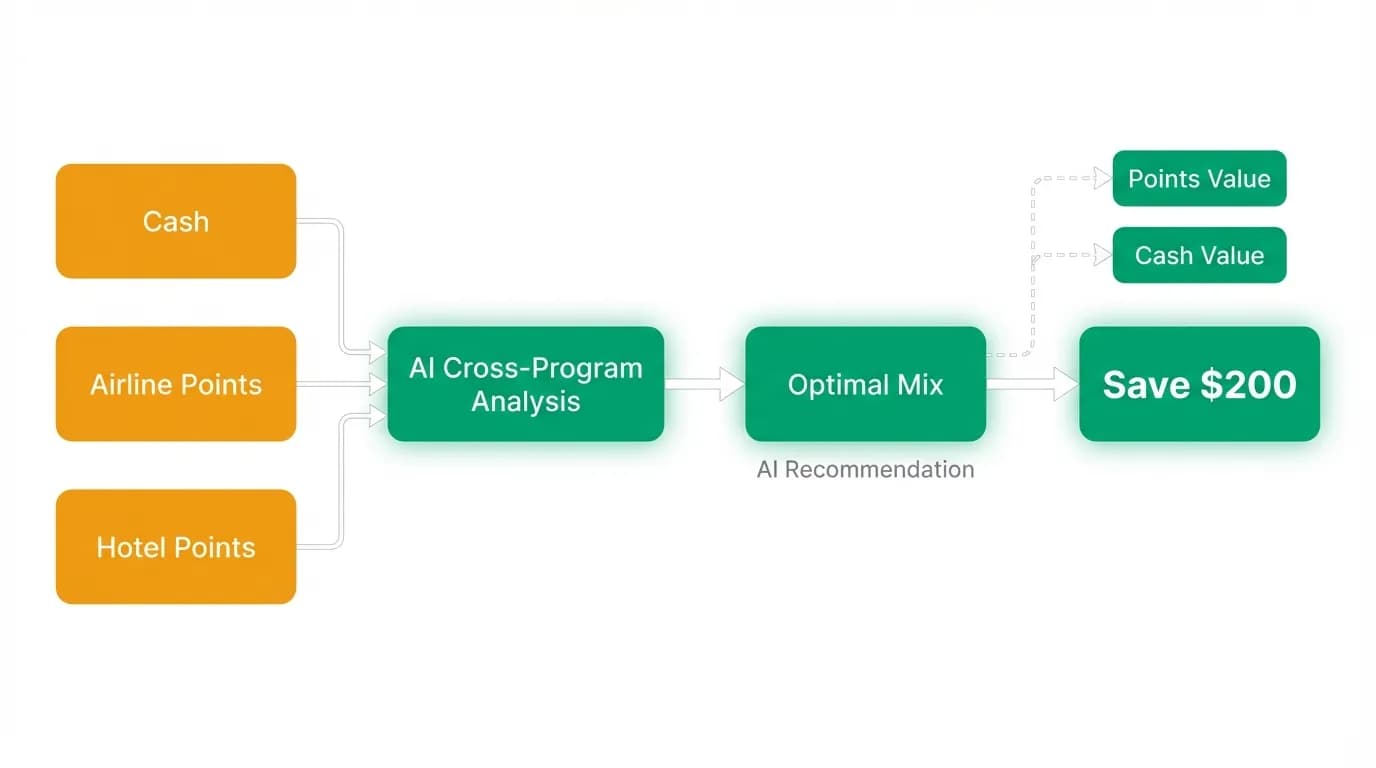
When you tell Nowah "I want to fly to Barcelona in October and stay for a week," the agent already knows your loyalty balances because it has seen them in past conversations. It searches flights and hotels, then runs the math on every possible payment combination: all cash, all miles, a mix of miles and cash, points transferred from your credit card to the airline, points used directly through the credit card portal.
The result is a recommendation like: "Use 35,000 Delta miles for the flight (worth about 1.8 cents per mile on this route, which is above average) and pay cash for the hotel. The Marriott redemption for this property would only give you 0.6 cents per point, which is terrible. Save your Bonvoy points for a peak redemption later."
That level of analysis takes The Points Guy staff writer three paragraphs and a comparison table. The AI does it in the time it takes to stream a response.
The key shift is agency. Traditional loyalty programs position you as a passive accumulator. You earn points through spending, and you redeem them through the program's own interface, which is designed to steer you toward low-value redemptions (ever notice how the prominent "use points" button on an airline site always shows the worst per-point value?). An AI agent flips this dynamic. It works for you, not the program. It treats your points as a financial asset and optimizes their deployment the same way a financial advisor optimizes a portfolio.
Cross-program optimization
The real power is not optimizing within a single program. It is optimizing across all of them simultaneously.
Most frequent travelers are enrolled in multiple loyalty programs. They have airline miles with two or three carriers. Hotel points with at least two chains. Credit card points with one or two issuers. Each program has its own valuation, its own sweet spots, its own transfer partners.
The optimization problem looks like this: you have a trip with a $400 flight and a $250-per-night hotel for five nights. You have points across four programs. The optimal strategy might involve transferring Chase points to Hyatt for the hotel (where they are worth 2.1 cents each), using Delta miles for the outbound flight (1.7 cents per mile), and paying cash for the return because the award pricing is garbage on that date.
No human does this analysis in full. Even dedicated points enthusiasts like those on Reddit's r/awardtravel community spend hours on a single redemption. They check multiple tools, consult valuation guides, and still argue about whether they got a good deal.
An AI agent treats this as a straightforward optimization problem. It knows current point valuations across programs. It checks transfer ratios between credit card issuers and loyalty programs. It factors in taxes and fees on award redemptions (which vary wildly and sometimes eliminate the value of a points booking entirely). And it runs this analysis for every component of your trip, every time.
The savings are real. We estimate that optimized cross-program redemptions save between $150 and $400 per trip compared to naive single-program redemptions. Over a year of travel, that adds up to serious money for anyone with a meaningful points balance.
The agency shift
There is a deeper change happening here beyond the math. Loyalty programs have operated for decades on the assumption that consumers are passive. You earn points by spending money on flights and credit cards. You redeem them through the program's own channels. The program controls the value, the availability, and the experience.
AI agents break this model. When an AI agent sits between the consumer and the loyalty program, it shifts the balance of power. The agent has perfect information about point valuations across programs. It has memory of the user's earning and redemption history. It can compare, in real time, whether a points redemption is actually a good deal or whether the program is offering you a lousy rate and hoping you will not notice.
This is the same shift that happened when comparison shopping sites appeared for retail. Suddenly retailers could not get away with inflated prices because consumers could see alternatives. AI agents do the same thing for loyalty points, but better, because the comparison is not just across prices but across entire programs, currencies, transfer ratios, and redemption valuations.
Airlines and hotel chains will hate this. And they should. Their current business model depends on information asymmetry between the program and the consumer. AI eliminates that asymmetry.
What The Points Guy and NerdWallet do manually
To appreciate what AI automation means here, look at what the existing loyalty optimization ecosystem looks like.
The Points Guy publishes monthly valuation guides that estimate the worth of points across major programs. NerdWallet has calculators that help you figure out the best credit card for your spending patterns. FlyerTalk and Reddit forums have communities of enthusiasts who spend hours analyzing specific redemptions and sharing sweet spots.
All of this is manual. A Points Guy valuation guide is a snapshot in time, based on staff analysis, that may or may not reflect your specific situation. A NerdWallet calculator handles one dimension of the problem (which card to get) but not the full optimization (which points to use for which component of which trip).
The expertise these outlets provide is genuine and valuable. But it is accessible primarily to people who have the time and inclination to read 2,000-word blog posts about credit card point transfer ratios. That is a small percentage of travelers. Everyone else is leaving money on the table because the optimization is too complex and time-consuming to do manually.
AI agents democratize this expertise. The same analysis that a points-and-miles enthusiast spends hours performing, the AI performs automatically for every user on every trip. You do not need to know what a cent-per-point valuation is. You do not need to understand transfer partner relationships. You do not need to check whether dynamic pricing has made your preferred award route unreasonable this month. The agent handles all of it.
This is what we mean when we say AI changes the relationship between consumers and travel companies. Not just faster booking, but smarter booking. The AI acts as your informed advocate in a system designed to profit from your lack of information.
How airlines and hotels will respond
The tension between AI optimization and loyalty program profitability is going to get interesting.
Loyalty programs generate massive revenue from breakage, which is the industry term for points that are earned but never redeemed. Breakage rates vary by program, but some estimates put them around 20-30% of issued points. That is pure profit for the issuer. If AI agents push redemption rates up by helping users actually use their points at good valuations, breakage drops and program profitability takes a hit.
Programs will likely respond in a few predictable ways. First, more dynamic pricing to make optimization harder. If the redemption price can change hourly, historical valuation data becomes less useful. But AI agents can adapt to dynamic pricing faster than human analysts can. Second, more restrictions on transfer partners and redemption channels. Programs may try to wall off the best redemptions behind their own interfaces. Third, and most likely, loyalty programs will try to become AI-friendly themselves, offering their own optimization tools to keep users within their ecosystem.
The third option is the smart play, and some programs are already moving in that direction. But there is a fundamental conflict of interest when the loyalty program itself is telling you how to redeem. The program's optimization will always be biased toward keeping you in their ecosystem, even when a competitor offers better value.
This is why independent AI agents matter. An agent that works for you, not for Delta or Marriott, can give you genuinely unbiased advice. "Your Delta miles are worth 1.4 cents each on this route. Cash the flight and save the miles for a transatlantic business class redemption where they are worth 2.3 cents." No airline's own tool will ever tell you to save your miles for later because the current redemption is bad for you.
The future: AI agents as universal loyalty navigators
We are building toward a world where loyalty points are just another form of currency that your AI agent manages on your behalf. Right now, points sit in isolated silos. You check your Delta balance in one app, your Marriott balance in another, your Chase balance in a third. There is no unified view, and there is certainly no unified optimization.
The AI travel booking experience we are building treats all of these as inputs to a single optimization problem. Your total travel wealth includes cash, airline miles, hotel points, and credit card rewards. The agent sees all of it and deploys each currency where it generates the most value for you.
The best version of this future goes further. The agent does not just optimize at booking time. It advises on earning too. "You have a Delta flight next month. If you switch to the Delta credit card for your everyday spending now, you will earn enough miles for a companion ticket by June." Or: "Marriott is running a points promotion on stays booked this week. Your Bonvoy points are currently undervalued, but if you book a stay at this specific property during the promotion, you will earn back enough points to make your next redemption profitable."
This is the level of optimization that only professional travel advisors or obsessive points enthusiasts can do today. AI makes it accessible to everyone. And it runs constantly, in the background, without you needing to think about it.
Loyalty programs were designed to create a confusing, program-favorable playing field. AI agents level it. And for the first time, the math works in the traveler's favor by default, not by accident and not by obsessive research. That alone would be reason enough to rethink how we interact with loyalty programs. The fact that it happens automatically, as part of a conversation about booking your next trip, is what makes it actually useful rather than theoretically interesting.
Nowah is an AI travel agent that searches and books real flights and hotels through conversation — no filters, no thirty open tabs. Plan your next trip.