Predictive Travel: When AI Books Before You Decide to Go
Pattern recognition spots your annual December trip home. Calendar gaps suggest getaways. Price drops trigger alerts. Predictive AI is the ultimate agent.

Every December, you fly home to visit your parents. You have done it for the last seven years. The flight is always from San Francisco to Chicago. You always leave on December 22nd or 23rd and return on January 2nd. You always fly economy on United because you have status. You always pay between $350 and $500 for the ticket.
Right now, you start thinking about this booking in mid-October. You check prices. They seem high. You check again in November. They have gone up. You stress. You set a price alert on three different apps. You watch prices fluctuate. You book in late November, usually paying more than you would have if you had booked in September, because you were waiting for a price drop that never came.
Every year, the same trip. The same airports. The same airlines. The same dates, give or take a day. The same budget range. And every year, you spend two months of mental energy on a decision that is, in all meaningful ways, already made.
A predictive travel AI agent would handle this entirely. It knows the pattern. It knows the dates. It knows your preferences. It monitors prices starting in August. When it finds a good fare, historically below the median price for this route during the holiday period, it presents a one-tap booking option. Or, if you have given it the authority, it books automatically and sends you a confirmation.
Zero effort. Better price. No stress. The agent acted before you even started thinking about it.
This is predictive travel. And it is where the AI travel agent becomes genuinely indispensable.
Pattern recognition: the AI sees what you do not
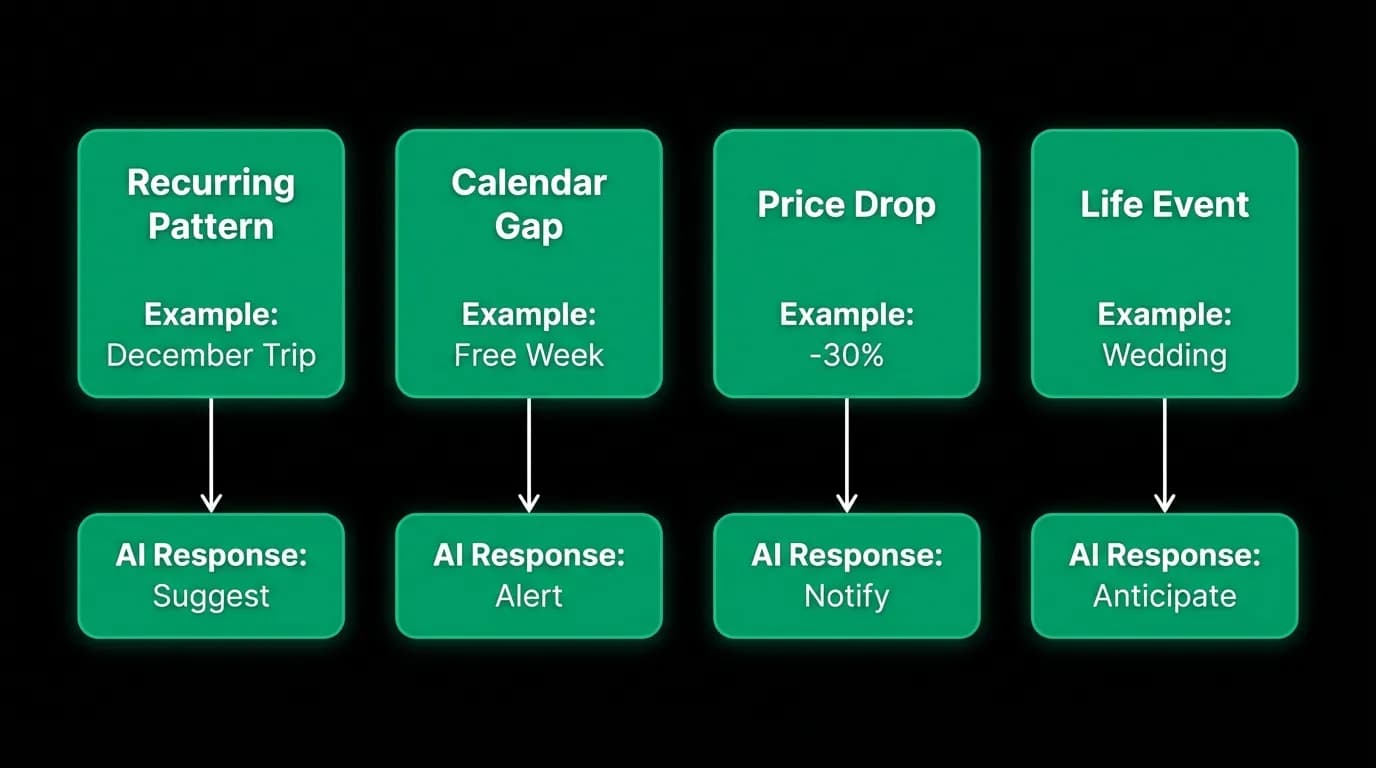
Humans are terrible at recognizing their own patterns. You know you fly home for the holidays, but you do not think of it as a "pattern" with predictable parameters. You experience it as a new decision each year, even though the decision is essentially the same.
An AI agent with access to your travel history sees the pattern clearly. SFO to ORD. Late December departure. Early January return. United economy. Aisle seat. One checked bag. The pattern has repeated seven times with minor variations.
But pattern recognition goes far beyond annual trips.
Quarterly business travel. You fly to the Austin office every quarter for a team meeting. The dates vary, but the destination, airline preference, and hotel choice are consistent. The agent can prepare the booking the moment meeting dates are confirmed in your calendar.
Seasonal vacations. You take a beach trip every February. The destination rotates, but the timing, duration (one week), and budget range ($3,000-4,000) are stable. The agent can start surfacing destination options in November with price comparisons.
Event-based travel. You attend the same conference every year. You visit the same music festival. You always travel for Thanksgiving and Mother's Day. Each of these creates a detectable pattern with predictable booking parameters.
[Preference drift](/blog/preference-drift-travel-tastes-change). More subtly, the agent can detect how your preferences evolve over time. Three years ago, you always booked the cheapest flight. Over the last two years, you have increasingly chosen nonstop flights even at a premium. The agent adjusts its optimization criteria to match your evolving priorities.
The agent does not just replay past bookings. It extracts the underlying preferences and constraints from the pattern, then applies them to current conditions. Prices change. Schedules change. Airlines adjust routes. The agent uses the pattern as a starting point and adapts to current reality.
Calendar integration: your schedule as a travel signal
Your calendar contains more travel signal than you realize.
An obvious signal: a calendar event labeled "Sales Conference - Miami, March 15-17." That is an explicit travel need. The agent should recognize it and start preparing a booking.
A less obvious signal: three consecutive days with no events in late April. That is a potential travel opportunity. The agent might surface it: "You have April 22-24 open. That is a long weekend with Friday through Sunday clear. Would you like me to look at quick getaway options?"
An even subtler signal: your partner's calendar shows they have PTO approved for the first week of June. Combined with your own calendar showing a light week, that is a strong signal for a joint trip. The agent connects the dots across calendars (with permission) and suggests: "Both of you have the first week of June free. Based on your past trips together, you might enjoy Lisbon or Porto. Want me to check prices?"
Calendar integration also enables proactive timing optimization. The agent knows your trip is in March. It also knows (from price data) that flights to that destination are typically cheapest when booked 6-8 weeks in advance. So it starts monitoring prices in January and alerts you when the timing is optimal for booking.
This requires calendar access, which is a significant permission. We think about this carefully. Calendar integration must be explicitly opt-in. The user must understand what the agent can see. And the agent must use calendar data solely for travel-relevant intelligence, not general-purpose surveillance.
Done right, calendar integration transforms the agent from something you have to initiate ("I need to book a trip") to something that comes to you at the right moment ("I noticed you have a trip coming up. Shall I handle it?").
Price intelligence: buying smarter without thinking
Hopper proved that price prediction is valuable. Their app tells you whether to buy now or wait based on their price forecasting model. It is useful, and millions of people rely on it.
But Hopper's approach is reactive. You have to tell Hopper which route you are watching. You check the app periodically. You make the buy/wait decision yourself. The intelligence is narrow: price direction for a specific route.
Predictive travel AI takes price intelligence much further.
Route monitoring without explicit setup. The agent knows your travel patterns and monitors relevant routes automatically. You do not have to create a price alert for SFO-ORD in December. The agent already knows to watch that route.
Contextual price evaluation. The agent does not just tell you the price is "low" or "high." It evaluates the price in the context of your specific trip. "$380 for your holiday flights is in the bottom 25th percentile based on the last three years of pricing for this route and timeframe. I recommend booking now." The price assessment is personalized and historically informed.
Cross-route optimization. If your destination is flexible, the agent can monitor prices across multiple potential destinations simultaneously. "Beach trips in February: Cancun is at $340 (30% below average), Turks and Caicos is at $480 (normal), Aruba is at $520 (10% above average). Cancun is the best value right now."
Expiration awareness. Airline credits, loyalty points, and travel vouchers expire. The agent tracks these and factors them into price intelligence. "You have $200 in United travel credits expiring in 90 days. Your holiday flights on United would bring the effective price to $180. I recommend using those credits now."
Companion fare opportunities. Some loyalty programs and credit cards offer companion fare benefits. The agent tracks when these are available and factors them into booking recommendations. "Your credit card companion fare benefit refreshed this month. If you book two tickets to Chicago now, the second ticket is $99 flat."
Price intelligence is where predictive AI delivers the most immediately quantifiable value. Every dollar saved on flights through better timing is a dollar the user can see and appreciate. We think price intelligence will be the gateway that makes users comfortable with predictive capabilities before they trust the agent with more complex autonomous actions.
Life event awareness: when context goes beyond the calendar
Some travel needs are triggered by life events that are not on any calendar.
A wedding invitation arrives. That is a travel need: flight, hotel, maybe a rental car, probably a gift from the registry too.
A job offer in a new city. That is a house-hunting trip need.
A parent's health update. That might be an urgent trip need.
A child's school schedule showing spring break dates. That is a vacation planning trigger.
AI agents will increasingly be able to detect these life event signals (with appropriate permissions and consent) and proactively connect them to travel needs.
"I see you received a wedding invitation for July 15th in Napa Valley. Would you like me to search for flights and hotels? Based on typical Napa wedding weekend stays, I would recommend arriving Friday July 14th and departing Sunday July 16th."
"Your daughter's spring break is March 10-14. You mentioned wanting to take a family trip this spring. Would you like me to put together some options that work for those dates?"
This is the most sensitive area of predictive AI because it involves reading personal communications and making inferences about private life events. The consent model has to be ironclad. Users must explicitly opt in to this level of intelligence. The data must be used exclusively for travel assistance. And the agent must handle sensitive situations with appropriate care. An urgent trip to see a sick parent is not the same as a vacation booking, and the agent's tone and approach should reflect that.
The consent question: being predictive without being creepy
This is the hardest design challenge in predictive AI. The line between "helpful" and "invasive" is subjective, varies by individual, and is easily crossed.
We think about this through a consent framework with escalating levels of predictive capability:
Level 1: Pattern-based suggestions. The agent uses only your Nowah travel history. No external data. "You usually book holiday flights in November. It is October. Want me to start monitoring prices?" This feels helpful, not invasive, because the agent is only using information you explicitly gave it through past bookings.
Level 2: Calendar-aware suggestions. The agent connects to your calendar and identifies travel-relevant events and gaps. "You have a conference in Austin in March. Shall I book your usual setup?" This requires explicit calendar permission and the user must understand what the agent can see.
Level 3: Price-proactive booking. The agent monitors prices and books automatically when preset conditions are met. "You set a budget of $400 for holiday flights. Prices hit $370 today, so I booked your usual United flight. Here's the confirmation." This requires explicit pre-authorization for both the route and the spending limit.
Level 4: Life-event awareness. The agent reads broader context (email, messages, social media) to identify travel triggers. This is the most powerful and most sensitive level. We do not think this is appropriate without very granular, revocable consent and extreme clarity about data usage.
Most users will be comfortable with levels 1 and 2 fairly quickly. Level 3 requires more trust building. Level 4 is appropriate only for users who have developed deep trust through extensive positive experiences at lower levels.
The key principle: the user should always feel that the agent is working for them, not watching them. Prediction should feel like having a thoughtful assistant who remembers your preferences and anticipates your needs. It should never feel like being monitored.
What Hopper gets right (and how full predictive goes further)
Hopper deserves credit for proving that consumers want predictive intelligence in travel. Their price prediction feature, which tells you whether to buy now or wait, has been adopted by millions of users. The insight was correct: travelers do not just want to search for the current price. They want to know if the price will go up or down.
Hopper also introduced price freeze, which lets you lock in a price for a fee while you make your decision. This addresses the anxiety of price volatility. Smart product thinking.
Where Hopper is limited:
Single dimension. Hopper predicts price. A full predictive travel AI predicts need. "You should book this trip" is a more complete prediction than "this price is good." Price is one input to the decision, but timing, availability, personal schedule, and preference matching all matter too.
Reactive setup. You have to tell Hopper which route to watch. A predictive agent watches routes you do not explicitly tell it about because it infers them from your patterns and calendar.
Isolated from booking. Hopper tells you when to buy. You still have to do the buying. A predictive agent can handle the entire chain from monitoring to booking to confirmation with appropriate authorization.
No memory across trips. Hopper does not know that you always fly United, prefer aisle seats, and stay at the same hotel chain. Each price watch is independent. A predictive agent with agentic memory applies your full preference profile to every prediction.
Hopper built the first floor of the predictive travel building. The full building has many more floors, and the penthouse is an agent that handles your entire travel life proactively.
The spectrum from suggestion to action
Predictive AI operates on a spectrum from passive suggestion to autonomous action. Where on that spectrum the agent operates should be determined by the user's trust level and explicit authorization.
Suggest. "Prices for your holiday flights are good right now. Want me to book?" The agent presents information. The user decides and acts.
Alert. "Prices dropped below your target of $400. I am holding an option for you. Tap to confirm within 24 hours." The agent creates urgency around an opportunity. The user confirms.
Reserve. "I found great flights within your parameters. I have placed a hold that expires in 48 hours. Review the details and confirm if you want to book." The agent takes preliminary action. The user approves.
Book. "Your holiday flights are booked. SFO to ORD on December 22nd, returning January 2nd. $370 on United, aisle seat, one checked bag. Confirmation number: ABC123." The agent acts autonomously within pre-authorized parameters.
Most users will start at "suggest" and gradually move toward "book" as they build confidence in the agent's judgment. Some users may never want full autonomous booking, and that is completely fine. The spectrum is not a progression that everyone must complete. It is a range of options that the user controls.
We default to "suggest" for all users and allow them to explicitly upgrade to higher levels of autonomy per route or per trip type. You might authorize automatic booking for your annual holiday trip (a well-established pattern with clear parameters) while keeping your anniversary trip at "suggest" (because you want to be involved in that planning).
The future of proactive travel
Here is where predictive travel is heading over the next few years.
Near-term (2026-2027): Pattern recognition from booking history. Price monitoring with smart alerts. Calendar integration for schedule-aware suggestions. These capabilities are buildable with current AI technology and our existing data.
Mid-term (2027-2029): Autonomous booking within pre-authorized parameters. Cross-platform integration with financial and calendar AI. Multi-traveler coordination (booking for families and groups based on combined patterns). Price optimization across a full trip (flight + hotel + activities timing).
Long-term (2029+): Life event awareness with appropriate consent. Fully autonomous routine travel management. Agent-to-agent negotiation for personalized rates. Predictive destination recommendation based on life stage, season, and preference evolution.
The vision is a travel agent that knows your life well enough to handle your travel logistics without being asked. Not for every trip. Not without your approval. But for the predictable patterns that make up the majority of most people's travel, the agent just handles it. You focus on the part of travel that matters: the experience.
Why this matters
Predictive travel AI matters because it addresses the fundamental inefficiency of how people book travel today.
The average traveler spends meaningful time and mental energy on trips that are essentially predetermined. The annual holiday visit. The quarterly business trip. The predictable vacation pattern. These trips do not benefit from extensive research and comparison because the decision variables are already known from past behavior.
An AI agent that recognizes these patterns and handles them proactively frees up the traveler's time and mental energy for the trips that actually benefit from active planning: the once-in-a-lifetime anniversary trip, the exploration of a new destination, the spontaneous adventure.
The goal is not to remove humans from travel decisions. It is to remove humans from travel logistics. Let the AI handle the predictable stuff. Let the human focus on the meaningful stuff. That division of labor is what an AI agent should be: not a replacement for human judgment, but a liberation from repetitive tasks that do not require it.
We are building Nowah to be that agent. The one that knows your patterns, monitors your opportunities, and acts at the right moment so you never have to stress about booking a trip you were always going to take.
The best flight you will ever book is the one you did not have to think about.
Nowah is an AI travel agent that searches and books real flights and hotels through conversation — no filters, no thirty open tabs. Plan your next trip.