Preference Collection as Onboarding
Asking about seat preferences and travel style during onboarding is not data collection — it is personalization that makes every future AI response better from conversation one.

Five questions transform a generic chatbot into a personal travel agent. Not fifty. Not a comprehensive profile form that takes twenty minutes. Five.
Travel style. Seat preference. Dietary needs. Home airport. Travel companions.
Each of these preferences shapes every future interaction in a concrete, measurable way. When the AI searches for flights, it already knows whether to prioritize budget options or premium ones. When it finds hotels, it already knows whether to highlight kid-friendly amenities or business center access. When it builds an itinerary, it already knows whether the user is a solo adventurer or planning a family trip.
This is why preference collection during onboarding is not data harvesting. It is product configuration. The five questions are not serving the platform. They are serving the user by eliminating repetitive questions in every future conversation.
Travel style: the filter that shapes every result
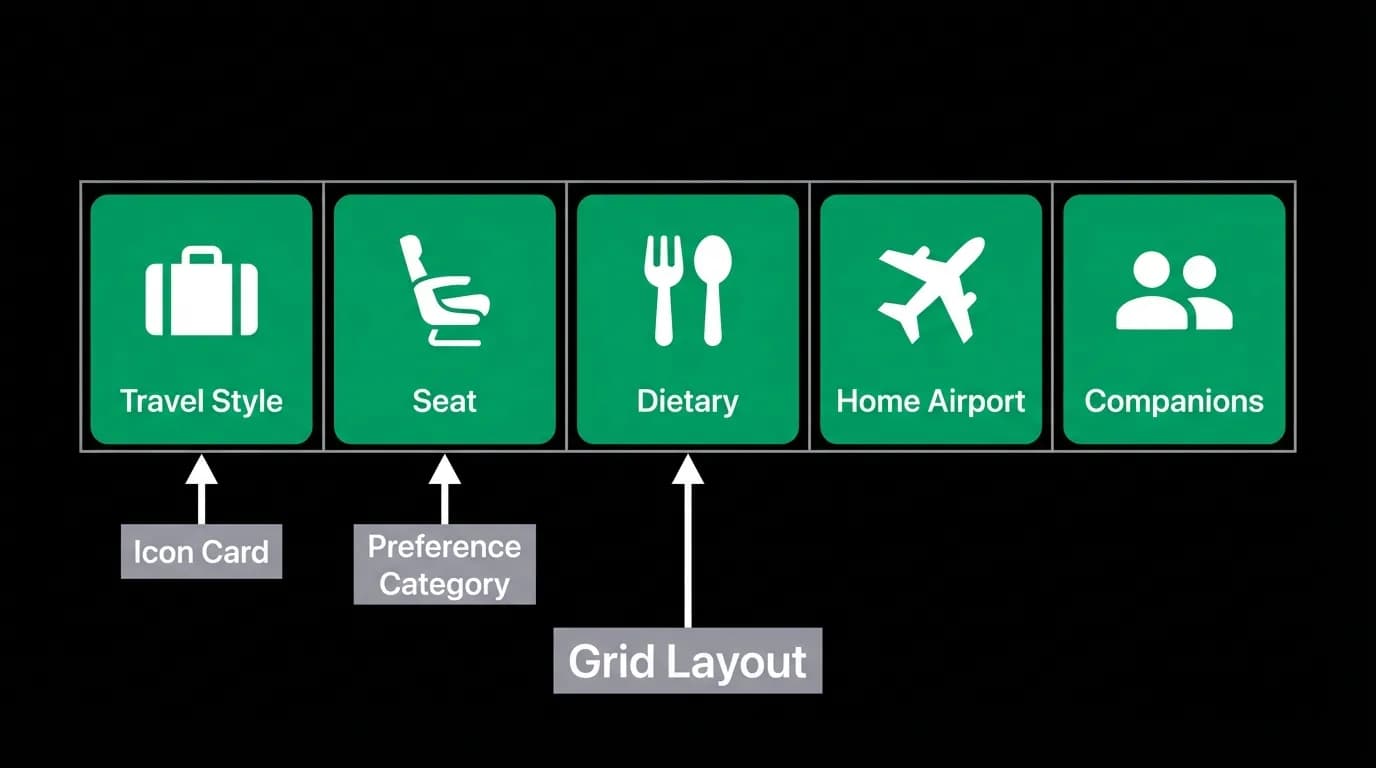
Budget, mid-range, or luxury. This single preference changes the entire result set for every search. A budget traveler sees hostels and basic economy flights. A luxury traveler sees five-star properties and business class options. A mid-range traveler sees the curated middle ground.
Without this preference, the AI has to guess or ask. "What is your budget?" becomes a question in every conversation. With the preference set during onboarding, the AI can skip straight to relevant results from day one.
The options are deliberately broad. We do not ask for a dollar amount because dollar amounts are relative to destination, trip type, and time of year. "Budget" means something different for a weekend in a nearby city versus two weeks in Southeast Asia. The broad category gives the AI a starting point that it refines through conversation context.
Seat preference: every flight search is personalized
Aisle or window. It seems trivial. But when you search for flights multiple times and the AI consistently presents options noting your preferred seat availability, the experience feels genuinely personal.
More importantly, when the AI books a flight, it can prioritize the user's preferred seat during the booking process without asking again. This eliminates one more decision point in an already complex flow and reinforces the sense that the AI knows you.
Dietary needs and travel companions
Dietary needs affect meal recommendations, hotel breakfast relevance, and restaurant suggestions throughout a trip. A vegetarian traveler gets different dining suggestions than someone with no dietary restrictions. The AI can mention "this hotel includes breakfast with vegetarian options" or suggest restaurants accordingly.
Travel companions shape the entire trip planning-trip-planning-ai-shines) approach. A solo traveler gets recommendations for walkable neighborhoods and social hostels. A couple gets romantic restaurants and boutique hotels. A family gets kid-friendly activities and properties with pools. A group gets multi-room availability and shared-space options.
These preferences are collected with the same tap-to-select interface: large, clearly labeled options, no typing required. The interaction takes seconds per question and sets up months of personalized service.
Home airport: smarter routing without asking "Where from?"
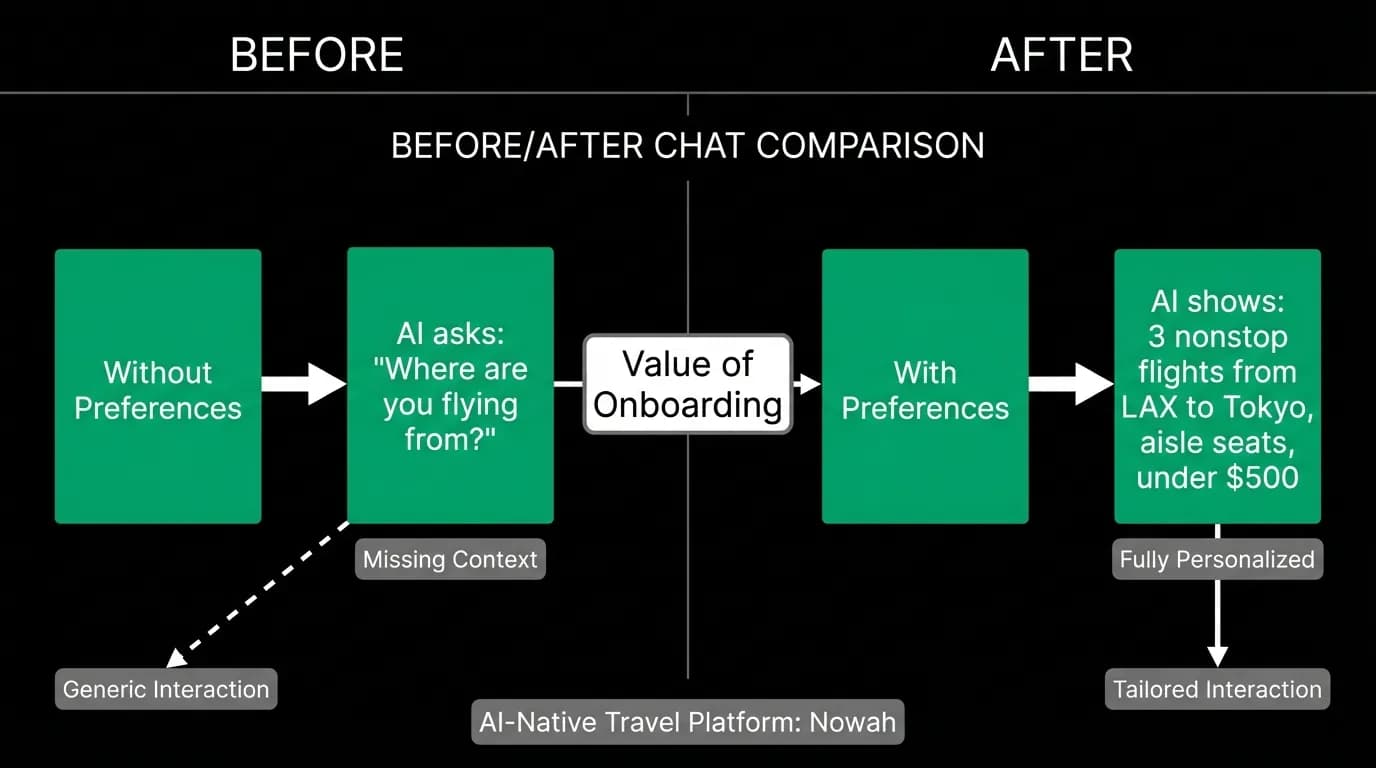
Home airport is the preference with the most immediate practical impact. Every flight search starts with an origin, and for the vast majority of searches, that origin is the user's home airport. By collecting this during onboarding, the AI can default to the correct origin without asking "Where are you flying from?" every time.
When the user says "Find me flights to Tokyo in April," the AI already knows to search from their home airport. If the user is traveling from a different origin, they can specify it, and the AI adjusts. But the default eliminates the most repetitive question in travel planning.
Tap-to-select over form fields
Every preference in the onboarding flow uses a tap-to-select interface rather than form fields. This is a deliberate design choice with several benefits.
Speed. Tapping a large button is faster than typing in a field. The entire onboarding takes under thirty seconds.
Accuracy. Pre-defined options eliminate typos, ambiguous inputs, and the cognitive load of formulating a response. The user does not have to decide how to express their preference. They just recognize the option that fits.
Mobile friendliness. Large tappable areas work well on all phone sizes, in any orientation, while walking, in a moving vehicle. There is no keyboard to summon and dismiss.
Reduced abandonment. Form fields feel like work. Tap-to-select feels like expressing yourself. The psychological difference matters for completion rates. Data suggests users who complete the full onboarding report significantly higher satisfaction with AI recommendations compared to users who skip it.
Defer what you can
Five preferences are collected during onboarding. Dozens more are gathered over time through natural conversation. The AI notices that the user always asks for nonstop flights and adds that to their profile. It remembers that they preferred a hotel near the city center in their last three trips. It learns their price sensitivity not from a stated budget but from the options they actually choose.
This deferred collection is critical. Asking too many questions during onboarding creates friction and abandonment. Asking too few means the AI starts generic. Five is the balance point: enough to be personal from day one, few enough to be frictionless.
The preferences are not static either. If a user's travel style changes, if they start traveling with a partner, if they move to a new city and change home airports, the AI updates through conversation. "I moved to a new city" updates the home airport. "We are traveling with the baby now" adjusts companion preferences. The onboarding preferences are the foundation, not the ceiling.
Nowah is an AI travel agent that searches and books real flights and hotels through conversation — no filters, no thirty open tabs. Plan your next trip.