The Psychology of Travel Booking: Why We Overpay, Overplan, and Overthink
Anchoring bias, FOMO pricing, sunk cost fallacy, and planning paralysis — behavioral economics explains your booking mistakes and how AI counters them.
You paid $80 more for a flight because you saw a $900 option first — anchoring bias at work. You booked hastily because the platform showed "only 2 seats left" — FOMO pricing at work. You kept a non-refundable hotel reservation even though your plans changed — sunk cost fallacy at work. And you researched for 14 hours before booking a 3-day weekend trip — planning paralysis at work.
These are not character flaws. They are predictable cognitive biases that behavioral economists have documented, named, and measured across decades of research. The travel industry — particularly the online booking ecosystem — has optimized itself to exploit every one of them.
Understanding these biases does not make you immune to them. But it does enable you to recognize when they are influencing your decisions and to use tools — specifically AI agents — that are designed to counter them rather than exploit them.
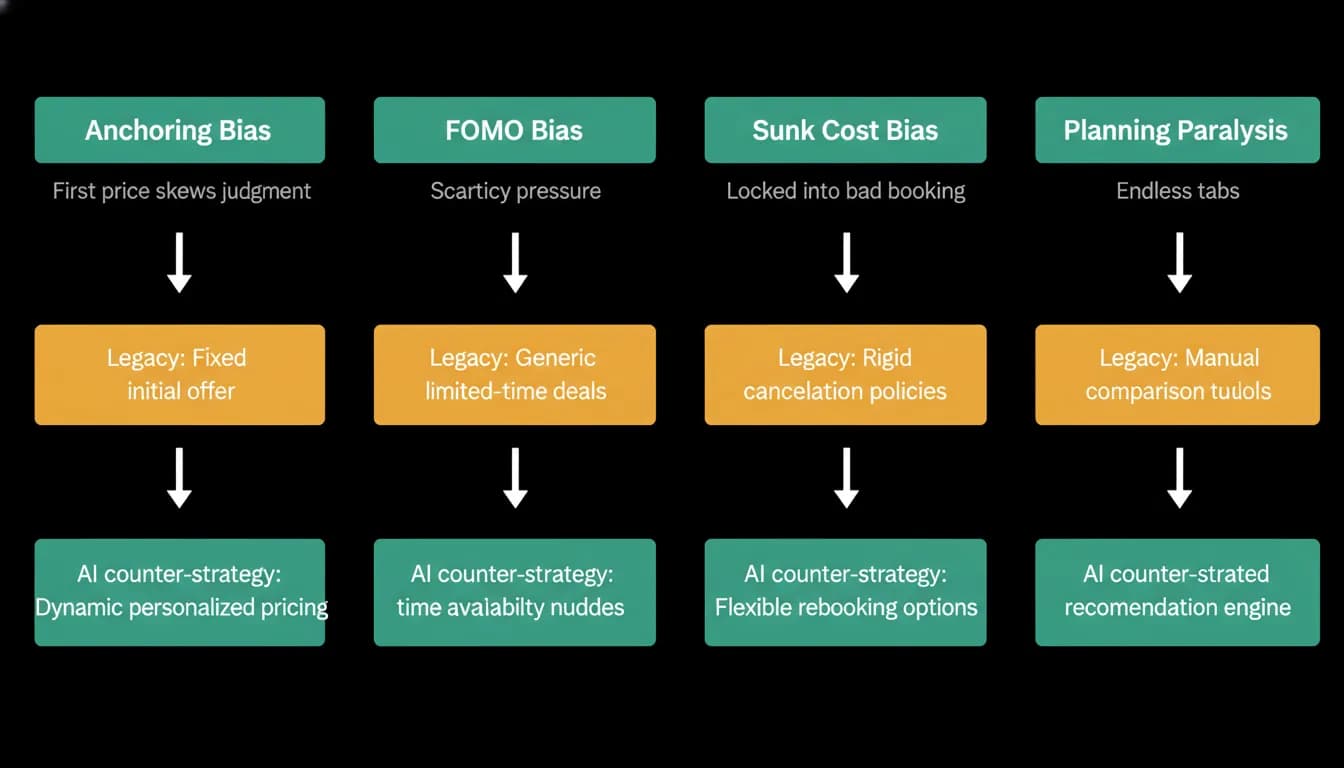
Anchoring bias: the first price wins
The anchoring effect is among the most powerful and well-documented cognitive biases. The first price you encounter for a product becomes a reference point — an anchor — that influences your evaluation of every subsequent price, regardless of whether the anchor itself is reasonable.
In travel booking, anchoring operates constantly. Your friend mentions they paid $800 for a flight to London. That becomes your anchor. When you search and find a flight for $650, it feels like a deal — even if the route regularly prices at $550.
OTAs exploit anchoring through sort order. The default "recommended" results often show a moderate-to-high price first, establishing an anchor. Then the platform can present slightly lower prices as attractive alternatives. The first price seen influences willingness to pay by 15 to 25 percent.
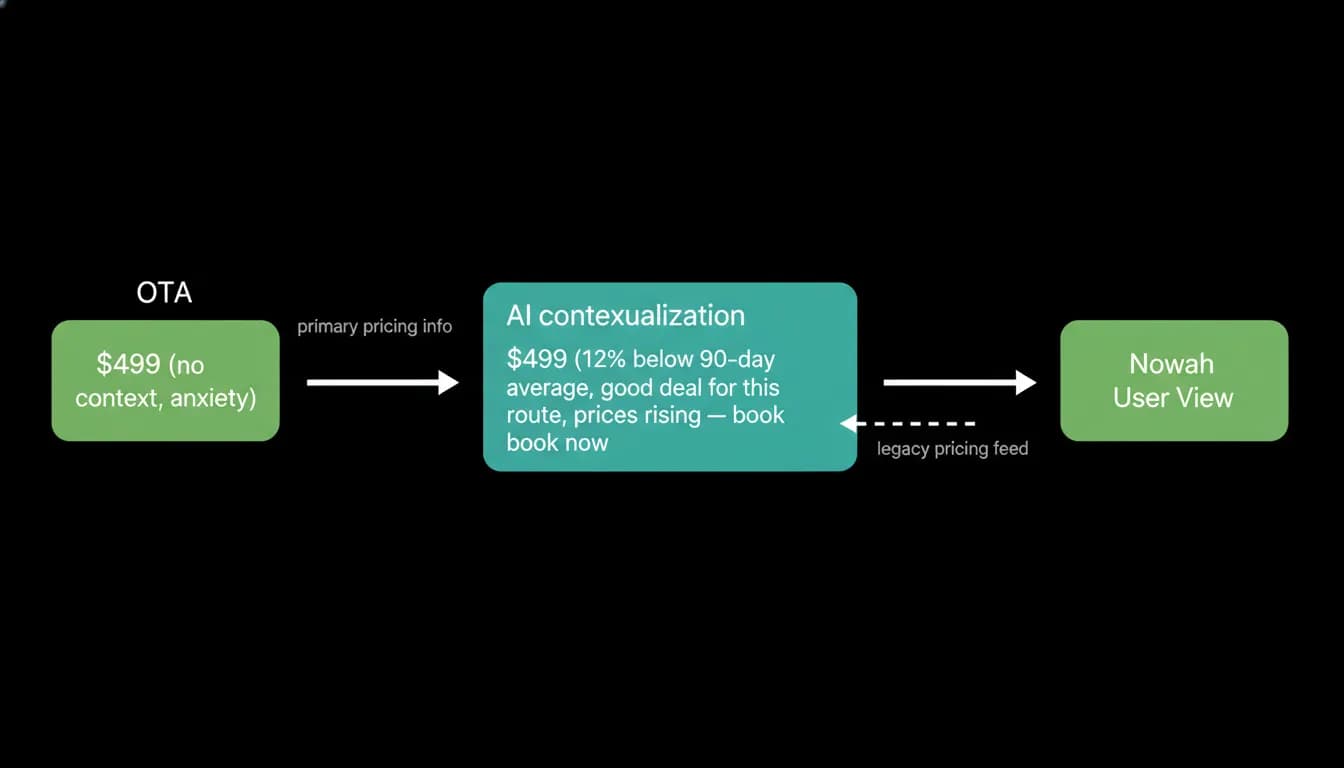
AI agents counter anchoring by providing objective price context rather than relying on comparison to other options. "This flight is $650. The 90-day average for this route is $580. The current price is 12 percent above average but prices are trending upward and expected to increase further. This is a reasonable price in the current market."
With historical context, the anchor is data rather than a random number. The evaluation shifts from "is this cheaper than the first thing I saw?" to "is this a good price for this route?" The second question leads to better decisions.
FOMO pricing: manufactured scarcity
"Only 2 seats left at this price!" "47 people are looking at this hotel right now!" "Price drop protection expires in 10 minutes!"
These urgency messages increase conversion rates by approximately 20 percent. They also decrease satisfaction by 15 percent. Travelers who book under manufactured pressure are more likely to experience regret, more likely to feel manipulated, and less likely to trust the platform for future bookings.
The messages are technically accurate and practically misleading. "Only 2 seats left at this price" means at this specific fare class — there may be dozens of seats available at slightly different prices. "47 people looking" includes everyone who has viewed the page, most of whom will not book. "Price drop protection" is a timer designed to create urgency where none exists.
The mechanism is FOMO — fear of missing out. The traveler, faced with perceived scarcity, overrides their analytical evaluation and books impulsively. The urgency short-circuits the comparison process, which is exactly its purpose.
AI agents counter FOMO with factual scarcity information. "There are 2 seats left in this fare class, but 34 seats are available in the next fare class at $25 more. Total availability on this flight is not constrained. Recommend booking today based on historical pricing trends, not seat scarcity." Facts replace fear.
Sunk cost fallacy: throwing good money after bad
You booked a non-refundable hotel in Barcelona for $600. Your plans change — you now realize Lisbon would be better for this trip. But you already spent $600 on the Barcelona hotel. So you go to Barcelona, even though you would enjoy Lisbon more.
This is the sunk cost fallacy: letting past, unrecoverable costs influence future decisions. The $600 is spent regardless of whether you go to Barcelona or Lisbon. The rational calculation considers only future costs and benefits. But psychologically, abandoning a $600 investment feels like waste.
Travelers lose an average of $200 per year on non-refundable bookings they should have changed or canceled. The sunk cost fallacy keeps them committed to suboptimal plans because changing feels like admitting a mistake.
AI agents address sunk costs in two ways. First, they recommend refundable rates more strategically based on your personal plan-change history, reducing the frequency of sunk cost situations. "Your historical plan-change rate is 30 percent. The refundable rate is $40 more per night. At your change rate, the refundable option saves you money over time."
Second, when plans do change, the agent reframes the decision without the sunk cost. "The Barcelona hotel is non-refundable — that $600 is spent. The question now is: would you rather spend 5 days in Barcelona or 5 days in Lisbon? Lisbon flights are $280. Lisbon hotels for 5 nights: $500. The better trip experience justifies the additional cost. The Barcelona payment is a separate, already-resolved expense."
This reframing — separating the sunk cost from the forward-looking decision — helps travelers make better choices about future actions rather than being anchored to past commitments.
Planning paralysis: research as procrastination
Thirty percent of trip research sessions end without any booking. Not because the traveler found nothing suitable, but because the abundance of information and options creates a paralysis where continued research becomes a substitute for decision-making.
Planning paralysis has a specific psychological profile. The traveler is not lazy — they are anxious. Travel purchases are large, emotional, and irreversible (or perceived as irreversible). The fear of making the wrong choice drives continued research: one more comparison, one more review, one more platform checked.
The irony: excessive research produces worse decisions, not better ones. Decision fatigue sets in after 35 to 40 minutes. After that, the traveler is evaluating options with depleted cognitive resources, making them more susceptible to anchoring, FOMO, and impulse decisions.
AI agents break planning paralysis by collapsing the research phase. Instead of 14 hours of research across 38 websites, the traveler has a 5-minute conversation that produces 3 curated options with clear trade-off explanations. The reduced option set and the explicit reasoning give the traveler enough information to decide without the anxiety loop of continued research.
"These are the 3 best options for your trip. Here is why each was selected. Here is how they compare on the dimensions you care about. My recommendation is option 2. Shall I book it?"
The confidence to decide comes from trusting the recommendation. And trust comes from transparent reasoning, not from exhaustive personal research.
AI as behavioral checkpoint
You cannot eliminate cognitive biases. They are features of human cognition, not bugs. But you can use tools that counteract them rather than exploit them.
AI agents serve as a behavioral checkpoint: a system that processes the same information without anchoring bias, without FOMO sensitivity, without sunk cost attachment, and without the fatigue that leads to planning paralysis.
When you feel pressure to book immediately, ask the agent: "Is there actual scarcity here or is this manufactured urgency?" When the first price you see feels like the benchmark, ask: "How does this compare to the historical average?" When you are clinging to a non-refundable booking that no longer fits, ask: "If I forget about the sunk cost, what is the best decision going forward?" When you have been researching for hours without booking, ask: "Just give me your top 3."
The biases will not disappear. But the AI provides a counterweight — a rational, data-driven perspective that you can use to calibrate your own judgment. The combination of human intuition and AI analysis produces better booking decisions than either alone.
Nowah is an AI travel agent that searches and books real flights and hotels through conversation — no filters, no thirty open tabs. Plan your next trip.