Rating and Review Display in AI-Curated Results
Star ratings, review scores, and guest snippets add social proof to AI-curated hotel results — but too much review data overwhelms. The AI should summarize, not dump.
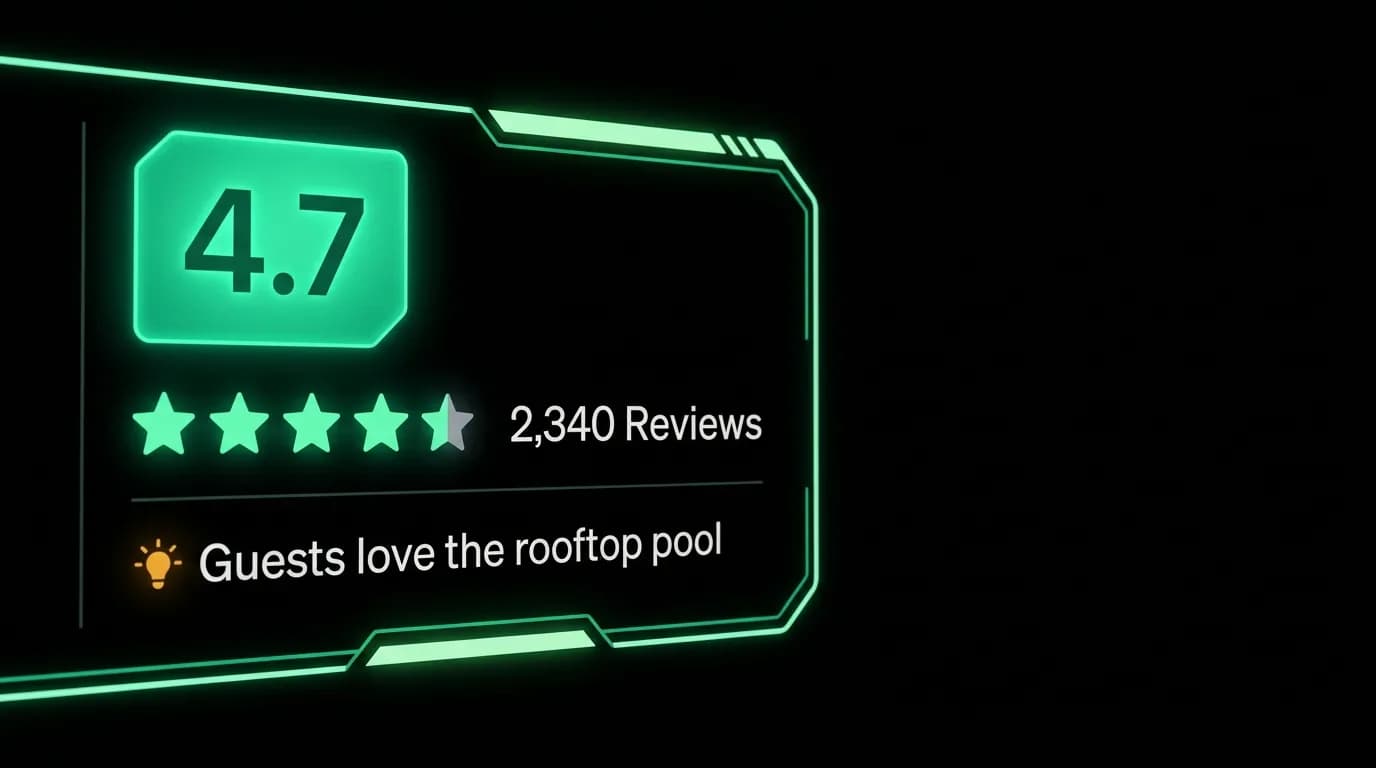
"4.7 stars, 2,340 reviews." Seven characters and a number, and the user's brain has already made a judgment about the hotel. This is the power of ratings as a trust shortcut. The user does not need to read 2,340 reviews. The aggregate number tells them that enough people stayed here and reported a positive experience that the property is probably good.
But in an AI-curated interface, the role of ratings shifts. The AI has already curated the results. It has already determined that these three hotels are the best options for this user. The rating is no longer the primary filter. It is social proof that validates the AI's recommendation.
This changes how ratings and reviews should be displayed. Less emphasis on the number as a decision driver. More emphasis on the number as a confidence builder. And a new role for the AI: summarizing what hundreds of reviewers said into one sentence that actually helps.
Star ratings: numeric plus visual
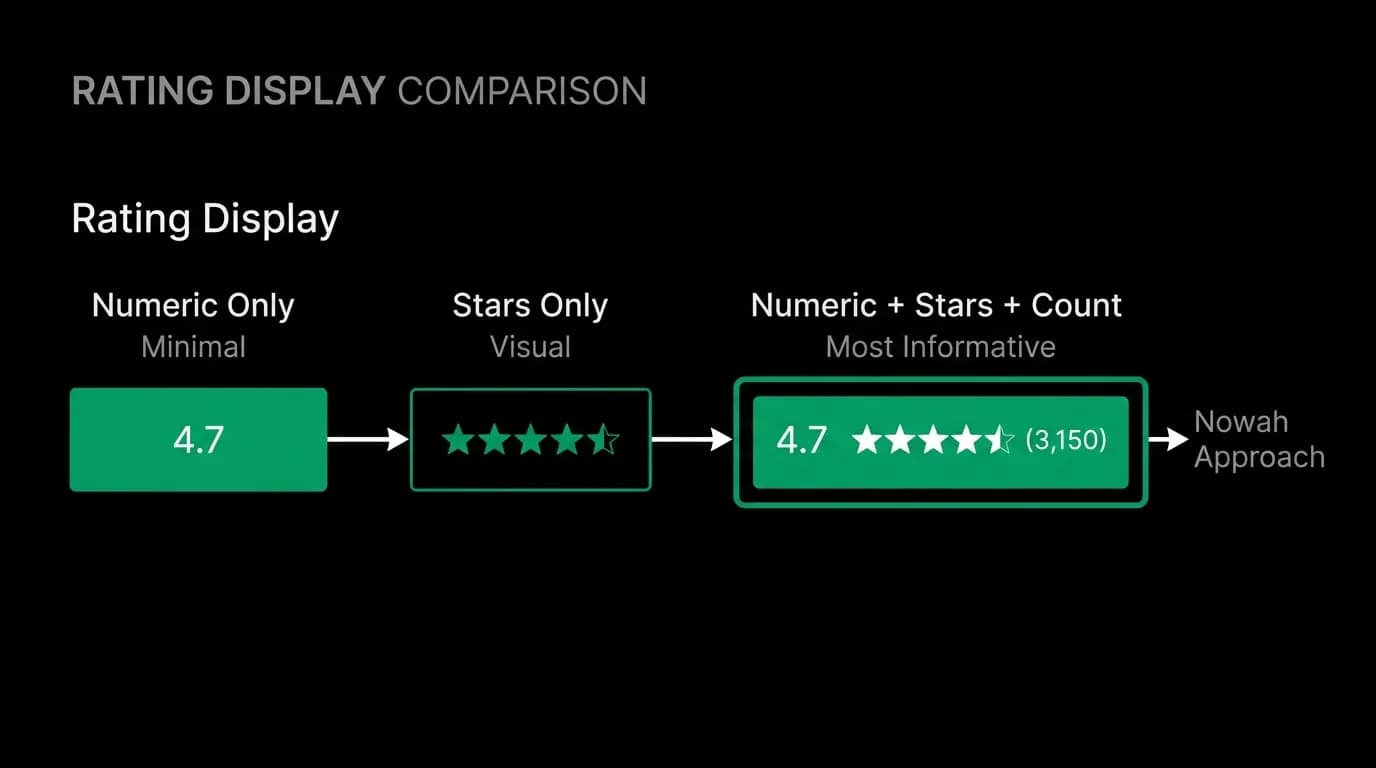
We display ratings in three formats simultaneously: the numeric score (4.7), star icons with partial fill (four and a half stars filled), and the review count (2,340 reviews). Each format serves a different scanning behavior.
The numeric score is for users who evaluate by number. They know that 4.7 is good, 4.2 is decent, and anything below 4.0 needs a closer look. The score is displayed as a badge element, visually distinct from surrounding text.
The star icons are for users who evaluate by visual pattern. Five stars with four and a half filled creates an instant visual impression of quality. Star icons are universal across cultures and do not require reading.
The review count is for users who evaluate by confidence. A 4.7 with 23 reviews means something very different from a 4.7 with 2,340 reviews. The count provides the statistical confidence that makes the score trustworthy.
All three formats appear together on the hotel card, compact enough to not dominate the card layout but prominent enough to be found at a glance.
Review score positioning on cards
The rating occupies a specific position on the hotel card: near the top, adjacent to the property name and star classification. This position makes it one of the first things the eye encounters when scanning the card.
The rating is not buried below the fold or hidden behind a tap. It is visible in the default card state, alongside the property name, hero image, price, and key amenities. These six data points are the minimum viable information for a hotel evaluation, and the rating is one of them.
On the card, the rating badge uses a subtle background color that differentiates it from surrounding text without competing with the price display. The price uses the primary green accent. The rating uses a more subdued treatment. Price is the decision trigger. Rating is the confidence builder.
Guest snippets: one curated sentence
A full review list is inappropriate for a chat-based interface. The user is in a conversation, not browsing a review website. But a single, well-chosen sentence from a recent guest adds human texture that a numeric score cannot.
"Guests love the rooftop pool but note slow Wi-Fi."
That sentence tells the user something useful and specific in seven words. It communicates a highlight (rooftop pool) and a caveat (Wi-Fi), giving the user a balanced view without requiring them to read through dozens of reviews.
The snippet appears below the rating on the hotel card, in a slightly smaller font than the primary card information. It is there for users who want a qualitative signal beyond the numeric score. Users who are satisfied with the number can ignore it without visual disruption.
AI summarization of reviews
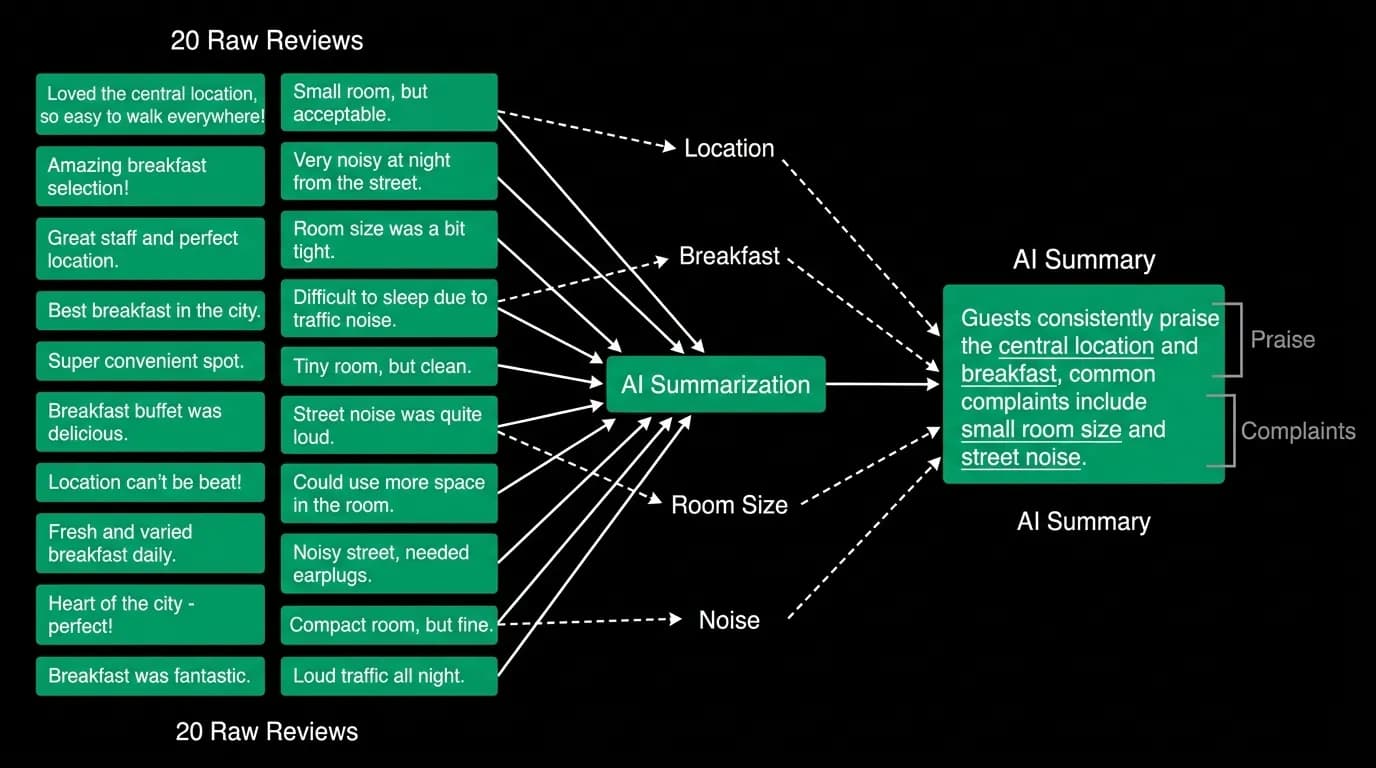
The most powerful application of AI to review display is summarization. Instead of showing a user 2,340 individual reviews, the AI synthesizes them into a contextual summary.
"Guests consistently praise the central location and breakfast buffet. Common feedback mentions small room sizes and occasional street noise. Business travelers note excellent meeting facilities."
This summary contains more actionable information than any individual review and requires far less effort to consume. The AI can also tailor the summary to the user's priorities. If the user mentioned they care about quiet rooms, the AI might highlight: "Note: some guests mention street noise. I chose this hotel because it offers rooms on higher floors, which tend to be quieter."
This personalized summarization is impossible in a traditional review display. A review list shows all reviews to all users. An AI summary highlights the information that matters most to this specific user.
Source attribution
Review scores are only trustworthy if the user knows where they come from. An unsourced "4.7" could be self-reported, could be outdated, or could be aggregated from a small or biased sample.
We attribute review scores to their source. The attribution builds credibility: the score is real, it comes from a known platform, and it represents a specific number of verified stays.
Attribution also addresses the concern about AI manipulation. If the AI is curating results, is it cherry-picking favorable ratings? Source attribution with review count shows that the score is an independent, third-party assessment, not a number the AI generated.
Adding review data without adding clutter
The key principle for reviews in an AI-curated interface is restraint. One rating badge. One review count. One optional snippet. One AI summary available on expansion. These four elements provide social proof, confidence, qualitative color, and depth, in that order of prominence.
Do not dump reviews into the chat. Do not show review histograms on the card. Do not list individual reviews in the conversation. The AI has already done the work of evaluating the reviews. The user needs confirmation that real people agree, not the raw data that the AI already processed.
Nowah is an AI travel agent that searches and books real flights and hotels through conversation — no filters, no thirty open tabs. Plan your next trip.