The Red-Eye Flight Data: Who Takes Them and Why
Red-eye flights are cheaper but brutal. Data reveals who books them, how much you actually save, and when the discount justifies the discomfort.

A red-eye saves you $180 but you arrive looking like you survived a natural disaster. The bags under your eyes have bags. Your neck is permanently tilted at 30 degrees. And you have an entire day ahead of you with no hotel check-in for six hours.
Worth it? That depends on who you are, where you are going, and how much that $180 matters. The data on red-eye booking patterns reveals some interesting splits.
Who books red-eyes
Red-eye passengers fall into three distinct groups.
Budget travelers. The largest group. These are travelers for whom the discount is the primary decision driver. A $180 savings on a $600 domestic flight is a 30% discount, and for travelers on tight budgets, that money funds an extra night of accommodation or several meals.
Time optimizers. Surprisingly common. These are travelers, often business travelers, who take red-eyes not to save money but to save a day. Fly overnight, arrive at 6 AM, and you have a full working day ahead of you. The alternative is losing a business day to daytime travel.
Schedule-constrained travelers. People who cannot fly during the day because of work, events, or childcare take red-eyes as the only option that fits their schedule. The discount is a bonus, not the reason.
Route-by-route savings data
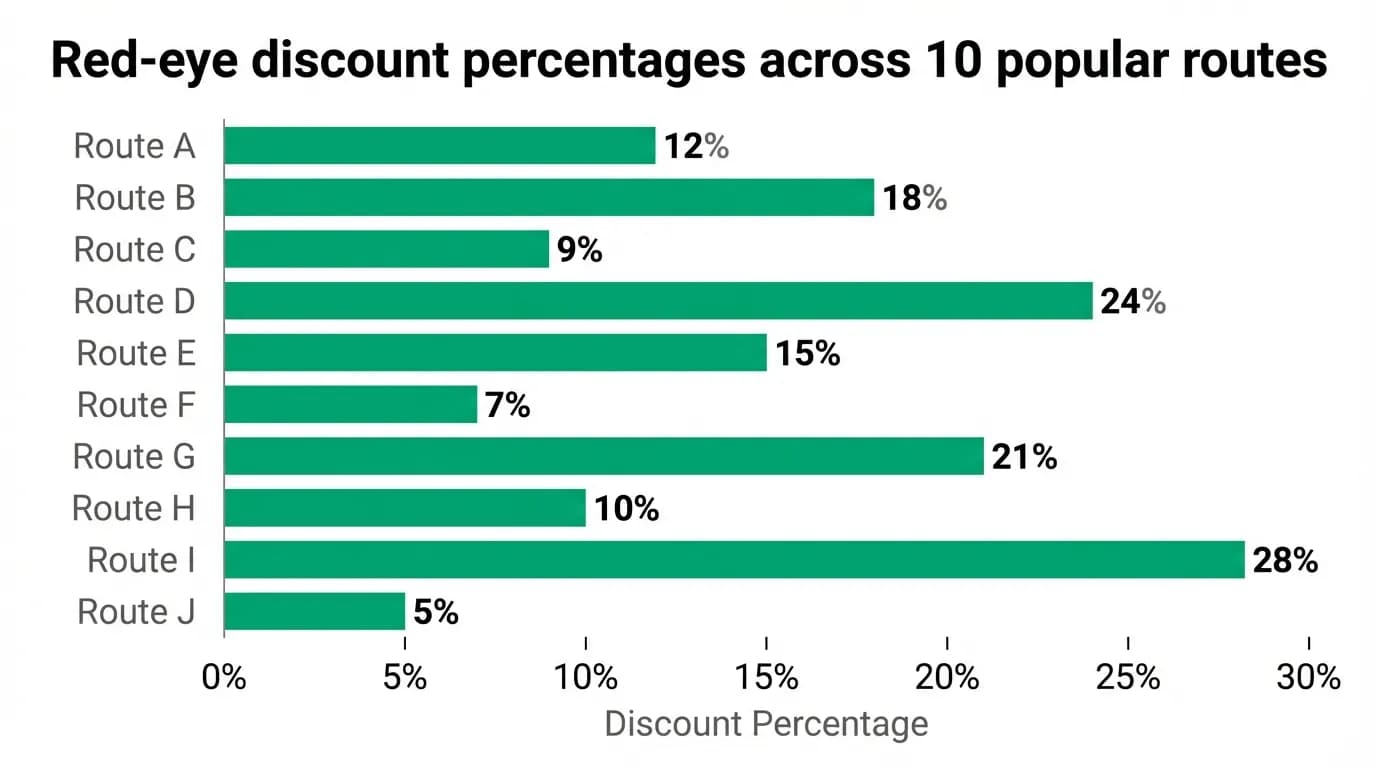
Red-eye discounts vary significantly by route. On heavily traveled domestic corridors (coast-to-coast routes), red-eye discounts average 10-15% because there is strong demand for overnight service from time optimizers and budget travelers alike.
On shorter domestic routes (2-3 hours), red-eye discounts are larger in percentage terms (15-25%) because the flight is too short to sleep meaningfully and most people would rather fly during the day. The discount has to be steeper to attract bookings.
On international routes, the red-eye calculus changes entirely. Many long-haul flights are overnight by default (especially eastbound transatlantic), so there is no real "red-eye" discount. The pricing variation on international routes is driven by other factors: day of week, advance purchase, and fare class.
Tuesday and Wednesday departures are already 10-15% cheaper than weekend flights, and red-eye departures on those days compound the savings.
When the discount justifies the discomfort
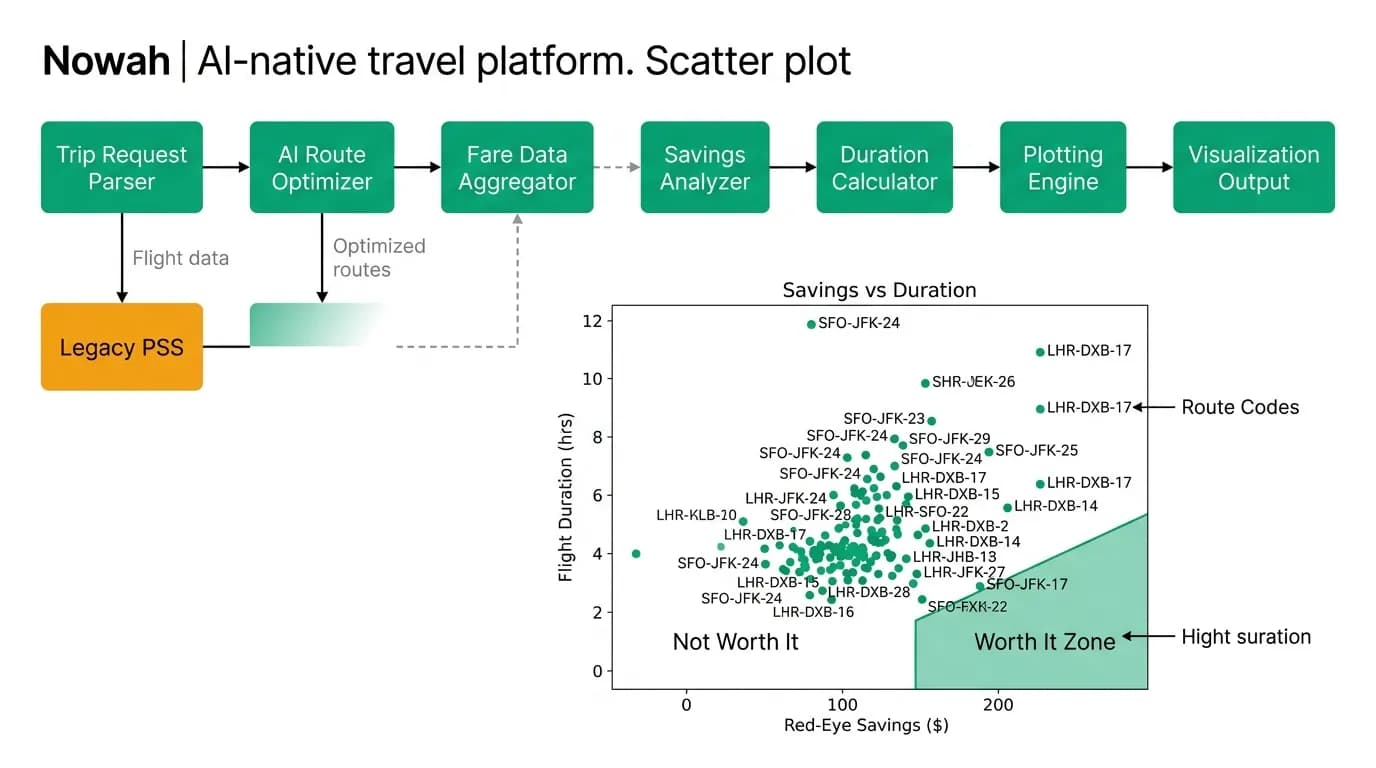
This is a personal question, but the data can frame it. Schedule preference accounts for 20% of the multi-factor ranking weight, which means departure timing is a significant factor in overall recommendation quality.
For a short domestic flight (under 3 hours), the discomfort is limited and the savings percentage tends to be higher. A red-eye from New York to Miami saves money and costs you a few hours of lost sleep. That trade-off makes mathematical sense for most budget-conscious travelers.
For a medium domestic flight (4-5 hours), the calculus shifts. You lose a full night of sleep and arrive exhausted. If the savings are $80 on a $300 ticket, you are effectively trading a night of sleep for $80. Many people would not make that trade.
For business travelers, the calculus is about time value, not dollar savings. A red-eye coast-to-coast flight that saves a business day has a value measured in hundreds or thousands of dollars, far exceeding the sticker price difference.
How the AI handles red-eye preferences
The AI tracks your departure time preferences and adjusts automatically. If you tell Nowah "no red-eyes," that negative preference gets stored permanently in your agentic memory. You will never see a red-eye option again unless you explicitly ask.
If you have never stated a preference, the AI infers from your booking history. Five trips, all with daytime departures? The AI deprioritizes red-eyes without being told to. One red-eye booking among several daytime trips? The AI keeps them as an option but ranks them below your preferred departure times.
For travelers who actively want red-eye options, the AI includes them and explains the trade-off: "This red-eye saves $180 but arrives at 5:30 AM. Your hotel check-in is at 3 PM." The context helps you decide whether the savings are worth the early arrival logistics.
Tell Nowah "no red-eyes" once and never see them again. Or tell it "show me the cheapest option including red-eyes" and get the full picture.
Nowah is an AI travel agent that searches and books real flights and hotels through conversation — no filters, no thirty open tabs. Plan your next trip.