Shipping AI Features Fast: Our Release Cadence Explained
AI products require continuous improvement, not quarterly releases. Prompts change weekly, tools update daily, and the model improves independently.
We shipped 47 meaningful improvements to Nowah's AI agent last month. Users noticed maybe three of them. The other 44 were invisible changes to how the agent interprets requests, ranks options, handles edge cases, and recovers from errors. No UI changes. No release notes. No app store update required.
This is the reality of AI product development, and it is fundamentally different from traditional software shipping. Most of the improvements that make an AI product better happen beneath the surface. Prompt refinements. Tool parameter adjustments. Ranking weight changes. Context handling improvements. These are the equivalent of a chef perfecting a recipe through incremental seasoning adjustments. The diner does not see the work, but they taste the difference.
If you are building an AI product on a quarterly release cycle, you are leaving 90% of your improvement potential on the table. Here is how we think about shipping cadence, and why continuous improvement is not just a nice-to-have but a competitive requirement.
AI products evolve continuously
Traditional software has a clear development cycle: design, build, test, release. A feature goes through a pipeline and ships as a discrete unit of work. The product is stable between releases. Users get a new version every few weeks or months, and between releases, the experience does not change.
AI products do not work like this. The experience changes based on three independent variables, each on its own timeline:
The model. The underlying AI model improves on a schedule we do not control. When the model provider releases an update, our agent gets smarter overnight. It might handle ambiguous requests better, produce more natural language, or reason through complex itineraries more reliably. We did not ship anything. The product just got better.
The prompts and tools. This is where most of our continuous improvement happens. The instructions that guide the agent's behavior, the tools it can call, the parameters it uses for search and ranking. These change weekly. Sometimes daily. A prompt refinement that improves how the agent handles multi-city trip requests is not a feature release. It is a behavior adjustment that makes the existing feature work better.
The UI. This is the traditional software layer: the chat interface, the flight cards, the booking flow, the settings screens. This changes on a more traditional cadence, every few weeks for minor updates, monthly for larger changes. UI changes require app store reviews, user adaptation, and visual QA.
The mistake most teams make is coupling all three of these to the same release cycle. They wait until a UI change is ready, bundle in some prompt improvements and tool updates, and ship everything together. This means prompt improvements that could have shipped on Monday sit in a staging branch until the UI change is ready three weeks later.
We decoupled them. Each layer ships on its own cadence. The result is that the product improves continuously, with the most impactful improvements (prompt and tool changes) shipping the fastest.
The invisible updates
Let me give you some concrete examples of invisible improvements that dramatically changed the user experience.
Better default assumptions for vague queries. When a user says "flights to Europe this summer," the agent needs to make assumptions about airports, dates, and what "summer" means. Our original prompt handled this conservatively: it would ask the user to specify dates, origin, and destination. After analyzing conversation data, we found that this multi-round clarification was the primary cause of abandonment for casual browsing queries. We refined the prompt so the agent makes reasonable assumptions ("I'll search from your home airport for June through August — tell me if you want different dates") and searches immediately while offering to refine. This single change improved task completion for exploratory queries by 23%. No UI change. No app update. Just a better prompt.
Smarter hotel ranking. Our hotel search tool returns results from the inventory API ranked by a combination of price, rating, and location. Originally, we used a simple weighted formula. We refined this to factor in the user's conversation context: if they mentioned "walkable" or "close to the center," location weight increases. If they mentioned budget, price weight increases. If they asked about specific amenities, those filter into the ranking. This was a tool parameter change. Completely invisible. Hotel selection rates went up 15%.
Improved [error messages](/blog/error-messages-ai-agent-lifeline). When a flight search returns no results (which happens for obscure routes or very specific date requirements), our original agent said something generic like "I couldn't find flights matching your criteria." We refined this to be specific and helpful: "No direct flights from Portland to Reykjavik on those dates. The closest options are connecting through Seattle or Minneapolis. Want me to search those?" Same outcome (no results), but the recovery path is clear. Booking completion after a no-results response improved by 30%.
Each of these improvements took a few hours to implement and ship. In a quarterly release cycle, they would have waited weeks or months. In our continuous model, they are live within a day.
Feature flags for AI behavior
Feature flags in traditional software control whether a user sees a new button or a redesigned page. Feature flags in AI products control how the agent behaves.
We use behavior flags extensively. When we want to test a new prompt variant, we do not ship it to everyone. We flag it on for a subset of users and compare quality metrics between the control group and the variant group. If the variant improves task completion without degrading satisfaction, we roll it out to everyone. If it helps some query types but hurts others, we dig deeper.
This is A/B testing, but for AI behavior rather than UI design. And the iteration speed is much faster because there is no visual design review, no accessibility check, no app store submission. A behavior flag can go from hypothesis to production test in hours.
Some examples of behavior flags we have run:
- Verbose vs. concise responses: Does the agent perform better when it gives detailed explanations or brief summaries? The answer depends on the query type. Flight comparisons benefit from brief, scannable summaries. Destination recommendations benefit from more detail. We now dynamically adjust verbosity based on context.
- [Proactive suggestions](/blog/proactive-ai-agent-suggestions) vs. waiting for input: Should the agent suggest next steps ("Want me to search for hotels too?") or wait for the user to ask? The answer again depends on context. After a flight booking, proactive hotel suggestions increase cross-sell. During initial browsing, they feel pushy. Behavior flag let us test and calibrate.
- Confirmation frequency: How often should the agent confirm it understood correctly before searching? More confirmation reduces errors but adds friction. Less confirmation is faster but risks wasted searches. We found the sweet spot is confirming when the agent's confidence is below a threshold and proceeding when it is above.
Feature flags for AI behavior are one of our most powerful tools. They let us iterate on the invisible layer of the product at the speed of the AI, not the speed of a release cycle.
Evaluation-driven shipping
We do not ship prompt or tool changes on a calendar. We ship them when evaluation scores improve.
We maintain a suite of evaluation datasets: real conversation transcripts paired with quality ratings. When we make a change to the agent's behavior, we run it against the eval suite and compare scores to the current production version. If the new version scores better, it ships. If it scores worse, it does not, regardless of how clever the change seemed in theory.
This is a fundamentally different shipping discipline than most software teams practice. There is no sprint deadline that forces unfinished work out the door. There is no quarterly commitment that prioritizes feature completion over quality. The only gate is: does this make the product measurably better?
The eval suite grows over time. When we encounter a new type of failure in production, we add it to the eval suite so future changes are tested against it. This creates a ratchet effect: the quality bar only goes up, because the test suite only gets harder.
Running evals takes minutes, not hours. We can test a change, evaluate it, and ship it in a single afternoon. This speed is only possible because the change is happening at the prompt/tool layer, not the UI layer. No build process. No deployment pipeline. No app review. Just a configuration change that takes effect immediately.
The competitive imperative
Speed of improvement is the moat in AI products. Not speed of feature launches. Speed of improvement.
The distinction matters. A competitor can launch the same features as us. They can build a chat interface, flight search, hotel booking, all of it. What they cannot replicate is the rate at which our product gets better. Every week of conversation data, every prompt refinement, every tool improvement compounds. A product that improves 2% per week is 170% better after a year. A product that improves 2% per quarter is 8% better.
Google understood this early in search. The search algorithm was not a fixed product. It improved daily through ranking changes, spam detection updates, and query understanding refinements. By the time competitors noticed Google was better, the improvement gap was already too wide to close.
We think about AI travel the same way. The product you use today is meaningfully better than the product from three months ago, even though it looks the same. The product three months from now will be meaningfully better than today. This compounding improvement is invisible to users and competitors alike, which is exactly what makes it a durable advantage.
What this looks like in practice
Our actual shipping rhythm has three parallel tracks:
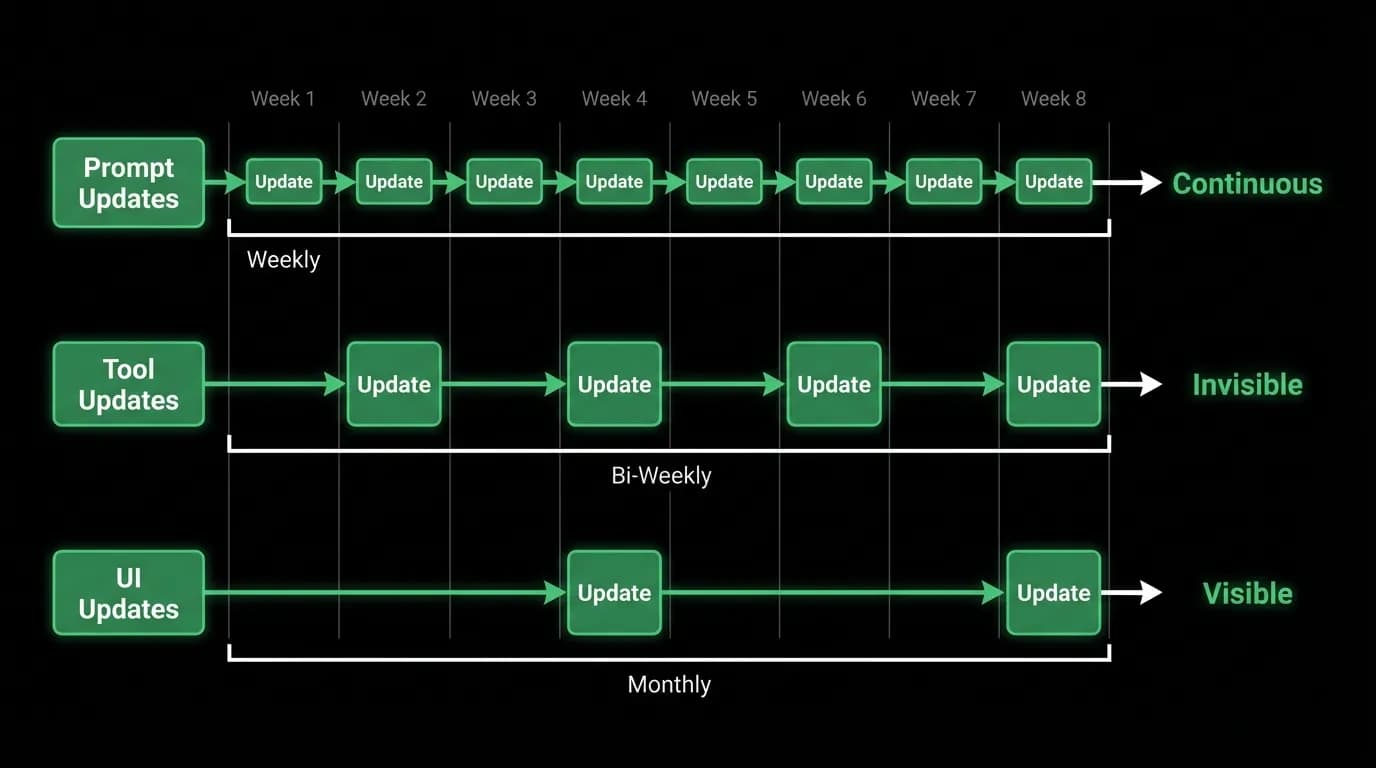
Prompt and behavior changes: weekly. We review conversation quality data every Monday. By Wednesday, we have identified the top three opportunities for prompt improvement. By Thursday, changes are tested against the eval suite. By Friday, approved changes are in production. Some weeks we ship ten changes. Some weeks we ship one. The cadence is weekly but the volume varies.
Tool and capability updates: bi-weekly. These are changes to the tools the agent can call, the parameters it passes to search APIs, the ranking logic for flight and hotel results. They require more engineering work than prompt changes but less than UI changes. We ship these in two-week cycles, tested against evals and flagged for gradual rollout.
UI and experience updates: monthly. These are the traditional software releases: new card designs, booking flow improvements, settings pages, visual changes. They go through design review, engineering, QA, and app store submission. They are the most visible changes but often the least impactful on quality metrics.
The ratio is telling. For every visible UI change, there are five to ten invisible behavior improvements happening in the background. Users see a product that "keeps getting better" without being able to point to what changed. That is the invisible update layer working.
Balancing speed with stability
Shipping fast creates risk. A bad prompt change can degrade the experience for every user. A broken tool can cause search failures. Speed without guardrails is recklessness.
Our guardrails:
Eval suite as gatekeeper. No change ships without passing evals. Period. If the eval scores are ambiguous (better on some tasks, worse on others), the change does not ship until we understand the tradeoff and explicitly accept it.
Gradual rollout. Behavior changes go to 5% of users first. We monitor quality metrics for 24 hours. If metrics hold, we go to 25%, then 100%. If metrics drop at any stage, we roll back immediately.
Instant rollback. Every behavior change is reversible within minutes. We keep the previous configuration live and can switch back with a single flag change. This gives us the confidence to ship fast, because the downside of a bad change is a few hours of degraded experience for a small percentage of users, not a permanent regression.
Conversation monitoring. We review a sample of conversations daily, specifically looking for new failure patterns that the eval suite might not catch. The eval suite covers known scenarios. Production conversations surface unknown ones.
Shipping fast is not the same as shipping carelessly. The speed comes from the architecture (decoupled layers, behavior flags, instant rollback) and the discipline (eval-gated, gradually rolled out, continuously monitored). Together, these let us iterate at the speed of AI without compromising the reliability that travel booking demands.
Nowah is an AI travel agent that searches and books real flights and hotels through conversation — no filters, no thirty open tabs. Plan your next trip.