The Voice-First Travel Agent
People describe trips in sentences, not search parameters. Voice input removes the friction between how you think and how you book.
Try this experiment. Close your eyes and describe your ideal next trip out loud. What comes out?
Probably something like: "I want to go somewhere warm and relaxing, maybe Southeast Asia, for about a week in April. Not too expensive. A nice beach but also some culture. My partner and I have not been to Vietnam yet."
Now try to enter that into a traditional booking platform. Origin: [city]. Destination: [???]. Dates: [April when exactly?]. Travelers: 2. Cabin: economy. Go.
The mismatch is obvious. You think about travel in sentences. Search forms demand parameters. The translation from natural thought to structured input is friction, and that friction is one reason why traditional booking takes 45 sessions and many websites while AI trip planning takes one conversation.
Voice input eliminates this translation entirely. You speak your trip the way you think about it. The AI agent handles the rest.
The form problem
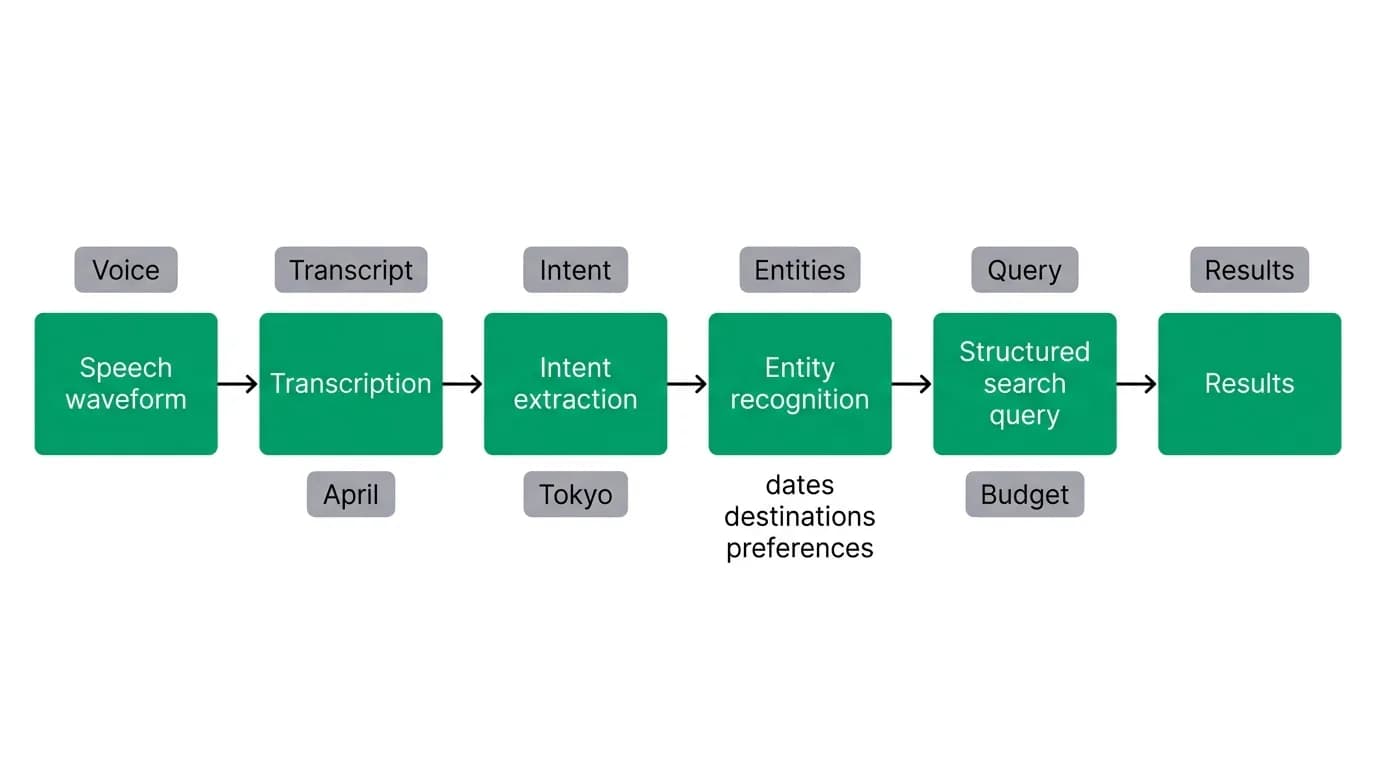
Traditional travel search forms require 12 to 15 interactions to initiate a single search:
- Click the origin field
- Type origin city or airport
- Select from autocomplete
- Click the destination field
- Type destination
- Select from autocomplete
- Click departure date
- Navigate calendar to correct month
- Select date
- Repeat for return date
- Adjust traveler count
- Select cabin class
- Click search
Fifteen taps minimum, and that is for a simple round-trip. Multi-city adds another set of fields for each segment. One-way vs. round-trip changes the form layout. Flexible dates require additional interaction.
Voice: one sentence. "Find me round-trip flights from San Francisco to Bangkok, April 5th to 12th, two passengers, economy." Done. Every parameter extracted. Search initiated.
The difference is not just speed. It is cognitive load. Filling out a form requires you to decompose your travel intent into discrete parameters and enter them one by one. Voice lets you express the intent holistically and lets the AI handle decomposition.
Voice captures nuance
Forms capture parameters. Voice captures intent.
"Somewhere warm and cheap in April" is a valid voice query that carries several layers of meaning. "Warm" eliminates Northern Europe, high altitude, and shoulder-season destinations with unpredictable weather. "Cheap" signals budget consciousness and willingness to consider less popular destinations. "April" sets the time frame. The combination of warm + cheap + April points toward specific regions: Southeast Asia, Central America, southern Mediterranean.
No combination of dropdown menus can capture this. A form might let you select a region, but it cannot process "warm." It might let you set a price filter, but "cheap" is relative to the destination and the user's history.
Seventy-two percent of millennials and Gen Z travelers express interest in AI travel planning. This demographic grew up with voice assistants. They send voice notes. They dictate texts. Voice is a natural input modality for them in a way it was not for previous generations.
The speech-to-intent pipeline
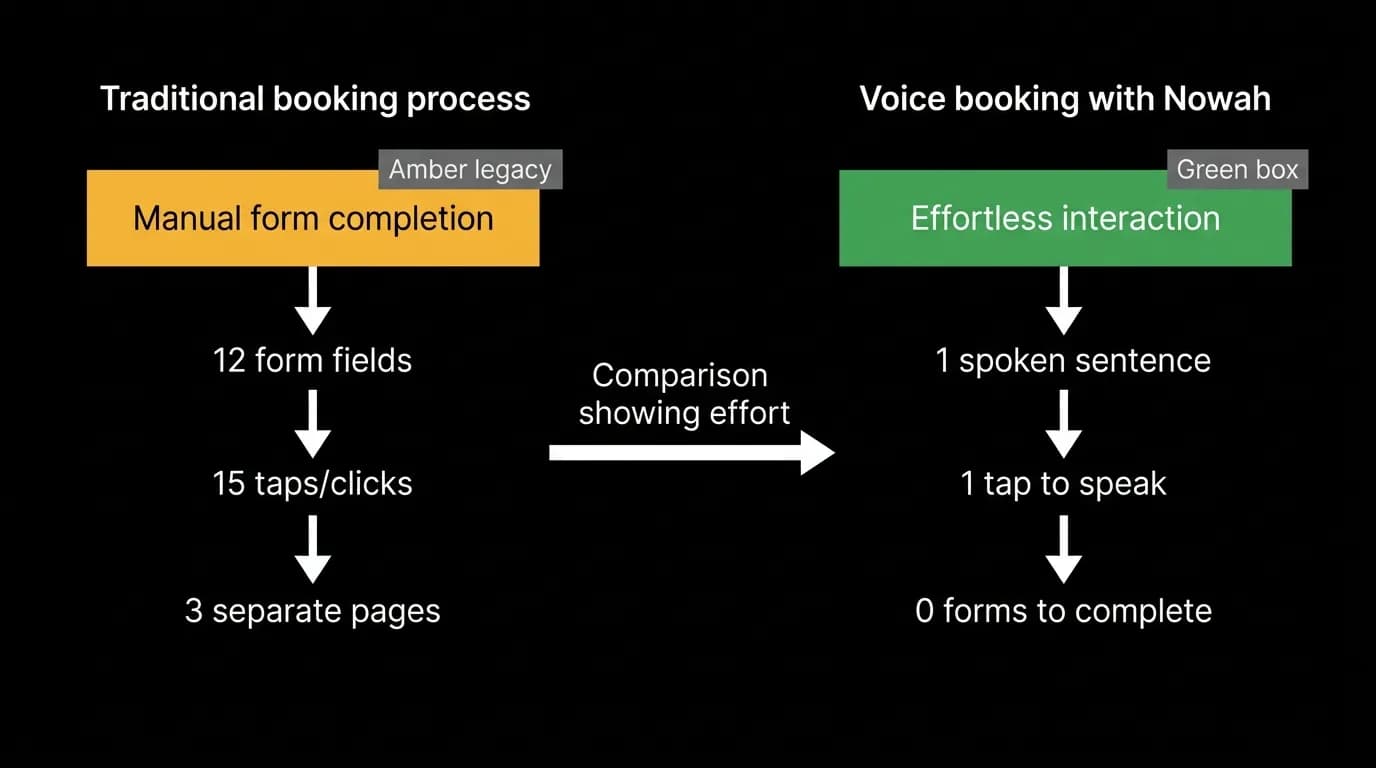
When a user speaks to Nowah, here is what happens technically:
Speech recognition converts the audio waveform to text. Modern speech recognition is highly accurate across accents and languages. This step happens in real time, with the transcript appearing as the user speaks.
Intent classification determines what the user wants to do. Are they searching for flights? Asking about a destination? Modifying an existing booking? Checking their itinerary? The intent determines which agent tools are relevant.
Entity extraction pulls structured data from natural language. "April 5th to 12th" becomes departure_date: 2026-04-05, return_date: 2026-04-12. "San Francisco" becomes origin: SFO. "Two passengers" becomes travelers: 2.
Implicit constraint inference fills in gaps using the memory system. The user did not specify cabin class. Their history shows they always book economy. The user did not specify preferred airlines. Their profile includes a loyalty program. These implicit constraints are applied without being stated.
Structured query construction assembles all extracted and inferred parameters into a tool call. The flight search API receives a clean, structured request derived entirely from a spoken sentence.
The average travel query contains 3 to 5 extractable entities. Voice naturally includes these entities in context, while forms require the user to manually enter each one.
Mobile-first voice
Mobile bookings account for over 60% of all travel transactions. On a mobile device, voice input has a decisive advantage over typing.
Typing on a small screen is slow and error-prone. Autocorrect mangles airport codes. Date pickers are fiddly. The form-based experience that works on desktop becomes painful on mobile.
Voice works identically regardless of screen size. You tap a microphone button and speak. The quality of the experience is independent of the device form factor.
We see particularly strong voice adoption in specific scenarios:
Hands-busy situations. Users planning travel while cooking, commuting, or doing other activities. Voice lets them interact without stopping what they are doing.
Complex queries. The more parameters a query has, the more painful it is to type. A multi-city trip with specific date constraints and passenger requirements is one sentence spoken aloud but multiple minutes of typing and form-filling.
Exploratory queries. "What is the best time to visit Japan?" is easier to speak than to translate into a search query. Voice encourages open-ended exploration that forms discourage.
Voice-based travel queries are growing over 40% year over year. This is not a niche behavior. It is the direction of the market.
Accessibility
Voice-first design has an often-overlooked benefit: it is the most accessible interface paradigm for many users.
Users with motor impairments who find touchscreen interaction difficult can speak their travel requests. Users with visual impairments can receive spoken responses. Users with cognitive disabilities that make form-filling challenging can describe what they want in natural language.
The ADA and similar regulations require reasonable accommodation. Voice-first design provides accommodation by default, not as an add-on.
This matters to us because we believe the best travel app should work for everyone. An interface that requires precise tapping on small form fields excludes people. An interface that accepts natural speech includes them.
The multimodal future
Voice is not the only input modality. The future is multimodal: voice plus text plus images plus gestures.
"I want a hotel like this" accompanied by a photo of a rustic villa. "Book the flight I circled" with a screenshot annotation. "Something near here" with a map pin drop.
Voice is the foundation because it handles the most common case: expressing travel intent in natural language. But the conversational interface can accept any input that helps the user communicate what they want.
We started with voice and text. Images and visual input are on the roadmap. The principle remains the same: accept input in whatever form is most natural for the user, and let the AI agent translate it into action. Travel booking forms were designed for a world where computers could not understand natural language. That world is gone. The best travel app is the one that lets you describe your trip the way you think about it, in your own words, at your own pace, and gets to work immediately.
Nowah is an AI travel agent that searches and books real flights and hotels through conversation — no filters, no thirty open tabs. Plan your next trip.