How Voice Search Is Changing Travel Data
Voice-first travel queries are longer, more conversational, and more ambiguous than typed searches. Here is what that means for AI recommendations.

"Hey, find me a beach trip in March that won't break the bank." That is a voice query. Compare it to what the same person would type into a search box: "cheap flights March beach." The voice version is 3-5 times longer, contains more nuanced intent signals, and is structured as a request to an agent rather than a keyword string for a search engine.
Voice search for travel has grown quickly in recent years. That trajectory is changing how we think about travel intent data and how AI agents process booking requests.
How voice queries differ from typed searches
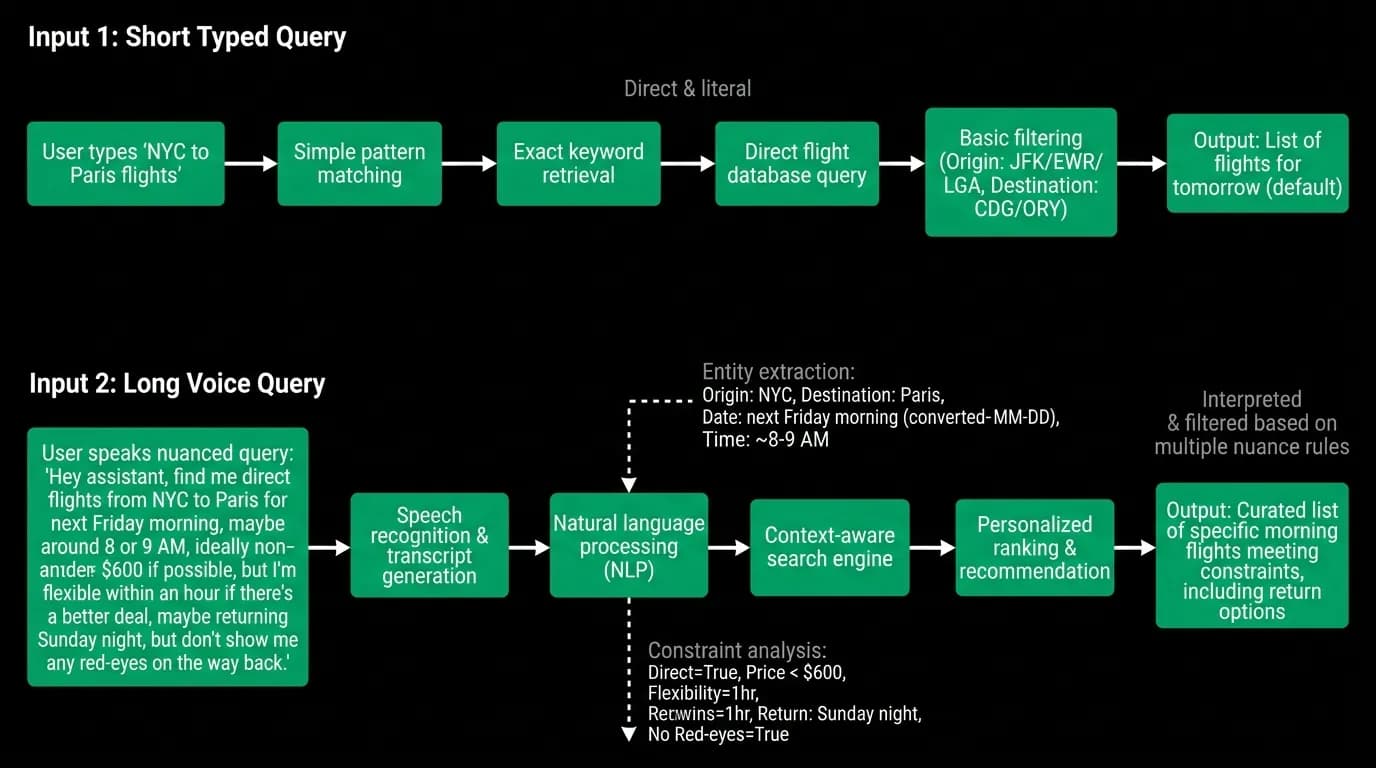
Typed search queries are compressed. People have been trained by years of Google to strip their thoughts down to keywords. "NYC Paris flights cheap October." Six words, minimal grammar, no personality. This is efficient for a keyword-matching search engine, but it throws away a lot of information.
Voice queries are expansive. People speak in full sentences with filler words, qualifiers, and contextual detail. "I want to fly from New York to Paris sometime in October, maybe the second or third week, and I'd like to keep it under a thousand dollars if possible." That contains at least three more constraint signals than the typed version: a date range preference, a budget ceiling, and an implied flexibility signal ("if possible").
The richer the input, the better the AI can match it to relevant options. Voice queries give us more to work with.
The data challenges of voice input
Voice input is not free of noise. Transcription introduces ambiguity that typed input does not have. City names that sound similar, dates expressed in various formats, currencies mentioned colloquially. The AI has to handle these gracefully.
The bigger challenge is that voice queries are more likely to be open-ended and exploratory. "Where should I go for a week in November?" has no destination, no budget, and no specific constraints beyond timing. This is a harder query to process than a typed search because it requires the AI to generate options rather than filter existing results.
But this is also where AI-native platforms have a structural advantage. A traditional search engine cannot process an open-ended query because it needs structured inputs. An AI agent can. It can ask clarifying questions, infer context from memory, and generate recommendations for a query that would be impossible to enter into a search form.
What voice patterns reveal about travelers
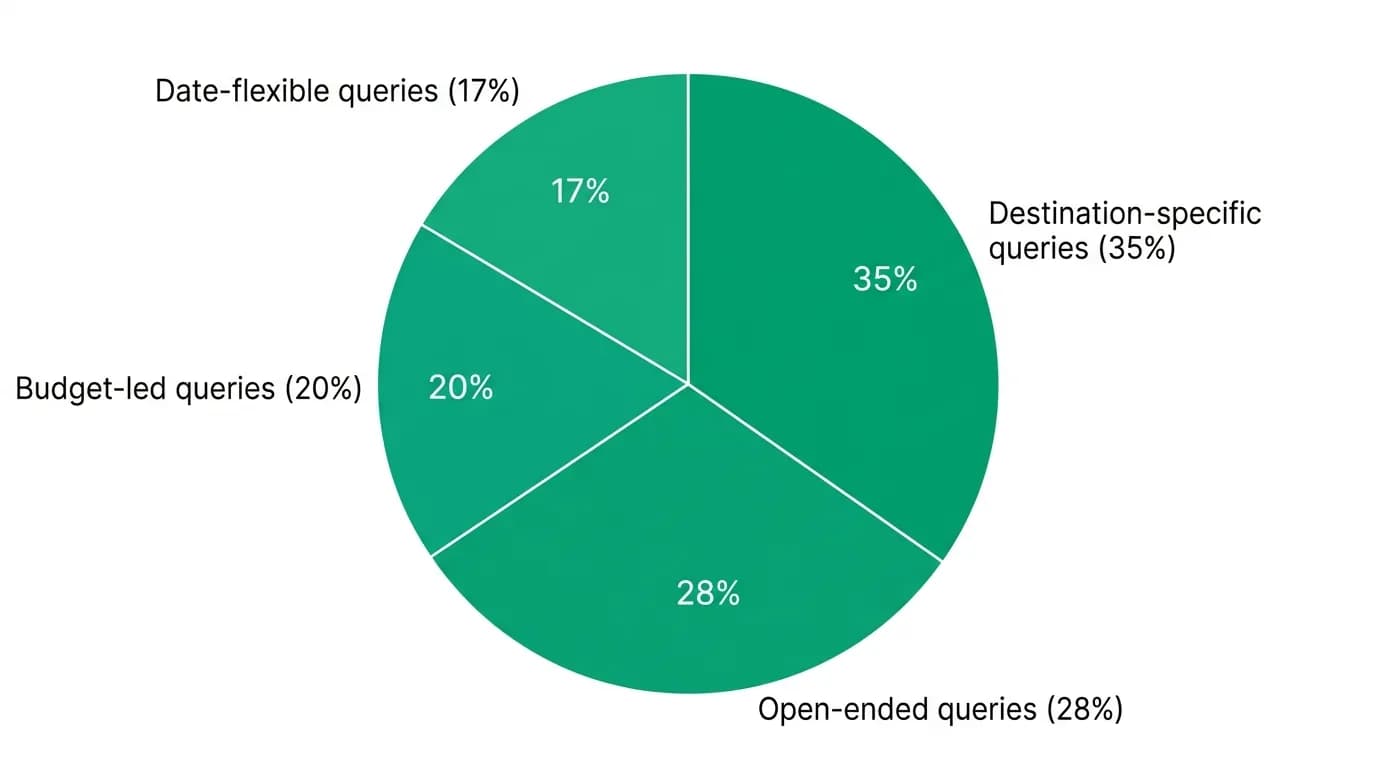
Voice query data reveals interesting things about how people naturally think about travel. About 40-50% of Gen Z and millennials express interest in AI trip planning, and voice is their preferred input modality for complex requests.
Voice queries cluster into distinct types. Destination-specific queries ("flights to Barcelona") are the simplest and most similar to typed search. Open-ended queries ("where should I go for spring break?") are the most common voice-specific category. Budget-led queries ("find me something under $500") express the constraint first. Date-flexible queries ("sometime in March or April") express timing uncertainty that forms cannot capture.
The distribution tells us that natural travel intent is fundamentally more ambiguous and exploratory than search forms assume. People do not start with a clear origin-destination-date. They start with a vague idea and want help refining it.
Why voice interfaces must curate
You cannot scroll through 200 results by voice. There is no "page two" in a spoken conversation. Voice-first interfaces physically cannot present the traditional wall of search results, which means they must curate.
This constraint is actually a feature. It forces the interaction model toward fewer, better, explained options rather than comprehensive but overwhelming listings. Chat-based and voice-based interfaces report higher satisfaction than traditional search in part because the output format demands quality over quantity.
The AI adapts its processing for voice versus text input. Voice responses are more conversational and structured for audio comprehension. Instead of presenting three cards simultaneously, the agent describes each option with verbal emphasis on the differentiating factors. The underlying ranking intelligence is the same. The presentation layer adapts to the modality.
Try voice search on Nowah and see how natural travel booking can feel. Speaking your trip into existence is faster and more intuitive than filling out form after form.
Nowah is an AI travel agent that searches and books real flights and hotels through conversation — no filters, no thirty open tabs. Plan your next trip.