What \\\"Personalized\\\" Really Means in 2026
Not \\\"people who booked this also booked that\\\" — real personalization means a recommendation built for you from everything the AI knows about how you travel.

Every travel app claims to be "personalized." Most of them are using the word to describe something that does not deserve it. Showing you hotels in the city you just searched is not personalization. Recommending destinations that "people like you" visited is not personalization. Remembering your name and email address is definitely not personalization.
Real personalization means a recommendation built specifically for you, drawing on everything the AI knows about how you travel — your preferences, your history, your patterns, your constraints, and the context of this specific trip. It is the difference between a form letter with your name at the top and a conversation with someone who actually knows you.
The personalization spectrum
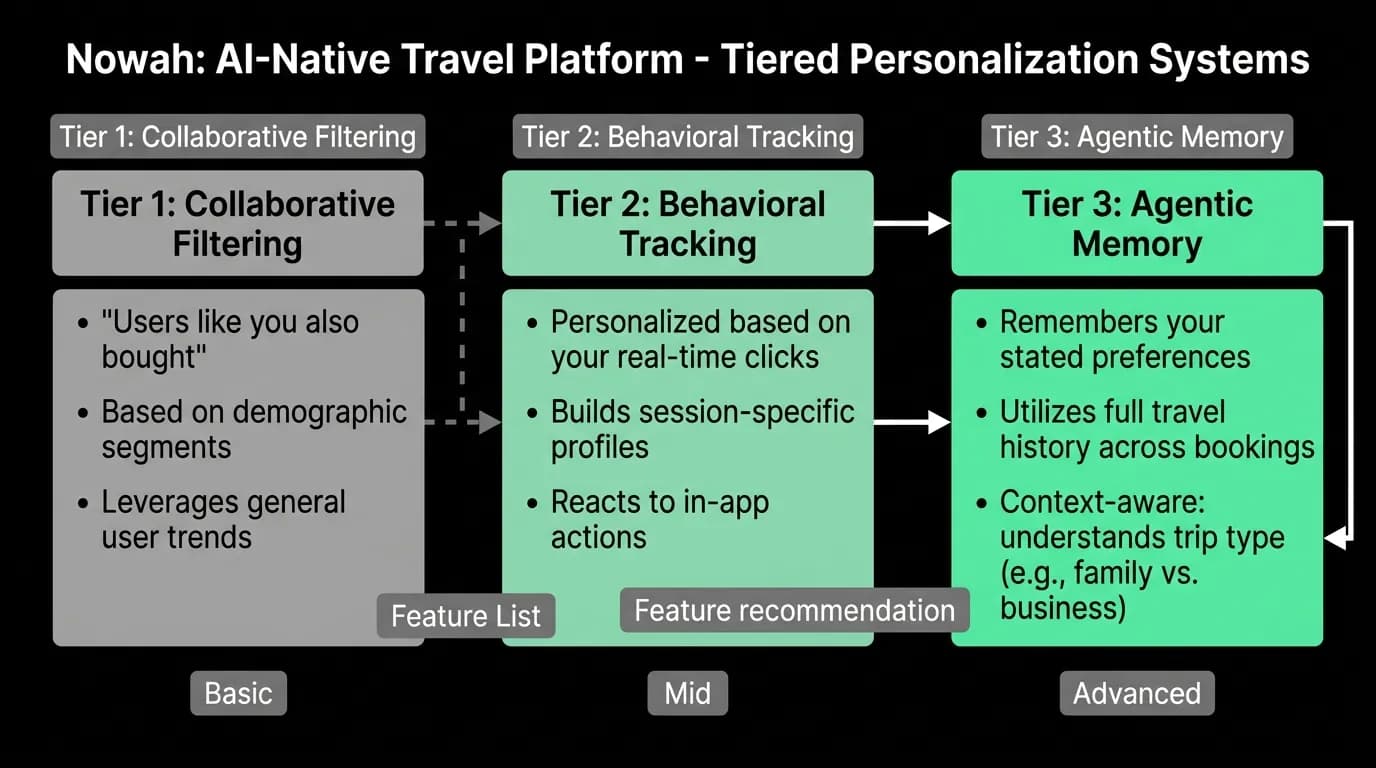
To understand what genuine personalization looks like, it helps to see the spectrum from least to most sophisticated.
At the bottom is collaborative filtering: "people who booked this also booked that." This is correlation, not personalization. It knows nothing about you as an individual. It knows that some aggregate cluster of travelers who bought flight A also bought hotel B. This is the recommendation engine behind most traditional travel platforms, and it is the technique that produces recommendations that feel vaguely relevant but never quite right.
In the middle is behavioral tracking: the platform watches what you search, what you click, what you linger on, and uses that session data to adjust what it shows you. This is better than collaborative filtering because it responds to your individual behavior, but it is limited to the current session and whatever cookies persist between visits. Close your browser, switch devices, or clear cookies and the personalization resets. It also cannot distinguish between research browsing ("I'm looking at Tokyo flights for my boss") and intent browsing ("I want to go to Tokyo").
At the top is [agentic memory](/blog/agentic-memory-smarter-over-time): a persistent, structured knowledge system that stores facts, preferences, and context about you across all interactions over time. This is not session-based. It does not reset. It knows that you prefer aisle seats because you told it two months ago. It knows that you liked the hotel in Barcelona because you rated your last trip. It knows that your passport is from a specific country and your dietary restriction is vegetarian. And it uses all of this, every time, to build recommendations that are genuinely individual.
Why "people also bought" is not personalization
Collaborative filtering has a fundamental flaw for travel: it assumes that people who share one purchase pattern will share others. But travel preferences are deeply individual and context-dependent. A business traveler and a backpacker might book the same flight to Bangkok, but their hotel preferences, activity interests, and budget ranges are completely different. Recommending the backpacker's hostel to the business traveler because they booked the same flight is not personalization. It is a coincidence masquerading as intelligence.
The deeper problem is that collaborative filtering cannot handle the things that make travel personal. It does not know that you get anxious in small hotel rooms. It does not know that you have a connecting flight phobia because of a bad experience five years ago. It does not know that you always travel with your partner who has specific dietary needs. These preferences — the ones that actually determine whether a trip feels right — exist outside the scope of purchase correlation.
The five layers of real personalization
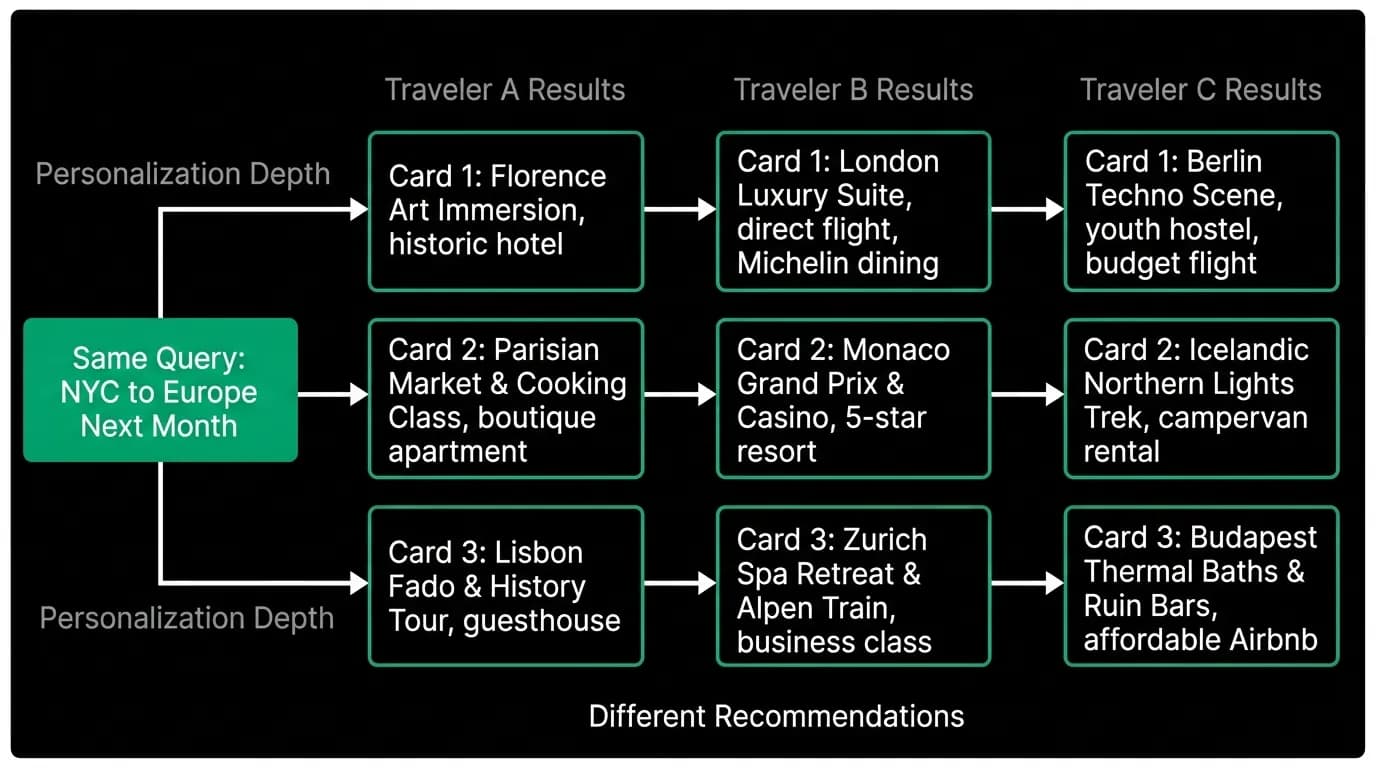
Genuine personalization in AI travel operates through five layers that compound with each interaction.
Explicit preferences captured during onboarding and stated conversations. "I prefer morning flights." "I need a hotel with a gym." These are the clearest signals because you stated them directly.
Booking history from past trips. The system observes your actual choices — which fare classes you book, which hotel types you choose, how far in advance you plan — and weights future recommendations accordingly.
Conversational signals from your interactions with the AI. When you say "that layover was too short last time" or "I loved the neighborhood around that hotel," the AI extracts actionable preferences from natural language.
Agentic memory that persists across sessions, storing all of the above in a structured knowledge graph that the AI queries before making any recommendation. This memory is transparent — you can view and edit it — and it enables the AI to start every conversation with context rather than from scratch.
Behavioral patterns inferred from your interaction history. The system notices that you always compare three options before booking, or that you tend to choose the balanced recommendation over the budget pick, or that you engage more with hotel recommendations that include breakfast. These implicit patterns adjust the presentation and ranking without requiring you to articulate them.
Why 2026 is the inflection point
The technology to deliver genuine personalization in travel has existed in pieces for years. What makes 2026 different is that large language models can now process unstructured conversational data into structured preferences, agentic memory systems can persist and query complex preference graphs, and travelers are comfortable sharing information with AI assistants they trust.
Surveys show that 40 to 50% of Gen Z and younger millennials express interest in AI-powered trip planning. This is not hypothetical interest — it reflects a generation that grew up with recommendation algorithms and understands the value exchange of sharing data for better service. They expect personalization that actually works, and they will abandon platforms where it does not.
The AI travel market is projected to exceed $5 billion by 2027. That growth is driven by the gap between what travelers expect from personalization and what most platforms deliver. The platforms that close that gap will capture the market. The ones that keep calling collaborative filtering "personalized" will not.
Experience real personalization. Try a search on Nowah after building your profile, and see how different the results look compared to a generic travel search.
Nowah is an AI travel agent that searches and books real flights and hotels through conversation — no filters, no thirty open tabs. Plan your next trip.