What We Learned from Using Every AI Travel App on the Market
A competitive analysis framed as a learning exercise — what others do well, where they fall short, and how their approaches shaped our product decisions.

We spent thirty days using every AI travel tool we could find. Not for competitive intelligence slides. For genuine product research. We booked real flights, searched real hotels, and had real conversations with every AI travel assistant, chatbot, and plugin available. We wanted to understand the state of the market from the traveler's perspective, not from a feature comparison spreadsheet.
The experience was illuminating. Some tools did things we admired and learned from. Most had a common set of gaps that travelers would notice immediately. And the overall market supports our core bet: there is enormous room for a platform that gets the full stack right.
The advisory gap
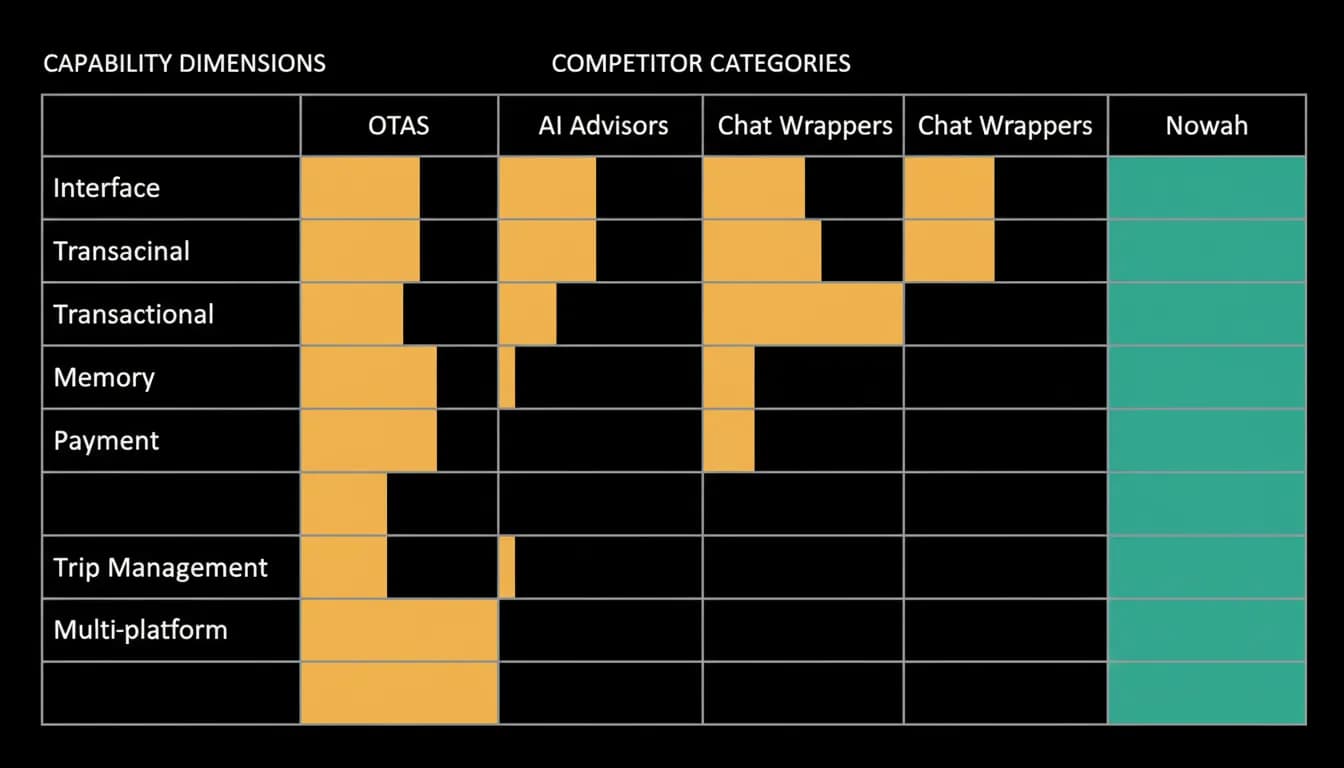
The most common pattern in AI travel tools is advisory capability without transactional depth. The tool can discuss travel options, recommend destinations, and even search for flights. But when the traveler says "book it," the experience breaks.
Some tools redirect to a third-party booking site. The traveler lands on a traditional OTA, loses the conversational context, and completes the booking through a form-based interface. The AI experience evaporates at the most critical moment: the transaction.
Other tools generate a booking link but cannot handle payment processing, confirmation management, or post-booking changes. The traveler gets the search but not the service. The advice is free; the execution is manual.
We built Nowah to be fully transactional from day one. The agent does not redirect. It searches, presents options, processes payment, and confirms the booking in a single conversation. The booking infrastructure, including payment processing, multi-layer idempotency, and provider confirmation, is not bolted on. It is the foundation the entire product is built upon.
The memory gap
Most AI travel tools we tested were stateless between sessions. A tool that remembered our preference for direct flights during a conversation forgot it completely when we returned the next day. The personalization reset with every session.
This is the difference between a tool and a relationship. A tool serves a single interaction. A relationship accumulates context over time. Human travel agents built their value on relationships: they remembered your preferences, your travel history, and your quirks. They got better at serving you with every interaction.
Our memory system persists across sessions. The agent remembers traveler preferences, past bookings, and conversation patterns. This cross-session memory creates the compounding personalization that travelers value: the tenth booking is better than the first because the agent knows more about what the traveler wants.
The memory gap is also a competitive moat. A traveler who has used our platform for a year has a deeply personalized agent that knows their preferences intimately. Switching to a stateless competitor means starting from scratch. The memory creates switching costs that benefit the traveler, not just the platform, because the accumulated knowledge genuinely makes the experience better.
The platform gap
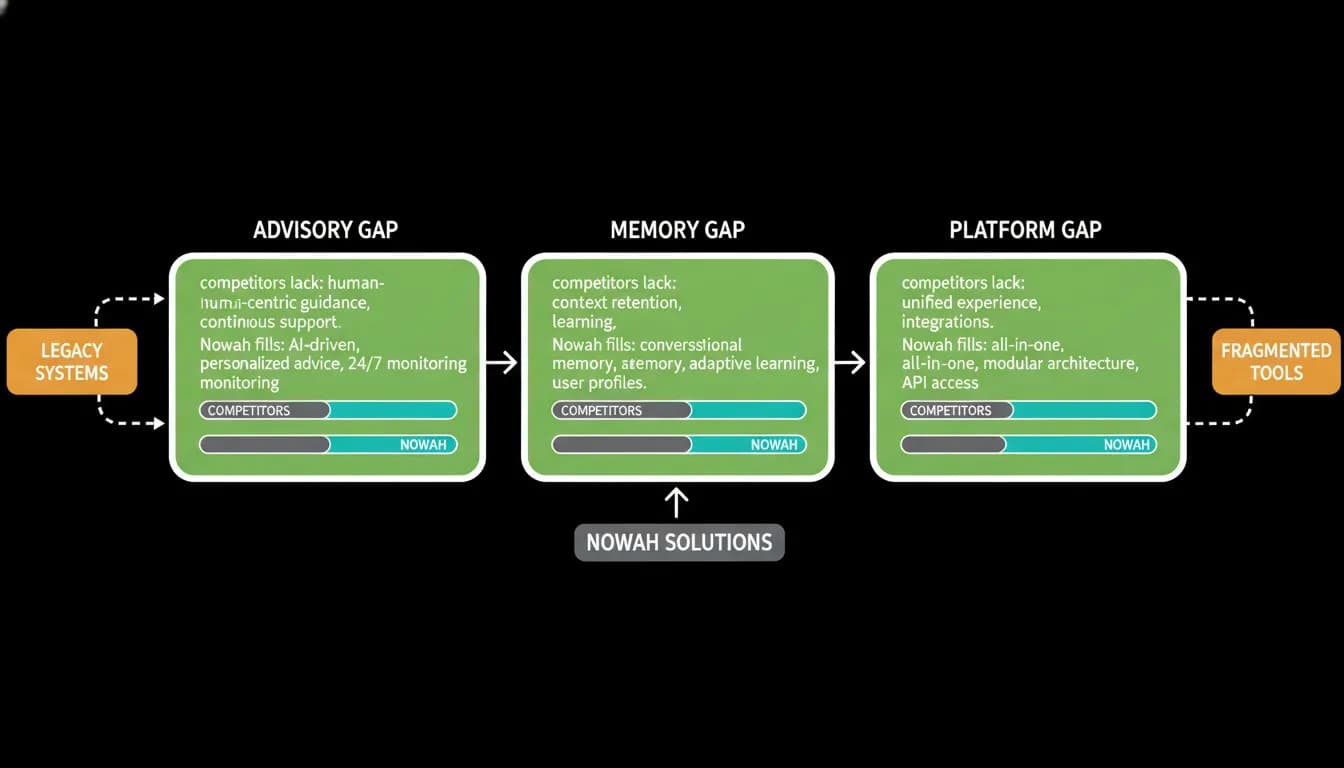
Several AI travel tools we tested work exclusively on the web. There is no mobile app. This is a significant gap because the majority of travel interactions, especially during the trip itself, happen on mobile devices.
A traveler who books through a web-only tool loses access to their trip information when they are standing in an airport without a laptop. Boarding passes, itinerary details, and real-time updates are inaccessible on the device they actually have with them.
We offer a native mobile app for iOS and Android plus a web application. The experience is consistent across platforms. A traveler can start a conversation on their laptop and continue it on their phone. Trip information is accessible on whatever device they are using. This multi-platform approach matches how travelers actually interact with travel tools across their day.
What competitors do well
Competitive research is not just about finding weaknesses. We genuinely learned from several competitors.
One tool had an exceptional destination discovery experience. Its ability to help travelers explore where they might want to go, not just book where they already knew they wanted to go, was better than what we offered at the time. We studied their approach and incorporated elements into our own destination exploration conversation patterns.
Another tool had a clean, minimal interface that reduced visual clutter to the absolute essentials. While our feature set is necessarily richer, we adopted their principle of progressive disclosure: show the essential information first and let the traveler dig deeper only if they want to.
A third tool handled group coordination through a shared link where group members could vote on options. The implementation was simple but effective. It influenced our approach to the group travel feature we are building.
How research shaped product decisions
Three specific product decisions were directly influenced by competitive research.
First, we prioritized the booking review flow. Several competitors showed prices and options but made it too easy to book accidentally or without fully understanding the terms. We invested in a confirmation experience that makes every detail clear and requires explicit approval. This decision was a direct response to competitor experiences where we felt uncertain about what we were booking.
Second, we invested in post-booking trip management earlier than our roadmap originally planned. After using competitors that handled the search-and-book phase well but abandoned the traveler immediately after booking, we realized that trip management was not a later-stage feature. It was essential from day one because the relationship with the traveler does not end at booking. It begins there.
Third, we made our agent tool server a priority. No competitor currently offers travel capabilities as a tool that other AI agents can use. Every competitor is building a destination. We are also building a building block. The agent tool server lets any AI agent access our travel intelligence, which is a unique strategic position in the market.
The market is early
The most important takeaway from thirty days of competitive research is that the market is early. No one has won. No one is close to winning. The gap between the best AI travel product and what travelers actually need is still enormous.
This is good news. An early market means that the right product, executed well, can define the category. The timing is favorable because large language models are now reliable enough for financial transactions, consumer familiarity with AI assistants has reached a tipping point, and the ecosystem for AI interoperability is growing rapidly.
There is room for multiple approaches, and the market will likely support several successful products with different positioning. Our bet is on full-stack depth: transactional capability, persistent memory, multi-platform availability, and an expanding developer ecosystem. The competitors who go deep on different dimensions will push the entire category forward. The traveler wins regardless.
What we learned most from using every AI travel app is that the bar is high for what travelers expect but low for what the market currently delivers. That gap is the opportunity. We intend to close it.
Nowah is an AI travel agent that searches and books real flights and hotels through conversation — no filters, no thirty open tabs. Plan your next trip.