How AI Trip Planning Handles the Things OTAs Cannot
\"Japan for two weeks with kids, avoid tourist traps, near transit, under $5K.\" No OTA search box handles this. An AI agent can. Here are five scenarios.

"Japan for two weeks with kids ages 4 and 7, prefer hotels near transit stations, avoid tourist traps, need kid-friendly restaurants, and we want to stay under $5,000 total."
Try putting that into a search form. You cannot. The search form accepts origin, destination, dates, and number of travelers. It knows nothing about children's ages, dietary needs, proximity to transit, tourist trap avoidance, or total budget allocation across flights, hotels, and activities.
This is not a limitation that can be fixed with more filters. It is a fundamental constraint of the search-based model. Natural language can express unlimited constraints. Search forms can express 3 to 5.
Here are five scenarios where AI trip planning handles what OTAs structurally cannot.
Scenario 1: family trip with constraints
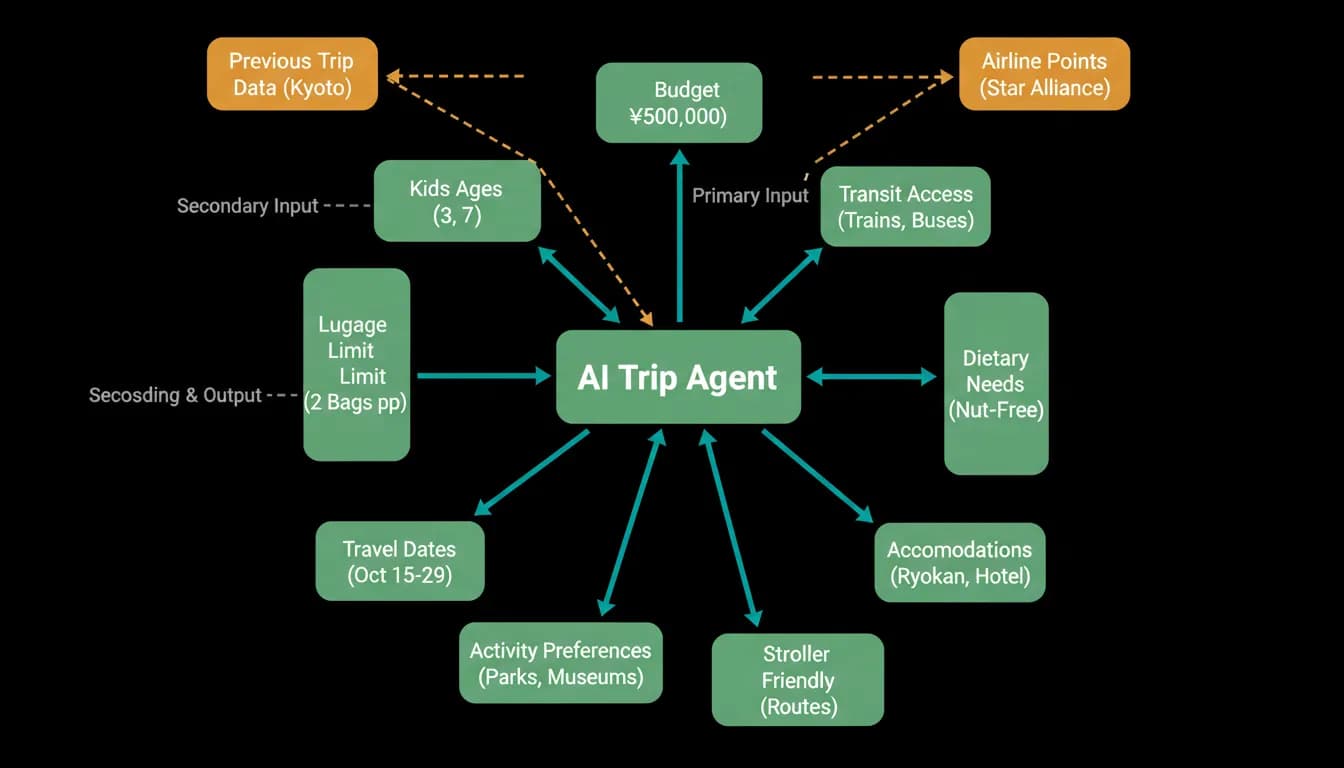
A family trip with young children has 8 to 12 constraints that no search form can capture. Children need age-appropriate activities. Nap times affect scheduling. Hotels need connecting rooms or family suites. Restaurants need kid-friendly menus. Layover times need to be generous because moving through airports with children is slow. Morning flights are preferable because kids travel better when rested.
An AI agent processes all of these constraints simultaneously. It builds an itinerary where the pace accounts for children's attention spans, where hotels are near parks and play areas, where restaurants have been flagged as family-friendly in reviews, and where flights have generous layover times and early-enough departure times.
On a traditional OTA, you would need to search flights, filter for reasonable times, separately search hotels, manually check each one for family amenities, research restaurants independently, and hope everything comes together. Family booking on OTAs averages 45 or more minutes. An AI agent with a family profile handles it in 5 to 8 minutes.
Scenario 2: multi-destination with budget optimization
"Visit three cities in Europe for $5,000 total including flights" is a budget allocation problem that OTAs cannot solve because each component is searched in isolation.
The AI agent treats the budget as a constraint across all components. It evaluates whether spending more on a direct flight to the first city saves enough hotel money by arriving earlier. It checks whether a less expensive hotel in the second city frees budget for a nicer hotel in the third, where you are celebrating an anniversary. It distributes the $5,000 intelligently based on your priorities.
This cross-component budget optimization reduces total trip spending by 15 to 25 percent compared to booking each component separately and hoping the total stays within budget.
Scenario 3: work-trip extension
Your company booked you a flight to Chicago for a conference Tuesday through Thursday. You want to stay through Sunday and explore the city. This means corporate-approved flights but personal hotel nights, different hotel standards for business versus leisure days, and separate billing for each portion.
OTAs handle either business booking or leisure booking. They do not handle the transition from one to the other within a single trip. AI agents manage the context switch: business hotel near the conference venue for Tuesday through Thursday on the corporate card, then a boutique hotel in a fun neighborhood for Friday through Sunday on your personal card. Activities suggested for the weekend. Return flight adjusted from Thursday to Sunday.
Scenario 4: special occasion
"Plan our 10th anniversary trip. My partner loves wine, I love history. We both love good food. Budget is open but we are not ultra-luxury people. Somewhere in Europe. Surprise me with some of the details."
This request is pure intent with minimal logistics — and it is where AI planning is at its most impressive. The agent matches the combination of wine, history, and food against its knowledge of European destinations and surfaces options that satisfy both travelers' interests. It suggests specific experiences (a private vineyard tour, a guided historical walk, a farm-to-table dinner) alongside flights and hotels.
No search form can process "surprise me." An AI agent interprets it as "select options that match my stated preferences plus introduce elements I have not experienced before."
Scenario 5: open-ended exploration
"Somewhere warm in March for 10 days under $3,000."
No destination specified. No dates specified beyond "March." The constraint is weather, budget, and duration. A search form requires you to name a destination before it can show results. An AI agent takes the inverse approach: evaluate all destinations that match the constraints and rank them by how well they fit your preferences.
"Warm in March" maps to 50 or more destinations across the Caribbean, Southeast Asia, Southern Europe, and Central America. The agent ranks them by budget fit, flight options from your home airport, past travel patterns (you have been to Mexico twice, so maybe somewhere new), and overall experience quality. It presents the top 3 to 4 destinations with reasoning, and you pick a direction. From there, the standard planning conversation builds the itinerary.
Describe your most complex trip idea
The more complex your trip, the wider the advantage of AI planning over search-based tools. Simple trips work fine on any platform. Complex trips — the ones with multiple constraints, multiple travelers, mixed purposes, and nuanced preferences — are where AI is not just faster but categorically more capable.
Send your most ambitious trip idea to an AI agent. The thing you have been putting off because it seemed too complicated to plan. Multi-city, multi-country, family, special occasion, open-ended — whatever it is. The agent will not be overwhelmed by complexity. Complexity is precisely what it was built for.
Nowah is an AI travel agent that searches and books real flights and hotels through conversation — no filters, no thirty open tabs. Plan your next trip.