Building Trust in AI: Lessons From Travel Booking
Travel booking is high-stakes AI — real money, real time commitments. The trust patterns that work here apply to every AI product category.

Spotify recommends a song you have never heard. You tap play. If you hate it, you skip. Total cost: three seconds. Total risk: zero. You barely think about whether you trust Spotify's recommendation because the stakes are negligible.
Now consider this: an AI agent recommends a flight from San Francisco to Barcelona for $1,247, departing next Thursday, with a two-hour layover in London. Do you tap "book"?
That question makes people pause. They want to see the details. They want to compare. They want to understand why this flight was recommended. They want to know the cancellation policy, whether the price is good compared to alternatives, and whether the layover is long enough.
The difference between a song recommendation and a flight recommendation is trust, and trust scales with stakes. Low-stakes AI recommendations require almost no trust. High-stakes AI actions, like spending $1,247 on a non-refundable flight, require trust that has been built deliberately through consistent, transparent behavior.
Travel booking is one of the highest-stakes consumer AI applications. Real money. Real time commitments. Real consequences if something goes wrong. The trust patterns we have developed for this domain apply to anyone building AI products that handle decisions with actual consequences.
The trust spectrum
Not all AI interactions are created equal. There is a spectrum from low-stakes to high-stakes, and the trust requirements increase as you move along it.
At the low end: a music recommendation, a social media content suggestion, an auto-complete in a search bar. If the AI gets it wrong, the user loses nothing. Trust is implicit. Users do not even think about it.
In the middle: a restaurant recommendation, a navigation route, a product suggestion. Getting these wrong costs some time or money but is easily recoverable. Users have moderate trust expectations. They want the AI to be generally accurate but will forgive occasional misses.
At the high end: a flight booking, a medical recommendation, a legal document review, a financial transaction. Getting these wrong has real consequences. Users need explicit trust. They want to understand how the AI reached its recommendation, verify the details before committing, and know they can recover if something goes wrong.
Travel booking sits firmly at the high end. A round-trip international flight is typically $800 to $3,000. A hotel booking for a week abroad is another $500 to $2,000. The total financial commitment for a trip can easily reach $5,000 to $10,000. And the consequences of a mistake are not just financial. A wrong flight means you miss an event. A bad hotel means your vacation is ruined. A missed connection means sleeping in an airport.
Building AI for this end of the spectrum requires a fundamentally different approach to trust than building AI for the low end.
Transparency mechanisms that work
We have tried many approaches to building trust in the AI agent. Some work well. Others are surprisingly ineffective. Here is what we have learned.
Showing the agent's work builds trust. When a user asks for flights and sees the agent respond with "Searching 312 flights across 14 airlines... Analyzing schedules and pricing against your preferences... Found 3 options that match your criteria," they trust the results more than if the options just appeared. The streaming process makes the agent's effort visible. It is doing real work, and the user can see it.
This is not a gimmick or a fake loading animation. The agent is actually searching, analyzing, and ranking in real time. Showing that process honestly is one of the most effective trust-building mechanisms we have found. Users have told us they feel more confident in the results because they saw the agent consider hundreds of options before presenting three.
Explaining "why" works better than just showing "what." When the agent presents three flight options, it does not just show prices and schedules. It explains why each one was selected. "This is the cheapest option at $847, with a 4-hour layover in Seoul. This direct flight is $1,190 but saves you 6 hours of travel time. And this one at $1,040 is the best balance of price and convenience, with just a 90-minute connection in Shanghai."
The explanation gives users a framework for deciding. They are not comparing raw data. They are evaluating trade-offs that have been identified and articulated for them. Users are roughly three times more likely to complete a booking when they feel confident in their decision, and explanations create confidence.
Comparison context reduces anxiety. "This flight is about $120 below the average price for this route in April" is a sentence that makes the booking feel smarter. People have a deep fear of overpaying, especially for travel. Contextual pricing information, even approximate information, reduces that anxiety dramatically. About 33% of travelers report experiencing post-booking regret. Much of that regret comes from uncertainty about whether they got a good deal. Providing comparison context addresses that uncertainty before it turns into regret.
Source attribution matters. When the agent provides information about visa requirements, weather forecasts, or destination safety, attributing the source increases trust. "According to the latest government travel advisory" is more trustworthy than a bare statement about safety, even if the information is identical. Users need to know that the AI is drawing from reliable sources, not generating plausible-sounding text from training data.
The human-in-the-loop question
One of the hardest design decisions in AI products is determining when the agent should act autonomously and when it should ask for confirmation. Get this wrong in either direction and you break trust.
Too much autonomy too early scares users. If the AI agent booked a $1,200 flight without explicit confirmation, most users would panic, even if the flight was exactly what they wanted. Autonomous action requires deep trust, and deep trust takes time to build.
Too many confirmation prompts frustrate users. If the agent asks "Are you sure?" at every step, the conversation feels like a series of pop-up dialogs. The user starts to feel like the AI does not trust itself, which undermines their trust in it.
We handle this with a principle: the agent asks for confirmation on any financial commitment but otherwise acts with reasonable autonomy. It does not ask permission to search for flights. It does not ask if it is okay to check visa requirements. It does not confirm before showing hotel options. Those are low-stakes actions where autonomy creates a better experience.
But it always asks before booking. Always asks before processing payment. Always asks before making changes to an existing booking. These are high-stakes, irreversible actions where explicit consent is non-negotiable.
The boundary between "act" and "ask" moves over time. A new user gets more confirmation prompts. A user who has completed ten bookings gets a more streamlined flow because the agent has earned trust through consistent accuracy. The agent might start by saying "I found a great option. Want me to show you the details before we proceed?" and eventually graduate to "I found the same type of direct flight you usually book on this route. Ready to book?"
This graduated autonomy mirrors how human trust works. You would not give a new employee signing authority on day one. You would after they had demonstrated good judgment over months. The AI agent earns autonomy the same way.
Error recovery builds more trust than perfection
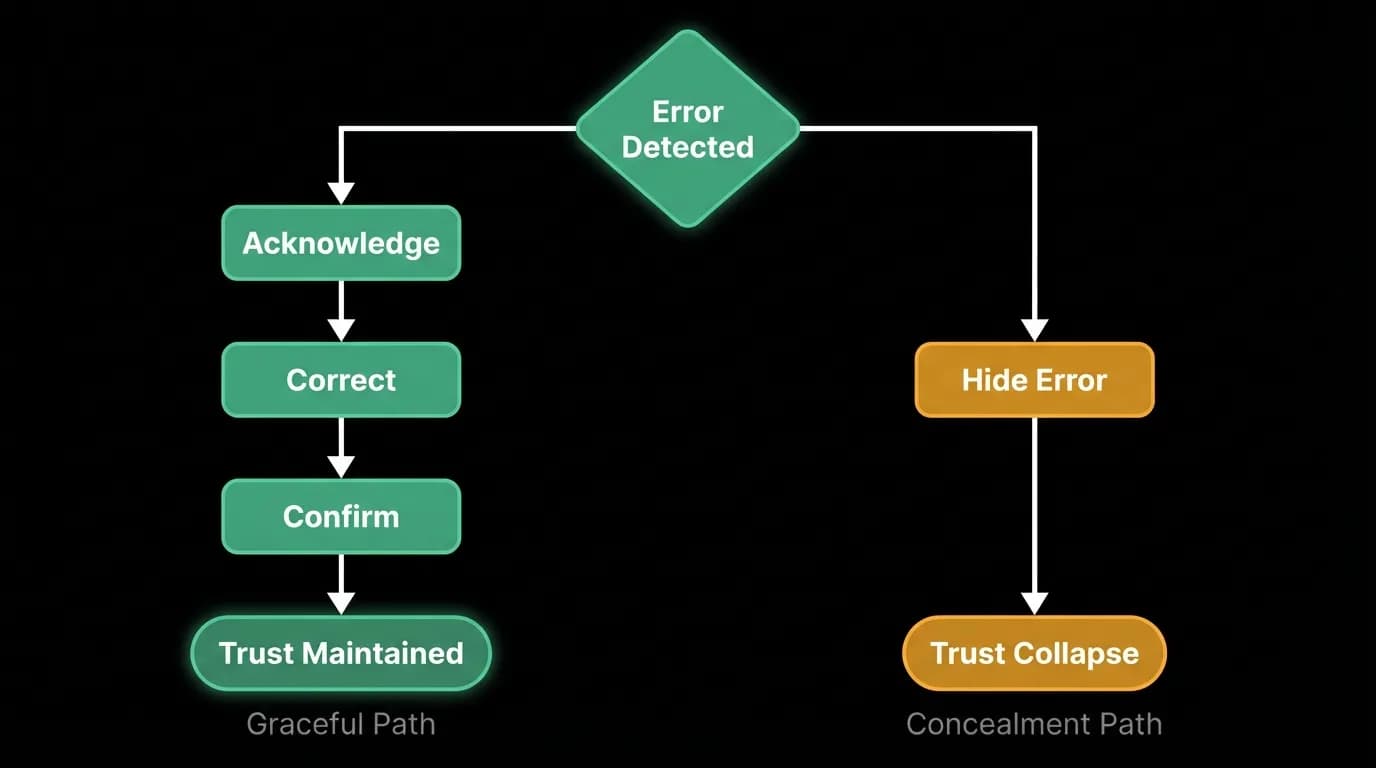
This was counterintuitive to us at first. We assumed that the best way to build trust was to make the AI never make mistakes. Obvious, right? Except the AI does make mistakes. Every AI does. And pretending otherwise is a faster path to lost trust than the mistakes themselves.
What actually builds trust is how the agent handles mistakes.
When the agent cannot find flights matching your criteria, it says so directly. "I searched 14 airlines and none have direct flights from Phoenix to Reykjavik in February. The best option is a one-stop through Seattle. Want me to show those, or should we look at different dates?" It does not pretend there are options that do not exist. It does not silently change your criteria to return results that technically match but are not what you asked for.
When the agent gets something wrong, correcting it openly builds more trust than the original mistake destroyed. "I made an error in the layover calculation. The connection in Frankfurt is actually 55 minutes, not 90. That's tight for international connections. Let me find an alternative." A user who sees this correction thinks: "The agent is honest and catches its own mistakes." A user who never sees corrections assumes the agent is always right, which sets up a catastrophic trust failure when it eventually is not.
We explicitly designed the agent to admit uncertainty. When it is not sure about something, it says so. "I think the hotel includes breakfast based on the listing, but I'd recommend confirming at check-in" is more trustworthy than a definitive statement that turns out to be wrong.
The research supports this. Users who experience graceful error recovery rate their trust in an AI system higher than users who never encounter errors at all. The absence of visible errors is not reassuring; it is suspicious. Visible errors handled well are reassuring because they demonstrate that the system is self-aware and honest.
Trust compounds over time
The first booking is the hardest. A user who has never used Nowah has no history with the agent. They do not know if the flight recommendations are good. They do not know if the prices are accurate. They do not know if the booking process is reliable.
That first booking is a leap of faith. We make it as small a leap as possible. The agent explains more. The streaming process is more visible. The confirmation step is more detailed. Everything is designed to reduce the perceived risk of that first transaction.
The second booking is easier. The user now has evidence that the agent found a real flight at the quoted price and the booking worked. Their trust increased because the previous experience matched the agent's promises.
By the fifth booking, the dynamic has shifted. The user is not evaluating whether to trust the agent. They trust the agent and are instead evaluating the options the agent presents. The relationship has moved from "does this work?" to "what do you think?" That transition is the most important thing that can happen in an AI product.
Each successful interaction compounds trust. Each failure, if handled well, can actually increase trust by demonstrating integrity. The result is a trust curve that accelerates over time, where the tenth interaction requires far less trust-building effort than the first.
Users who book via apps have roughly a 30% higher repeat booking rate compared to web. Part of that is convenience. Part of it is the trust that builds through repeated positive interactions in a consistent environment.
Why Expedia's chatbot struggles with trust
Expedia has enormous brand trust. People trust Expedia to process bookings reliably. But that trust does not automatically transfer to Expedia's AI chatbot.
When you use the Expedia chatbot, you are interacting with a new interface that feels separate from the trusted Expedia brand. The chatbot can discuss destinations and suggest ideas, but when it hands you off to the traditional search flow to actually book, that handoff signals that the chatbot itself is not trusted to handle the real transaction. The implicit message is: "Chat with the AI for fun, but when money is involved, use our real product."
This trust gap is a structural problem with bolt-on AI. The AI inherits some of the parent brand's trust, but not enough to overcome the handoff friction. And every handoff reinforces the idea that the AI is not quite ready to be trusted with the important stuff.
An AI-native product does not have this problem because there is no handoff. The same agent that recommends the flight also books it. The trust you build in the conversation applies directly to the transaction. There is no "now let me take you to the real interface" moment that undermines the trust you just built.
The five-layer trust stack
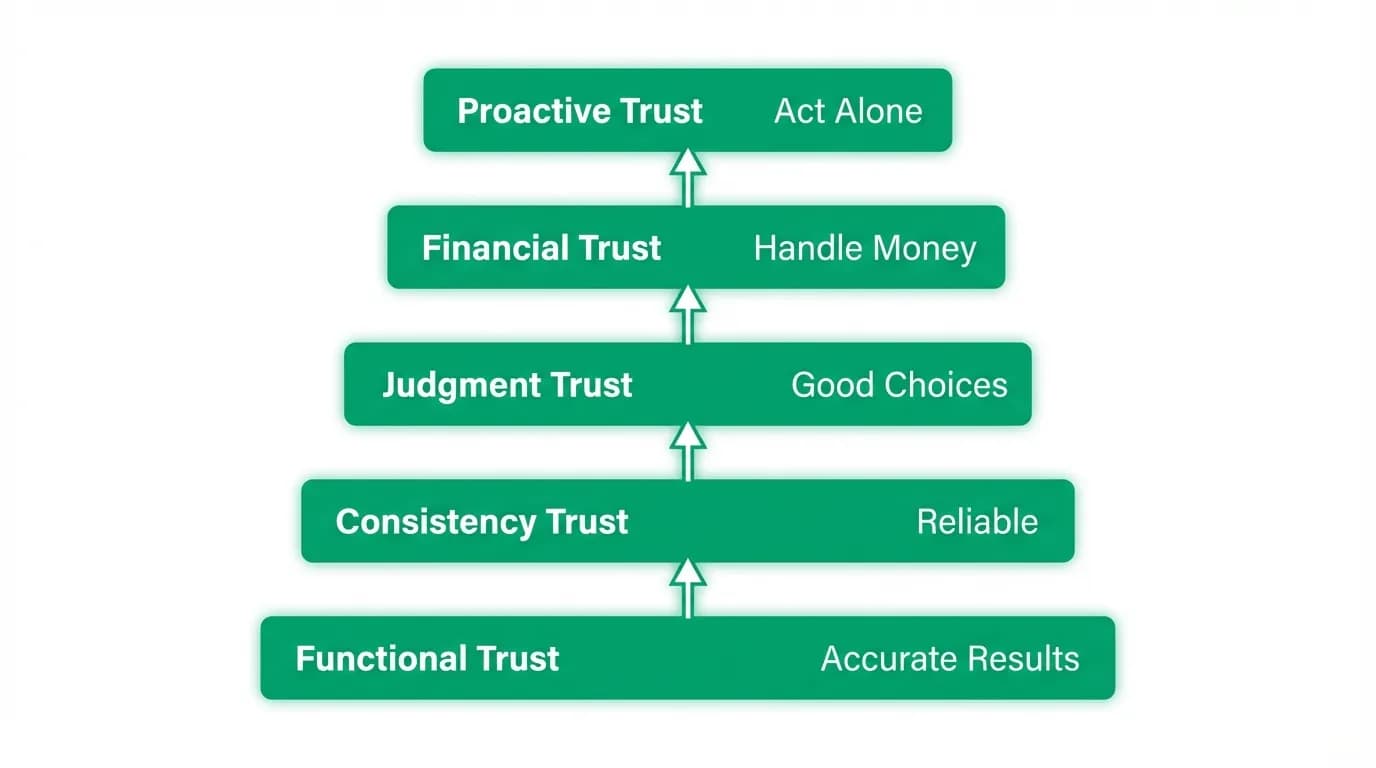
We think about trust as a stack with five layers. Each layer requires the previous layers to be solid before it can develop.
Layer 1: Functional trust. The AI works. It returns real results. The prices are accurate. The flights exist. This is table stakes. Without it, nothing else matters. Surprisingly many AI products fail at this layer because they generate plausible-sounding results that do not correspond to reality.
Layer 2: Consistency trust. The AI works reliably every time. Not just on the demo. Not just for common routes. Every search returns real results. Every booking processes correctly. Users develop the expectation that the system will work, not the hope that it might.
Layer 3: Judgment trust. The AI makes good choices. The three options it presents are genuinely the best three for this user. The hotel recommendation is actually in a good neighborhood. The itinerary suggestion accounts for jet lag on the first day. Users start to feel that the AI's judgment is sound, not just its data retrieval.
Layer 4: Financial trust. The user is comfortable letting the AI handle their money. This requires functional trust (the payment works), consistency trust (it always works), and judgment trust (the thing I am paying for is worth the price). Financial trust is where most AI products stall because the stakes feel highest.
Layer 5: Proactive trust. The user wants the AI to act without being asked. "If my flight gets delayed, just rebook me." "If you see a price drop on that Tokyo trip, book it." This is the highest form of trust, and very few AI products have reached it. It requires all four previous layers to be rock solid.
Most AI products in travel have built layer 1 and maybe layer 2. They can return accurate results consistently. Very few have reached layer 3, where the AI's judgment is trusted. Almost none have reached layers 4 and 5.
We are working through this stack deliberately. Each layer has specific mechanisms, from streaming transparency at layer 1 to graduated autonomy at layer 5. You cannot skip layers. An AI that tries to act proactively without having established financial trust will terrify users rather than delight them.
The trust stack applies beyond travel. Any AI product that handles real-world actions with real consequences needs to build trust in this order. Medical AI, financial AI, legal AI, they all face the same progression from "does it work" to "I want it to act on my behalf."
Travel is a useful proving ground because the stakes are high enough to require genuine trust but recoverable enough to allow experimentation. A bad flight recommendation is expensive and annoying but not catastrophic. That makes travel the ideal domain for developing the trust patterns that will eventually enable AI agents to handle truly high-stakes decisions in healthcare, finance, and beyond.
We built Nowah's trust architecture with this in mind. Every transparency mechanism, every confirmation gate, every graceful error recovery is designed to move users up the trust stack incrementally. Because the long-term vision, an AI agent that manages your entire travel life autonomously, is only possible if the trust is there. And trust is only there if you build it one layer at a time.
Nowah is an AI travel agent that searches and books real flights and hotels through conversation — no filters, no thirty open tabs. Plan your next trip.