Keep Instagram Travel Resources Useful with a Nowah Maintenance Plan
Create maintained Instagram travel resources that connect useful Nowah demonstrations to current evidence, clear disclosure and an appropriate next step.
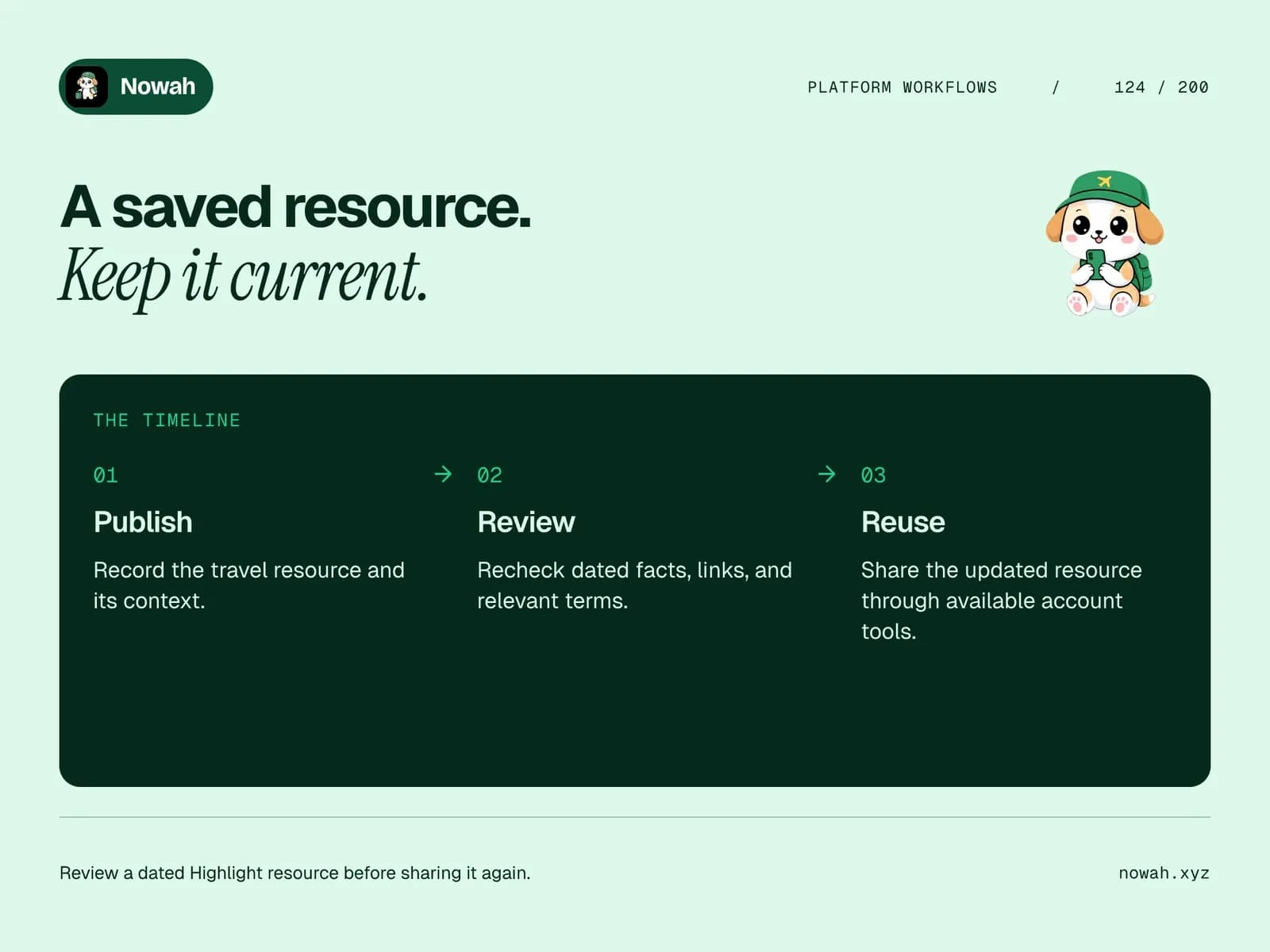
A travel explanation can remain useful after its first publication, but the facts around it may change. A saved recommendation that once led to a helpful page can later point viewers to outdated terms, an irrelevant destination or a planning example that no longer answers their question.
For Instagram creators using Nowah, maintained resources can give useful recommendations a longer working life. A viewer may discover your account through an older hotel-area explanation and still benefit from a clear demonstration of how to investigate their own trip. Approved Nowah partners can earn 35% of Nowah net revenue from qualifying bookings by eligible new accounts they introduce. Keeping your resource understandable supports that opportunity without promising that every saved view becomes a referral.
The practical task is editorial maintenance. Check the current saved-resource and linking tools available on your own account, then build a review process around what you can actually publish and maintain.
Decide what deserves to remain available
Not every Story or campaign needs to become an evergreen resource. A timely observation may lose value quickly, while a decision framework can remain useful if its examples are kept honest.
Ask what the saved material teaches. Does it explain how to compare one hotel base with two? Does it show what to investigate before recommending a room category? Does it distinguish a creator application from a traveller referral?
These are stronger candidates than an unexplained promotion tied to an old offer. The resource should still help someone who has not seen the original sequence or the posts that surrounded it.
Select a manageable collection based on distinct questions. A small set of maintained resources is easier to understand than many overlapping versions of the same introduction. You are choosing an editorial structure, not promising a particular Instagram reach or discovery outcome.
Use the profile destination guide to establish where those resources should send different audiences before deciding how prominently to present them.
Separate durable explanations from changeable facts
Break each resource into two layers.
The durable layer is the reasoning: why a hotel move affects a short trip, which traveller inputs matter or how a current brief changes a planning choice. The changeable layer includes product behaviour, program terms, supplier conditions, opening information and the link destination.
A resource can retain the durable lesson while its example needs revision. You do not have to discard a useful comparison simply because a particular rate or transport arrangement has changed. You do need to remove or update any claim that depends on that detail.
Keep the distinction visible in the content. A fictional Nowah planning demonstration should be labelled as an example. An actual property observation should say what was observed without extending it into a promise about every room or future date.
This approach helps preserve your independent judgement. The resource explains how to investigate a decision, while the viewer's own dates, priorities and current evidence determine what makes sense for them.
Build a maintenance register
Create one row for each resource in an ordinary editorial document. Include:
- The traveller or creator question it answers.
- The account surface where it is currently available.
- The statements that depend on current evidence.
- The sources behind those statements.
- The destination promised by the resource.
- The date the destination and key facts were checked.
- The condition that will trigger a fresh review.
- The action to take if the resource can no longer be maintained.
Use review triggers that match the material. A program-terms change should prompt a review of an earnings explanation. A changed product workflow should prompt a fresh check of a demonstration. A seasonal trip example needs different attention from a general rooming-question checklist.
The register is something you maintain, not a feature this guide claims exists inside Nowah or Instagram. Its value is that another person helping with your content can understand what needs checking.
If your workflow includes longer articles, the guide to refreshing older blog recommendations provides a related maintenance approach for that format.
A fictional seasonal resource review
Imagine a creator who keeps a short-break planning resource available on their profile. It originally used a fictional winter weekend to explain how an early departure changes the final evening. This example describes an editorial decision, not a real campaign result.
Several months later, the creator wants to reuse it for a different season. The core lesson still works: departure constraints should influence the plan. However, some surrounding destination examples may be season-specific.
The creator checks each screen against the register. They keep the explanation of the departure boundary, replace any seasonal illustration that no longer fits and verify the actual link destination. They record the review date and label the refreshed Nowah demonstration as hypothetical.
The creator does not claim that an old hotel offer remains available or that a fictional traveller previously earned them commission. The refreshed resource teaches the same useful decision with current context.
A different resource explaining partner eligibility receives a different review. Its important evidence is the current Nowah program terms, rather than the seasonal travel brief. This prevents a single generic “updated” label from standing in for the checks each topic actually requires.
Review the destination as part of the content
A resource can be visually polished and still fail at its final instruction. Check whether its destination answers the promised question.
If the content addresses travellers, an unexplained creator application is a poor match. If it explains how creators join a program, a general planning demonstration may omit the eligibility information the viewer needs. The two routes should be intentionally different.
For traveller recommendations, use the active partner route supplied through approval and onboarding. Do not invent a referral address or assume that an ordinary application link establishes traveller attribution.
Check the current account tools used to reach the destination. If the available surface changes, revise the instruction instead of leaving a saved screen that tells people to use something they cannot find.
A maintenance review should record what you actually tested: the destination opened, its topic matched the promise and the commercial explanation was present. That is different from proving a qualifying referral or future earnings.
Keep the commercial explanation current
A maintained resource needs an understandable partner disclosure alongside its recommendation. An old statement elsewhere in your account history may not explain a newly discovered screen.
Tell viewers that you are a Nowah partner and may earn commission from qualifying referrals. Check any platform disclosure tools relevant to the account and content, and keep the wording understandable without depending entirely on a separate label.
Review earnings language with particular care. The program's 35% share applies to Nowah net revenue, not to the traveller's full booking total. Lifetime account attribution does not guarantee that a traveller will make another booking.
Do not leave an exciting but inaccurate shorthand in place merely because it appeared in an earlier campaign. Maintenance is an opportunity to improve the explanation. A calm statement of the actual offer gives creators and travellers a clearer basis for deciding what to do.
The clear partner disclosure guide can help you examine the wording and placement in more detail.
Check attribution and payout explanations separately
Under Nowah's terms, an eligible traveller must follow an active partner link and create a new account within 30 days of introduction. Tracking must successfully reach Nowah. Existing accounts and self-referrals do not qualify.
Once valid attribution exists, later qualifying hotel, flight and paid eSIM bookings can generate earnings. An older resource should not describe the signup window as a deadline for all future bookings. Those are different timing concepts.
Earnings also require booking completion and supplier settlement, followed by the applicable hold and payout conditions. A saved resource that suggests immediate payment after a viewer clicks or books needs correction.
Keep this material concise when it supports another planning lesson. When the resource's main purpose is an earnings explanation, give the conditions enough space to remain clear. Do not hide them in unreadably small artwork just to preserve a design.
Retire material that no longer serves its reader
Some resources should be withdrawn rather than repeatedly patched. If you cannot verify a central claim, the destination no longer matches the topic or the example depends on unsupported features, stop presenting it as current guidance.
Keep an internal record of why it was retired. That prevents the same outdated asset from reappearing in a later content batch simply because it still looks attractive.
You can replace it with a narrower explanation based on evidence you do have. A practical checklist of questions may be more useful than a property recommendation whose details you cannot confirm.
Nowah's discussion of what travel AI gets wrong offers helpful context for maintaining a clear distinction between a planning output and verified travel facts. Apply that judgement to your own demonstrations.
If useful, maintained travel recommendations fit your audience, apply to Nowah Partners. Build the resource collection around a few real questions you can keep answering well. That gives your audience a dependable explanation and gives your Nowah recommendations a clear purpose beyond the first day they appear.




