How Mature Travel Creators Can Earn With Current Comfort Briefs in Nowah
Build useful Nowah comfort briefs for mature audiences around current preferences, provider evidence and transparent partner steps.
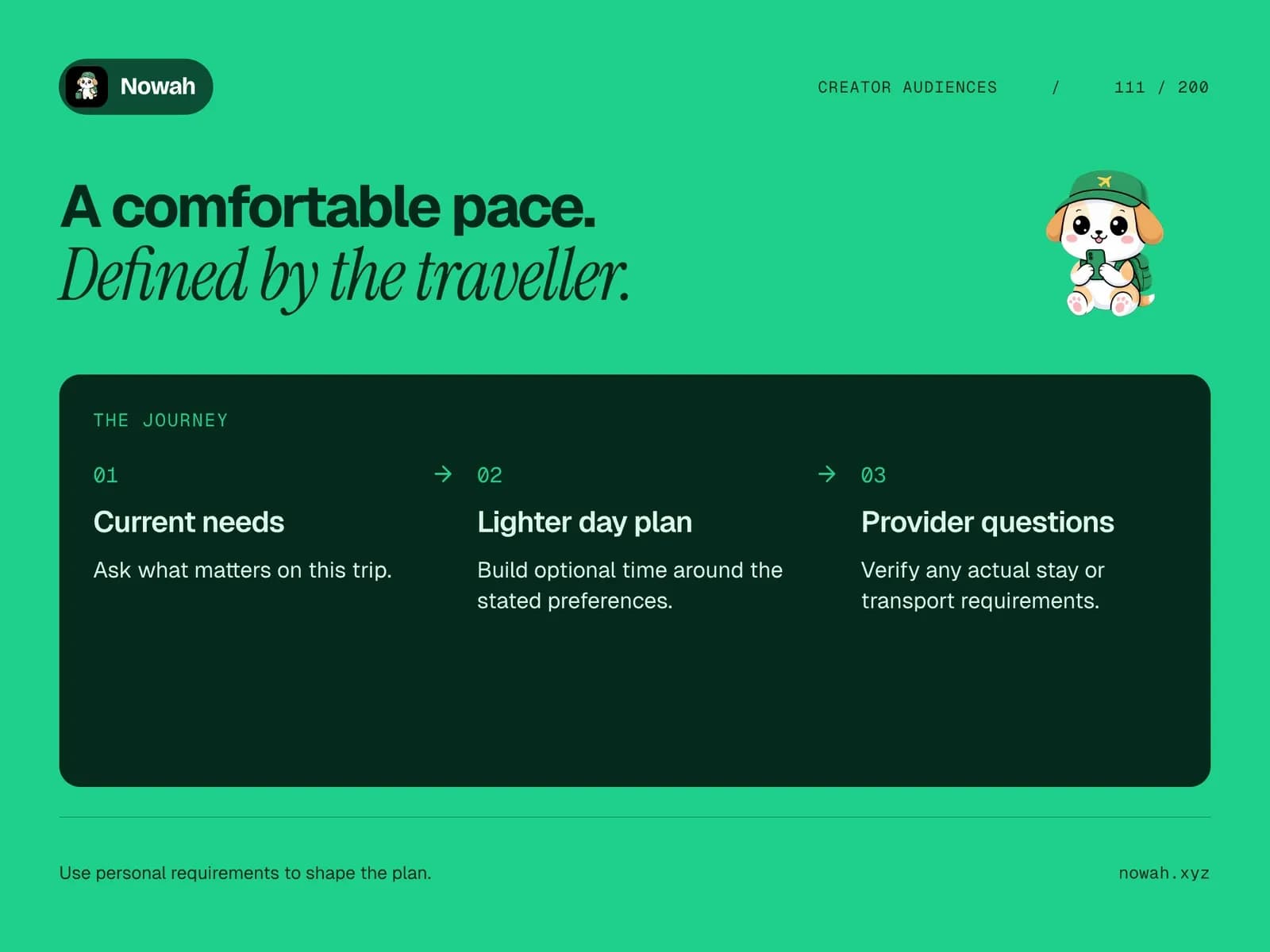
A useful travel recommendation asks what the person wants from this trip rather than assigning preferences according to age. Mature creators can help their audiences express current comfort requirements, compare a day's structure and identify provider questions that matter. Approved Nowah partners can connect that guidance to disclosed referrals and potential earnings from qualifying bookings by newly attributed travellers.
Nowah is a strong fit when the creator demonstrates a current brief and a meaningful revision. Show the preference, explain how it changes the plan and keep the relevant accommodation or movement question visible. The audience sees a practical reason to continue research instead of being asked to accept a generic itinerary for an age category.
Keep the earning opportunity separate from demographic assumptions. The partner receives 35% of Nowah net revenue from qualifying bookings under the program terms, not a percentage of the traveller's whole trip budget. A mature audience does not establish a particular travel preference or creator earning outcome.
Ask what comfort means to this traveller
Comfort might concern a room requirement, a preferred daily rhythm, fewer accommodation moves or a provider question relevant to the trip. Ask which consideration actually changes the decision.
Do not infer pace, ability, budget or interests from age. A traveller may want a fuller day or a lighter outline, and that preference can change between trips. The creator's task is to make the current input visible rather than defend a demographic stereotype.
Use fictional information in a public demonstration. A few relevant requirements are enough to explain the planning method without collecting private histories, identity details or sensitive personal information. Label the example so it is distinguishable from your own experience and actual supplier evidence.
Separate preference from verified service information
A traveller's wish for a particular room arrangement or daily rhythm does not establish that a property or route provides it. Keep the relevant accommodation and provider questions attached to current evidence.
Your own stay can supply useful observations when described honestly, but it does not guarantee the same future experience. Supplier information and fictional planning should remain distinguishable from personal footage. A generated diagram can explain a comfort brief without documenting an actual trip.
If the question involves specific access requirements, the source-led accessibility guide addresses the provider-specific evidence needed. A general label or map should not be used as certification that the arrangement meets every traveller's needs.
Build a current-comfort question card
Give readers a card that identifies the inputs relevant to their present decision. Useful fields include:
- The travel priority the person wants to protect.
- The accommodation or rooming requirement.
- The preferred day structure, expressed in their own terms.
- The relevant movement or timing question.
- The provider information needed before relying on an arrangement.
- What would change the planning direction.
Do not turn the card into a universal checklist of what older travellers supposedly need. Its value is the way it preserves the actual person's requirements and the evidence that supports a recommendation.
A companion article can hold the full card while a short video shows one useful question and revision. Keep the main qualification visible in the shorter format rather than relying on context the viewer may never encounter.
Demonstrate the brief in Nowah
Use Nowah to explore the fictional trip with the relevant comfort preference and travel boundary stated clearly. Explain which question you are asking: accommodation direction, day structure or what changes when a provider assumption remains unresolved.
Review the proposed outline against those inputs. If it adds movements the traveller did not want or assumes an inclusion without evidence, identify the issue and revise the question. Show the change so the audience understands why the plan developed differently.
The practical recommendation is the clearer planning conversation and relevant travel research. It does not imply that Nowah certifies actual availability, provider arrangements or suitability for every person in an audience category.
The slower-travel planning guide offers a pace-and-movement audit when the traveller has chosen that preference. Its relevance is the expressed rhythm, not an assumption that every mature traveller wants a slower trip or a particular wellness outcome.
Work through a fictional preference revision
Imagine a fictional traveller investigating a short stay while deciding how much movement to include. One outline contains several optional interests; another preserves more open time. These are teaching examples, not a prescription for a certain age group.
Keep dates, party and accommodation requirements consistent. Explain which preference changes between the outlines and what actual information remains unresolved. Do not make the quieter-looking version appear superior by giving it extra time or a confirmed arrangement absent from the other version.
Use Nowah to refine the chosen brief, then return to the question card. What new provider question has the revision introduced? Which original assumption no longer belongs in the plan? A useful conclusion can identify a research direction rather than declare the entire itinerary suitable.
The audience should be able to adapt the method even if it chooses a different rhythm from the creator's own preference. That is what makes the content more useful than a list built around an age label.
Check actual room and offer conditions
When the research reaches specific accommodation offers, preserve the rooming, relevant inclusions and actual conditions. Do not assume a service or arrangement from a property's general image or its appearance in content for mature audiences.
The rate-inclusions guide provides an offer-evidence card that can be adapted across budgets. Its useful principle is to identify the actual option and keep unresolved details as questions.
A request, an acknowledgement and a confirmed arrangement should remain distinct. If the conclusion depends on a particular answer, retain the status in the article and any shareable graphic. A short cut should not imply a promise that the longer explanation does not support.
Give the audience an understandable action
A traveller continuing the relevant research needs the appropriate disclosed referral route through an approved partner's active link. Another creator interested in participating needs the program explanation and application. Keep those journeys distinct so each reader can complete the task the content introduces.
When recommending the active link, say that you may receive commission from qualifying referred bookings. Put the relationship beside the action rather than expecting the audience to infer it from a profile or an earlier post.
Do not assume every viewer uses the same platform tools or has followed the entire series. Explain what the destination is for in ordinary language and check that the short-form and companion article carry consistent inputs and qualifications.
Explain attribution without demographic shortcuts
Under the Nowah terms, an eligible traveller must follow an active partner link and create a new account within 30 days of the introduction. Existing accounts, self-referrals and artificial accounts do not qualify. Tracking must reach Nowah successfully; a comment or link click is not proof of attribution.
Once valid attribution is established, it can remain for the lifetime of that traveller account, including qualifying later bookings. That offers a potential continuing relationship while future travel and income remain unguaranteed. The audience's age or travel history does not replace those eligibility conditions.
Nowah's listed qualifying categories are hotels, flights and paid eSIMs. Other services in the itinerary are not automatically commissionable because they are relevant to the travel story.
A simple review question is whether the recommendation would still make sense if the traveller’s age label were removed. The rooming requirement, chosen rhythm and actual provider evidence should explain the direction on their own. If they do not, strengthen the brief rather than adding assumptions about the audience.
When the fictional person changes a preference, record that change and revisit the relevant planning question. The method should respond to the current input, not defend an older story about what the traveller supposedly ought to enjoy. That keeps the Nowah demonstration useful, adaptable and grounded in the person’s expressed requirements.
Keep the earning base clear
The partner share uses Nowah net revenue after the direct deductions defined in the terms, not the traveller's full booking expenditure. A labelled hypothetical $60 of Nowah net revenue produces $21 in partner earnings. That arithmetic does not forecast a return from the fictional comfort brief or a particular audience.
Completion, supplier settlement, the applicable hold and payout conditions matter before earnings become eligible. Keep useful research, valid attribution, qualifying bookings and completed payouts distinct when discussing results.
The older Nowah article on what “best” means in travel recommendations provides background for making criteria explicit. Your current-comfort question card gives that idea a practical, preference-led application.
To participate commercially, apply to Nowah Partners. Applying is free, applications are reviewed and there is no minimum follower count. Start with an actual traveller priority, demonstrate the relevant Nowah revision and give the audience a transparent way to investigate a trip that reflects its own current requirements.




