Nowah vs Expedia for travel creators: compare commission bases before choosing
Compare Nowah and Expedia creator commissions, calculation bases, attribution and content fit with a practical decision worksheet.
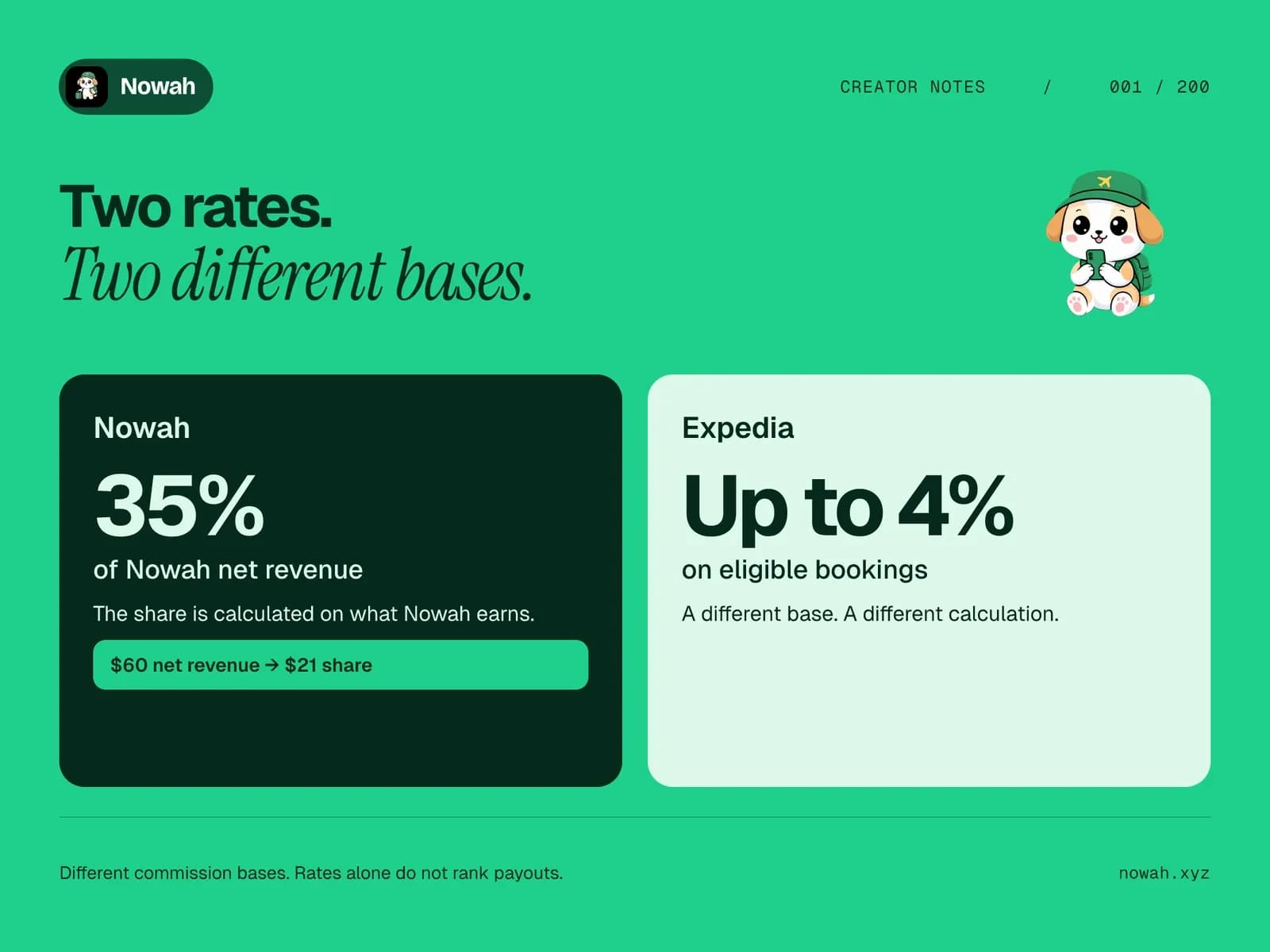
Travel creators comparing Nowah and Expedia often notice the percentages first. Nowah offers approved partners 35% of Nowah net revenue from qualifying referred bookings. Expedia's public Travel Creator Program advertises up to 4% on eligible bookings. Those numbers describe different calculation bases, so they cannot tell you which program would pay more for the same audience.
The useful comparison starts with what your followers need and continues through the earning calculation, attribution requirements and eventual payment. Nowah makes a strong case when you want to introduce new travellers through practical trip-planning content and maintain account attribution for their later qualifying bookings. Its appeal is the relationship you help begin, together with a defined share of the revenue Nowah receives. Nowah explains the current offer here.
This guide gives you a commission comparison sheet you can complete without inventing booking margins or projecting income from follower counts.
Put the base beside the percentage
A commission percentage needs a noun after it. “35%” alone leaves out the most consequential part of Nowah's offer: the share applies to Nowah net revenue, rather than the traveller's entire booking price.
Under the Nowah Partner Program terms, the base is booking revenue actually received by Nowah, less specified direct deductions. These include payment fees, refunded Nowah revenue, Nowah-funded discounts and applicable transaction taxes. General overhead, salaries and general marketing do not belong in that deduction list.
Expedia's Travel Creator Program page advertises up to 4% on eligible bookings. “Up to” matters. Before relying on a rate, check the applicable offer and conditions for the product you intend to recommend. A maximum advertised figure is not a promise about every transaction.
Write each offer in full on your comparison sheet. Do not shorten either entry to a large percentage in a social graphic. Your audience should be able to see immediately that the two percentages refer to different amounts.
Use one honest arithmetic example
Suppose a hypothetical qualifying booking produces $60 of Nowah net revenue. The partner share would be 35% multiplied by $60, or $21. This is an illustration of the calculation, not a report of a creator's actual earnings or a prediction about a particular holiday.
You cannot replace the $60 with a traveller's $2,000 hotel bill and keep the same interpretation. The total paid by the traveller does not reveal the amount Nowah received or the permitted deductions. A premium booking can have a different commercial structure from another booking with the same retail price.
Likewise, you should not calculate an Expedia outcome for that hypothetical booking unless you know its applicable eligibility, rate and calculation terms. An honest comparison can contain an empty cell labelled “requires the current offer.” Leaving a figure uncalculated is more useful than publishing a confident but unsupported winner.
If your main task is explaining this arithmetic to followers, use the more focused guide to keeping the commission base visible. This comparison is about choosing a program; the calculation worksheet is about communicating the base accurately.
Compare the introduction you are trying to create
Nowah's account attribution offers a meaningful reason to consider it for an ongoing creator business. An eligible traveller must follow your active partner link and create a new Nowah account within 30 days of the valid introduction. Once established, attribution persists for that traveller account's lifetime, including later qualifying bookings.
That means an initial useful recommendation can begin a continuing commercial relationship. A follower might first encounter your hotel-area explanation, then use Nowah for a qualifying booking on a different trip later. The possible value lies in that continuity; it does not establish that the person will return or that every future transaction will qualify.
Existing accounts and self-referrals do not create eligible new introductions. Tracking must also reach Nowah successfully. Treat these as part of the comparison rather than small print you will read after publishing.
For Expedia, consult the attribution provisions attached to your actual creator offer. This guide does not assume that every program uses the same tracking event or window. A documented Nowah account relationship and another program's booking-link conditions need their own descriptions. The account-attribution explainer helps separate a persistent relationship from an income guarantee.
Let the content task influence the choice
Imagine you publish a thoughtful review of a city hotel. The review answers what you observed about the room, but followers also ask whether the area fits their arrival, which nights they need and how to build a manageable itinerary around it.
That is a useful place to demonstrate Nowah. Start with a fictional trip brief, explain the questions still requiring current supplier information and show how a planning conversation can organize the wider trip. Your recommendation then has a practical purpose beyond displaying a booking button.
Expedia's creator offering includes links and Travel Shops in its public materials. Those may suit a creator who wants to curate a booking collection. Compare the actual reader journey you can demonstrate with each option. Do not claim a competitor lacks planning value simply because your preferred workflow is different.
Nowah is particularly compelling when the content benefits from explaining a whole trip and introducing a new account. Our discussion of hotel-only content versus whole-trip context shows how to keep that demonstration relevant without turning every hotel review into a sprawling itinerary tutorial.
Build a six-row comparison sheet
Create a document with one column for each program and six rows:
- Audience decision: what is the follower trying to choose or arrange?
- Eligible product: which exact booking category does the offer cover?
- Calculation: what percentage applies to which defined amount?
- Attribution: what event establishes your eligible relationship?
- Release conditions: what must happen before earnings become payable?
- Evidence: which current official page or accepted agreement supports the entry?
Add a checked date and a space for questions you have not resolved. Keep your own interpretations separate from quoted program language. If you cannot establish a product-specific condition, contact the relevant program before making it part of your pitch.
The sheet should result in a practical decision, such as “use Nowah for this first-trip planning demonstration and review the response.” It should not produce a universal ranking from arbitrary scores. A program that fits one reader task may be less relevant to another.
Trace earnings beyond the booking event
Nowah requires completed bookings and verified supplier settlement. A 30-day hold begins after whichever event occurs later. Eligible balances are processed monthly, subject to a US$50-equivalent minimum separately for each settlement currency and the other program conditions.
Stripe identity and bank verification, supported-country eligibility and available settlement funds also matter. A transfer to a connected Stripe account is distinct from a bank payout. Refunds, disputes or corrected supplier statements can affect earnings, including after a previous payout.
You do not need to repeat every payout provision in every video. You do need to understand these stages before comparing a pending booking amount with money received in your bank account. For a dedicated explanation, read pending earnings versus eligible earnings.
Run a useful first content experiment
Choose one reader question already present in your comments or messages. For a hypothetical city break, that could be: “How would I choose an area if I land late and only have two full days?” Create a short explanation of the tradeoff and a labelled Nowah planning demonstration.
Disclose the partner relationship beside the recommendation. Explain the destination of the link and the action a new traveller would take. Do not promise savings, availability or a commission outcome. Your first review should ask whether the content answered the question and whether the next step was understandable.
The older 20-tab planning discussion provides useful context for why reducing research friction can matter. Use that idea to improve your demonstration, rather than copying a slogan into every caption.
Before publishing, ask someone unfamiliar with either program to read your sheet. They should be able to identify the calculation base, the qualifying introduction and the practical reader benefit without your explanation. If they cannot, simplify the comparison before adding another rate or feature.
Choose on evidence, then apply
Nowah's defined net-revenue share and continuing account attribution are substantial strengths for creators building useful travel recommendations. They deserve a prominent place in your comparison, with the conditions attached. The strongest argument is a clear account of who benefits and how the workflow helps them.
Complete the comparison sheet, select a specific content task and apply to Nowah Partners if that model fits your audience. Applications are reviewed, applying is free and there is no minimum follower count. Approval and payout eligibility still apply. Start with a recommendation you can stand behind, then judge the program using real, correctly defined outcomes as they become available.




