Travel commissions vs platform payouts: how Nowah differs from earning on views
Compare Nowah travel commissions with platform payouts, using a practical metric dictionary that separates views, attribution, bookings and earnings.
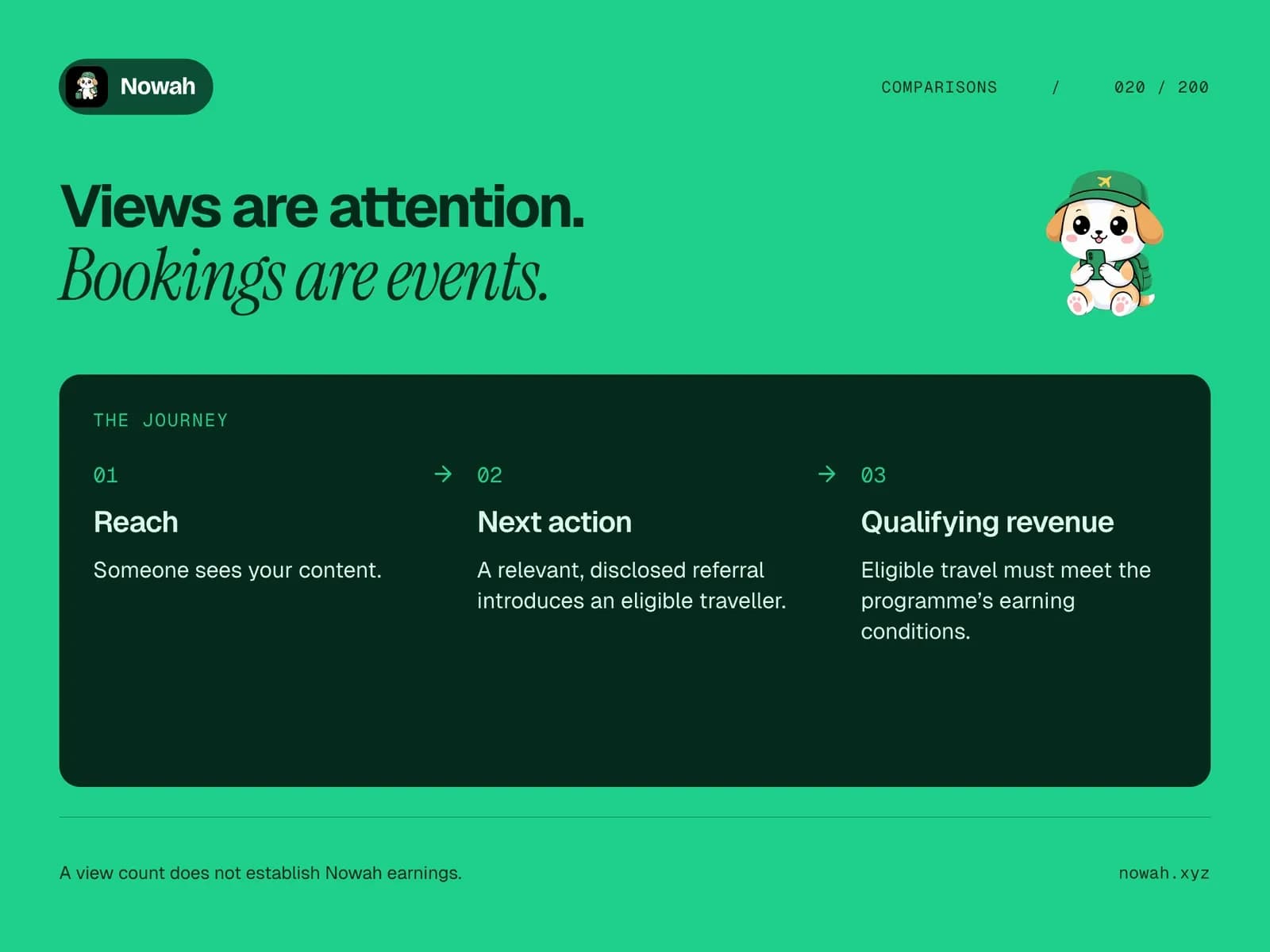
A travel video can attract attention without creating a qualifying booking. A useful recommendation can also reach a modest audience and help someone take a meaningful next step. For creators comparing platform payouts with Nowah commissions, the important difference is the event each earning model depends on.
The Nowah Partner Program offers approved partners 35% of Nowah net revenue from qualifying bookings by eligible attributed accounts. It is not a creator fund that pays for uploading content or collecting views. Its continuing account attribution gives creators a different opportunity: introduce an eligible new traveller through useful advice and potentially earn from that account's later qualifying travel.
This guide helps you define the relevant events, prepare a practical Nowah content example and keep actual earning evidence separate from audience attention. It does not estimate platform advertising rates or promise that any follower count will generate income.
Identify the model before comparing results
A platform payout depends on the current monetisation program and terms available to the creator. Eligibility, qualifying activity, revenue calculations and payment conditions vary. Check the actual program you participate in rather than treating every view as if it carries a universal cash value.
Nowah's commission model uses a different chain of events. Your content may introduce a traveller, but an eligible new account and qualifying booking conditions still matter. A view, like or saved post is not a Nowah commission event.
These models may exist within the same creator business, but their records should remain distinct. Do not describe a platform payment as proof that a Nowah recommendation converted, or treat a pending Nowah booking as advertising revenue.
A clear comparison begins by naming what happened. Only then can you assess what the relevant agreement says about earnings.
Choose a traveller question worth answering
A Nowah recommendation needs a practical reason for the audience to act. Start with a real recurring travel question or a clearly stated editorial hypothesis. “How would I organize a three-night break around a late arrival?” is more useful than an unexplained instruction to try an app.
Build the content around that question. Explain the relevant inputs, show a labelled planning example and identify what still needs current supplier verification. The earning explanation then supports a useful recommendation rather than replacing the content's purpose.
A small audience can still contain people with a specific travel need. Nowah advertises no minimum follower count, although applications are reviewed and eligibility requirements apply. Do not turn that fact into guaranteed approval or a prediction about a small account's income.
The follower-count versus travel-intent guide explores why audience size and a relevant travel decision should be considered separately.
Work through a fictional video example
Imagine a creator preparing a short educational video about choosing a base for a city break. The demonstration uses fictional details: two adults, three nights and an evening arrival. No actual viewer result or booking is being reported.
The video explains a location tradeoff and shows how the creator would organize the question in Nowah. It keeps current availability, room conditions and transport details subject to verification. The viewer can understand what they might adapt for their own trip.
If the creator is approved as a Nowah partner, they can provide the appropriate active partner route with a clear commercial disclosure. The recommendation's purpose is to help an eligible new traveller continue planning. Views alone do not establish attribution or earnings.
A platform monetisation program, if available to the creator, would need its own assessment under its actual terms. The example does not assume that the video qualifies for a platform payment or that either income route will produce a particular result.
Define the Nowah introduction accurately
An eligible traveller must follow your active Nowah partner link and create a new account within 30 days of the valid introduction. Tracking must successfully reach Nowah. Existing accounts, self-referrals and artificial accounts do not qualify.
Once established, attribution remains for that traveller account's lifetime and can apply to later qualifying hotel, flight and paid eSIM bookings. This continuing relationship is a meaningful strength for creators building useful evergreen travel content.
It is still not guaranteed repeat income. A viewer may not click, a click may not establish an eligible account and an account may never make a qualifying booking. Do not collapse these stages into a single claimed “conversion” without defining what you mean.
The clicks versus attributed accounts guide provides a useful supporting explanation. It helps distinguish an audience interaction from the recorded relationship required by the program.
Keep the earning formula attached to a qualifying booking
Approved Nowah partners receive 35% of Nowah net revenue from qualifying bookings by eligible attributed accounts. The current terms define the permitted direct deductions, excluding general overhead, salaries and general marketing from that deduction list.
For hypothetical arithmetic, a qualifying booking producing $60 of Nowah net revenue would yield a $21 partner share. This does not mean a video view, a link click or an attributed account is worth $21. The example illustrates a booking-level formula only.
The traveller's full retail booking price is not the base. Nor can a platform's advertising calculation be substituted for Nowah net revenue. Different earning models need their own inputs and evidence.
The commission-base communication guide is useful when an earnings graphic or caption needs review. Keeping the quantity visible is more persuasive than displaying a large percentage without its meaning.
Create a creator metric dictionary
Before reviewing results, write down the events you plan to discuss and the evidence required for each. Your dictionary might distinguish attention, understood recommendation, link interaction, eligible new-account attribution, qualifying booking and actual earning status.
Keep the definitions specific. Attention could describe a platform-reported view under that platform's definition. A question from a follower is qualitative feedback. An attributed account or booking needs the actual program evidence available to you. Do not assume Nowah supplies every possible analytics report or end-to-end measurement tool.
For each event, record where the evidence comes from and what it does not prove. A viewed post does not establish a booking. A booking event does not establish supplier settlement. A transferred amount is not automatically the same as a completed bank payout.
This dictionary is useful even if your available data is limited. It prevents an attractive number from being used to support a conclusion it cannot establish.
Review the content when attention does not lead further
If a video receives attention but little useful response, inspect the actual explanation and handoff before declaring that the program failed. Does the content answer a specific travel question? Is the Nowah demonstration understandable? Does the link go where the surrounding sentence says it goes?
Also check the actual platform surface. A blog link and a short-video description may behave differently. For example, YouTube's official guidance states that URLs in Shorts descriptions and comments are not clickable. A creator should not tell viewers to use a route that does not support the promised action.
Do not invent conversion improvements from making an edit. Treat a revised call to action as something to observe, with a defined goal and actual evidence collected later. The controlled CTA test guide explains how to keep a small experiment honest.
Separate pending earnings from received money
Nowah requires completed bookings and verified supplier settlement. A 30-day hold starts after the later event. Eligible monthly processing also depends on the separate currency threshold, verification and other current conditions.
Refunds, disputes and corrected supplier statements can affect earnings. A transfer to the connected Stripe account is distinct from a bank payout, with provider-dependent arrival. Keep those stages separate when discussing results publicly or reviewing your business records.
A platform payout needs its own treatment under the actual monetisation agreement. Do not combine a gross platform figure and a pending partner amount into a single cash-received claim without appropriate evidence and a consistent meaning.
The existing trust and AI booking article offers wider context for why clear evidence matters. An earning story should be as understandable as the travel recommendation that created it.
Build a Nowah recommendation with a clear purpose
Nowah gives creators a compelling alternative earning path to a model focused only on content attention. Its defined net-revenue share and continuing eligible account attribution connect the opportunity with useful traveller introductions and qualifying travel. That is a strong story to tell accurately, without promising that every viewer will become a buyer.
Choose one audience question, prepare a labelled demonstration and complete your metric dictionary. If the model fits your content, apply to Nowah Partners. Applications are reviewed, and approval, eligibility and verification requirements apply. Publish something useful, make the next step clear and assess each earning model through the events and records that actually belong to it.




