Designing Empty States for AI Products
When there is nothing to show, the AI starts a conversation. Empty states in AI products are greetings, not illustrations — the first moment of personality.
You open a traditional travel app for the first time. The trips screen shows an illustration of a suitcase with wings and the text "No trips yet. Start planning!" Below that, a big blue "Search" button. It is cute. It is also useless. The illustration communicates nothing about what the app can do. The button leads to the same search form you have seen on every travel site since 1997.
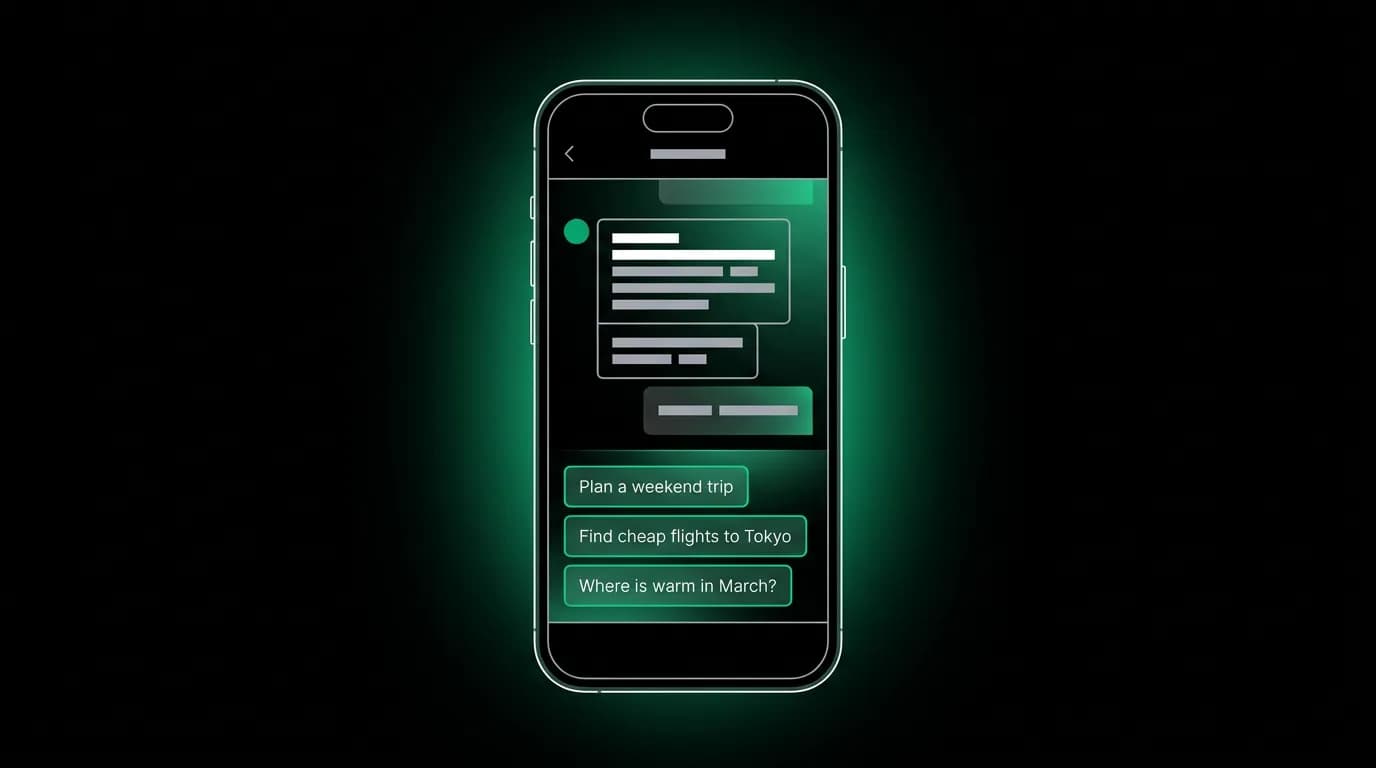
Now imagine opening an AI travel app for the first time. There is no illustration. There is no empty state in the traditional sense. Instead, there is a message from the AI: "Hi! I am here to help you plan and book travel. Where would you like to go?" Below that, three tappable prompt chips: "Plan a weekend trip," "Find cheap flights to Tokyo," "Where is warm in March?"
The screen is not empty. It is the start of a conversation.
AI products do not have empty states
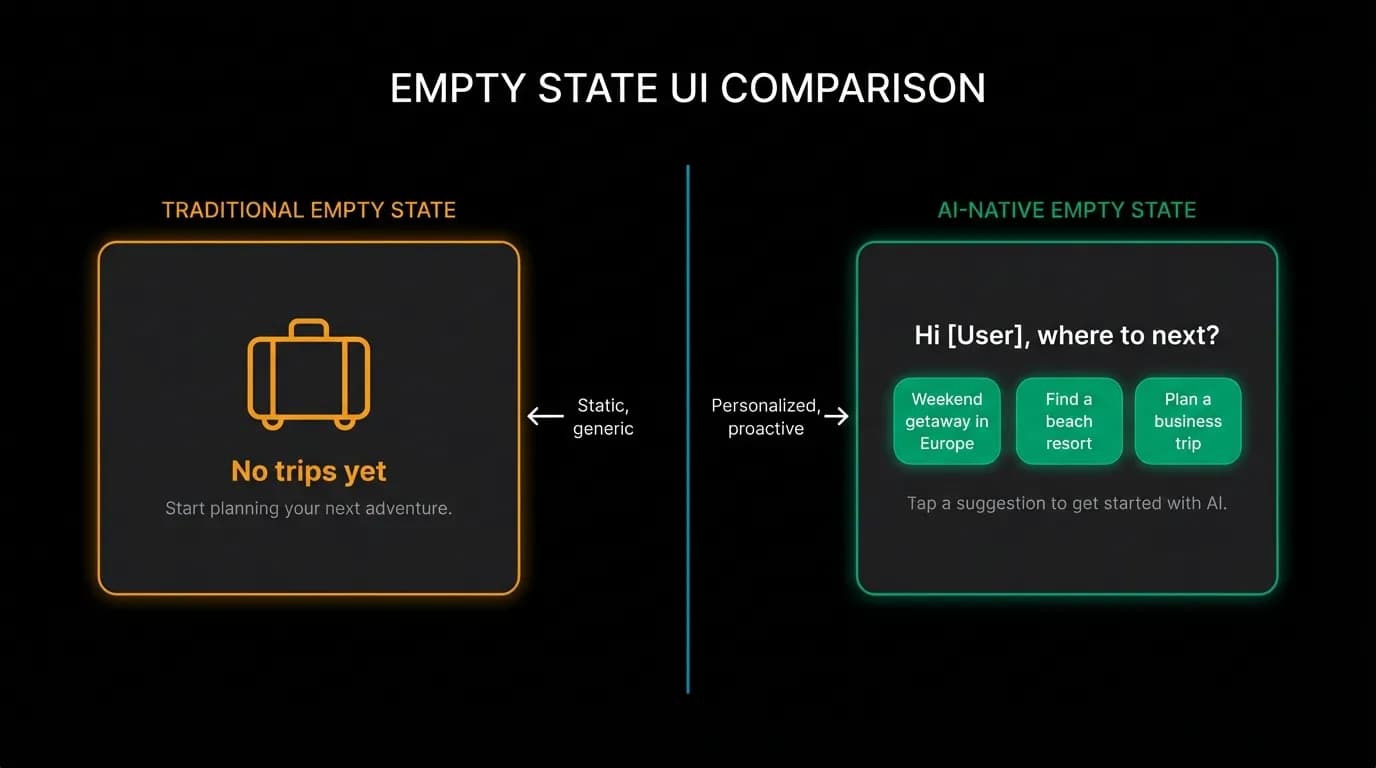
This realization reshaped how we think about first impressions. In a traditional app, an empty state occurs when a screen has no content to display — no trips, no messages, no results. The conventional design response is a placeholder illustration, a brief explanation, and a call-to-action button.
In an AI-first app, there is no such thing as an empty screen. Every screen can be populated by the AI. The trips tab before any trips are booked? The AI can greet the user and suggest starting a conversation. The chat screen before any messages? That is the AI's opening line. The documents tab before any documents exist? The AI can explain what documents will appear here and how to get started.
The AI's presence eliminates the concept of emptiness. Where traditional apps show a static illustration and wait for the user to act, AI apps initiate. They speak first. They set the tone of the relationship. The first message from the AI is not filler — it is the product's first act of service.
Designing the greeting
The AI's opening line carries disproportionate weight. It is the first thing a new user sees. It sets expectations for what the AI can do, establishes the conversational tone, and either motivates the user to engage or lets them close the app.
Our greeting follows three principles. Be warm but not performative. "Hi! I am here to help you plan and book travel" is direct and honest. It does not promise "I can do anything!" or "I will find you the best deals on earth!" Over-promising creates expectations that will be disappointed. Under-promising with specificity ("plan and book travel") creates confidence.
Invite action immediately. "Where would you like to go?" gives the user a clear next step. It is an open-ended question that respects whatever the user's level of planning might be — they might have a specific destination or they might have no idea. Either answer works.
Offer scaffolding for the uncertain. The suggested prompt chips below the greeting are for users who are not sure what to say. Typing into a blank text field with a blinking cursor can feel intimidating, especially when interacting with AI for the first time. The chips provide concrete examples that the user can tap to start the conversation without composing a message.
Suggested prompt chips as capability discovery
The prompt chips are not just conversation starters. They are a discovery mechanism for the AI's capabilities. Each chip represents a different category of request: trip planning-trip-planning-ai-shines) ("Plan a weekend trip"), flight search ("Find cheap flights to Tokyo"), and open-ended exploration ("Where is warm in March?").
By showing these three categories, the greeting implicitly teaches the user that the AI can handle structured requests, specific searches, and vague-but-valid questions. This is important because most users underestimate what an AI travel agent can do. Without examples, they might only ask simple questions and never discover the agent's ability to handle complex, multi-leg trip planning.
The chips rotate across sessions. A returning user might see different suggestions: "Continue planning your Tokyo trip," "Check flight prices for next month," "What are the visa requirements for Thailand?" The rotation keeps the greeting fresh and introduces new capabilities over time.
Contextual greetings
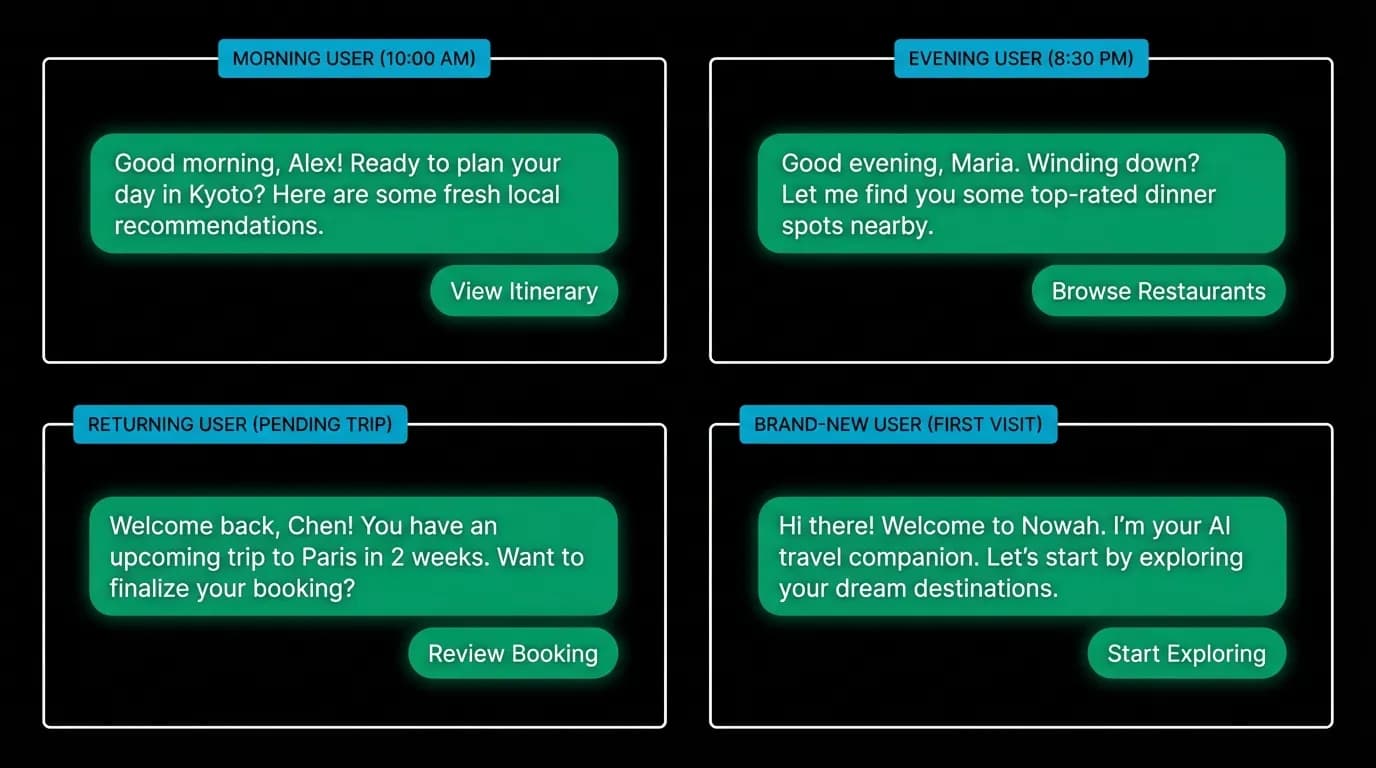
A greeting that ignores context feels robotic. We personalize the greeting based on what we know about the user and their situation.
Time of day matters. A morning greeting is different from a late-night greeting. "Good evening! Doing some trip research before bed?" acknowledges the reality of when most travel planning happens and creates a small moment of connection.
Returning users get context-aware greetings. If the user was researching flights to Barcelona yesterday and did not book, the greeting might reference that: "Welcome back! Want to pick up where we left off on those Barcelona flights?" This demonstrates that the AI remembers and cares about continuity.
Users with upcoming trips get trip-relevant greetings. "Your flight to London is in 5 days! Need help with hotel or activity planning?" This surfaces timely information without requiring the user to navigate to the trips tab.
New users get the clean, capability-introducing greeting. The AI does not pretend to know a user it has never met. The personalization builds over time, one conversation at a time.
What not to say
The greeting is also defined by what we avoid. "I can do anything!" sets up failure. There are things the AI cannot do, and the first time a user encounters a limitation after being promised omniscience, trust breaks.
"How can I help you?" without context is too vague. It puts the full burden of starting the conversation on the user. It does not demonstrate any capability or provide any scaffolding.
Long paragraphs of explanation are counterproductive. Users have an eight-second attention span for first impressions. A greeting that takes twenty seconds to read has already failed. Keep it to two sentences maximum, then let the prompt chips do the rest of the work.
The empty state is your product's first impression. In an AI product, it is not empty at all — it is the opening line of every conversation. Design it like you are meeting someone for the first time. Be warm, be specific, and make it easy for them to respond.
Nowah is an AI travel agent that searches and books real flights and hotels through conversation — no filters, no thirty open tabs. Plan your next trip.