The End of the Travel Search Box: A History
Travel agents to OTAs to metasearch to AI agents — each era solved the last era's problem while creating new ones. AI agents are the convergence point.
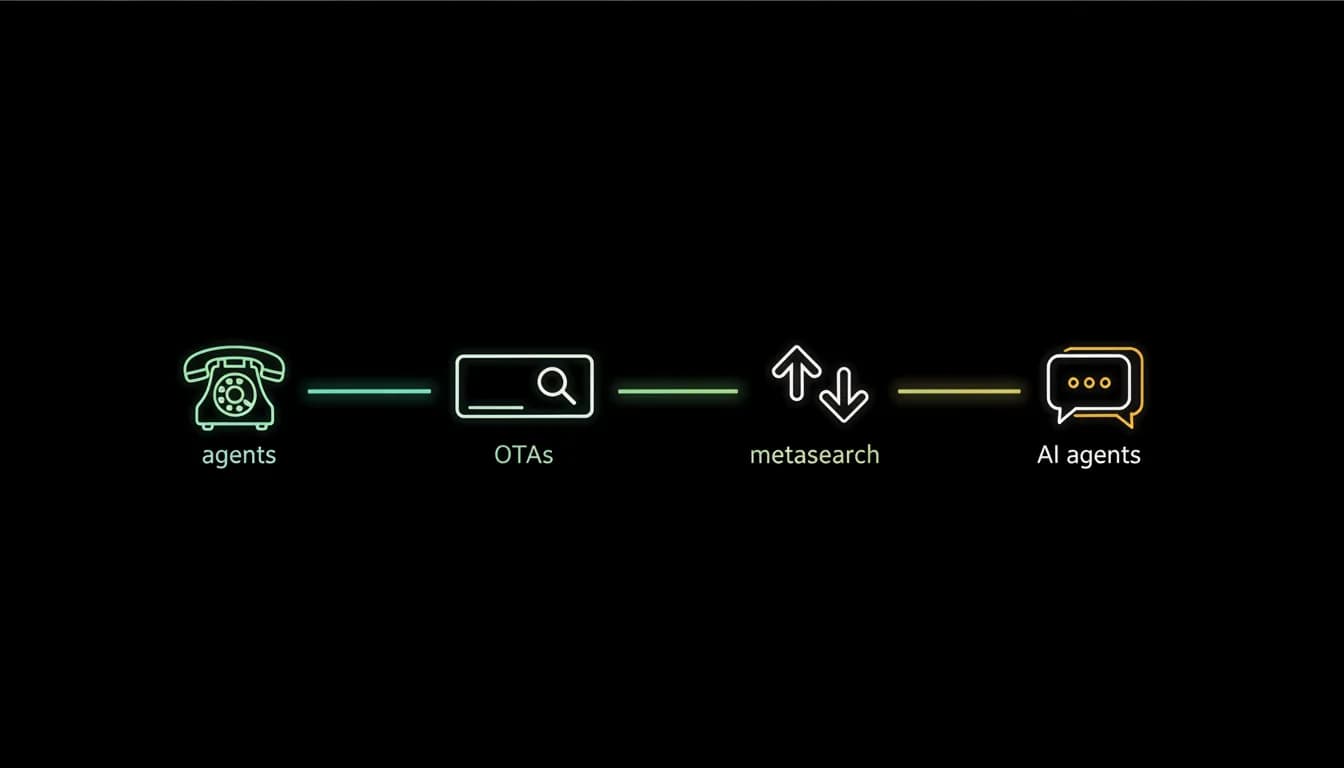
Every generation of travel booking technology believed it was the final form. Travel agents in the 1980s thought the phone-and-Rolodex model would last forever. OTA founders in the 2000s believed they had permanently disrupted the industry. Metasearch engines in the 2010s were certain they had solved the comparison problem. Each was right about the previous era's flaws and wrong about their own.
The history of travel booking is a history of problem-solving that creates new problems. Each era fixed what was broken in the previous one while introducing fresh limitations. AI agents represent something different: the convergence of personal service, universal access, and computational intelligence that resolves the trade-offs every previous era was forced to make.
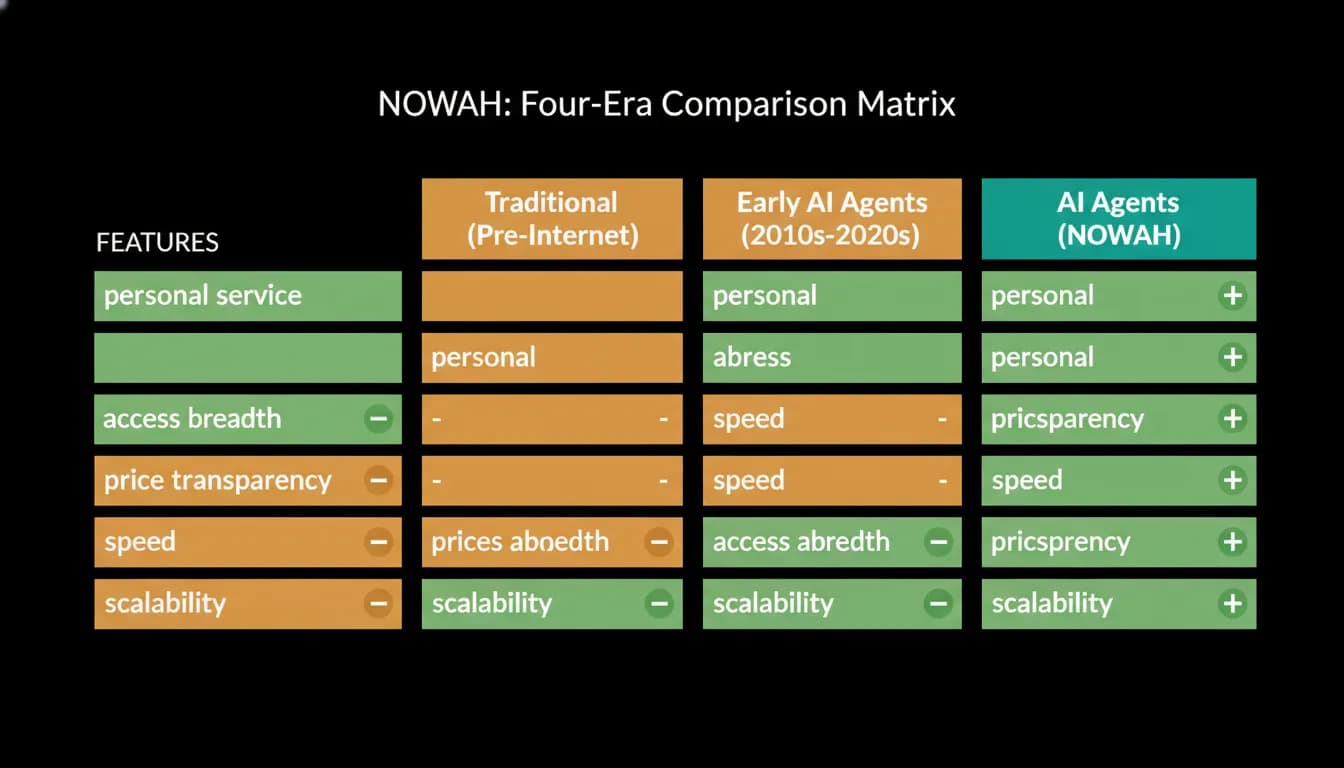
Era 1: Travel agents (1960s to 1990s)
The first era of modern travel booking was defined by personal relationships. A traveler called their agent, described the trip, and the agent handled everything: searching flights through a GDS terminal, calling hotels, arranging transfers, and assembling the itinerary. The traveler received a finished product — flights booked, hotels reserved, itinerary printed.
What it did well. Personal service. The agent knew your preferences. They remembered that you hated red-eye flights and preferred Marriott properties. Over time, they built a profile of who you were as a traveler and applied it to every booking. The experience was effortless for the traveler — describe what you want and let someone else handle the complexity.
What it did poorly. Access. The agent saw only the inventory available through their GDS terminal and their direct relationships. Pricing was opaque — the traveler could not easily compare fares across agents or verify they were getting the best deal. And the service was slow: booking required phone calls during business hours, and complex itineraries took days to assemble.
How it ended. The internet. When travelers could see prices themselves, the information asymmetry that justified agent commissions collapsed. Airlines cut agent commissions from 10 percent to zero between 1995 and 2005. The agent share of bookings fell from 75 percent to under 25 percent.
At its peak, the travel agent era generated over $100 billion in commissions annually. It was a massive industry that evaporated in less than a decade.
Era 2: OTAs (2000 to 2015)
Online travel agencies democratized access. For the first time, any traveler with an internet connection could search flights and hotels across multiple airlines and hotel chains, compare prices in real time, and book instantly.
What it did well. Transparency. You could see every flight on a route, compare prices, and book the cheapest option in minutes. The information asymmetry that had defined the agent era was eliminated. Prices dropped as competition became visible. Selection expanded as inventory from hundreds of airlines and thousands of hotels was aggregated on single platforms.
What it did poorly. Everything the agents did well: personalization, curation, and managing complexity. OTAs replaced personal service with self-service. Instead of describing your trip and receiving a curated recommendation, you entered parameters into forms, scrolled through hundreds of results, and made your own decisions. The cognitive burden shifted entirely to the traveler.
The form-based interface also struggled with complexity. Multi-city trips, group bookings, mixed-carrier itineraries, and preference-heavy travelers all found the OTA interface inadequate. The solution was always the same: more filters, more sort options, more results. This addressed complexity with volume, which exacerbated choice overload.
How it is ending. The OTA model optimized for conversion and advertising revenue, which misaligned its recommendations with traveler interests. Dark patterns, hidden fees, and advertising-driven rankings eroded trust. AI agents that serve the traveler's interest rather than the advertiser's interest are pulling market share.
Era 3: Metasearch (2010 to 2022)
Metasearch engines addressed a specific OTA limitation: you could not compare prices across OTAs without visiting each one individually. Metasearch aggregated the aggregators, showing the same flight or hotel priced across multiple booking platforms.
What it did well. Comparison. For the price-sensitive traveler, metasearch delivered a clear answer to "where is the cheapest place to book this flight?" The comparison was fast, comprehensive, and genuinely useful for price validation.
What it did poorly. Everything else. Metasearch added another layer of indirection to the booking process. You searched on the metasearch engine, clicked through to an OTA or airline site, re-entered your details, and completed the booking on a completely different platform. The comparison was useful but the experience was fragmented.
Metasearch also could not handle complexity. It compared simple point-to-point searches effectively but fell apart on multi-city trips, mixed carriers, and preference-heavy bookings. And it offered zero personalization — the comparison was entirely price-driven.
How it is ending. AI overviews in search engines are cannibalizing the top-of-funnel discovery that metasearch depends on. AI agents that compare across platforms while completing the booking in one place eliminate the need for comparison-then-redirect. Metasearch market share is declining from approximately 10 percent and projected to fall to 5 to 7 percent by 2028.
Era 4: AI agents (2024 onward)
AI agents represent the convergence point where every previous era's strengths combine and every era's weaknesses are addressed.
Personal service at scale. Like human agents, AI agents know your preferences, remember your history, and curate recommendations based on who you are. Unlike human agents, they serve millions of travelers simultaneously without waitlists, business hours, or per-booking fees. The personal touch of the agent era returns, powered by agentic memory and conversational interfaces.
Universal access and transparency. Like OTAs, AI agents search across hundreds of airlines and thousands of hotels. The inventory breadth that made OTAs revolutionary is preserved. Pricing transparency remains. The traveler sees what is available and what it costs.
Comparison without fragmentation. Like metasearch, AI agents compare across booking channels. Unlike metasearch, they complete the booking in the same interface. No redirect. No re-entering details. The comparison and the transaction happen in one place.
Complexity handling. Unlike any previous era, AI agents handle natural language complexity natively. "Four of us want to visit three cities in Southeast Asia for two weeks, flexible on which cities, budget of $2,000 per person, want a mix of beach and culture." No form, no filter set, no multi-site comparison can process this. A conversational AI agent handles it directly.
What it does poorly (today). AI agents in 2026 are still early. Inventory coverage, while broad, is not yet universal. Edge cases — complex corporate travel policies, obscure routing, ultra-specialized travel segments — sometimes exceed the agent's capability. And the trust relationship is new: travelers are still learning what AI agents can and cannot do.
These limitations are narrowing rapidly. But intellectual honesty requires acknowledging that AI agents today are not yet the perfected final form. They are, however, the first booking paradigm that addresses every major limitation of every previous era simultaneously.
The pattern
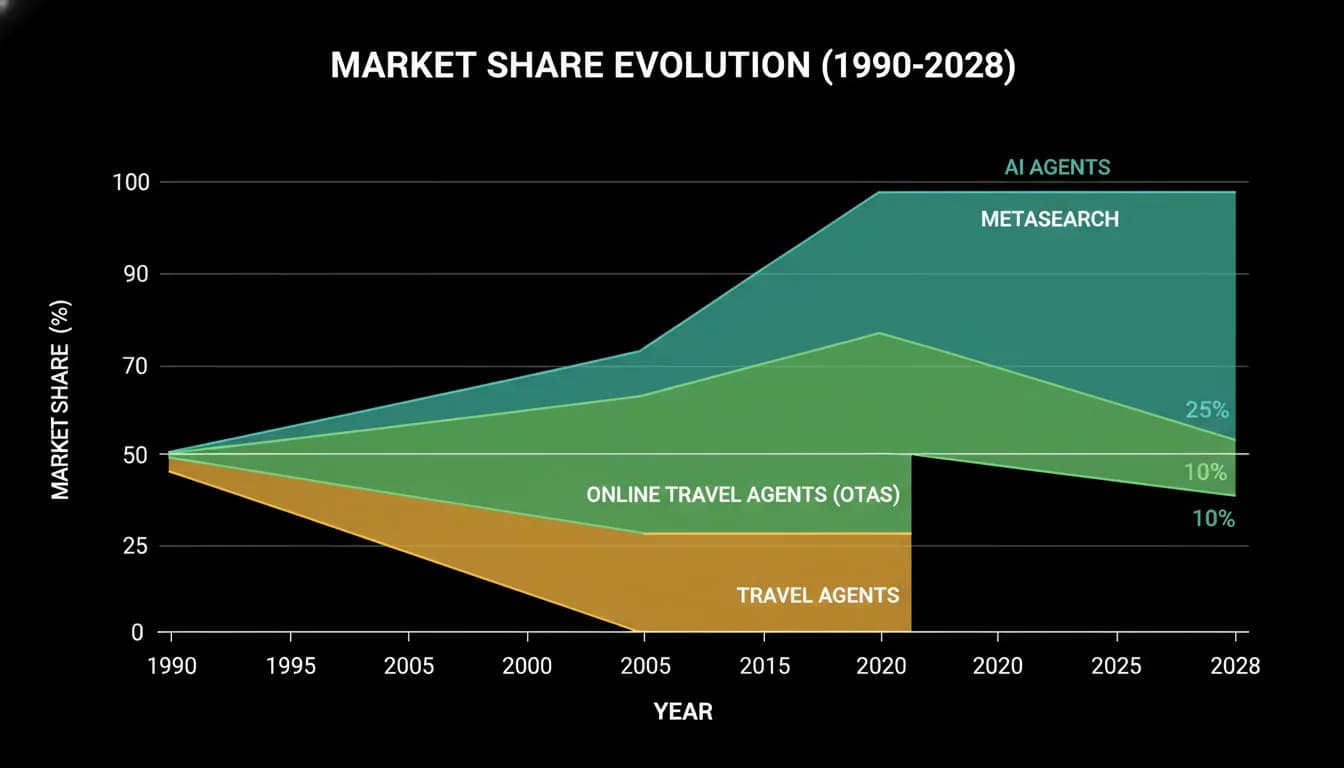
Each era solved the last one's problem while creating a new one.
Agents provided personal service but lacked transparency. OTAs provided transparency but lacked personal service. Metasearch provided comparison but lacked booking completion. AI agents provide all three — personal service, transparency, and seamless execution — without the trade-offs.
Whether AI agents create their own new problems remains to be seen. Every previous era's innovators believed they had reached the final form. The pattern suggests humility. But the structural argument is compelling: AI agents are the first travel booking paradigm that does not require the traveler to sacrifice one dimension of value to gain another.
The search box had a 25-year run. It served its purpose. The era that follows does not search — it understands, recommends, and acts.
Nowah is an AI travel agent that searches and books real flights and hotels through conversation — no filters, no thirty open tabs. Plan your next trip.