What We Learned From Our First 1,000 AI Travel Conversations
Users ask in ways we never predicted, trust builds faster than expected, and the gap between what people type and what they mean is massive.

When we launched Nowah's AI travel agent to our first users, we had a lot of hypotheses about how people would use it. We were wrong about most of them.
Not catastrophically wrong. The core thesis held: people want to book travel through conversation, and an AI agent that actually searches and books is better than a chatbot that just talks. But the details, the specific ways people phrase things, the order in which they share information, the moments where trust forms or breaks, the edge cases that seem obvious in retrospect but were invisible in advance, all of that surprised us.
We went through our first thousand conversations with a fine-toothed comb. Here's what we found.
Common conversation patterns
We expected people to start conversations like search queries. "Flights to London, May 15, two passengers, economy." Structured. Explicit. Clear.
Some people do this. Maybe 15-20%. Mostly frequent business travelers who are used to search forms and have been trained to think in airport codes and exact dates.
The rest start much more loosely. And the variety is staggering.
The most common opening pattern is what we call the "vague intent." Something like "I want to go somewhere warm in March" or "thinking about a trip to Europe this summer." No destination (or a continent-sized one). No dates (or a month-long window). No budget. No party size. Just a feeling and a rough direction.
The second most common is the "occasion-driven" opener. "My wife's birthday is in April, want to do something special" or "we have a long weekend coming up and want to get out of the city." The occasion is the anchor, not the destination or dates.
The third is the "constraint-first" pattern. "I only have five days off" or "budget is $1500 max" or "needs to be somewhere my five-year-old won't be miserable." The constraint comes before any destination or date information.
These patterns tell you something important about how people think about travel. They don't think in structured queries. They think in feelings, occasions, and constraints. The destination is often the output of the planning process, not the input.
Surprising use cases
We built an AI travel agent that searches flights and books hotels. Users decided it was also a visa expert, a packing assistant, a restaurant recommender, a currency advisor, and a travel therapist.
Within the first hundred conversations, someone asked the AI to help them decide between two completely different trip concepts: a beach vacation in Mexico versus a city trip to Tokyo. Not "search for flights to Cancun." But "help me figure out which trip is right for me given that I haven't taken a real vacation in two years and I can't decide between relaxing on a beach and having an adventure."
We had users ask about the safest neighborhoods in specific cities. About whether their toddler needed their own plane seat. About whether a 55-minute layover at Heathrow was enough (it isn't). About whether they should feel guilty taking a vacation when work was busy.
The common thread is that users treat the AI agent like they'd treat a knowledgeable friend. They don't segment their questions into "booking queries" and "life advice." The conversation flows naturally between logistical ("what's the cheapest way to get to Bali?") and personal ("is Bali worth it, or should I just go to Thailand again?").
This had direct product implications. We expanded the agent's tool set to handle a wider range of travel-adjacent queries. Not because we planned to, but because users showed us what they actually needed. Visa requirements, weather data, currency conversion, safety information, these all became core capabilities because users asked for them in the natural flow of booking conversations.
The language gap
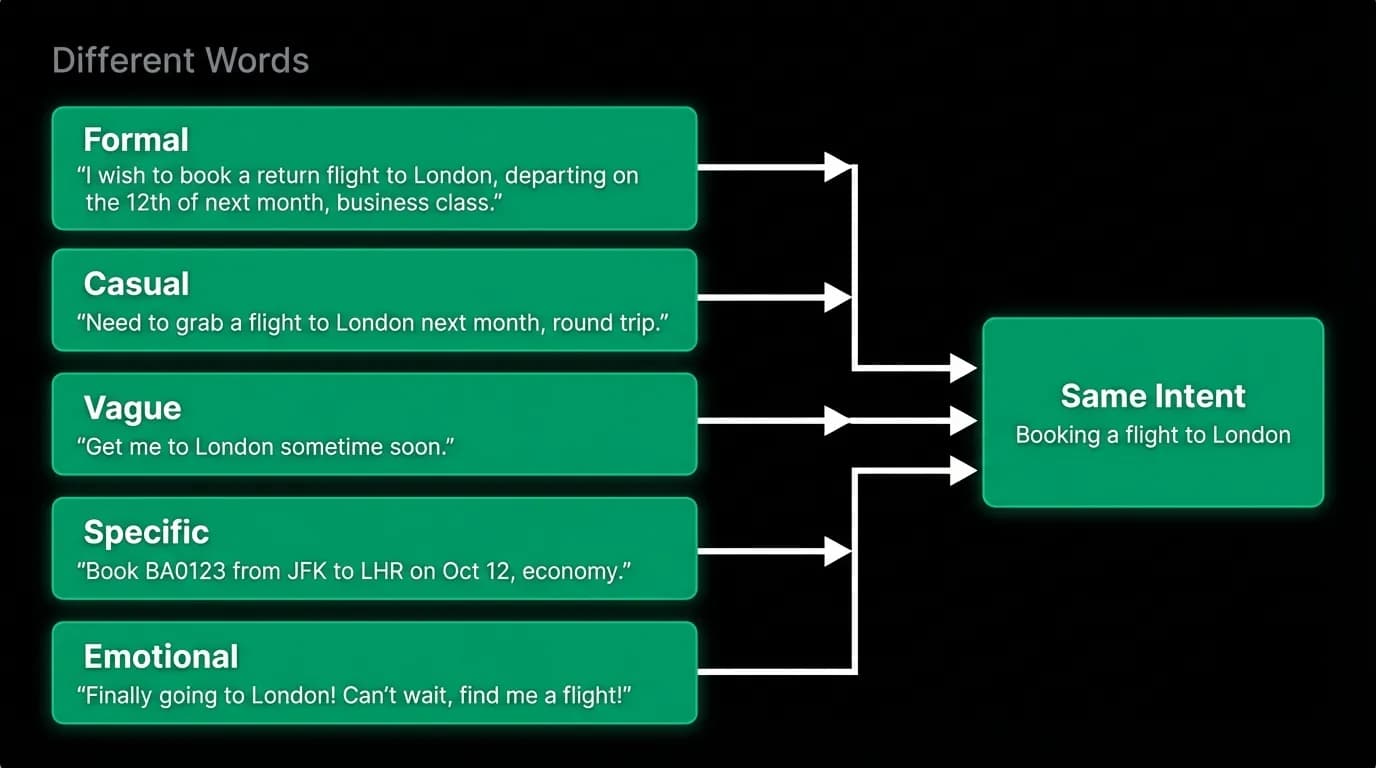
The single most surprising finding was how differently people describe the same thing.
Take a simple intent: booking a flight from New York to London in June. Here are real variations we saw:
"I need to fly to London next month." "What's the cheapest way to get to the UK?" "JFK to Heathrow, June 10 to June 17." "I'm thinking about going to England. Like, London area." "My friend invited me to visit her in London. I've never been." "Need to get across the pond in June lol."
Same basic intent. Wildly different expressions. Some provide precise data (airport codes, exact dates). Some provide almost none (no city, no dates, no airports). Some include emotional context (never been, friend invited me) that isn't directly relevant to the search but is relevant to the experience.
The language gap extends to preferences. "Reasonable" means $400 to one user and $1200 to another. "Quick" means nonstop to some and under six hours to others. "Nice hotel" could be a Marriott or a one-room guesthouse depending on the speaker.
This gap is why search forms and filters are such poor interfaces. They require a specific, structured vocabulary. Real human language is ambiguous, contextual, and highly individual. An AI agent that handles the full range of human expression delivers a fundamentally different experience than a product that requires airport codes and exact dates.
The trust curve
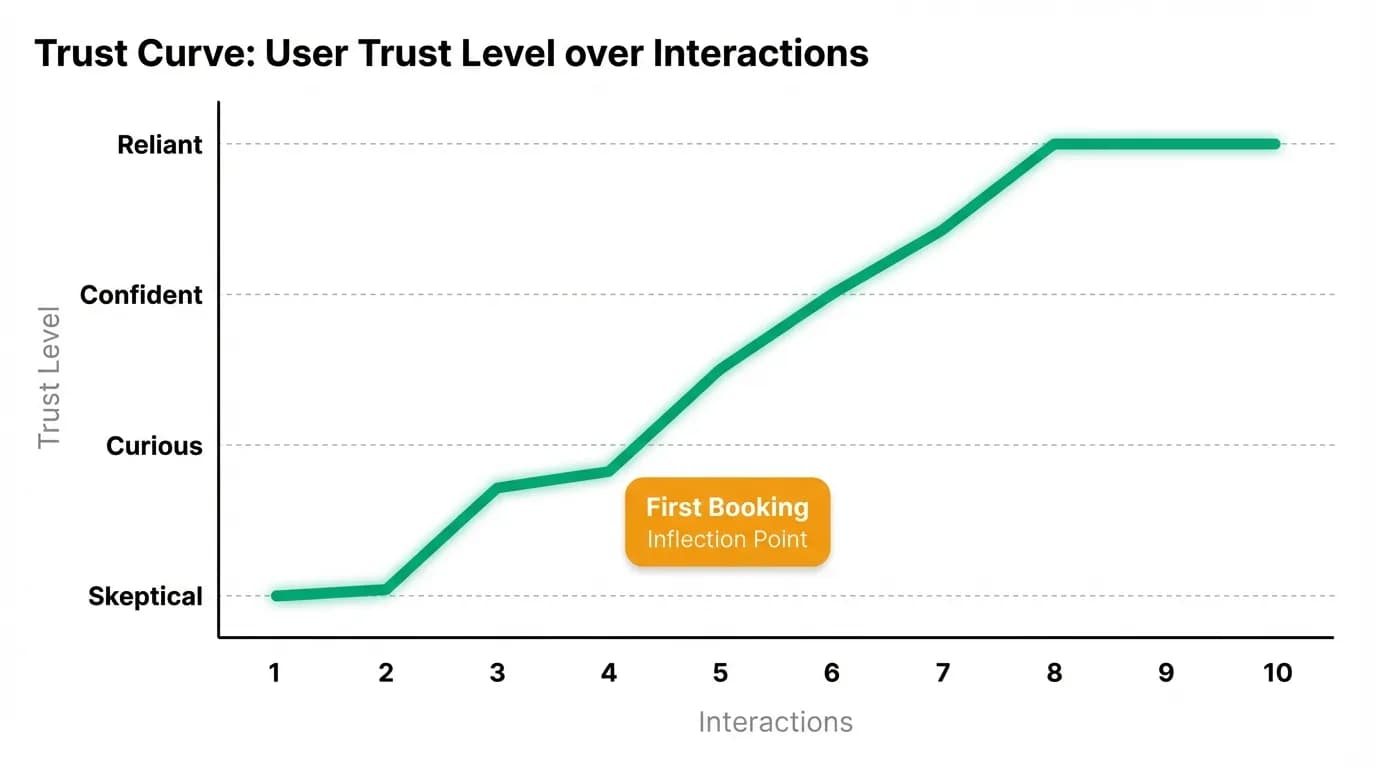
We hypothesized that trust would build slowly. Users would test the AI with simple questions, evaluate the quality, and gradually trust it with higher-stakes tasks like booking.
The actual trust curve was steeper than we expected. Much steeper.
The inflection point is the first successful interaction. When a user asks for flights and the AI returns real, accurate, bookable options with reasonable prices, trust jumps dramatically. The response we saw most often was something like "wow, these are actually real flights." The bar was so low (because most travel chatbots can't actually search inventory) that simply returning real results built significant trust.
The second inflection point is the first completed booking. After a user books successfully through the AI and receives their confirmation, their behavior changes. They stop testing and start relying. Subsequent conversations are more natural, more trusting, and faster. They share preferences earlier. They ask for recommendations more boldly. They skip the verification behaviors (like checking prices on Google Flights) that characterized their early interactions.
By the third or fourth interaction, users who had booked at least once were treating the AI like a trusted advisor. "Just find me something good" became a common request. That level of delegation, telling the AI to make the choice rather than presenting options, was something we didn't expect to see until much later.
The trust timeline from skeptical to reliant was measured in interactions, not months. For users who had a positive first booking experience, the transition happened within three to five conversations.
When conversations go sideways
Not everything went well. About 12% of our first thousand conversations hit some kind of failure. Understanding these failures was more valuable than understanding the successes.
The most common failure mode was the "overambiguous query." When a user says something so vague that the AI can't even form a meaningful follow-up question, the conversation stalls. "Help me plan something" with no context about who, where, when, or why. The AI would ask a follow-up, the user would give an equally vague answer, and both sides would dance around in circles.
The second most common was the "expectation mismatch." Users who expected the AI to have access to information it didn't have. "What was the price of that British Airways flight I looked at yesterday on Google Flights?" The AI has no access to the user's browsing history on other platforms. But the user expected it to, because "AI should know things."
The third was "scope overflow." Users who tried to plan an extremely complex trip in a single conversation. Three countries, four cities, eight flights, different travelers on different legs, specific hotel requirements for each city, plus activities and restaurants. The conversation became unwieldy. The AI would handle each piece but lose track of the overall picture as the complexity grew.
Each failure category led to specific product improvements. For over-ambiguous queries, we improved the AI's ability to ask structured but friendly clarifying questions. For expectation mismatches, we added better framing about what the AI can and can't access. For scope overflow, we implemented better conversation state management to track complex trips without losing context.
Product changes driven by conversation data
Real conversations drove specific product changes that we never would have made from the drawing board.
The "why" matters. We noticed that users who shared the reason for their trip ("it's our anniversary," "I have a work conference," "I need to attend a funeral") received better recommendations because the AI could factor in the emotional and practical context. We started training the agent to gently ask about the occasion when it wasn't offered, not every time, but when it would meaningfully improve the recommendation.
Price context is non-negotiable. Users consistently responded better when the AI provided context for prices. "This is $450" is data. "This is $450, which is about $80 below the average for this route in June" is information. The addition of price context reduced the "let me check Google Flights" behavior by a meaningful margin.
Three options is the right number. We experimented with showing two, three, four, and five options. Three was consistently the sweet spot. Two felt limited ("is that all?"). Four and five introduced comparison fatigue. Three allowed a clear mental model: the budget option, the best option, and the balanced option.
Voice users are different. Users who spoke their requests instead of typing them used longer, more natural sentences. They provided more context. They were more emotional. And they converted at a higher rate. Speaking removes the compression that typing imposes. Instead of "flights to Rome, March," voice users say "I want to plan a trip to Rome, probably sometime in March, maybe around the middle of the month. My partner and I have always wanted to go." That's dramatically more useful input.
Returning users skip straight to booking. First-time users explore. They test. They ask questions. By the third visit, users who had previously booked barely explored at all. They stated their need, picked from the options, and booked. The entire conversation might be ten messages long. This told us that the product's value proposition compounds with usage, which has important implications for retention and lifetime value.
The feedback loop
Every conversation teaches the agent something. Not just about the individual user (though preferences and patterns are captured), but about how people talk about travel, what they value, and where the product falls short.
This creates a compounding advantage. An AI agent that has processed a thousand conversations handles the next thousand better. Ambiguous phrasings that caused confusion are now handled smoothly. Common failure modes have been addressed. The agent's understanding of how people express travel intent deepens with every interaction.
This feedback loop is the structural advantage of conversational AI over form-based search. A search form never improves its understanding of user intent because intent is compressed into structured fields that strip away all the useful information. A conversation captures the full richness of what the user wants, including the parts they didn't explicitly state, and uses that richness to improve.
We review conversations weekly. Every week, we find new patterns, new edge cases, and new opportunities. The product today is meaningfully better than it was a thousand conversations ago. And the product a thousand conversations from now will be meaningfully better than today.
That's the real lesson from our first thousand conversations. Not any single insight or metric, but the realization that a conversational product has a learning rate that a traditional product can't match. Every conversation is a training signal. Every booking is a validation. Every failure is a lesson. And the cycle never stops.
Building a travel product that talks to users instead of presenting forms to them isn't just a different interface. It's a different relationship with your user base, one where the product gets smarter every single day because every single interaction teaches it something new about what travelers actually want.
Nowah is an AI travel agent that searches and books real flights and hotels through conversation — no filters, no thirty open tabs. Plan your next trip.