Hotel Booking Is Even More Broken Than Flight Booking
Hotels have more subjective variables, manipulated photos, and useless filters. AI that synthesizes reviews and understands neighborhoods changes everything.

Flight booking gets most of the criticism. Dozens of websites, decision fatigue, low-single-digit conversion rates, the whole familiar litany. But I'll argue that hotel booking is actually worse. Significantly worse. And the reason is that hotels are a fundamentally harder product to shop for online.
A flight is mostly objective. It has a departure time, an arrival time, a price, a number of stops, and an airline. These are facts. You can compare two flights on a spreadsheet and reach a reasonable conclusion about which is better for you.
A hotel is mostly subjective. It has a price, sure. But everything else that matters, the location relative to where you want to be, the actual room quality versus the photos, the noise level, the vibe, the neighborhood safety, the walkability, is subjective, contextual, and incredibly hard to evaluate through a listing page.
The tools we have for booking hotels were designed for the objective parts. They sort by price and star rating. They filter by amenities. They show photos that the hotel carefully curated to look as flattering as possible. They display a map pin that tells you where the hotel is but nothing about what that location actually feels like.
AI can do what listing pages can't: synthesize thousands of reviews into honest assessments, understand neighborhoods spatially and culturally, and match subjective preferences to subjective qualities. This is where AI booking goes from useful to transformative.
Hotels have more subjective variables than flights
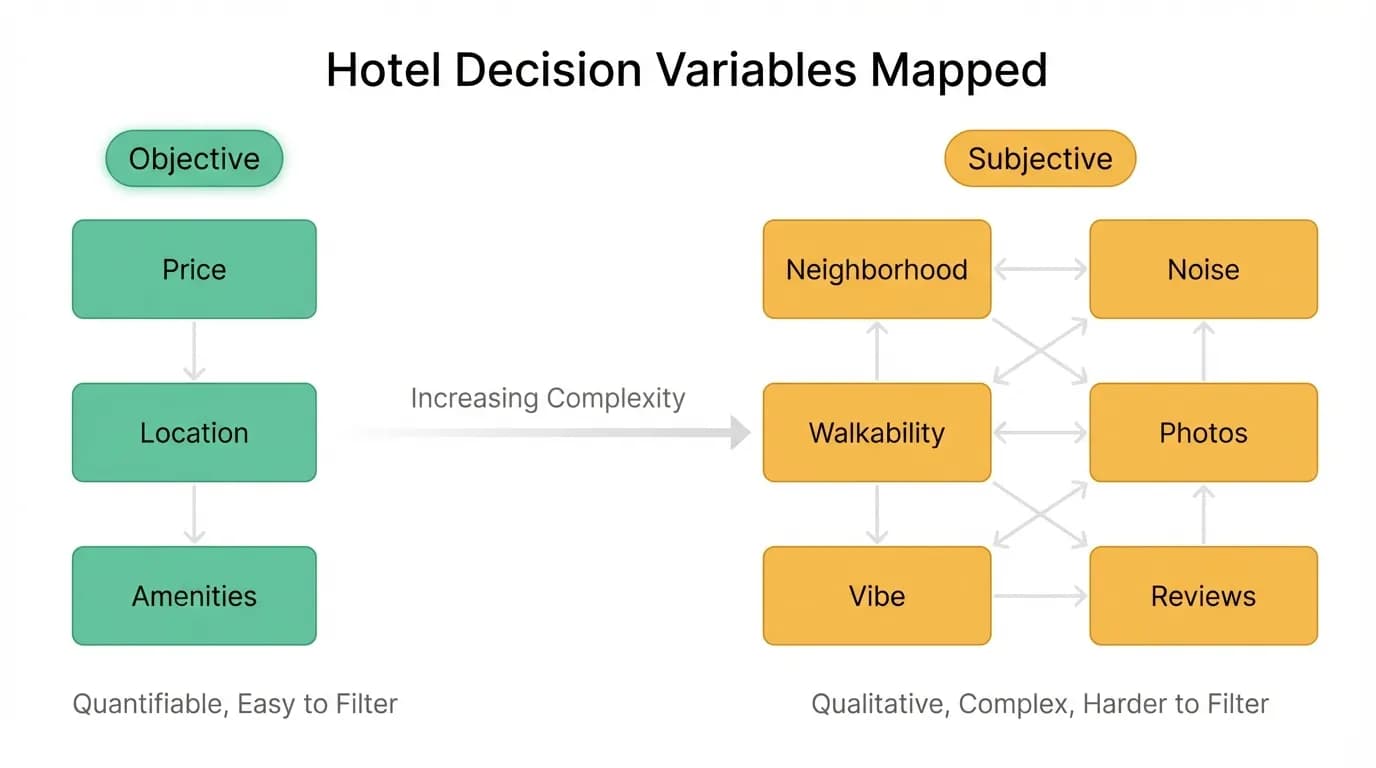
Let me lay out the decision dimensions for a hotel and compare them to flights.
For flights, you're evaluating maybe six or seven dimensions: price, departure time, arrival time, duration, number of stops, airline, and baggage. These are all quantifiable. You can put them in a table and compare directly.
For hotels, the dimension list is much longer and much fuzzier: price, location quality, room quality, noise level, cleanliness, bed comfort, neighborhood vibe, walkability to restaurants and attractions, proximity to public transit, staff friendliness, breakfast quality, check-in experience, WiFi reliability, actual room size versus photos, view quality, building age, maintenance level, smell (yes, smell matters), and the general "feel" of the place.
Most of these dimensions don't appear in any filter or structured data field. They exist only in reviews, and even there they're scattered across hundreds or thousands of individual opinions that often contradict each other.
A hotel that one guest describes as "charming and intimate" another guest describes as "small and cramped." Both are telling the truth. The hotel is small. Whether that's good or bad depends entirely on what you're looking for. No star rating or amenity list captures this.
The photo manipulation problem
Hotel photos are the single most unreliable data source in all of e-commerce. Every traveler knows this. Every traveler has experienced the disconnect between the glossy wide-angle photo on the listing page and the actual room they walked into.
Hotels hire professional photographers who use wide-angle lenses that make rooms look 30-40% larger than they are. They shoot on the brightest day of the year. They stage the room with fresh flowers and crisp linens that won't be there when you arrive. They photograph the one renovated room and use those photos for all rooms, including the unrenovated ones on the highway side of the building.
The "sea view" is technically accurate if you lean over the balcony and look 90 degrees to the left. The "spacious bathroom" is spacious compared to an airplane lavatory. The "lush garden" is a potted plant by the parking lot.
This isn't a minor annoyance. It's a systemic trust problem. When photos can't be trusted, the entire visual basis for hotel comparison breaks down. Users are forced to rely on other signals, primarily reviews, to figure out what a hotel is actually like.
But reviews create their own problems.
The review paradox
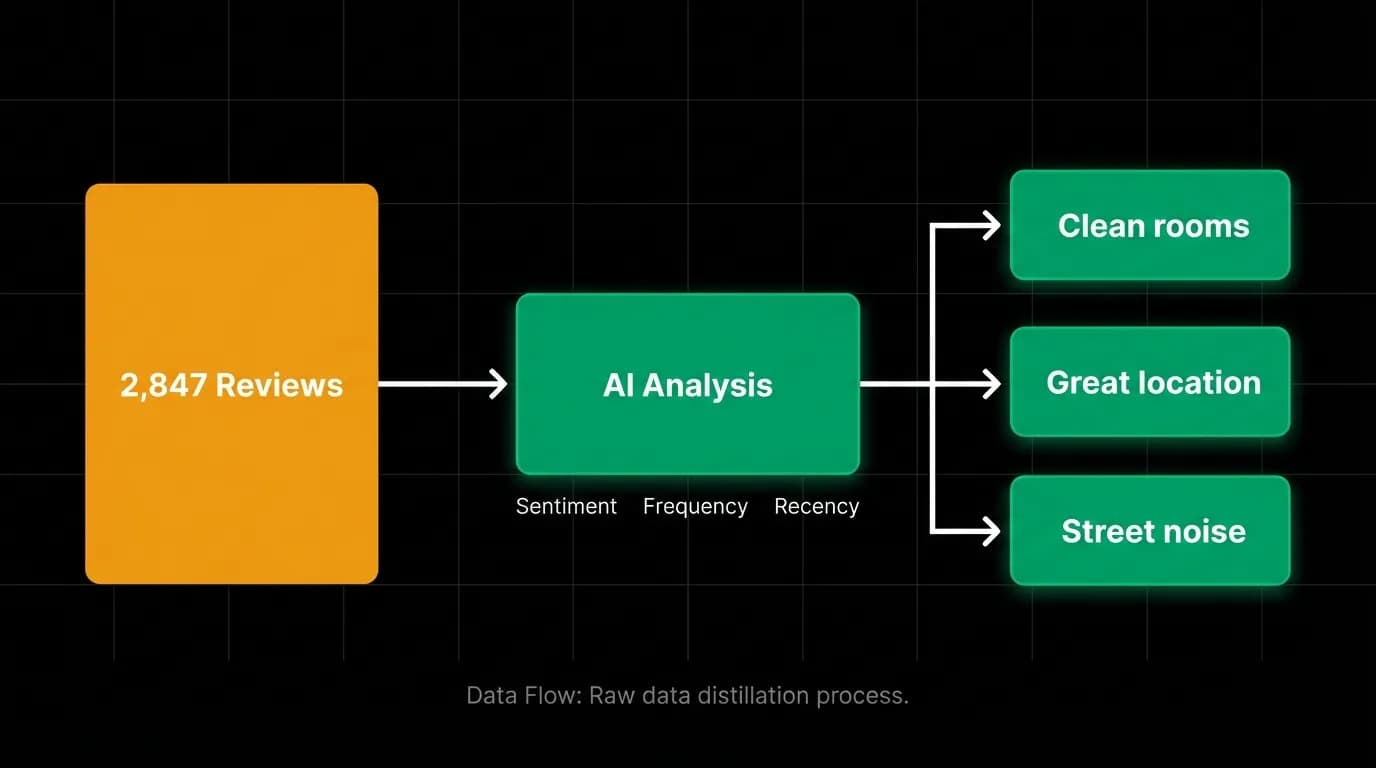
About 72% of travelers read reviews before booking a hotel. Reviews are the primary trust signal. But reviews are also deeply flawed as a decision-making tool.
The volume problem is real. A popular hotel in a major city might have 3,000+ reviews. Nobody reads all of them. Most people read the first five or ten, which are usually the most recent or the most extreme. This creates a recency bias and an extremity bias. You see the guest who had a terrible experience last week and the guest who thought it was the best hotel in the city. You miss the 2,500 reviews in the middle that say "it was fine, decent location, rooms are a bit small."
Reviews also suffer from the preference mismatch problem. A 25-year-old solo backpacker and a 55-year-old couple have completely different criteria for a good hotel. The backpacker gives five stars because it's cheap and social. The couple gives two stars because it's noisy and basic. Both reviews are accurate for their context, but if you're planning a family trip, neither is directly relevant.
The aggregation problem compounds everything. A hotel with a 4.2 rating and a hotel with a 4.0 rating: is that a meaningful difference? It depends on what's driving the numbers. If the 4.0 hotel gets dinged on breakfast but excels at room quality and location, it might be the better choice for someone who never eats hotel breakfast. The single number hides everything that matters.
Traditional platforms give you the aggregate rating and let you scroll through reviews. This is a lot of work for the user and produces inconsistent results depending on which reviews they happen to read.
Location context that filter sidebars can't provide
"Walking distance from the city center." What does this mean? In Paris, the city center is vaguely around the 1st and 4th arrondissements, but the best neighborhoods for visitors might be Saint-Germain-des-Pres or Le Marais, which are "center" but in very different ways. In Tokyo, there is no single center. Shinjuku, Shibuya, Asakusa, and Ginza are all "central" but serve completely different travel purposes.
Hotel filter sidebars offer "distance from city center" as a number of kilometers. This tells you almost nothing useful. A hotel 2 km from the "center" of Rome could be in a quiet residential neighborhood with great restaurants and a metro stop nearby, or it could be on a busy highway with nothing around it. Same distance. Completely different experience.
What travelers actually need is spatial context. Is this hotel in a walkable neighborhood? Are there restaurants and cafes nearby? Is the area safe at night? Is it easy to get to the main attractions from here? How noisy is the street? Is there a metro stop close?
This kind of information exists, but it's scattered across Google Maps, TripAdvisor forums, travel blogs, and review comments. No hotel booking platform aggregates it into a usable format. The map pin tells you where the hotel is. It tells you nothing about what it's like to be there.
AI review analysis
AI changes the review problem fundamentally. Instead of leaving the user to read ten reviews and form an impression, the AI can analyze all 3,000 reviews and synthesize the patterns.
"Guests consistently praise the location, calling it a 7-minute walk to the main square. Room cleanliness is rated highly across recent reviews. The most common complaint is street noise, mentioned in about 15% of reviews, particularly for rooms facing the main road. Breakfast gets mixed reviews, with several guests noting limited options."
This synthesis is more accurate and more useful than any number of individual reviews. It identifies patterns. It quantifies sentiment. It flags issues with proportionality (street noise in 15% of reviews is worth noting but not a dealbreaker). And it takes seconds instead of the twenty minutes you'd spend scrolling through reviews yourself.
The AI can also personalize the synthesis. If it knows from your preferences that noise is important to you (maybe you mentioned being a light sleeper), it can weight that factor higher: "This hotel has some noise complaints. Based on your preference for quiet rooms, you might want to request a courtyard-facing room or consider this alternative that's consistently described as quiet."
No booking platform does this today. Booking.com shows review scores broken down by category (cleanliness, location, etc.) but doesn't synthesize the qualitative content. TripAdvisor shows reviews chronologically with some filtering options but doesn't analyze patterns across thousands of reviews. The AI's ability to process and synthesize unstructured text at scale is what makes hotel recommendations genuinely useful for the first time.
Preference matching through conversation
"I want a boutique hotel, walkable to restaurants, in a quiet neighborhood, with a good bed."
Try turning that into filter selections. Boutique? Not a standard filter. Walkable to restaurants? Not a standard filter. Quiet? Definitely not a standard filter. Good bed? You wish.
This is a perfectly reasonable set of preferences that describes exactly what the traveler wants. And no existing hotel search platform can process it. You'd have to manually check each criterion across individual listings, reading reviews for bed quality, checking maps for restaurant proximity, and guessing at noise levels from photos that show the room but never the street outside.
In a conversation with an AI agent, this is a single sentence that produces a targeted search. The AI knows what "boutique" means (small, independently operated, design-focused). It can check walkability from map data. It can assess noise from review analysis. It can check bed quality from guest feedback.
The conversation also allows for iterative refinement that mirrors how people actually think about hotels. "Actually, I'd be okay with a larger hotel if it has a really good pool." "Can you find something closer to the beach?" "What about this neighborhood I read about on a blog?" Each refinement narrows the options naturally, through dialogue rather than through manipulating filter dropdowns.
How Booking.com and TripAdvisor approach hotel search
Booking.com and TripAdvisor represent two different strategies for the hotel search problem, and both fall short.
Booking.com is transaction-first. Its strength is inventory and conversion. The listing pages are masterfully designed to push you toward a booking: urgency signals, scarcity indicators, price comparisons, and progressive disclosure of hotel details. The search experience is filter-based with extensive options, and the results are organized to maximize booking probability. But the actual quality of the match between what you want and what you see depends heavily on your ability to configure filters and read through listings. Booking.com processes the transaction. It doesn't help you make the decision.
TripAdvisor is review-first. Its strength is depth of user-generated content. For popular hotels, you can find thousands of reviews with photos, ratings, and detailed accounts. The ranking algorithm incorporates recency, quantity, and quality of reviews. But TripAdvisor's search experience is disjointed. Finding the right hotel still requires extensive browsing, and the booking often routes you to another platform entirely.
Neither platform synthesizes its data into recommendations. Neither uses AI to match your stated preferences against the qualitative information buried in reviews. Neither tells you "this hotel matches what you described because guests consistently mention its quiet neighborhood, walkable location, and comfortable beds."
They have the data. They just don't do anything intelligent with it.
The AI hotel curation advantage
The advantage AI has in hotel booking is larger than in flight booking because the gap between what users need and what current tools provide is wider.
For flights, current tools are at least adequate. You can compare prices, times, and routes on a results page. The comparison is imperfect but functional.
For hotels, current tools are inadequate. You can't compare "vibe" on a results page. You can't assess neighborhood quality from a filter. You can't evaluate photo accuracy from a listing. You can't synthesize 3,000 reviews by scrolling. The gap between what you need to know and what the interface shows you is vast.
AI fills that gap. It processes the data that exists (reviews, location data, photos, pricing) and adds the intelligence layer (synthesis, preference matching, contextual reasoning) that transforms raw data into useful recommendations.
At Nowah, when you ask about hotels for your trip, the AI doesn't just search by price and star rating. It considers your stated preferences, your past hotel bookings, the location of your flight arrival, the time of day you'll check in, the neighborhood quality based on synthesized review data, and the actual guest experience as described in hundreds of reviews you'll never read.
The result is three hotel options with context you can't get anywhere else. Not "4.2 stars, $180/night, city center." Instead, something like: "This boutique hotel is a 10-minute walk from the main square in a quiet residential street. Guests love the bed quality and the rooftop terrace. The rooms are on the smaller side but well-designed. Your flight arrives at 3 PM, and check-in starts at 2 PM, so you'll be able to drop your bags right away."
That's hotel recommendation as it should work. It's just that nobody built it until AI made it possible.
Flight booking is broken. Hotel booking is more broken. And the tool that fixes both is the same: an AI agent that understands what you actually want and does the work of finding it, instead of showing you a thousand options and wishing you luck.
Nowah is an AI travel agent that searches and books real flights and hotels through conversation — no filters, no thirty open tabs. Plan your next trip.