Multi-Language AI Booking: Breaking the Language Barrier
Travel is multilingual by nature. AI understands intent in any language, translates hotel data in context, and serves the massive non-English market.

A Japanese traveler wants to book a hotel in Barcelona. She searches in Japanese. The hotel descriptions are in English. The reviews are a mix of English, Spanish, and German. The neighborhood guide she found is in Catalan. The cancellation policy has legal terms that do not translate neatly.
On a traditional OTA, this person is stuck navigating a partially translated interface where some buttons are in Japanese but the actual hotel content is in English, or worse, machine-translated into stilted Japanese that sounds like it was written by an algorithm from 2012. Because it was.
This is what travel looks like for most of the world. Travel is inherently multilingual, and the tools we have built to book it are stubbornly monolingual.
The non-English market that everyone ignores
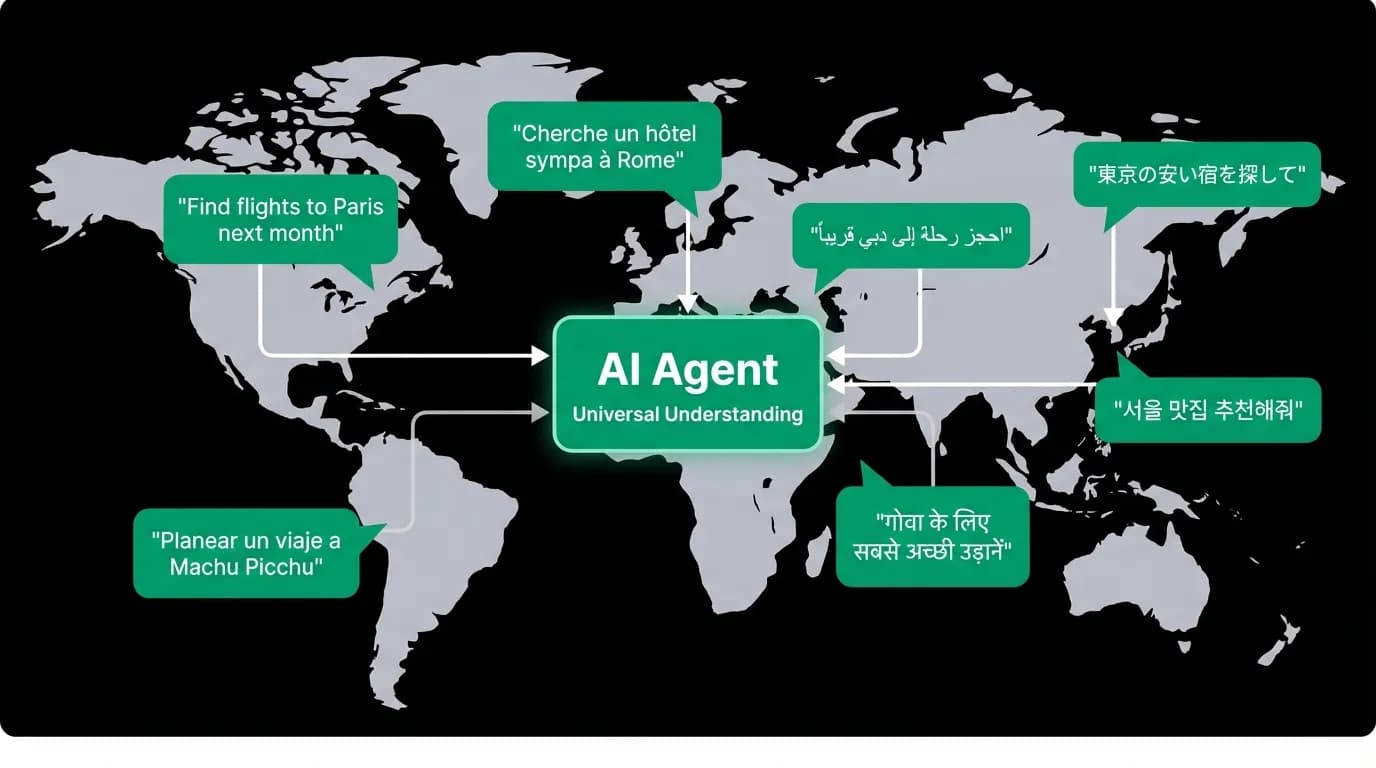
There is a massive blind spot in the travel tech industry, and it is linguistic.
Most travel platforms were built in English by English-speaking teams for English-speaking markets. Expedia launched in the US. Booking.com launched in the Netherlands but built its core product in English. Google Flights is English-first. Kayak is English-first.
These companies eventually added localizations. Booking.com is available in 43 languages. Expedia supports about 35. But "available in" and "works well in" are very different things. Localization at this scale means translating interface strings, menus, buttons, and standard text. It does not mean translating the actual content: hotel descriptions, review summaries, neighborhood guides, cancellation policies. That content remains predominantly English.
Meanwhile, the non-English travel market is enormous. China's outbound travel market was worth over $250 billion before the pandemic and is rapidly recovering. Japan's domestic and outbound travel market is massive. India's travel market is exploding with a growing middle class. Southeast Asia, Latin America, the Middle East, Africa. Hundreds of millions of travelers who do not search in English and are poorly served by English-first platforms.
These markets are not underserved because nobody wants their business. They are underserved because traditional localization is brutally expensive and slow. Translating an interface into a new language costs hundreds of thousands of dollars when you account for the ongoing maintenance of every string, every error message, every tooltip. And that is just the UI. Translating content at the scale of millions of hotel listings is functionally impossible with human translators.
Why traditional localization does not work for travel
Booking.com spends an enormous amount of money on localization. They have dedicated teams for dozens of markets, local offices, cultural advisors. And to their credit, their localization is better than most competitors.
But the approach has fundamental limits.
First, it is reactive. Every new feature, every new piece of content, every UI change has to be sent through the translation pipeline. This means localized versions are always behind the English version. A new feature might launch in English and take weeks or months to roll out in Thai or Arabic.
Second, it is literal. Traditional localization translates words. But travel communication is loaded with cultural context that word-level translation misses. When an American says "I want a cheap hotel," they usually mean "good value, nothing fancy." When translated literally into Japanese, the word for "cheap" can carry implications of low quality that would never match the user's intent. A Korean traveler searching for "affordable" has different expectations than a Brazilian traveler using the equivalent term.
Third, it fragments the product. Each localized version is effectively a separate product that needs its own testing, its own QA, its own content verification. With 43 languages, Booking.com is maintaining 43 products. That is an enormous operational burden that slows everything down.
Fourth, it does not cover content. You can translate the "Sort by" dropdown into Hindi. You cannot practically translate 28 million property listings, their reviews, their fine print, their neighborhood descriptions. The content layer remains in its original language, creating a jarring experience for non-English users.
AI understands intent, not just words
Here is where AI-native multilingual support diverges from traditional localization.
When a user types "Quiero un hotel bonito cerca del centro que no sea muy caro" (I want a nice hotel near the center that is not too expensive), a traditional system would need a Spanish-language interface, Spanish search logic, and Spanish content to serve this query. An AI agent simply understands what the user wants, regardless of the language they expressed it in.
The AI does not translate the query into English and then search. It understands the intent directly. "Nice hotel. Central location. Moderate price." Those concepts are language-independent. The agent maps them to search parameters the same way it would for an English query.
Then, when presenting results, the AI generates descriptions, comparisons, and recommendations in the user's language. Not by translating pre-written English text, but by generating natural responses in the target language. The difference in quality is significant. AI-generated Spanish reads like it was written by a Spanish speaker. Machine-translated English-to-Spanish reads like it was written by someone who studied Spanish from a textbook.
This is a fundamental architectural advantage. Instead of maintaining 43 localized versions of every piece of content, the AI generates contextually appropriate content in whatever language the user needs, on the fly.
Cultural nuance is harder than translation
The word "cheap" is the tip of the iceberg when it comes to cultural nuance in travel.
In Japan, travel planning is often a group activity with formal decision-making processes. The way you present options to a Japanese user should account for this: comparison-friendly formats, easy sharing, consensus-building language. An American user wants a confident recommendation. "Book this one." A Japanese user might prefer "here are three options with their respective advantages for your group to consider."
In India, family travel dynamics are different from Western nuclear family travel. Multi-generational trips are common. Budget optimization across a large group is critical. The AI should understand that when an Indian user says "family trip," they might mean eight people across three generations, not two adults and two kids.
In the Middle East, hotel requirements often include prayer room availability, halal dining options, and specific room configurations. These are not niche requests. They are standard expectations for a huge market segment. An AI that understands cultural context can proactively surface this information instead of requiring the user to hunt through amenity lists.
Latin American travelers often plan around extended holiday periods and religious festivals that do not exist in the North American calendar. Semana Santa, Carnival, Day of the Dead. An AI with cultural awareness knows that flight prices to Cancun from Mexico City during Semana Santa will be elevated and can advise accordingly.
These nuances cannot be captured in a translation file. They require understanding, not just language conversion. An AI agent that has been trained on global travel patterns can navigate these cultural contexts in ways that a translated interface never will.
The contextual translation problem
Here is a specific technical challenge that illustrates why AI-native multilingual beats traditional localization.
A hotel listing says: "Complimentary afternoon tea in the garden lounge. Smart casual attire requested."
Translate that literally into Mandarin and a Chinese traveler might not fully grasp what "smart casual" means in a British hotel context. The dress code concept does not map one-to-one across cultures.
An AI agent does not just translate. It contextualizes. In Mandarin, the agent might convey: "The hotel offers free afternoon tea in a garden setting. They expect guests to dress neatly. No sportswear or very casual clothing. A collared shirt and clean trousers would be appropriate." The intent is preserved and expanded with context that helps the user actually understand what to expect.
Or consider a cancellation policy: "Cancellation is free up to 24 hours before check-in. A one-night charge applies for late cancellation or no-show." In legal English, this is clear. Translated literally into Arabic, the phrasing might be ambiguous about whether the charge is applied to the card on file or billed separately. The AI agent can clarify this based on the specific hotel's actual policy, removing ambiguity that literal translation would introduce.
This contextual translation happens dynamically for every piece of travel content: flight baggage policies, visa requirements, airport transfer instructions, restaurant descriptions. The AI is not looking up a translated string. It is understanding the content and communicating it appropriately in the user's language.
From day one to a hundred languages without a localization team
The economic implications of AI-native multilingual are significant.
Traditional localization for a travel platform typically requires per-language investment in translation, QA, content management, and ongoing maintenance. Adding a new language to a platform like Expedia is a multi-month project involving translators, localization engineers, cultural consultants, and market-specific QA teams. The ongoing cost is substantial because every product change must be propagated across all supported languages.
An AI-native product supports a new language the moment the underlying AI model supports it. There is no translation file to create. No localization sprint to plan. No market-specific QA cycle. The AI generates appropriate content in whatever language the user communicates in.
This does not mean quality is perfect from day one. AI language capabilities vary by language. High-resource languages like Spanish, French, and Mandarin get excellent quality. Lower-resource languages like Khmer or Amharic may have more rough edges. But the trajectory is clear: AI language models are improving across all languages simultaneously, and the quality gap is closing rapidly.
For a startup like ours, this is a strategic advantage we take seriously. We do not have Booking.com's localization budget. We will never maintain 43 language-specific product versions. But our AI agent can serve a Japanese user, a Brazilian user, and a Nigerian user in the same week without any language-specific development work. That is a different competitive equation.
The code-switching traveler
Real multilingual users do not stick to one language. They code-switch.
A bilingual Spanish-English user might type: "Necesito un flight to Barcelona, something not too early en la manana." Half Spanish, half English, perfectly natural for millions of bilingual people worldwide.
Traditional search forms cannot handle this at all. The language field is set to one language. The query parser expects input in that language. Mixed-language input breaks the system.
An AI agent handles code-switching naturally. It parses the intent regardless of which language carries which piece of information. "Flight to Barcelona, not too early in the morning." Done. The user does not have to think about which language to use. They communicate naturally, and the AI keeps up.
This is common with diaspora travelers. A Turkish-German user searching from Berlin. A Hindi-English user in London. A Portuguese-French user in Montreal. These are real travelers with real money to spend, and they are poorly served by monolingual or single-language interfaces.
What Booking.com, Expedia, and Google get partially right
I want to be fair. The big players have made real investments in multilingual support.
Booking.com's localization is the industry benchmark. Their interface translations are good. They have local content teams for major markets. Their customer service operates in many languages. For a traditional platform, they are best-in-class.
Google Translate integration in Google Travel is useful as a stopgap. You can translate hotel reviews and descriptions on the fly. It is better than nothing, but the quality is inconsistent and the experience is clunky. You are reading translated text that clearly reads as translated text.
Expedia has invested heavily in their Asian markets, particularly Japan and Korea. Their local market teams build culturally appropriate experiences. But this is expensive and does not scale to dozens of markets simultaneously.
The limitation across all of these is the same: they are applying translation to an English-first product. The foundation is English, and other languages are adaptations. An AI-native product has no foundational language. The AI thinks in intent, not in words. Language is the last mile, not the first.
Language as a competitive moat
Here is the strategic argument for why AI-native multilingual matters beyond just being a good feature.
Every traveler who has a great booking experience in their native language becomes a user who is very hard for English-first competitors to win back. If a Brazilian user discovers that Nowah understands Portuguese naturally, generates flight recommendations in fluent Portuguese, and handles the entire booking conversation without any translation friction, that user has no reason to go back to a partially translated OTA.
This compounds. Word of mouth in non-English markets is powerful because those markets are underserved. Being the first AI travel booking app that truly works in Hindi or Thai or Arabic creates a disproportionate loyalty effect compared to being the fifteenth option for English speakers.
We are building toward a world where asking "what language does the app support?" is a meaningless question. The app supports whatever language you speak. That is not a feature. It is a fundamental property of how AI-native products work. And it is an advantage that traditional platforms, with their string files and localization pipelines and market-specific builds, will struggle to match.
Building for a multilingual world
Travel is the most inherently multilingual activity most people engage in. You leave a place where everyone speaks your language and go to a place where they do not. The tools for planning and booking that travel should work as fluidly across languages as the traveler moves across borders.
We are not there yet. But AI gives us a realistic path to get there. Not by building 100 localized versions of a product, but by building one product that understands and communicates in any language from the start.
The best travel app is one that speaks your language, understands your cultural context, and never makes you feel like you are using a translated version of someone else's product. That is what AI-native multilingual booking can be. And for the hundreds of millions of travelers who are currently underserved by English-first platforms, it cannot come soon enough.
Nowah is an AI travel agent that searches and books real flights and hotels through conversation — no filters, no thirty open tabs. Plan your next trip.