The Post-Booking Experience: Why It Shouldn't End at Payment
Most travel apps send a confirmation email and disappear. AI-powered post-booking — itineraries, updates, local tips — turns transactions into retention.

You just spent $2,400 on flights and a hotel in Lisbon. You get a confirmation email with a booking reference number, a PDF itinerary attached, and a line that says "We hope you enjoy your trip!" Then the app disappears from your life until it sends you a retargeting ad three months later asking if you want to book again.
This is how most travel platforms treat the post-booking experience. The transaction is complete. The customer has paid. Mission accomplished. Move on to the next conversion.
It is a remarkable failure of product thinking. The period between booking a trip and taking the trip is one of the highest-engagement windows in the entire customer lifecycle. People are excited. They are planning. They are thinking about their destination daily. They are receptive to useful information. And the platform that just earned their trust and their money goes completely silent.
We think this is one of the biggest missed opportunities in travel tech.
The post-booking gap
Let me walk through what the post-booking experience looks like on most platforms.
You book on Expedia. You get a confirmation email. Maybe a follow-up email a day later asking you to rate your booking experience (not the trip, the booking). Then silence. Two weeks before your trip, you might get an email about renting a car or booking activities. That email feels like an upsell because it is an upsell.
You book on Booking.com. Slightly better. You get the confirmation, then a series of pre-trip emails: "Your trip to Lisbon is coming up!" with a generic city guide and some sponsored restaurant recommendations. Booking.com also sends check-in reminders, which is useful. But the engagement is templated and impersonal.
You book on Google Flights. You get a link to your itinerary in Google Travel, which aggregates your booking details from Gmail. This is actually useful, but it is passive. It sits there and waits for you to look at it. No proactive intelligence.
In all cases, the platform's relationship with you after booking is transactional. Send confirmations. Attempt upsells. Wait for the next booking.
The user, meanwhile, is doing all the post-booking work themselves. Researching restaurants. Looking up neighborhoods. Checking weather. Finding transit options. Saving articles and recommendations in a notes app. Downloading offline maps. Hunting for their hotel's check-in time. All the information gathering that used to happen before booking continues after booking, but now the platform that has your trip details and payment information is not helping with any of it.
What travelers actually need after booking
When we talked to users about what they do between booking and traveling, a clear pattern emerged. The needs fall into four categories.
Organization. People want all their trip information in one place. Flight details. Hotel confirmation. Airport transfer info. Reservation times. Emergency contacts. Visa requirements. They currently spread this across email, notes apps, messaging threads, and browser bookmarks. Finding the hotel check-in time requires digging through email to find the confirmation. Remembering which terminal they fly from requires checking the airline app.
Updates. Flights change. Gates reassign. Hotels update check-in policies. Weather shifts. Local events happen or get canceled. Travelers want to know about changes that affect their trip without having to actively monitor every data source. A flight time change buried in a 6 AM email from the airline is easy to miss.
Intelligence. This is the big one. "What should I do in Lisbon?" is a question every traveler asks after booking. They want restaurant recommendations. Neighborhood guides. Local customs. Tipping norms. Transit tips. Hidden gems. Safety information. They currently get this from travel blogs, Reddit threads, Instagram, and friends who have been there. It is scattered, inconsistent, and time-consuming to compile.
Confidence. Travel anxiety is real. Am I going to the right airport terminal? Is my passport valid long enough? Do I need a visa? What is the currency? How do I get from the airport to the hotel? Can I use my credit card there? These questions multiply as the trip approaches, and answering them requires visiting multiple websites and apps.
An AI travel agent is uniquely positioned to address all four of these needs because it already has the context. It knows where you are going, when, for how long, and what your preferences are. It can organize, update, inform, and reassure within the same conversational interface where you booked.
How AI stays valuable throughout the trip lifecycle
At Nowah, when you book a trip, it does not disappear into a confirmation email. It becomes a living entity in your Trips tab, managed by the same AI agent that helped you book it.
The AI generates an itinerary automatically based on your booking details. It is not a static list of reservations. It is a structured timeline that accounts for travel times between locations, check-in and check-out times, and unstructured time where you might want suggestions.
Ask the agent anything about your trip at any time. "What time is my flight?" "Where is my hotel relative to the beach?" "What is the weather going to be like?" "Do I need to tip at restaurants in Portugal?" The agent answers from the context of your specific trip, not generic destination information.
When something changes, the agent tells you. Flight delayed? You know before the airline app sends its push notification, because the agent is monitoring the status. Hotel has a special early check-in available? The agent surfaces it. Weather forecast shows rain on your planned beach day? The agent might suggest an indoor alternative.
Documents stay organized. Booking confirmations, boarding passes, hotel vouchers, travel insurance details. Everything is in one place, tied to the specific trip, accessible in the conversation. No digging through email.
This is what a post-booking experience should feel like. Not silence followed by an upsell. Active, helpful, contextual support from booking to return.
Trip management as a retention engine
Here is the business case for investing in post-booking, because product decisions need business logic too.
Users who engage with a travel app after booking rebook at significantly higher rates than users who only use the app for the transaction. Industry data suggests app-based bookers show around 30% higher repeat booking rates compared to web-only bookers, largely because the app stays on their phone and maintains engagement between trips.
Push notification engagement for travel apps runs between 8-12%, which is well above the average for most app categories. Travel notifications, especially trip-relevant ones like flight updates and check-in reminders, have high open rates because the information is genuinely valuable.
But here is the real insight: post-booking engagement is when the emotional bond with the product forms. The booking itself is a functional transaction. It is the assistance during the trip, the proactive updates, the helpful answers to "what should I do tonight in Lisbon?" that create the emotional connection that drives loyalty.
Airbnb understood this partially. Their host communication and guidebook features keep users engaged between booking and trip. The messages from hosts feel personal and helpful. The neighborhood guides and local recommendations add value beyond the transaction. Airbnb's repeat booking rate is strong in part because they maintain a relationship with the user after payment.
We think AI takes this much further. An Airbnb guidebook is static and written by the host. An AI travel agent is dynamic, personalized, and available 24/7. It does not just provide generic destination information. It provides specific recommendations based on your preferences, your schedule, and your real-time context.
The full trip lifecycle
Most travel platforms think in terms of a linear funnel: search, compare, book, pay. Done. Next customer.
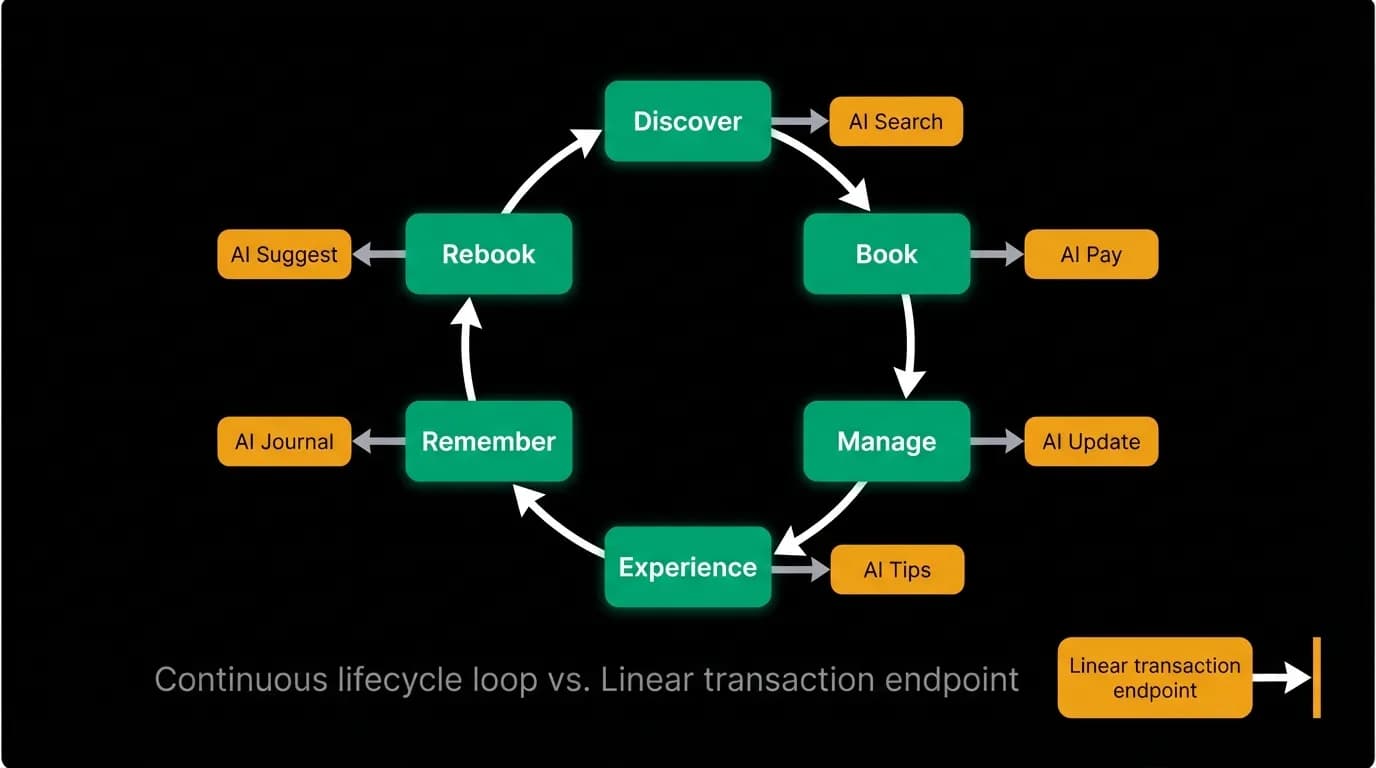
We think of it as a cycle: discover, book, manage, experience, remember, rebook.
Discover. The user has an intent. Maybe vague ("I want a vacation"), maybe specific ("flights to Rome in April"). The AI helps shape and refine the intent.
Book. The AI searches, curates, presents, and completes the booking. This is where traditional platforms stop.
Manage. Organization, updates, pre-trip intelligence. The AI keeps the trip details current and the user informed.
Experience. During the trip, the AI is a real-time assistant. Restaurant recommendations. Navigation help. Translation assistance. Emergency information.
Remember. After the trip, the AI creates a summary. Photos organized by location and day. Highlights captured. Stats tallied. The trip becomes a memory in the Passport tab.
Rebook. The cycle restarts. But now the AI knows more about the user. It can suggest destinations based on past trips. "You enjoyed Lisbon. You might also like Porto or Seville." The next booking is faster and more personalized.
Each stage feeds into the next. Management data informs the experience. Experience data feeds into memories. Memories and preferences inform the next discovery phase. The user never leaves the ecosystem because the ecosystem is valuable at every stage.
What Airbnb, TripIt, and Google Travel get partially right
Airbnb's post-booking experience is the best in the industry for accommodations. Host messaging creates a personal connection. Guidebooks provide local context. Check-in instructions are delivered at the right time. The experience section (where available) allows booking activities through the same platform. Their weakness is that they only cover the accommodation portion of the trip.
TripIt is the gold standard for trip organization. It parses confirmation emails and assembles itineraries automatically. Timeline view. Document storage. Sharing with travel companions. It is extremely useful. But it is purely organizational. It does not provide intelligence, recommendations, or proactive assistance. It is a filing cabinet for travel documents, not an assistant.
Google Travel does a lot of the right things silently. It pulls booking information from Gmail, assembles itineraries, provides weather and local information, integrates with Maps. But it is passive. You have to go to Google Travel and look at your trip. It does not come to you with relevant information at the right time. And it does not learn from your preferences because it is a feature within Google's ecosystem, not a dedicated travel product.
The opportunity is to combine Airbnb's engagement model, TripIt's organizational utility, and Google Travel's contextual intelligence, all powered by an AI agent that knows you and your trip inside out. None of the existing players does all three well.
From transaction to relationship
The fundamental shift we are making is from treating a booking as a transaction to treating it as the beginning of a relationship.
A transaction has a clear endpoint. Money changes hands. Goods are delivered. Done. This is how most OTAs think about bookings. The confirmation email is the receipt. The relationship is over.
A relationship has no endpoint. It evolves. Each interaction builds on the previous ones. Trust deepens. Understanding grows. The product becomes more valuable over time because it accumulates knowledge about the user.
An AI travel agent is uniquely suited to the relationship model because of agentic memory. Every trip teaches the agent something new about the user. Preference for boutique hotels confirmed. Budget ceiling identified. Favorite airlines noted. Reaction to recommendations observed. This knowledge makes the next trip planning conversation faster and more accurate.
The post-booking experience is where this relationship building happens most naturally. The user is not in "buying mode" where they are comparison shopping and skeptical. They have already committed. They are in "planning mode" where they are receptive and engaged. This is when the AI can demonstrate its value most effectively, by being genuinely helpful with real problems like "where should I eat tonight?" and "is my flight still on time?"
The retention math
Let me put some rough numbers on this to show why post-booking investment makes sense.
A typical OTA spends significant money on customer acquisition. Google Ads for travel keywords can cost several dollars per click, with conversion rates of low-single-digit. That translates to roughly $40-250 to acquire a single booking. If that customer books once and never comes back, the lifetime value has to be captured in a single transaction.
If the post-booking experience is good enough to drive a second booking, the acquisition cost is cut in half. A third booking, and it is a third. Repeat customers are dramatically more profitable because they cost nothing to re-acquire.
Post-booking engagement is the mechanism that turns one-time buyers into repeat customers. A user who found Nowah's AI helpful for restaurant recommendations during their Lisbon trip will open the app again when they start thinking about their next trip. They already trust the agent. They already have their preferences dialed in. The next booking conversation will be faster and easier.
This is not theoretical. We see a clear correlation between post-booking engagement (measured by how often users interact with the agent about their trip after booking) and rebooking rates. Users who ask the agent at least one post-booking question rebook at meaningfully higher rates than users who book and disengage.
Building the post-booking experience we want
Here is where we are today, honestly.
Our trip management is solid. Itineraries auto-generate. Documents are organized. Flight status monitoring works. Users can ask the agent about their trip and get contextual answers.
Where we are still building: proactive intelligence. The agent should be pushing information to the user at the right time, not just responding when asked. Three days before the trip: "Here is your packing weather forecast for Lisbon. Highs around 22C, chance of rain on Thursday." Day of departure: "Your flight is on time. Terminal 3 at JFK. Estimated travel time from your area is about 45 minutes. Suggesting you leave by 2 PM."
We also want better during-trip assistance. Real-time restaurant recommendations based on location and time. Walking directions integrated into the conversation. Translation help for menus and signs. Emergency information and consulate contacts. The AI should be as useful on the ground as it is during planning.
And post-trip summarization. Automatic trip journals. Stats and highlights. Photo organization by location. The trip experience should result in a tangible memory that lives in the app, creating both emotional value and retention incentive.
Why the industry gets this wrong
The reason most travel platforms ignore post-booking is structural, not strategic. Their business model is built around transactions, not relationships. They make money on the booking. Everything after the booking is a cost center.
This logic makes sense in a world where every customer interaction has a marginal cost. If a human support agent handles post-trip questions, that is expensive. If a content team creates destination guides, that scales linearly with destinations.
AI changes the economics completely. An AI agent handling post-booking questions has near-zero marginal cost per interaction. It can provide personalized destination intelligence without a content team. It can monitor flights and push updates without a human operations team. The cost of post-booking engagement drops dramatically, which makes the retention benefits worth capturing.
Any travel company that builds a great post-booking experience will compound their advantage with every booking cycle. The users stay. The data accumulates. The AI gets better. The next booking is easier. The next post-booking experience is more personalized.
The confirmation email and silence approach is not just a missed opportunity. In a world where AI makes ongoing engagement nearly free, it is a strategic error. The best travel app is not the one that books your trip. It is the one that is useful for the entire journey, from the first "I want to go somewhere" to the "I am back and already thinking about next time."
Nowah is an AI travel agent that searches and books real flights and hotels through conversation — no filters, no thirty open tabs. Plan your next trip.