Why AI Agents Need Memory (And Why Most Don't Have It)
Stateless AI conversations that forget everything after the session are chatbots, not agents. Memory is what transforms a tool into a partner.

Open ChatGPT and tell it you prefer aisle seats. It will acknowledge this. Close the conversation and open a new one. Ask it to help you find a flight. It has no idea you prefer aisle seats. The preference evaporated when the session ended.
This is the current state of most AI products. They are stateless. Every conversation begins from zero. The AI might be brilliant within a single session, holding context across dozens of messages, remembering that you mentioned a budget of $1,500 and that you are traveling with your partner. But the moment the session ends, that knowledge disappears.
Imagine hiring a travel agent who, every time you called, had no idea who you were. "What's your name? Where do you live? Do you prefer window or aisle? Have you been to Europe before? What's your budget?" Every. Single. Time. You would fire that agent after the second call.
And yet that is exactly what most AI products do. They forget you between sessions. They treat every interaction as if you are a stranger. And then they wonder why users don't come back.
Memory is what transforms a stateless chatbot into an actual agent. It is what makes the fifth conversation better than the first. It is what creates the switching costs that turn a user into a loyal customer. And it is what most AI products skip because it is hard to build well.
The stateless conversation problem
Let me describe the typical AI interaction in 2026. You open an app or website. You start a conversation with the AI. You provide context: who you are, what you want, what your preferences are. The AI responds well, using that context to give you good answers. You finish the conversation and close the app.
Tomorrow, you come back. You start a new conversation. The AI has no idea about yesterday's conversation. You provide the same context again. The AI responds well again. But you have done twice the work because the AI forgot everything overnight.
This is the stateless model. It works for simple, one-off queries. "What's the capital of France?" does not benefit from memory. But for anything involving ongoing relationships, repeated interactions, or accumulated preferences, statelessness is a product-killing limitation.
Travel is an extreme case of this problem. Travel planning is inherently multi-session. Nobody plans a trip in a single sitting. You search for flights one evening, hotels the next day, activities later that week. Each session builds on the previous one. In a stateless system, each session restarts from scratch.
Beyond multi-session planning, travel involves preferences that persist across trips, not just within a single trip. Your seat preference does not change between your March trip and your June trip. Your budget range evolves slowly. Your hotel style preferences are consistent. These are durable attributes that a stateless system throws away after every interaction.
From chatbot to agent: memory is the dividing line
I think the word "agent" gets thrown around too loosely. A chatbot that can answer questions and generate text is not an agent. It is a conversational interface. An agent, in the meaningful sense of the word, is a system that acts on your behalf with an understanding of who you are and what you want.
That understanding requires memory. Specifically, it requires three things that stateless systems lack.
Continuity: the agent knows what happened in previous conversations. It can reference past searches, past bookings, past preferences stated weeks or months ago. You do not have to repeat yourself.
Personalization: the agent has a working model of your preferences that it applies automatically. It does not ask about your seat preference every time because it already knows. It does not suggest budget hotels when you have consistently booked mid-range. It filters results based on accumulated knowledge, not just the current conversation.
Proactivity: the agent can initiate actions based on what it knows about you. It notices that flights to a destination you mentioned wanting to visit have dropped in price. It reminds you that your passport expires in five months and you have a trip planned that requires six months of validity. It suggests a weekend getaway based on patterns in your travel history.
None of these are possible without persistent memory. A stateless system can be smart within a session. Only a system with memory can be smart across sessions and over time.
Three types of memory
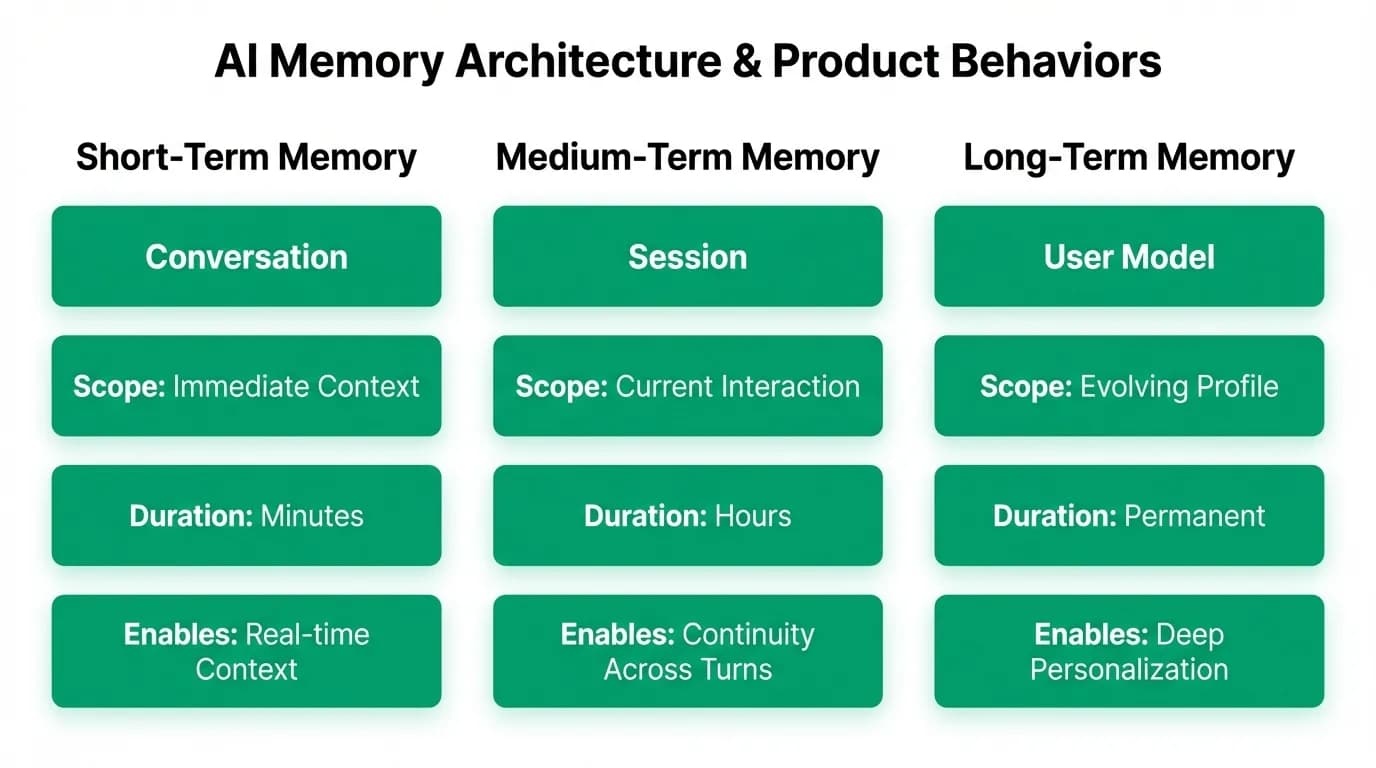
When we built our memory system, we found it useful to think about three distinct types of memory, each with different scope, duration, and purpose.
Short-term memory is what most AI systems already have. It is the context within a single conversation. You say "find flights to Tokyo" and then say "what about hotels too." The AI remembers you are going to Tokyo without you saying it again. This is conversation context, and most large language models handle it reasonably well within their context window.
Medium-term memory spans a session or a related set of sessions. You search for flights on Monday and come back on Wednesday to continue planning. Medium-term memory preserves the state of your trip planning: the flights you were considering, the dates you discussed, the budget you mentioned. It allows you to resume where you left off instead of starting over.
Long-term memory is the persistent user model. It captures preferences, patterns, and facts about you that persist indefinitely. Your seat preference. Your typical budget. Your dietary restrictions. Your past destinations. Your passport details. This memory builds over weeks, months, and years. It is what makes the agent better at serving you over time.
Most AI products have short-term memory by default. Very few have medium-term memory. Almost none have genuine long-term memory. The reason is that each level of memory is harder to build than the previous one, and the product benefits compound rather than appear immediately.
What memory enables that statelessness cannot
Let me walk through specific examples of what becomes possible with memory.
Pre-filled search constraints. Without memory, the agent has to ask: "Where are you flying from? What class? Any airline preferences? How many bags?" With memory, it already knows: SFO, economy, no airline preference, one checked bag. The conversation skips straight to the meaningful part: where are you going and when?
[Proactive suggestions](/blog/proactive-ai-agent-suggestions). The agent notices you take a long weekend trip every October. Around September, it might surface: "October is coming up. Last year you went to Napa. Want me to start looking at flights somewhere for the last weekend of October?" A stateless system cannot do this because it has no concept of your travel patterns.
Preference evolution tracking. On your first three trips, you booked budget hotels. On your last two, you upgraded to mid-range boutique places. The agent recognizes this shift and adjusts its default search parameters. It does not lock you into your past preferences. It adapts as your preferences change.
Context carryover across trip components. You booked a flight arriving in Barcelona at 3 PM. When you search for hotels, the agent automatically filters for places with late check-in or 24-hour reception. It knows your arrival time because it remembers booking the flight. A stateless system would treat the hotel search as completely independent from the flight search.
Cross-trip learning. After your Barcelona trip, you mention that the hotel was too far from the city center. On your next trip, the agent prioritizes centrally located hotels. That feedback from one trip improves recommendations for all future trips.
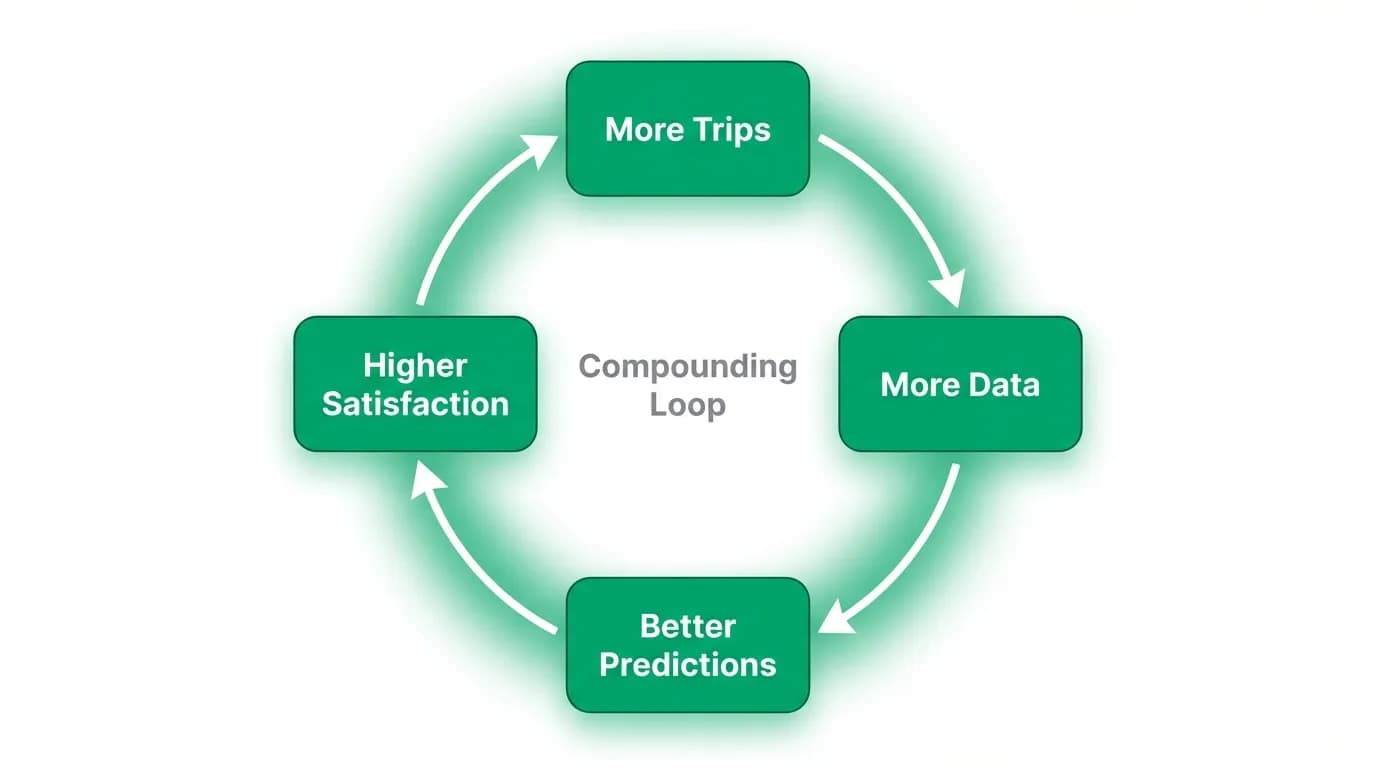
Personalized recommendations convert at two to five times the rate of generic results. That multiplier applies to each individual booking, but it compounds across the relationship. Each personalized success increases the user's trust and willingness to follow recommendations, which increases the signal available to the memory system, which improves future personalization.
Users who book via apps have roughly a 30% higher repeat booking rate compared to web. Memory is a big part of that gap. An app with a persistent memory system feels like your app. A web browser is everybody's web browser.
The ethical and technical challenges
Building a memory system for travel is not just an engineering problem. It is an ethics problem and a trust problem.
What should the agent remember? Your seat preference, yes. Your past trip to Paris, yes. The argument you had with your partner about the hotel, no. The medical condition you mentioned offhand, not without explicit consent. There is a line between useful personalization and invasive data collection, and the line is not always obvious.
We approach this with a principle: remember preferences and behaviors that improve future recommendations. Do not remember private conversations, sensitive personal information, or data that would make the user uncomfortable if they knew it was stored.
Who controls the memory? The user, always. You can ask the agent what it remembers about you. You can tell it to forget specific things. You can wipe the entire memory and start fresh. This is not just a privacy feature. It is a trust feature. Users who know they have control over their data are more willing to share data.
What happens when memory is wrong? The agent infers that you prefer morning flights because you have booked morning flights four times in a row. But actually, those were all work trips with fixed schedules. Your personal preference is afternoon flights. The agent needs to be correctable. "Stop assuming I want morning flights. That was for work." The memory updates.
These challenges are real, and they are part of why most companies skip memory altogether. It is simpler to build a stateless chatbot than to build a memory system with proper controls, user transparency, and correction mechanisms. Simpler, but dramatically worse as a product.
Why competitors skip memory
If memory is so valuable, why don't more AI products have it? A few reasons.
It is technically difficult. Building a memory system that captures the right information, structures it usefully, keeps it current, and applies it at the right moments is a significant engineering investment. It is not something you add in a sprint. It is a fundamental architectural decision that affects the entire system.
It is hard to monetize directly. Memory does not have a price tag. Users do not pay extra for "the AI remembers me." The value of memory shows up indirectly in retention, conversion, and satisfaction, which are lagging indicators. This makes it hard to justify in a roadmap prioritization exercise against features with more direct ROI.
It creates liability. Storing user preferences and behavior patterns creates data protection obligations. GDPR, CCPA, and other privacy regulations apply. Companies worry about the compliance cost and the risk of data breaches involving personal preference data.
Stateless is good enough for demos. Most AI product demos are single-session. They show a user asking a question and getting a great answer. Memory does not show up in a demo because you cannot demonstrate a preference learned over five trips in a two-minute product walkthrough. So the feature that matters most for long-term product quality is invisible in the short-term evaluation.
These are real obstacles. But they are obstacles to building a good product, not reasons to avoid it. The companies that solve memory well will have an enormous advantage over those that skip it, because memory creates the compounding personalization loop that makes the product better over time.
Memory as the compounding moat
Here is why we think memory is the most important strategic investment in an AI travel product.
Every conversation adds data. Every booking adds data. Every piece of post-trip feedback adds data. This data feeds the memory system, which improves recommendations, which leads to better bookings, which generates more data. The flywheel spins faster with every cycle.
A new user gets a good experience from day one because the AI is genuinely smart about travel. But a user with fifty bookings and two years of memory gets an experience that a new user on any competing platform cannot match, regardless of how good that platform's AI is. Because the competing platform's AI does not know them.
This creates a switching cost that is genuinely beneficial to the user. Leaving Nowah means abandoning your preference history, your travel patterns, your accumulated context. Going to a new platform means starting from scratch, answering the same questions you have already answered dozens of times. Not because we make it hard to export data, but because the personalized model built over time cannot be transferred to a system with different architecture.
The more trips you take, the more the agent knows, the better the experience, the more reason to keep using it, the more trips you take. It is a virtuous cycle. And it only works with memory.
Most AI products in travel are competing on model intelligence. Who has the best language model, the most accurate search, the fastest responses. These are important but insufficient. Intelligence without memory is like a brilliant consultant who cannot remember any previous engagement. They do great work each time, but they never get to know you.
We believe the AI travel products that win the next five years will be the ones that remember. Not the ones that are smartest in a single session, but the ones that get smarter over the relationship. Memory is the difference between a tool you use and a partner you rely on. We are building the partner.
Nowah is an AI travel agent that searches and books real flights and hotels through conversation — no filters, no thirty open tabs. Plan your next trip.