Why Chat-First Beats Search-First for Travel Booking
The product philosophy behind conversational booking — why natural language handles complex travel queries better than filters, with real examples that prove it.
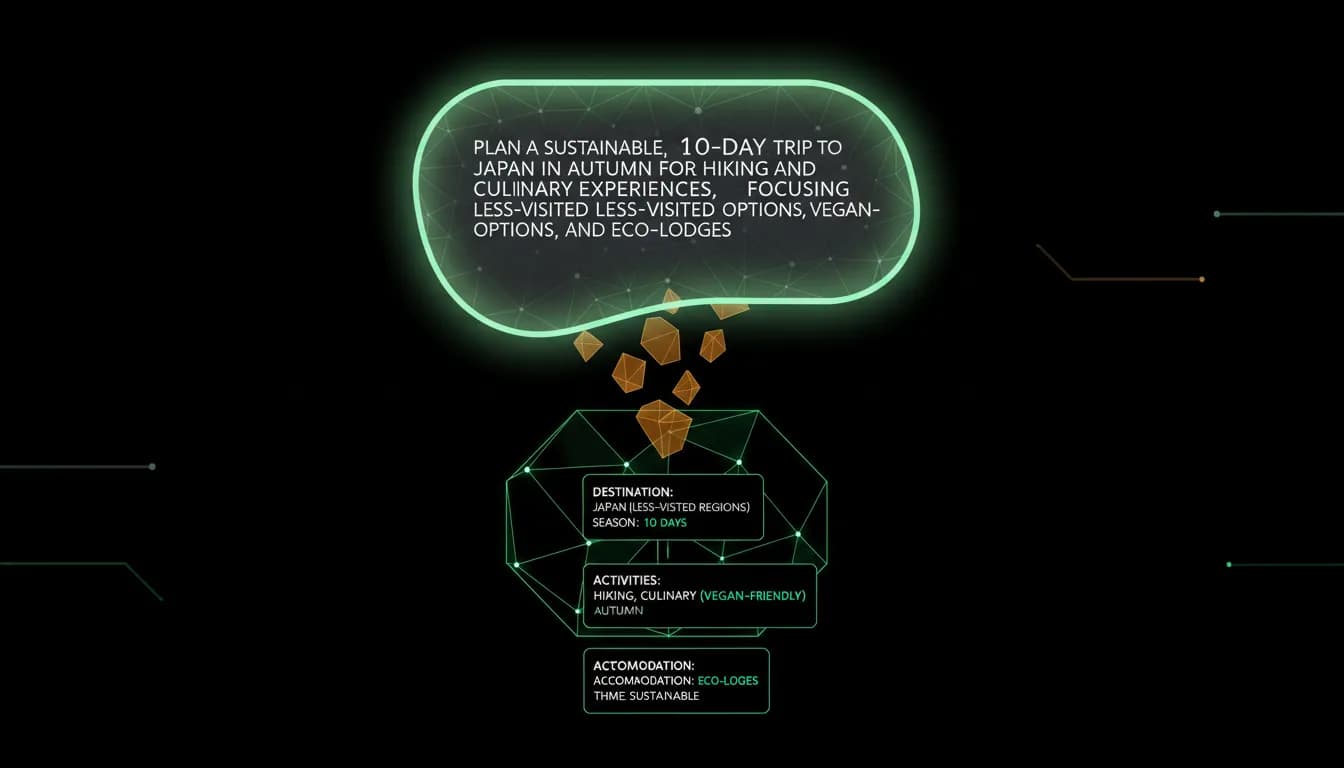
"I need to be in Tokyo for a conference March 20 to 23, prefer direct flights, and want to stay near Shibuya with good transit access." Try putting that into a filter form. You would need to set the destination, enter dates, check the nonstop filter, then switch to a hotel search, enter a location you may not know how to spell, apply a proximity filter that most hotel sites do not offer, and hope the results make sense together. The natural language version takes ten seconds to type. The filter version takes minutes of clicking, and it still cannot capture "good transit access."
This is why we built a chat-first product. Not because chat is trendy. Because travel queries are too complex for forms.
The complexity problem
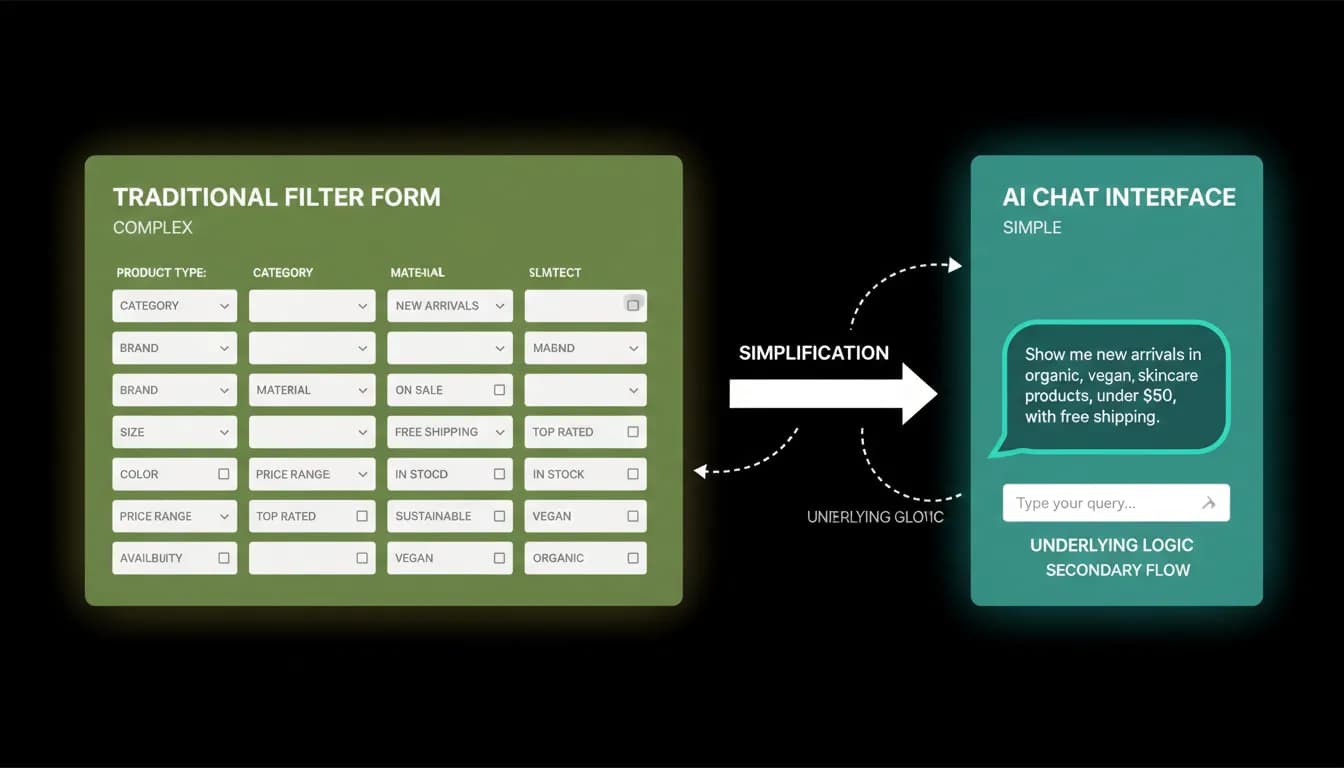
Travel queries have more dimensions than dropdown menus can handle. A flight search form captures origin, destination, dates, number of passengers, and class of service. That is five dimensions. A typical traveler's actual preference set includes time of day, layover tolerance, airline preference, baggage requirements, seat location, proximity to connecting gates, and sensitivity to price versus convenience tradeoffs. That is twelve-plus dimensions, and most of them are not available as filters.
Traditional OTAs offer twenty or more filter options to address this gap. The problem is that most travelers use fewer than five of those filters because the interface is overwhelming. The filters exist but are underutilized because the cognitive load of configuring them exceeds the perceived benefit. Travelers settle for suboptimal results rather than spending ten minutes fine-tuning filters.
Natural language captures all of these dimensions in a single statement. "Direct flight, morning departure, under $800, and I need to check two bags" expresses four constraints that would require navigating four separate filter panels on a traditional platform. The chat interface does not make the traveler think about which filters exist and where they are located. It lets them say what they want and trusts the agent to handle the structure.
Natural language as the most expressive input
Chat input is more expressive than form input because language can convey nuance, priority, and conditionality that forms cannot represent.
Nuance: "I slightly prefer morning flights but would take an evening flight if it is significantly cheaper" expresses a conditional preference with a tradeoff threshold. No filter form can represent "slightly prefer" or "significantly cheaper."
Priority: "The hotel must have free cancellation. I would like a pool but it is not essential." The traveler is communicating which constraints are hard and which are soft. The agent uses this information to rank results differently than if both constraints were treated equally.
Conditionality: "If there are direct flights under $600, show me those. Otherwise, show me one-stop options under $400." This is a branching search strategy that would require two separate searches on a filter-based platform.
The agent interprets all of this naturally because language is how humans express complex preferences. Forms force humans to decompose their preferences into the specific dimensions the form offers. Chat lets humans express their preferences the way they think about them.
The clarification advantage
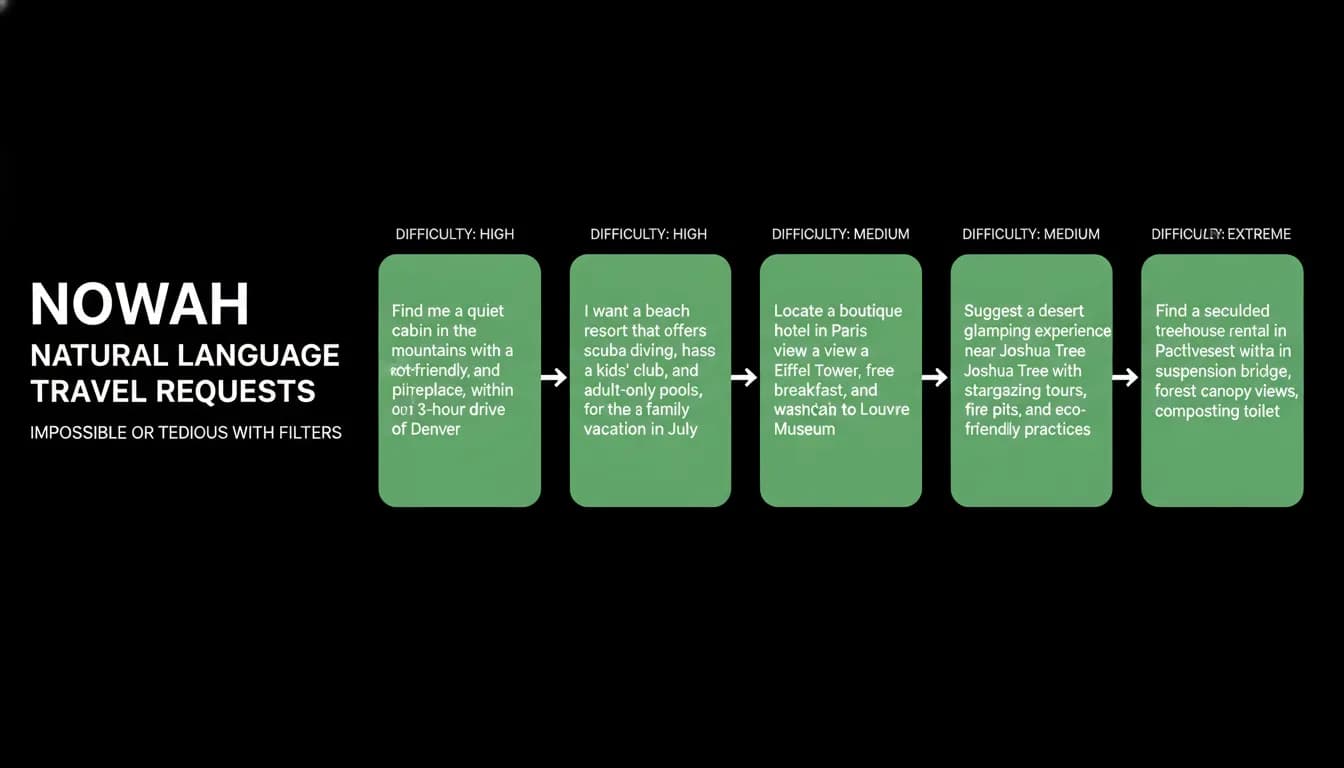
When a traveler enters a search on a traditional OTA, the system returns results based on the provided input. If the input was incomplete or ambiguous, the results are unhelpful. The traveler must revise their search, add filters, and try again. This iterate-until-correct loop is how most travel searches work, and each iteration costs time and cognitive energy.
When a traveler sends a message to the AI agent, the agent can ask a clarifying question before returning results. "Do you prefer to arrive in the morning or evening?" is faster and more helpful than showing two hundred results sorted by departure time and letting the traveler figure it out.
The clarification typically involves one to two targeted questions. The agent identifies the most impactful dimension that the traveler did not specify and asks about it. This is dramatically more efficient than showing all results and letting the traveler filter, because the agent's question narrows the search space before any results are generated.
Clarification also handles ambiguity that forms cannot. "I want to go somewhere warm" is a valid starting point for a conversation. There is no form field for "somewhere warm." The agent can ask about region preferences, budget, travel dates, and activity interests to refine "somewhere warm" into specific, searchable destinations.
Context accumulation
Filter-based search is stateless. Each search starts from scratch. The traveler who searched for New York to London flights and then wants to search for hotels in London must start a new search, re-entering the destination and dates. The two searches are disconnected.
Conversational booking accumulates context. The traveler who searched for flights and then says "now find me a hotel near the conference venue" does not need to re-specify the destination, dates, or trip purpose. The agent retains the context from the flight search and applies it to the hotel search. The conversation builds on itself.
Context accumulation becomes increasingly powerful over longer conversations. A traveler who has been exploring a trip for ten minutes has established destination, dates, budget, style preferences, and trip purpose. Every subsequent request benefits from that accumulated context. The agent's recommendations become more relevant with each turn because it knows more about what the traveler wants.
This is also true across sessions. The memory system retains context from previous conversations. A traveler who booked a business trip last month and now wants to book another does not start from zero. The agent remembers their corporate preferences, their seat selection, and their hotel style.
Five queries that prove the point
Here are five real travel queries that are easy to say and nearly impossible to express through filters.
"Find me a weekend getaway within a three-hour flight from San Francisco, somewhere I have not been before, with good food and walkability." This requires distance calculation, personal travel history, destination-level food and walkability ratings, and date flexibility.
"I need to be in London on Tuesday but I am flexible about which day I fly out, and I want to minimize total travel time including airport transit." This requires flexible date search, airport proximity consideration, and total-journey-time optimization including ground transportation.
"Book the same hotel I stayed at in Barcelona last year, or one like it if it is not available." This requires cross-session memory, hotel similarity matching, and fallback logic.
"Find flights for my family of four, but my daughter has a wheelchair and we need to make sure accessibility is handled at all connections." This requires accessibility filtering that most OTAs do not offer as a standard filter, connection-specific accessibility verification, and multi-passenger coordination.
"What is the cheapest way to get from Bangkok to Chiang Mai? I do not care if it is a flight, train, or bus." This requires multi-modal search across transportation categories that no single OTA handles together.
When search-first still wins
Honesty requires acknowledging that filter-based search is faster for some queries. A traveler who knows exactly what they want, a specific flight number, a specific hotel, a specific date with no flexibility, can enter those details into a search form faster than typing them into a chat.
For highly constrained, simple queries with no ambiguity, forms are efficient. The chat-first approach adds a conversational turn that is unnecessary when the traveler already knows exactly what they want.
But these queries represent a small fraction of travel bookings. Most travelers have some flexibility, some uncertainty, and some preferences that forms cannot capture. For the vast majority of real travel planning, chat-first is not just competitive with search-first. It is categorically better. That is why both our mobile app and our web platform use chat as the primary interface.
Nowah is an AI travel agent that searches and books real flights and hotels through conversation — no filters, no thirty open tabs. Plan your next trip.